
Almost every guide to influencer pricing is written by the side that is paying. This one is built from the other side of the table. It draws on 103 videos published in the last four months by creators talking to other creators about what to charge, what to accept and what to walk away from, which is where the real numbers live because nobody is negotiating. The finding that matters most to a brand is not the fee at all: the extras a brand asks for casually are the ones creators price highest, so the cheapest way to make an offer feel generous is to stop asking for them.
The short version. A video the creator posts to their own audience sits around $500, which is what about 5,000 views comes to. One Instagram reel runs $1,000 to $2,000. The extras cost more than the video itself: owning it forever runs 2.5 to 4 times the price, and stopping the creator working with your rivals adds 20% to 30% every single month. Pay a real price, ask for 30 days with no adverts, do not block their other work, and give a share of sales on top of the price rather than instead of it.

Name a price in your first email, because creators are trained never to answer "what is your rate"
The opening move decides the whole negotiation, and most brands give it away by asking the creator to go first.
- Creators are coached to treat "what is your budget" as a trap and to never answer a rate question with a question.
- Creators are also coached never to send a rate card, because a published price list sets a limit on what any brand will ever offer them.
- One creator accepted a $2,000 offer without asking for more, and other creators said the brand had offered the smallest sum it was willing to pay.
- One creator agreed a price and learned afterwards that the brand had set aside $50,000 for that partnership.
- A brand that names a real figure first looks organised rather than cheap, and it is the single fastest way to get a reply.

Price the deal on the creator's average views, not on their follower count
Follower count is the number brands look at first, and it is the number creators say has stopped meaning anything.
- The measure creators use is cost per 1,000 views, which is the fee divided by the average views of a video, then multiplied by 1,000.
- Follower count does not predict views, because how many followers see a post is decided by the platform and not by the creator.
- One agency booked a creator with under 25,000 Instagram followers at $8,000 for a single piece of content.
- Creators also count clicks on the sales links they share as evidence, because a click proves an audience acts rather than only watches.
- Ask for their average views per post before you name a number, because that one figure sets the fair price.

Expect a plain average, because nobody in these videos guarantees a view count
The number you are paying against is an average the creator worked out and typed in themselves.
- Average views per post is the figure creators put in a media kit, and no video here mentions a median or a lower estimate.
- Not one of these 103 videos offers a guaranteed view count or any money back when a video misses.
- One video tells creators to be honest and not inflate their numbers, while saying rounding to a neat figure is fine.
- Ask which months the average covers, because an average taken across a good year hides a bad quarter.
- Pay a smaller fixed price plus a bonus for every 1,000 views when the average looks generous, because then the real number settles the bill.

Pay $150 to $250 when the creator films the video and your brand posts it
This is the cheapest real deal available, and it is the one price on this page that needs no view count attached to it.
- Creators call this UGC, short for user generated content, and it means they film the video and hand it over for you to post.
- Nobody watches the video on the creator's account, so the price covers filming and editing and nothing else.
- Creators call $150 to $250 a reasonable price for one such video while they are still building up proof of their work.
- Experienced creators quote well above $250, so treat $150 to $250 as the starting price rather than the usual one.
- A brand that pays this price and then posts from the creator's account has paid for filming and taken the audience as well.

Pay about $500 when the creator posts the video and averages about 5,000 views
Once the creator posts the video themselves, a flat price means nothing on its own. The same $500 is generous for 3,000 views and an insult for 50,000, so the view count is what decides it.
- $500 for one video posted by the creator is the middle figure across the 103 videos, and it assumes a small audience.
- Multiply the creator's average views by the rate to get the real number, so 5,000 views at $100 for every 1,000 views comes to $500.
- Posting to their own audience is charged separately from filming, and creators name that split explicitly.
- Creators with a portfolio quote $150 to $400 per video, and experienced creators quote $300 to $1,000.
- Paying one creator every month for an agreed number of posts costs $1,000 to $7,500 a month, and it is the cheapest way to get a lot of videos.
- Offering a monthly deal is the easiest yes you can get, because creators say steady income is the thing they are chasing hardest.

Expect $1,000 to $2,000 for an Instagram reel seen 10,000 to 20,000 times, not for a follower count
Instagram is priced far above a plain video, and a small follower count does not bring the price down. A reel is a short upright video, and it is shown to people who do not follow the creator, which is why the follower count tells you so little.
- One creator with fewer than 30,000 Instagram followers charges about $2,000 for a single reel.
- A creator with 50,000 followers and strong engagement is described as able to charge $500 to $3,000 for one post.
- The middle figure for a single Instagram post across the 103 videos is $2,000.
- $1,000 to $2,000 is what 10,000 to 20,000 views comes to at the rate creators ask for, which is why a small account can cost more than a large one.
- Stories are cheaper than a reel or a post on their profile, because a story disappears after 24 hours.

Pay more for an Instagram reel than a TikTok, because posts are priced on how long they last
Price does not follow the work. It follows how long the post keeps being found.
- A mention inside a YouTube video costs two to four times an Instagram or TikTok post from the exact same creator.
- YouTube costs the most because the video stays findable in search for years.
- A TikTok post is described as dead in the algorithm within days, which is why it is cheapest.
- Instagram sits between the two, matching how long a post on each platform keeps working.
- Buy the TikTok post for a burst this week, and the Instagram reel or YouTube mention to still be working next year.

Expect the same creator to charge twice as much on Instagram as on TikTok
The gap shows up in one creator's own rate card, and it is not explained by clicks.
- One creator with under 30,000 followers on both charges about $2,000 for an Instagram reel and $750 to $1,000 for a TikTok video.
- At $100 for every 1,000 views, $2,000 is a video seen 20,000 times and $900 is one seen 9,000 times.
- The videos never give that creator's view counts, so it is either twice the views or twice the price.
- None of that price buys clicks, because a reel carries no clickable link at all.

Start a monthly deal at one video a month for three months, because creators suggest exactly that
This is the cheapest way to buy a lot of videos and the easiest offer to get accepted, and almost nobody spells out what it actually involves.
- A monthly deal means you pay the same amount every month and the creator delivers an agreed number of videos each month.
- The creator stays free to work with other brands, because stopping them working with your rivals is a separate thing you pay extra for.
- It is part-time for the creator, who normally runs several monthly clients at the same time.
- One creator recommends starting at one video a month for three months, then extending to six or twelve months if it works.
- Many monthly deals have no end date and simply roll on, which creators warn makes it easy to never review the price again.

Expect 10% off for three videos and 15% off for five, because the setup work overlaps
There is no separate rule for pricing a month. You work out the price of one video, multiply it, then take off the discount for buying several at once.
- Work the monthly price out from the price of one video, so five videos a month at $500 each is $2,500 before any discount.
- One creator puts the discount for buying several at 10% off for three videos and 15% off for five.
- The discount is for the emails, the briefing and the approvals that only happen once, not for the filming itself.
- Creators are warned to cut what they deliver rather than cut the price, so expect fewer videos rather than a cheaper rate.
- Monthly prices across these videos run from $1,000 to $7,500 a month, and one written offer carried a three month minimum.

Compare what each thing you are buying costs before you write the offer
The word "video" hides four different products, and each one has its own price and its own value to the brand.
| What you are buying | Price for every 1,000 views | How hard it is to get a yes |
|---|---|---|
| Creator films the video, your brand posts it | No views bought, $150 to $250 for the filming alone | Easiest, their own name is not on it |
| Video posted by the creator to their own audience | $100, from $500 for about 5,000 views | Moderate, the creator's name is attached |
| Instagram reel | $100, from $1,000 to $2,000 for 10,000 to 20,000 views | Moderate, this is what brands normally ask for |
| Instagram post on their profile | Unknown, priced at $500 to $3,000 with no view count given | Moderate, priced on how many followers react |
| Instagram story | Unknown, never given a price in these videos | Easy, it is a small commitment |
| The same creator posts for you every month | $85 to $90, once the bulk discount is taken off | Easiest, steady monthly income is what creators want most |
| Rush delivery inside 24 to 48 hours | $100 plus a rush fee, the dearest way to buy | Hard, it pushes their other work aside |

Treat $90 to $110 for every 1,000 views as one creator's target, not as a market price
This is the shakiest number on the page and it is the one everything else multiplies by, so it is worth knowing exactly where it comes from.
- A sponsor that offered $8 for every 1,000 views was named and quoted in a public video about bad sponsors.
- One creator, working the sum out loud on camera, picks $90 to $110 for every 1,000 views as a rate to aim for.
- The same creator suggests pushing toward $150 for every 1,000 views once a deal is already around $10,000.
- Only 3 of these 103 videos put any dollar figure on 1,000 views, so treat every rate here as a starting point rather than a going price.
- The gap between what creators want and what most brands pay is what you are negotiating over, so expect to agree somewhere in between.
- Work out your own figure before you send the email, because a brand that cannot state its cost per 1,000 views cannot tell whether its own offer is fair.

Work out what 1,000 views is worth to you before you agree any rate
Every price on this page is set by the seller. None of it says whether the deal makes you money.
- Multiply your sales per 1,000 views by the profit on one sale, and that is the most a creator is worth to you.
- A $10 product that sells once per 1,000 views earns you $10 for every 1,000 views, so no rate here pays for itself.
- A $500 a month subscription needs far fewer sales than a $10 lip gloss, which is why creators charge it more.
- Creators charge 40% to 80% more in finance, crypto, business software and health.
- One creator says $1,200 paid for 10 videos returning $700 is not a return, and that brand does not come back.

Ask where their viewers live before you agree a price, because the wrong country is worth nothing
A rate for every 1,000 views assumes those views can buy from you.
- Count only the views from countries you sell to, so 10,000 views with 1,000 in your market is a 1,000 view deal.
- Agencies treat audience location as a pricing factor, and one asks which country before quoting.
- A creator who will not show you where their viewers live is the one case where walking away costs you nothing.

Ask for the media kit, because it already shows where their viewers live
You do not have to take anyone's word for it. The breakdown already exists.
- Where the audience lives is a standard part of a media kit, and brands ask about it in almost every email.
- A YouTube creator in the Partner Programme has a built-in media kit inside YouTube Studio, two clicks away.
- Ask for a screenshot of the analytics screen when there is no media kit, because every platform shows top countries.
- One creator names being Canadian in the first line of every pitch, because a specific buying market is worth money.

Expect a creator to cost ten times a Google ad, because the fee also pays for making the video
Some of that gap is a different product being sold, not greed.
- An advertising rate buys only the showing of a video you already paid to produce.
- A creator fee covers the script, the filming and the edit as well as the showing.
- Brands used to pay $100,000 or more to produce one television commercial, and creators price against that.

Buy the ad instead when you only need to be seen, because that is the honest price of attention
The rest of the gap is what an advert cannot do, and it only pays off on some products.
- An advert is skipped and a recommendation from somebody you follow is not.
- One creator claims creator content produces five times the sales of traditional advertising, which is the argument behind the premium rather than a checked figure.
- Creators charge 40% to 80% more in finance, crypto, business software and health, because one buyer there is worth far more.
- The rate only works for a high price or a customer who keeps paying, so a cheap one-off product cannot carry it.
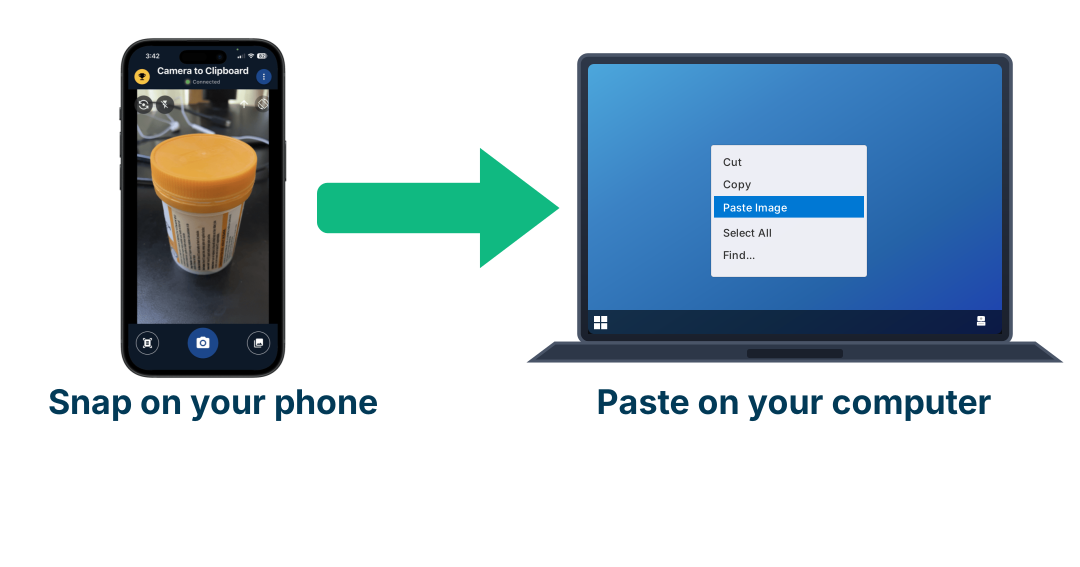
Use Camera to Clipboard to send product photos to a creator
Writing up a job for a creator stalls on the pictures more often than on the price, because the product photos are on a phone and the email is on a computer. Camera to Clipboard, one of my own apps, closes that gap: you photograph the product on your phone and the picture is already on your computer's clipboard, ready to paste into the email you are writing.
- You photograph the product on your phone and paste it on your computer, with no cable, no email to yourself and no upload step.
- Sending the real product shots in the first email is part of naming a price first, which is the move that gets a reply.
- The picture arrives on the clipboard, so it pastes straight into an email, a message or a shared document.

Asking for advert rights is not a deal breaker, but asking for them free is
Creators price this charge rather than refuse it, and the refusals in these videos are about getting it for nothing.
- One creator accepted a flat $2,500 that bundled six months of advert use into a single number with no separate line for it.
- Creators call the advert charge non-negotiable, which means they will always price it rather than that they will refuse you.
- One creator answered a request to simply hand the video over with a hard no, then offered to talk about paid licensing in the same breath.
- Your advertising budget buys the showing, and the fee buys the right to use that person's face and name inside your advertising.
- Creators do walk away, but they describe walking when the whole job outgrows the pay, not over advert rights on their own.
- Say you want advert rights and ask what they cost, because the version that ends the conversation is asking for them free.

Pay again if you want to run the video as an advert, because the video price does not cover that
A brand can do two very different things with the same video, and creators charge two very different prices for them.
- Putting the video on your own page is normally included in the price of the video.
- Paying to show the video as an advert to people who have never heard of the creator costs more.
- The creator does the same amount of work either way, so the extra money buys what you do with the video, not more filming.
- One creator charged $200 for a video and then found out the brand planned to run it as an advert for six months.
- Paying for a video does not mean you own it forever, and creators say most brands assume it does.
- A contract calls this "usage rights", and the number that matters is how many months it runs for.

Buy the advert rights later, because creators offer that deal themselves
You do not have to decide up front. Waiting until you know the video works is a deal creators put on the table without being asked.
- One creator's written proposal put the base at $7,500 a month and listed advertising rights underneath as an optional extra at $1,800 a month.
- Another creator scripts the exact deal, offering 30 days of free reposting and saying to reopen the conversation about advertising if the post performs well.
- Waiting means you only pay the advertising price on the videos that turned out to be worth advertising.
- Agree the advertising price up front even when you do not buy it, because a creator can name any number once they know the video is a hit.
- Never just run the advert without asking, because one creator found six months of advertising buried in a contract and creators now read for it.

Do not treat your advert as free publicity for the creator, because it sends almost nobody to them
Brands assume an advert helps the creator too, so paying extra for it feels unfair. Creators answer that objection directly, and the short version is that an advert is not publicity for them.
- One brand asked for the video to stay unlisted, so it never appeared on the creator's channel at all.
- An advert is shown to the people a brand pays to reach, not to people who are looking for the creator.
- Brands use the creator's viewers to find similar strangers, which builds the brand's audience rather than the creator's.
- The advert carries the brand's name and the brand's link, so a viewer has no reason to go and find the creator.
- Creators point out that the brand is using the video to sell things, which is why they treat it as a separate thing to charge for.

Ask for 30 days of advertising, because a whole year adds 150% to the price
The price goes up with how long you advertise, not with how much work the creator does. A short window is the cheapest thing you can ask for.
- Advertising with the video for 30 to 90 days adds 30% to 50% to the price of the video.
- One creator charges 25% to 100% extra for just four weeks of advertising.
- Advertising for 6 or 12 months is priced at 150% extra, which more than doubles the bill.
- Running the advert from the creator's own account, under their name, adds another 30% to 50%.
- Creators say running adverts from their account is the thing brands most often take for nothing, because it sits in the small print.
- Asking for 30 days with no adverts costs you almost nothing and removes the thing creators argue about most.

Never ask to own the video forever, because that costs 2.5 to 4 times the price of the video
Owning the video forever looks like a tidy legal detail, and it reads to a creator as the most expensive thing in the document.
- Rights that never expire are priced at 2.5 to 4 times the price of the video, as a minimum rather than a percentage on top.
- Creators are warned to treat the words "full usage" and "in perpetuity", which means forever, as vague and to refuse them until an end date is written down.
- A brand asking for worldwide use across every format is described as the point where a creator should hire a lawyer.
- One creator found a request for 6 months of ad usage buried inside a contract rather than stated in the offer.
- Writing a specific end date into the first email removes the single thing most likely to stall the deal.

Do not stop the creator working with your rivals, because that costs 20% to 30% every month
Brands often ask a creator not to work with their rivals for a while. Of everything on this page, that is the extra which costs the most and gains the least.
- Creators charge 20% to 30% of the video price for every month you stop them working with your rivals.
- Blocking rivals for six months on a $1,000 video therefore adds $1,200 to $1,800, which is more than the video.
- Creators price a block on rivals as lost income, because it stops paid work they would otherwise have taken.
- One creator refuses to sign any block on rivals unless the brand pays separately for the work it prevents.
- Most brands do not need to block rivals at all, and dropping it makes room in the budget for a higher price.

Compare what each extra adds to your bill before you ask for it
Creators charge for each of these separately, and added together the extras often cost more than the video itself. Two of the rows need spelling out. "Every clip they filmed" means the whole filming session rather than the finished video, so your own editor can cut fresh versions out of it later. "Extra opening lines" means the same video supplied with several different first sentences, so you can test which one stops people scrolling.
| What you ask for | What the creator adds to the price | What it buys the brand | Worth asking for |
|---|---|---|---|
| The video sits on your own page, 30 days | Little or nothing above the price of the video | A month of the post staying live | Yes, this is the normal one to ask for |
| Running the video as an advert, 30 to 90 days | 30% to 50% on top | Run the video as an advert for three months | Only if you will actually run ads |
| Running the video as an advert, 6 to 12 months | 150% of the price of the video | A year of advertising | Rarely, most videos look dated by then |
| You own the video forever | 2.5 to 4 times the price of the video | No expiry date to track | No, it is the most expensive thing you can ask for |
| Advert runs from the creator's account | 30% to 50% on top | Ads carrying a real person's name | Only when the creator already sells well |
| Creator cannot work with your rivals | 20% to 30% of the video price, every month | Your rivals cannot use them for a while | No, it costs more than it protects |
| Every clip they filmed, not just the finished video | A separate fee on top | One filming session becomes several different adverts | Only if you have someone who can edit |
| Extra opening lines or extra versions | A separate fee per version | Different versions to test against each other | Yes, it is cheap next to a second video |

Pay a fixed price and add a share of sales on top, never a share of sales instead of a price
Commission means paying the creator a share of every sale their video brings in, instead of or on top of a fixed price. Offering it instead of a price is the loudest complaint in the whole set of videos.
- Commission only offers are described as the majority of what brands send on TikTok and as the central struggle of working with brands.
- One creator did the arithmetic out loud, noting that generating $5,000 of sales on 10% commission left them $500 while the company kept $4,500.
- Sellers offering 10% or 20% commission on a marketplace are described as hoping the creator will work for free.
- Creators read a commission only offer as the brand asking the person with the least money to take all the risk.
- A fixed price with a share of sales added on top is described by creators as a win for both sides.
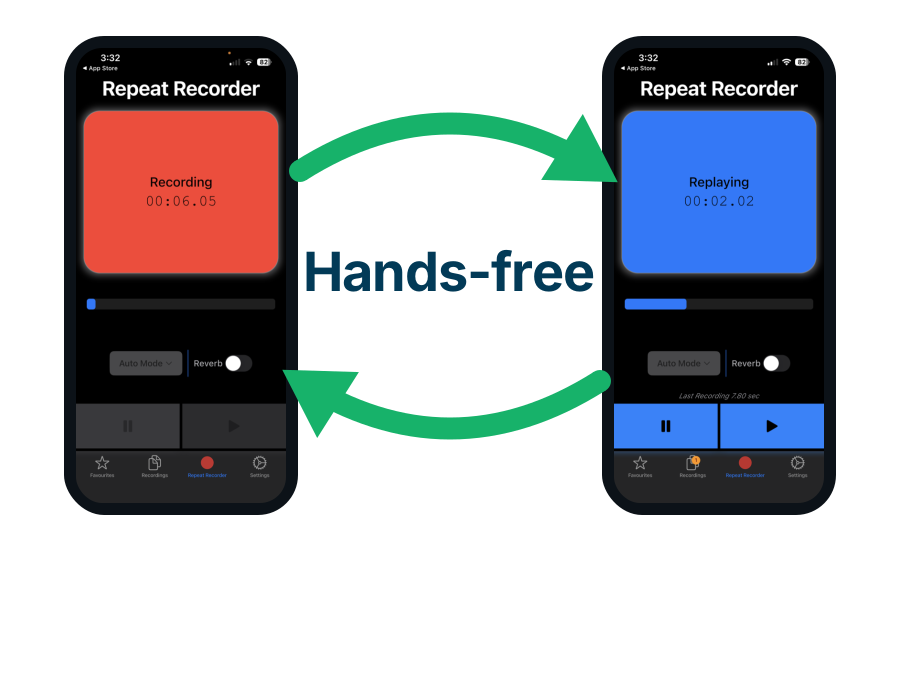
Use Repeat Recorder to rehearse your first call with a creator
Naming a price out loud is harder than typing it, and the first call is where brands talk themselves down. Repeat Recorder, another of my own apps, records what you say and plays it back on a loop, so you can hear your own offer the way the creator will hear it before you make the call.
- The record and replay loop runs continuously, so you can say the same sentence a dozen times and hear each attempt.
- Hands-free controls let you rehearse while driving or walking, which is when most people actually practise.
- Hearing yourself say a number is the quickest way to stop the apologetic tone that invites a counter offer.

Pay 10% to 20% of each sale on top of the fee, because it does not work as the only payment
A share of sales is not the problem. A share of sales instead of a price is the problem, and the same percentage reads completely differently once a fixed price sits underneath it.
- A commission rate of 10% to 20% is what brands already offer, so it needs no explaining to a creator.
- Commission added to a paid fee is described by creators as a way to prove the campaign worked and to justify a higher fee next time.
- A creator who is paid a fixed price will happily push a link, because the share of sales is now extra money rather than the only thing they earn.
- Brands that make little profit on each sale can offer a smaller percentage honestly, and creators accept that when the fixed price is real.
- Count sales for at least 30 days after the post, because one post keeps producing sales for weeks.

Add a bonus for every 1,000 views, because creators are told to look for a fixed price plus a bonus
There is one kind of offer creators are taught to watch for, and a brand that offers it without being asked stands out at once.
- Creators starting out are told to look for a fixed price plus a bonus per 1,000 views, rather than a fixed price on its own.
- A view bonus costs the brand nothing when the video does badly, which is the outcome the brand is worried about.
- A bonus per 1,000 views ends the argument about how many people will see it, because you pay for the people who actually did.
- Combining a fixed price, a bonus per 1,000 views and a share of sales covers all three things a creator wants.
- State the bonus in the first email rather than saving it for the negotiation, because it is what makes the offer memorable.

Offer a share of your advert budget, because no video prices a bonus per extra view
There is no agreed rate for a post that travels further than expected. The one scaling deal anyone puts a number on works a different way, because in it the creator never posts anything.
- Not one of these 103 videos puts a price on views above the average, so no rate exists for a video that takes off.
- In this deal the creator only films the video, and your own brand posts it and buys the adverts behind it.
- The creator is paid a share of the money you spend on those adverts, instead of a fee for posting to their own audience.
- One creator took 10% of advert spend instead of a flat $500, then made over $100,000 in six weeks when the brand spent more than a million.
- The same creator says 10% has come down since, and that 5% of advert spend is still worth asking for at a large brand.
- This is the safe shape on a small budget, because you control the advert spend and the creator earns nothing extra until you spend it.

Send the product free as well, but never call the free product the payment
Free product is welcome as an extra and insulting as the payment, and the difference is entirely in how the email describes it.
- An offer of free product in exchange for a video is the offer creators name most often as the one they decline.
- Creators call a product only deal a gifted collaboration and treat it as unpaid work rather than as a deal.
- A gifted collaboration does work for brand new creators who want a portfolio piece, which is why the offer keeps being sent.
- Sending the product alongside a real fee removes an expense the creator would otherwise carry.
- Say "we will also send the product" rather than "the product is the compensation", because the second version ends the conversation.

Put the number of videos, the delivery date and the advertising end date in the first email
Most of the anger in these videos is not about money at all. It is about a job that grew after the price was agreed.
- Creators describe agreeing a price and then discovering the brand wanted three videos, every clip they filmed, five different opening lines, six months of advertising and no work for rivals.
- A brand that hides the advertising terms until the contract is described as the reason creators now read every line.
- Naming the number of videos, the delivery date and the advertising end date up front lets a creator quote once and stand by it.
- A complete first email gets a straight yes or no, which is faster than three rounds of questions.
- Ask for a rush turnaround only when you need it, because delivery inside 24 to 48 hours costs extra.

Expect a counter offer, because creators are taught your first number is the least you will pay
Every negotiation guide aimed at creators says the same thing about a brand's opening figure, so plan for the reply before you send it.
- Creators are told directly that a brand's first offer is the smallest sum it is willing to pay, and that taking it without asking for more is a mistake.
- Set your first number 20% to 30% below the most you will pay, so you can say yes when the creator asks for more.
- Creators are coached to ask for extras rather than only for money, such as a longer advertising window in exchange for buying several videos at once.
- Buying several videos at once for a lower price each is a trade creators suggest themselves.
- Refusing to negotiate at all reads as a marketplace listing rather than a partnership, and creators decline those on principle.
Use Camera to Clipboard to save a signed creator contract
A creator deal ends in paperwork, and the signed page is usually a photograph taken on somebody's phone. Camera to Clipboard, one of my own apps, puts that photograph straight onto your computer's clipboard, so the signed contract lands in the folder for that campaign instead of staying in a camera roll.
- The photograph moves from phone to computer over your own Wi-Fi, with no upload to a third party in between.
- Keeping the signed end date on file matters, because that date decides when you must stop running the video.
- Camera to Clipboard works the same way for a receipt, a delivery note or a printed page of instructions, so one habit covers the whole campaign.

Never ask a creator to work just to be seen by your audience, because they will not reply
Brands sometimes offer to mention the creator to their own followers instead of paying them. The word for this in the trade is "exposure", and in these videos it appears only as a joke.
- Creators name being mentioned to a brand's followers, alongside free product, as the two offers they refuse without replying.
- Creators tell each other about bad offers, so one such email can close a whole group of creators to your brand.
- A brand offering only a mention is asking to borrow an audience the creator spent years building, which is the one thing they have to sell.
- Even a small real fee changes the offer completely, because it proves a budget exists.
- If you genuinely have no budget, say so plainly and ask what is possible, because creators respect that far more than an offer with no money in it.
Conclusion: how much to pay an influencer, in one glance
These are the figures creators state when they are talking to each other rather than to a brand, ordered by how much they change your bill.
- Owning the video forever costs 2.5 to 4 times the price of the video.
- Advertising with the video for 6 to 12 months adds 150%.
- Stopping the creator working with your rivals adds 20% to 30% every month.
- Advertising with it for 30 to 90 days adds 30% to 50%.
- Running the advert from the creator's account adds 30% to 50%.
- One Instagram reel seen 10,000 to 20,000 times runs $1,000 to $2,000.
- One video posted by the creator sits around $500.
- A video the creator films and your brand posts starts at $150 to $250.
- Paying one creator every month for an agreed number of posts costs $1,000 to $7,500 a month.
- One creator aims at $90 to $110 for every 1,000 views.
- Name your price first, and keep 20% to 30% spare to say yes with.
- Give 10% to 20% of each sale on top of the price, never instead of it.
- Add a bonus per 1,000 views, because creators are taught to look for one.
- Ask for 30 days, no adverts, and no block on your rivals.
- Send the product free, and never call the product the payment.
The 103 videos this article is based on
Every figure on this page comes from these videos, all published in the four months to September 2026, and all made by creators speaking to other creators rather than to brands.
How creators pitch brands
- How to Get UGC Brand Deals in 2026 - 5 Ways to Find Paid Work Without Relying on Cold Pitching
- How to Get Brands to Reach Out to You Without Pitching (Your Inbound Game Plan)
- EMAILING BRANDS FOR PR WITH ME 💌 | how I reach out to brands as a teen creator
- I Sent 100 Cold Emails to Brands - Here's What Happened
- How a Keynote Speaker Landed a Brand Deal Seen by 1M+ People
- How to Pitch Brands for UGC (A Pitch That Actually Gets Responses)
- How to Write a Pitch Email That Actually Gets Read | Pitching Series
- How to Pitch Brands & Land More Opportunities in Business
- Get PAID with UGC apps | Find your first brand deal in 24 hours (w/out portfolio)
- How to Pitch Hotels for FREE Stays (+ My Email Template)
- 99% of Creators Ignore This Brand Deal Angle
- This Brand Deal Script Made Me $500,000 (With Low Followers)
- The Exact Script That Landed Me a $4,000/Month Brand Retainer (Copy This)
- The AI UGC Pitch Script That Got Me a Reply in Under 24 Hours
- How to Get Brands to Reach Out to You
- Startup Founder Sold A Sponsorship With Zero Social Following
- How to Get More Brand Deals & Sales with THIS Instagram Strategy | Ep 129
- How to Write a Brand Deal Pitch SO Good Brands Pay Instantly
- Watch Me LIVE Land a $3,000/mo Social Media Brand Deal
- What to Say in a PR Pitch Email (Word-for-Word)
- Brand deals for YouTubers - the only guide you need!
- How I Landed $500k in Brand Deals on TikTok (My Exact System)
- My Exact $10K UGC Pitching Strategy
- HOW TO MAKE THE BEST FIRST IMPRESSION ON BRAND PARTNERS AS A CONTENT CREATOR
- HOW TO AUDIT YOUR INSTAGRAM TO LAND MORE BRAND DEALS & PARTNERSHIPS
- ARE INFLUENCER PLATFORMS DEAD? HERE'S WHAT TO DO INSTEAD
- YouTube's Creator Partnerships: watch this BEFORE you use it
- Sponsors Want THIS, Not Big Numbers! | Creator Sponsorships 101
- Watch this to 10x your brand deals
- Is Cold Pitching Dead? What's Working for UGC Creators Landing Brand Deals in 2026
- Why This Simple Email Got Me My First Brand Partnership
- How to Pitch and land your first brand collaboration
- Creator Pitching Strategy: Beyond Brand Deals
- How To Pitch The Media & Press as a Creator / Influencer
- WHAT TO POST ON LINKEDIN AS A CONTENT CREATOR | HOW TO GET BRAND DEALS VIA LINKEDIN
How creators negotiate a deal
- How To Negotiate Your Next Brand Deal As A Content Creator | The Creator Deal w/ Jae Shin Ep. 7
- A Brand Offered $225 for This Brief. Here's What It's Worth
- How to Negotiate Brand Deals (Even When You're Nervous)
- How to Negotiate Brand Deals …..A Brand Asked for My UGC Rates… Now What?
- How to Negotiate Paid Brand Deals
- Inside Our $125K Sponsorship Month (as Married Creators)
- Don't Fall For These Mistakes When Negotiating Brand Deals | Molly McAdam
- How to Respond When a Brand Asks "What Are Your Rates?" (The Anchor Method)
- How I Lost a $6K/mo Brand Deal With Perplexity
- How to Renegotiate Your Brand Deal Rates (Real Example + 3-Step Framework)
- How to Negotiate with Brands as a UGC Creator (Scripts + Real Examples)
- You shouldn't be afraid to ask for more money & charge your worth as a UGC creator! #ugctips
What creators say they charge
- How Much Should You Charge for a Brand Deal?
- How Much Should a Beginner UGC Creator Charge in 2026?
- How to Price Yourself as a Creator (Even if You Have Under 10k Followers)
- How Much Should You Charge for a Brand Deal? Creator Rates + Pricing Tips
- How Much Should You Charge Brands? The Creator Pricing Rules No One Tells You - Mikhailla Fitzgerald
- How Much Should You Charge for UGC in 2026? (Real Rates)
- How Much Do Brands Really Pay Influencers in 2026?
- My Amazon Influencer Media Kit + What I Charge Brands
- 7 Lessons from $500k in Brand Deals | collaboration tips for content creators
- UGC Creator Pricing 2026: What to Charge Your First Year + How to Raise Rates
- 5 Things Social Media Creators Should Price For (Other Than Follower Count)
- How to Price Your Brand Deals Like a Pro by Full Time Content Creator w/ @PhilipLemoine
- How Much UGC Creators Actually Make (Beginner to $20K+ Months)
- How Much Should You Charge for UGC and Brand Deals? | I Am That Content Creator
- How Much To Charge for a Sponsorship? (CPM Explained) - Esports Masterclass EP4
- Brand Deal Strategy: Your Worth vs. Are you Actually "Worth It"
Small creators and first deals
- How Small Creators Get Brand Deals in 2026 (Even Under 10K Followers)
- The Secret to Getting Paid by Brands as a Creator
- How I Got 2 UGC Brand Deals In My First Week Starting UGC
- I did this to get brand deals as a small creator | Road to ironman
- how much I REALLY make as a youtuber | exposing how influencers ACTUALLY make money
- How I Got My First UGC Brand Deal
- How This Creator Went From Journaling Videos to Paid Brand Deals
- How to get Paid Brand Deals as a micro creator | Under 1k Followers | Paid UGC deals | Small Creator
- I Got a BRAND DEAL After Only 30 Days ... YouTube
- Create Content, Work With Brands AND Get Paid | How to Start UGC - Part 2
- How to Build a Personal Brand That Gets You Paid as a UGC Creator
- Answering your most asked UGC questions (no gatekeeping)
- How Small Creators Land Big Brand Deals
- I Got My FIRST Brand Deal?! | 20 Things Before 20 EP 9
- How to Get Your FIRST Brand Deal as a Small content creator!
- The Truth About Brand Deals For Small Channels
- I Got My First Ever Brand Deal!?
- How To Get Brand Deals As A Small Creator
- how I make money as a content creator 📷💸 brand deals, content creation tips, finances, taxes, Q&A!
- Landing My First Brand Deal at 5k Subs: What I Wish I Knew
- Small Creator? You Can Still Get Brand Deals (Here's Proof)
- How I landed 5 figures in TikTok Shop brand deals, with no followers.
- How to Get Brand Deals for Small Creators (Under 1,000 Subs)
- How I Get Brand Deals as a Creative Business Owner (Without a Big Audience)
Media kits and portfolios
- How I Built My UGC Portfolio Before Landing a Single Client
- 7 steps to build a ugc portfolio from scratch
- How to Create a UGC Portfolio on Canva (to get brand deals ASAP)
- How to Make a Media Kit That Gets Brand Deals (What to Include - and What to Leave Out)
- How to Make a STANDOUT Portfolio For Brand Deals (FULL GUIDE)
Contracts, rights and warnings
- The Anatomy Of A Brand Deal
- Business Basics for Content Creators: Contracts, LLCs & Protecting Your Brand
- YouTube's Newest Scam Sponsor
- They Stole My Brand Forever! What A Brand Contract Shows!
- ⚠️ Small YouTubers Are Being Targeted With Deals Like This
- Your Brand Deal Contract: What Brands Don't Want You to Know
- HOW TO DISCLOSE A BRAND PARTNERSHIP AS A CREATOR | DO I NEED TO USE THE PAID PARTNERSHIP LABEL?
Mistakes creators tell each other to avoid
- 5 Content Creator Business Mistakes Keeping You Broke (LLC, Rates, and More)
- 4 mistakes UGC creators make that are costing them brand deals
- 5 Mistakes Slowing Down Serious UGC Creators
- The Brand Deal Mistake That's Costing Creators Money