
Meta publishes the nine things the Threads feed measures. This article pairs them with studies covering millions of real posts, and names the popular tactics with no evidence behind them.
The short version. Replies grow a Threads account faster than posting does.
- Posts that collected over 500 replies in a month grew followers 10.09%.
- Posting 5 or 6 times a week grew followers 8.87%, and daily posting grew less.
- Answering the comments on your own posts raised engagement 42%.
- Post in the morning, because evenings lost on every day of the week.
- Post a video or a photo, because 5.55% of viewers react to a video and 2.79% to plain text.
- Keep the link out of the post itself.
- Never build an account out of other people's posts, because Meta stops recommending it.

Learn the nine things Threads measures about a post, because every rule below comes from them
Meta publishes a document it calls a system card for the Threads feed. It lists the nine guesses Threads makes before it picks what goes at the top of your screen.
- Threads guesses how likely you are to like a post, to reply to it, to click it, to click the author's profile, and to keep reading after either click.
- Threads also guesses how long you will look at a post, and it counts that time as a good sign.
- Threads guesses how likely you are to scroll straight past a post, and that guess counts against the post. A post nobody stops on is punished, not ignored.
- "Likelihood to create a reply" is one of the nine, which is why every measured tactic on this page is about starting conversations rather than collecting likes.
- Meta gathers a portion of all public Threads posts plus everything from accounts you follow, then ranks that pile with the nine guesses.
- Meta has never published what the nine guesses are worth relative to each other, and it has never published what gets pushed down.

Aim for 500 replies a month on your own posts, because those accounts grew followers by 10.09%
One study sorted 283 creators by how many replies their posts collected, then measured how much each account grew that month.
- Accounts whose posts collected more than 500 replies in the month grew their follower count by 10.09%, the best result in the study.
- 500 replies in a month is about 17 replies a day, which one good question a day can produce.
- A reply costs a reader far more effort than a like, which is why Threads treats it as the stronger sign of interest.
- That study covered 21,864 posts from 283 creators and 26.5 million views in a single month.
- Across every post in the study, 5.3% of the people who saw a post reacted to it.

Reply to the comments on your own posts, because that raised engagement 42% on Threads
Buffer analysed nearly 2 million posts from more than 220,000 accounts across six platforms, of which 128,000 posts were on Threads. It compared each account against itself over time, so a big account's normal advantage cannot explain the result.
- Posts where the author replied to the comments got 42% more engagement on Threads than posts by the same author where they did not.
- Threads had the largest lift of the six platforms, ahead of LinkedIn at 30%, Instagram at 21%, Facebook at 9%, X at 8% and Bluesky at 5%.
- About two thirds of Threads accounts in the study did better on posts where they replied, so this is not a handful of big accounts skewing an average.
- Buffer says plainly it cannot prove replying causes the lift, because posts that do well attract more comments to reply to in the first place.
- Meta will not let you schedule a reply, and said in December 2024 that this was deliberate, to keep replying live.
| Platform | Extra engagement when the author replies to comments | Worth doing |
|---|---|---|
| Threads | 42% | Yes, the best of any platform measured |
| 30% | Yes | |
| 21% | Worth the time | |
| 9% | Small effect | |
| X | 8% | Small effect |
| Bluesky | 5% | Barely measurable |

Reply to other people far more than you post, because over half of what Threads shows is replies
Replying does not push your own posts higher. It grows an account a completely different way.
- Replying to other people does not make your own posts do better, so this is not a trick for boosting what you already published.
- A reply on Threads is a full public post that appears in other people's feeds, which is how it reaches readers who have never heard of you.
- Your own posts mostly reach people who already follow you, which is why posting alone grows an account slowly.
- Meta's Japan office said in July 2026 that replies are more than half of everything people are shown on Threads worldwide.
- Adam Mosseri, who ran Threads until July 2025, said all your replies together are worth about as much as all your posts.
- Nobody has measured whether replying to strangers grows your own account, so treat this as Meta's advice rather than proof.

Reply even with no followers, because Threads judges a reply on its words, not your follower count
Researchers at the Polytechnic University of Marche built a map of every public reply in the European Union between 14 December 2023 and 21 February 2024. The map has 45,349 people in it and 72,333 reply connections between them.
- The most connected 2.59% of Threads accounts receive replies at nearly twelve times the rate of everybody else.
- Whether an account is already popular has almost no effect on who replies to it, because the study measured that link at effectively zero.
- That means a reply from a stranger is earned by what you wrote, not by the follower count on your profile.
- The most connected accounts talk to each other about 56 times more densely than the network as a whole.
- Becoming one of those most connected accounts matters most, because their replies are what carry a post into other people's feeds.

Post 5 or 6 times a week, because those accounts grew followers by 8.87% and daily posters grew less
Posting more is the first thing most people try, and it stops helping sooner than expected. The same March 2026 study grouped accounts by how often they posted and measured the follower growth of each group.
- Accounts posting 5 or 6 times a week grew followers by 8.87% in the month, the best result of any posting rate measured.
- Posting every single day did not beat 5 or 6 times a week, so the seventh post bought nothing.
- 5 or 6 posts a week is one post on each weekday and a rest at the weekend.
- Two of your own posts within an hour compete for the same readers, so they split the replies between them.
- The hour freed up by not writing a seventh post is better spent replying, which grew followers by 10.09% rather than 8.87%.

Post in the morning between 6am and 11am, because evening posts did worse on every day
Buffer measured 2.5 million Threads posts and ranked every hour of every day by how much engagement the middle post got. Read all times as the reader's own local time.
- Weekday mornings from 6am to 11am were the best window on Threads.
- The single best slot was Thursday at 9am, followed by Wednesday at midday and Wednesday at 9am.
- The 6pm to 11pm window underperformed on every single day of the week, with no exceptions.
- Wednesday, Thursday and Tuesday were the best three days, and Saturday was the worst.
- Buffer's own earlier study said Wednesday at 7am, so even the same company gets a different answer ten months apart.
- Monday at 10am is when the most brands post to Threads, which makes it the busiest hour rather than the best one.

Post on Thursday at 9 am if you can pick any hour, because it beat every hour of the week
Buffer counted the likes, replies and reposts every post collected, for every hour of every day, across 2.5 million Threads posts sent through its own tool. One hour came out on top.
- Thursday at 9 am was the single best hour of the week in that 2.5 million post study.
- Wednesday was the strongest day overall, followed by Thursday and then Tuesday.
- The hours are in your readers' local time, not yours, so pick the morning of the country you sell to.
- A scheduling tool removes the only real obstacle here, which is being awake and free at 9 am.
| Day | Best hour to post | How the day ranked in 2.5 million posts | What the 21,864 post study found |
|---|---|---|---|
| Wednesday | 12 pm, outside the strong morning window | Best day of the week | Not named as a peak for views or replies |
| Thursday | 9 am, the best single hour of the week | Second best day | Not named as a peak for views or replies |
| Tuesday | 10 am, inside the strong morning window | Third best day | Not named as a peak for views or replies |
| Monday | 12 pm, outside the strong morning window | Middle of the week | Not named as a peak for views or replies |
| Friday | 10 am, inside the strong morning window | Middle of the week, and mornings underperform | Most viewers reacting, at 6.29% |
| Saturday | 10 am, inside the strong morning window | Fewest viewers reacting of any day | Most views per post, at 1,853 each |
| Sunday | 11 am, inside the strong morning window | Second lowest of the week | Not named as a peak for views or replies |

Test your own weekend, because the two largest Threads timing studies disagree about Saturday
Weekdays are settled. Weekends are not, and the two biggest datasets point in opposite directions, which is worth knowing before anyone sells you a rule about them.
- The 2.5 million post study found Saturday collected the fewest likes, replies and reposts of any day.
- The 21,864 post study found Saturday gave the most views per post, at 1,853 views each.
- The same two studies also split on Friday, which had the weakest morning in one and the most viewers reacting in the other, at 6.29%.
- Being seen and being replied to are different things, so a day really can be strong on one and weak on the other.
- Run your own four week test before you believe either study about your own readers.

Do not spend long picking a posting time, because what you post matters far more than when
The company that published the best-time-to-post study also published the sentence that undercuts it. It is worth reading before you build a schedule around a single hour.
- Buffer's own conclusion from 52 million posts is that what you post matters most, how often you post matters a lot, and when you post matters least.
- Buffer says the best time is a window rather than a slot, and the difference between the top few windows is smaller than people expect.
- Buffer describes timing as something that helps a good post get its first push and cannot rescue an average one.
- Threads users are in the app for about five minutes a day, so a post has a short life whatever hour you send it.
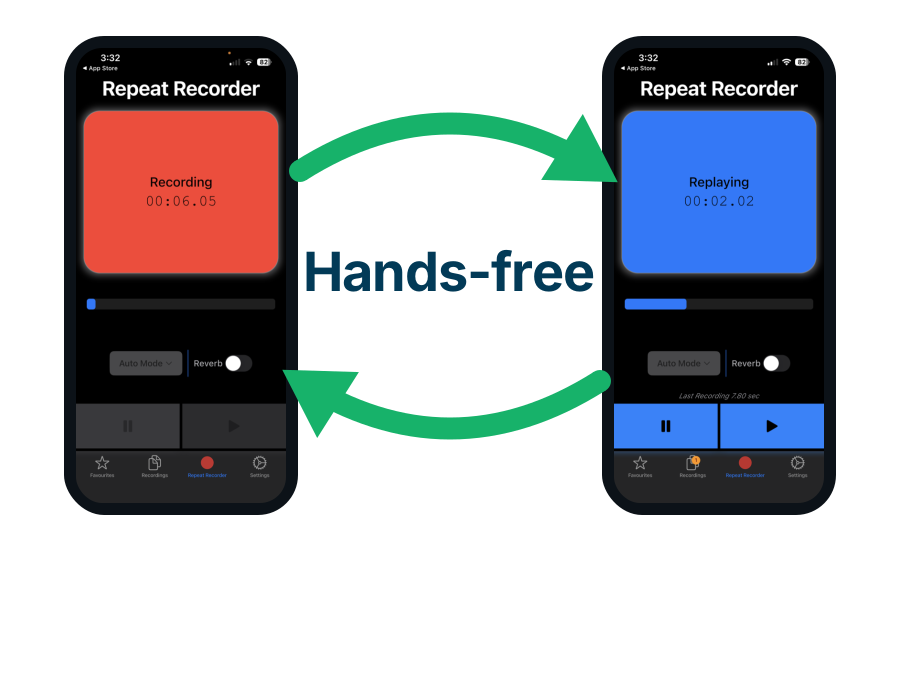
Use Repeat Recorder to rehearse the line before you film a Threads video
Video performs best on Threads, and most people avoid it because the first take sounds wrong. Repeat Recorder, one of my own apps, plays your take straight back on a loop so you can fix the one word that is off.
- Repeat Recorder loops your recording hands free, so you can rehearse with the phone face down on a table.
- 5.55% of the people who see a video post on Threads react to it against 2.79% for a plain text post, so the rehearsal is worth doing.
- Recordings stay on your phone and are never uploaded, shared or used to train anything.

Attach a video or a photo to your post, because plain text gets about half the reaction
Threads is sold as a text app, and text performs worst on it. Buffer measured this across part of a set of more than 52 million posts. Every percentage below is the share of viewers who reacted.
- 5.55% of the people who see a video post on Threads react to it, against 4.55% for a photo post, 2.79% for a plain text post and 2.34% for a link post.
- Video beats plain text by 99% and a photo beats plain text by 63%.
- Buffer's own earlier study put photos ahead of video, so which of the two is best is genuinely unsettled and the gap between them is small.
- Both Buffer studies agree that plain text is well behind and that link posts finish last.
- Buffer warns that a good text post easily beats a mediocre video, so the format is a nudge and not a rule.
- Nobody has published figures for a Threads carousel, which is a post holding several pictures you swipe through, and the 21.77% figure people quote for one is Buffer's LinkedIn result.

Put one person in the photo you attach to a post, because a crowd photo gets almost no replies
This is about the photo you attach to a post, not your profile picture. Researchers put 62,321 Threads posts and 21,572 images through Meta's own research tool. It covers one protest movement in Taiwan, so treat it as a strong hint.
- What the post is about predicted its likes better than any other single feature the researchers measured.
- Photographs containing people took the largest share of views, likes and reposts, a repost being when a reader passes your post on to their own followers.
- A post whose photo showed one person drew far more replies than a post whose photo showed a crowd.
- A crowd photograph spread widely and started almost no conversation, which is the wrong trade on a platform that ranks replies.
- Formal wording raised likes and so did negative feeling, which is the opposite of the cheerful tone most brands write in.
- Drawings and computer generated pictures were passed on to other people's followers more often, without getting more likes.

Keep most posts short, because 6.09% of the people who saw a short post reacted to it
Nobody had measured post length on Threads until March 2026. One study now has, and length turns out to decide what a post is for.
- 6.09% of the people who saw a short post liked, replied to or reposted it, the best of any post length in the study.
- The average across every post in the same study was 5.3% of viewers reacting, so a short post beats the typical post.
- A short post is read in full on the screen, so nobody has to tap "more" to reach the point.
- The most viewed post in the whole study, at 763,300 views, was a short post.

Write one long post when you want views, because long posts averaged 4,416 views each
Long posts do the opposite job to short ones, and the same study measured the trade clearly.
- Long posts averaged 4,416 views each, the highest reach of any format in the study.
- A smaller share of the people who saw a long post reacted to it, so a long post reaches more people and collects fewer replies.
- Use a long post for the thing you want strangers to find, and short posts for the daily conversation.
- A long post can be split into a chain of replies to itself, which keeps every screen short while the whole thing stays long.

Put your link in the first reply, not in your Threads post, because link posts reach fewer people
Threads does not block links. A web address in a post becomes a normal clickable link that anyone can tap. The problem is that a post carrying a link is shown to fewer people.
- Links work normally on Threads, in a post and in a reply, and Meta blocks nothing.
- Meta denies that it pushes link posts down, and Adam Mosseri said so directly in November 2024.
- Mosseri's stated reason for link posts doing badly is that people rarely like or comment on a link, and the feed ranks a post on how likely you are to do exactly those two things.
- Mosseri then said in June 2025 that Meta had been "working on making sure links are ranked properly", which is hard to square with nothing having been wrong.
- Buffer's data from six months after that fix still puts link posts last, with only 2.34% of the people who see one reacting to it.
- Write the post so it stands on its own without the link, and put the link in your first reply underneath it.
One hard limit does exist. The Threads posting tool rejects a post containing more than five links outright.

Post in most weeks of the year, because steady posting got 450% more reaction per post
Buffer followed more than 100,000 accounts across ten platforms including Threads for 26 weeks, and grouped them by how many of those weeks they posted in at all.
- Accounts that posted in 20 or more of the 26 weeks got 450% more engagement per post than accounts that posted in four weeks or fewer.
- Accounts that posted in 5 to 19 of the weeks got 340% more than the occasional group, so most of the gain arrives early.
- The gain per extra week shrinks fast, from 58% at week three down to 16% by week seven.
- Engagement peaked at week 21 and then flattened out, so this is not a reason to post forever without thinking.
- The average Threads account posts 6.46 times a week, measured across 1,059,949 accounts.
- Threads accounts with 100,000 to 1 million followers post more than 53 times a week, which is eight times the average.
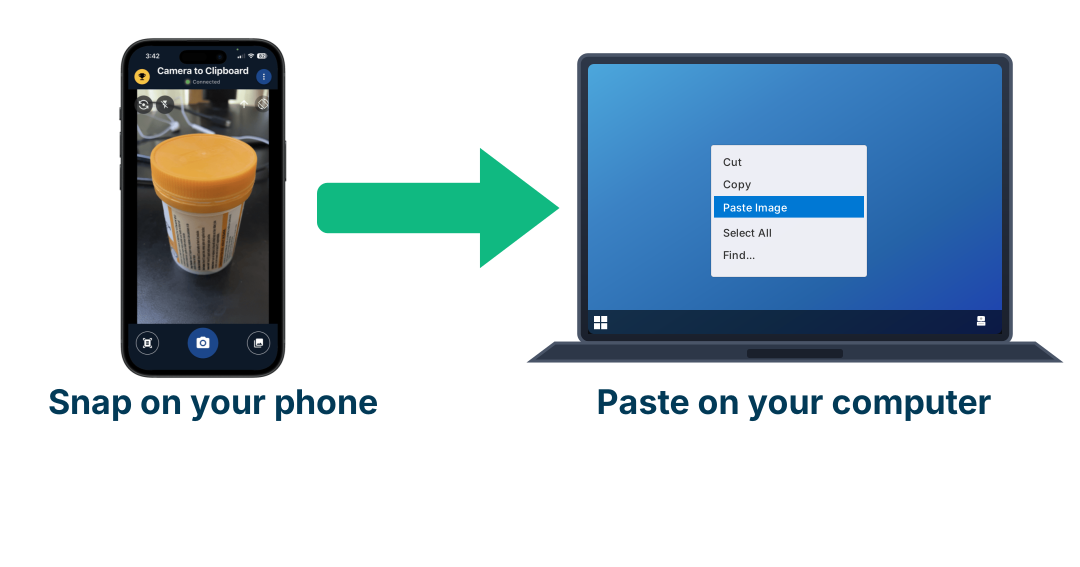
Use Camera to Clipboard to add a photo to a Threads post you wrote on a computer
Posting six times a week gets slow if every picture has to be emailed from your phone first. Camera to Clipboard, another of my own apps, puts the photo straight onto your computer's clipboard, ready to paste.
- Camera to Clipboard puts the photo on your computer's clipboard, so writing on a keyboard no longer costs you the picture.
- 4.55% of the people who see a photo post on Threads react to it against 2.79% for a plain text post, so the picture pays for the extra step.
- You can attach up to 20 photos or videos to one Threads post.

Post about more than one subject, because switching topics beat repeating the same one
Every growth guide tells you to pick one subject and never leave it. Two separate academic datasets point the other way on Threads, and this is the most surprising finding in the whole article.
- Researchers analysed 4,716,626 Threads posts and found that a post on a different subject to the author's last post did better than one on the same subject.
- Only 8.93% of Threads posts share a subject with the author's previous post, against 28.25% on Instagram, so subject switching is normal behaviour on Threads.
- A separate study found that people who post across more than one subject are 17.9 times more likely to be among the platform's most connected accounts.
- The topic switching finding and the multiple subject finding come from different research teams and different datasets, and they agree.
- The reason is that Threads ranks each post on its own merits and keeps no running score for your account, so a change of subject costs you nothing.

Tag exactly one topic per post, because Threads allows one and Meta says tagged posts get more views
Threads did not copy hashtags from Twitter. It built a different thing with a deliberate limit, and the limit has not moved since December 2023.
- Threads allows exactly one topic tag per post, and Meta said the reason is to make it easier for people who care about that topic to find the post.
- Meta said in 2025 that posts with a tagged topic generally receive more views than posts without one, and published no number alongside that claim.
- You can put up to ten topics in your profile bio, which is a separate limit from the one tag per post.
- Nobody outside Meta has ever measured whether a Threads topic tag helps, so this rests entirely on Meta's own word.
- Ignore any article claiming a specific percentage lift from Threads tags, because no study behind those numbers exists.

Ask a real question but never ask for likes, because Meta demotes posts that beg for likes
Meta calls asking for engagement "engagement bait" and publishes both the definition and the punishment. It also publishes a carve out that most people writing about this leave out.
- Meta defines engagement bait as a post that explicitly asks for votes, shares, comments, tags or likes for no reason other than to get them.
- The punishment is that Meta pushes the post down in the feed rather than removing it, and the demotion gets worse if you keep doing it.
- Meta says it has trained its systems specifically to avoid demoting posts that ask for help, advice or recommendations.
- So "what should I do about this" is protected and "comment YES if you agree" is not, even though both end in a question.
- Adam Mosseri said in October 2024 that engagement bait had increased on Threads and that Meta was working to get it under control.
- Nobody has measured whether question posts actually get more replies on Threads, so ask questions because they start conversations, not because a study says so.

Never trade follows with anyone, because Meta's spam rules ban exchanging engagement
Meta's Community Standards name Threads directly, so the Spam policy genuinely applies here rather than being borrowed from Instagram. The word that catches most people is "exchanging".
- Meta bans selling, buying or exchanging engagement such as likes, shares, views, follows and clicks.
- No money has to change hands, so a follow-for-follow arrangement and an engagement pod are both banned by the word "exchanging".
- Meta bans posting or engaging at very high frequencies, whether you do it by hand or with software.
- Meta bans making people like, share or follow you before they can see something, which it calls like-gating and share-gating.
- Meta's nearest official name for an engagement pod is a "coordinated comment network", and content from one is not eligible to be recommended.
- Buying Threads followers is the same rule, and 260 people a month search for how to do it anyway.

Try an idea as a ghost post, because it disappears after 24 hours and the replies go to your inbox
Ghost posts launched on 27 October 2025 and are the most searched Threads feature that nobody explains properly. About 720 people a month search for what one is.
- A ghost post is a normal Threads post that files itself away automatically 24 hours after you send it.
- Replies to a ghost post go into your direct message inbox instead of appearing publicly under the post.
- Only you can see who liked a ghost post and who replied to it.
- You turn a post into a ghost post by tapping the ghost icon while you are writing it.
- Meta's stated purpose is to let people post spontaneous thoughts without them sitting on the profile forever.
- A ghost post is the cheapest way to find out whether an idea gets a reaction before you commit to it as a normal post.

Retrain your own feed with "Dear Algo", because Meta shipped it as a real control in 2026
People kept posting messages addressed to the Threads ranking system as a joke. In February 2026 Meta shipped it as a working control, and it matters for growth because your own feed is where you find people to reply to.
- Writing a public post that starts with the words "Dear Algo" adjusts your own Threads feed for three days.
- You can pass somebody else's "Dear Algo" request on to your own followers to apply the same adjustment to your own feed.
- "Your Algo" arrived in June 2026 and does the same thing privately, for one, three or seven days, with nothing posted publicly.
- "Dear Algo" and "Your Algo" work only in the United States, Canada, Britain, Australia and New Zealand.
- Point your own feed at the subject you post about, because you cannot reply to conversations you never see.

Join a Community, because Meta credited them for taking Threads to 500 million users
Communities launched as a test on 2 October 2025 and became a finished feature on 16 June 2026, the same day Meta announced 500 million monthly users and said Communities were part of the reason.
- A Threads Community is a public group built around one subject, and Meta created the first hundred rather than letting users make them.
- Threads passed 200 Communities by December 2025 and added a Community Champion badge and small labels members can put next to their name.
- Community Champions are chosen for being highly followed inside the community and for actually talking in it.
- A Community Champion can host a Live Chat, which is a public group conversation with up to 150 active participants.
- Your community membership shows on your profile, so it doubles as a signal of what you post about.

Stop reposting other people's work, because Meta stops recommending accounts that mostly repost
Meta published this rule in April 2026, and it can quietly undo every other tactic on this page.
- Meta makes an account ineligible for recommendations when most of what it posts in a month was made by somebody else.
- Losing recommendations means your posts stop being shown to people who do not already follow you.
- Meta looks at a whole month of output rather than at a single post, so one repost does no harm.
- The penalty applies to everything the account posts afterwards, not only to the reposted items.
- Accounts that cross the line can also lose access to Meta's paid creator programmes for a period.

Add your own opinion to anything you share, because Meta says a credit line is not enough
Sharing is not banned. Meta published what separates a share it counts as yours from one it does not.
- Meta says low effort edits such as a watermark or a credit to the original creator do not make a post original.
- Meta names what does count, which is your own text, a real edit, a voiceover, a joke, or context that was not there before.
- Sharing somebody's chart with your own one line reading of it counts as original, and posting the chart on its own does not.
- This rule is why writing your own short posts every day is the safest growth plan on Threads.
Use Repeat Recorder to practise the voiceover that makes a post yours
Meta names a voiceover as one of the few things that make somebody else's clip your own post. Repeat Recorder, one of my own apps, gets those words right before you record them.
- A voiceover is one of the edits Meta itself names as making a post original, so it is worth more than one take.
- Your own voice plays back about a second after you stop speaking, so you hear the problem while you still remember what you were fixing.
- Automatic mode needs no tapping at all, so a line can be rehearsed while walking, driving or washing up.

Write posts made for Threads, because 52% of brands paste theirs in from another app
The feed is already full of posts that were written for somewhere else. That is the opening, not the obstacle.
- 52% of brands copy their Threads posts across from another app, and only 26% write posts made for Threads.
- A further 21% of brands use a mix of copied posts and posts written for Threads.
- 57% of brands post on Threads at all, so the feed is already crowded with recycled material.
- Brands selling to shoppers are on Threads at 64%, while brands selling to other businesses are at only 19%.
- Writing fresh is the cheapest way to look different from three quarters of the brands in the feed.

Open Settings then Account then Account Status, because it says whether Threads will recommend you
Reach can drop for a reason no posting change will fix. Threads now says so directly, and almost nobody looks.
- Account Status sits under Settings, then Account, then Account Status, inside the Threads app.
- A green tick reading "Eligible to be recommended" means Threads will show your posts to people who do not follow you.
- An orange warning mark means your reach is being held back, and tapping it shows what caused it.
- Account Status also lists any post Meta removed for breaking its Community Standards.
- Check this first when reach falls, because a restriction explains a drop that better posting cannot repair.

Just start posting, because 46.47% of early Threads accounts never posted once
Researchers collected 1,253,438 Threads accounts in the month after launch and counted how many posts each one had written. The answer explains why the bar on Threads is lower than it looks.
- 582,459 of those 1,253,438 accounts, which is 46.47%, had never posted anything at all.
- A further 43.36% had written fewer than 25 posts, so nearly nine accounts in ten were barely active.
- An account with under 2,000 followers averages 761.31 views per post on Threads against 128.82 on X, so the reward for starting is real.
- Threads accounts average 1.65 posts a day, slightly more than Instagram accounts at 1.19.
- Reposts make up 20.83% of everything on Threads, so a fifth of the feed is people passing on somebody else's post.

Start even with 200 followers, because 8 of the 10 fastest growers began under 10,000
The usual reason for not starting is that the account is too small to matter. The fastest growing accounts in the data say the opposite.
- Eight of the ten fastest growing accounts in the 21,864 post study began the month with fewer than 10,000 followers.
- The fastest grower went from 2,370 to 29,264 followers in one month, a rise of 1,134.8%.
- The account that gained the most followers in raw numbers added 41,329 of them in the same month.
- Threads recommends posts to people who do not follow the author, so a new account can reach the same readers as an old one.

Judge a post by whether 6 in 100 viewers react, because that is what a typical Threads post gets
A number only means something next to the normal number. These are the ones to measure against.
- The typical Threads post is liked, replied to or reposted by 6.25% of the people who see it, against 3.6% on X.
- That means a Threads post gets a reaction from nearly twice the share of viewers that an X post does.
- The 21,864 post study measured a slightly lower 5.3% of viewers reacting, so treat anything from 5% to 6% as normal.
- Very large accounts do far worse, and across the 20 most followed Threads accounts in June 2026 the typical post was reacted to by 0.02% of viewers.
- A small account getting 6 reactions from every 100 viewers is doing better than a famous account with a million followers.

Give Threads the time you give X, because Threads grew 127.8% in a year while X fell 15.2%
Where an audience is going matters more than where it is now, and the two apps are moving in opposite directions.
- Threads passed X on mobile daily users in early 2026, at 141.5 million against 125 million.
- Threads grew 127.8% over that year while X shrank by 15.2%.
- Threads reached 500 million monthly users in June 2026, which Meta announced itself.
- The average Threads session lasts about 4 minutes, so posts are read in short bursts rather than long sittings.
- 7% of social media users say they plan to use Threads more in 2026, so the audience is still arriving.

Every Threads growth tactic ranked by the evidence behind it
Green means a measured study with a sample size, amber means Meta says so without publishing a number, and red means nobody has measured it at all.
| Tactic | What the evidence is | Size of the effect | How strong the evidence is |
|---|---|---|---|
| Collect over 500 replies a month on your posts | 21,864 posts from 283 creators | 10.09% follower growth in the month | One month, one study, no second team |
| Post 5 or 6 times a week rather than daily | 21,864 posts from 283 creators | 8.87% follower growth in the month | One month, one study, no second team |
| Never build an account out of other people's posts | Meta's published originality rule | The account stops being recommended | Meta stated it in April 2026 |
| Reply to comments on your own posts | 128,000 Threads posts, each account compared to itself | 42% more engagement | Strongest on this page |
| Post in most weeks rather than occasionally | 100,000 accounts over 26 weeks | 450% more engagement per post | Large sample, Threads included |
| Post a video instead of plain text | Part of 52 million posts | 5.55% against 2.79% | Buffer's two studies disagree on the top format |
| Post a photo instead of plain text | Part of 52 million posts | 4.55% against 2.79% | Buffer's two studies disagree on the top format |
| Post about more than one subject | 4,716,626 posts, plus a second study | Better than staying on one subject | Two teams agree independently |
| Put one person in the photo you attach to a post | 62,321 posts, one movement, one language | Far more replies than a crowd photo | Narrow sample, strong method |
| Post on a weekday morning | 2.5 million Threads posts | Best window of the week | Buffer says timing matters least |
| Put your link in the first reply, not the post | Part of 52 million posts | 2.34% react against 2.79% for text | Where to put the link instead is unmeasured |
| Reply to other people more than you post | Adam Mosseri said so in an interview | Replies worth about as much as posts | Meta's own advice, never measured |
| Tag one topic on the post | Meta's own newsroom statement | Generally more views, no number given | No independent measurement exists |
| Ask a question in the post | Nobody has measured it | Unknown | Do it to start a conversation, not for reach |
| Cross-post from Instagram to Threads | Nobody has measured it | Unknown | Meta has never said whether it helps |
| Write a short post rather than a long one | 21,864 posts from 283 creators | 6.09% react against 5.3% on average | One month, one study, no second team |
| Buy followers or trade follows | Meta's published Spam policy | Against the rules | Banned by the word "exchanging" |

Ignore these six popular Threads tips, because none of them has a study behind it
Every claim below is repeated across dozens of Threads growth articles. Each one was traced back to its source and the source does not exist.
- "Posts of 100 to 200 characters get 3.2 times the engagement" comes from one marketing page with no named author and no method.
- "Threads carousels get a 21.77% engagement rate" is Buffer's LinkedIn figure with the wrong platform name on it, and it is about six times too high for Threads.
- "Native Threads posts get 3 to 5 times the follower growth of cross-posted ones, per Meta's own data" is invented, because Meta has never published anything on cross-posting.
- "Links now perform 17% better than text-only posts, per Meta" contradicts the only real measurement, which puts links 19% below text.
- "Threads grades the speed of your first 100 reactions" appears on a dozen sites and traces back to nobody.
- Nobody has published a credible figure for how fast a typical Threads account gains followers, so treat "200 to 500 new followers a month" as fiction.

Conclusion: how to grow on Threads and get more followers, in one glance
Threads ranks each post on how likely a reader is to reply to it, so write to be replied to. These are ordered by how large the measured effect is, and the table above holds the rest.
- Aim for more than 500 replies a month on your posts, because those accounts grew followers by 10.09%.
- Post 5 or 6 times a week, because those accounts grew followers by 8.87% and daily posters grew less.
- Post in most weeks of the year, because that beat occasional posting by 450% per post.
- Reply to the comments on your own posts, because that raised engagement 42%, the biggest lift of any platform measured.
- Post a video or a photo rather than plain text, because 5.55% of viewers react to a video and only 2.79% react to plain text.
- Post about more than one subject, because two research teams found switching topics beats repeating the same one.
- Post on a weekday morning, and put your link in the first reply rather than in the post.
- Never build an account out of other people's material, because Meta stops recommending it.
- Keep most posts short, because 6.09% of the people who saw one reacted to it.
- Start now even if you are small, because 8 of the 10 fastest growers began under 10,000 followers.