
On 13 August 2026 X published the code that builds the For You feed, including the number it gives every action a reader can take on your post. You no longer have to guess what the feed rewards, because the file says it. This article pairs those numbers with the only study that ever tested tweet wording properly, plus four peer reviewed papers on what people share and why.
The short version: X ranks your feed on points. A like on your post scores half a point and a reply scores five, so one reply scores the same as ten likes. A reader copying your link and pasting it into a chat scores 20 points, the same as forty likes, and so does a reply from somebody who follows you back. One reader complaining to X about your post takes 234 points off, the score of 468 likes. Your second post in the same feed keeps only half its points. If you have 1,000 followers or fewer, X reserves a slot at position 15 of a stranger's feed for one of your original posts. Then write the post to be replied to, not liked.

Understand how X scores a post, because every rule below comes straight out of it
Everything on this page comes out of one file X published on 13 August 2026. It is worth two minutes to understand what that file does, because the rest of the article is just its numbers.
- X gives every post a number of points, then puts the posts with the most points at the top of your feed.
- The points are a guess, not a count, because X works out how likely you personally are to like, reply, repost or complain before you have done any of it.
- Every action a reader can take scores a fixed number of points, and X has now published all of those numbers. A like scores 0.5 of a point. A reply scores 5.
- X keeps no running score on your account, because the total is worked out fresh for one post and one reader every single time it builds a feed.
- Complaints, mutes and blocks take points off, and they take off far more than any friendly action adds.
- So your post is not competing on how good it is, it is competing on what X guesses that one reader will do next.

Reply to other people more than you post, because one reply scores the same as ten likes
Here is what each action is actually worth. The gaps between them are far bigger than anybody expects.
- A like on your post scores 0.5 points and a reply scores 5 points, so one reply scores the same as ten likes.
- A quote post scores 5 points too, the same as ten likes, because it starts a second conversation somewhere else.
- A repost scores 1 point, the same as two likes, so the button everybody chases scores a fifth of what a reply scores.
- A reader copying your post's link and pasting it into a chat scores 20 points, the same as forty likes, and is the biggest number X publishes.
- A profile visit from your post scores 0 points, so the thing most growth guides tell you to chase does nothing for your reach.
- Time a reader spends staring at your post scores 0 points too, so a post people read and do nothing about earns you nothing.
Here is every action X publishes a number for, with what each one scores against a single like.
| What a reader does | Points it gives your post | Same score as this many likes | Can your writing cause it |
|---|---|---|---|
| Copies your link into a chat | 20.0 | 40 likes | Only if the post is useful to one person |
| Replies, and follows you back | 20.0 | 40 likes | Yes, follow people back |
| Replies to your post | 5.0 | 10 likes | Yes, ask a real question |
| Quote posts your post | 5.0 | 10 likes | Yes, leave room to disagree |
| Sends your post in a direct message | 5.0 | 10 likes | Only if the post is useful to one person |
| Follows you from the post | 4.0 | 8 likes | Only through the profile they land on |
| Taps the share button | 2.0 | 4 likes | Only if the post is useful to one person |
| Reposts your post | 1.0 | 2 likes | Yes, ask people to repost it |
| Likes your post | 0.5 | 1 like, the baseline | Yes, agreement earns likes |
| Taps into your post | 0.4 | 0.8 likes | Yes, a cut off first line |
| Opens your link | 0.2 | 0.4 likes | Yes, links no longer cost reach |
| Opens your photo | 0.05 | 0.1 likes | Barely worth the effort |
| Opens your video | 0.05 | 0.1 likes | Barely worth the effort |
| Watches enough video to count | 0.05 | 0.1 likes | Barely worth the effort |
| Opens your profile | 0.0 | Nothing | Nothing you write changes this |
| Stares at your post | 0.0 | Nothing | Nothing you write changes this |
| Blocks you, cutting you off | -31.2 | Minus 62 likes | Avoid, this is pure loss |
| Asks X for less of your posts | -43.2 | Minus 86 likes | Avoid, this is pure loss |
| Hides your posts from their feed | -58.8 | Minus 117 likes | Avoid, this is pure loss |
| Complains to X about your post | -234.0 | Minus 468 likes | Avoid, this is pure loss |

Follow back everyone who replies to you, because their reply then scores the same as forty likes
The biggest single boost X publishes is not for a kind of post. It is for a kind of relationship.
- When you and the reader follow each other, a reply from them jumps from 5 points to 20 points.
- A reply from somebody who follows you back therefore scores the same as forty likes, the most X gives for anything.
- That four times jump only applies to your original posts, because the code leaves replies and reposts out of it.
- X's head of product said the feed was ignoring who follows who back, and that it was put in on purpose so friends stop disappearing from each other's replies.
- A hundred replies from people who follow you back score the same as four thousand likes from strangers.
- Following somebody back costs you nothing and raises the score of every post you write afterwards.

Write posts people paste into a group chat, because a copied link scores higher than anything
The three highest numbers X publishes, after the follow-back jump, are all a reader taking your post somewhere else. They tap share, copy the link, and paste it into a group chat or send it to one person in a direct message. You never see any of it happen.
- A reader copying your post's link scores 20 points, the score of forty likes.
- Sending your post to somebody in a direct message scores 5 points, the same as ten likes.
- The plain share button scores 2 points, the same as four likes, so a copied link and a direct message both beat it.
- Copying a link, sending a direct message and tapping share score 27 points together, more than every public action X measures put together.
- A post that solves one named person's problem beats a post everybody agrees with, because agreeing earns a like and solving gets your link pasted into a chat.
- Your own numbers on X never show you that somebody pasted your link into a chat, so write for it on purpose instead of waiting to see it.

Post once and then stop, because X gives your second post half the points of your first
Posting more is the first thing everybody tries. X's code is built specifically to stop it working.
- X multiplies your second post in one reader's feed by 0.5, so it keeps only half the points it earned.
- X stops halving at a quarter, so your third post and your tenth post in one feed both keep only a quarter of their points.
- Ten posts in one day are worth about three and a half posts of reach, not ten.
- X's head of product said accounts have a daily reach budget that repetitive low-value posting uses up.
- The average brand went from 50 posts a month in 2024 to 70 in 2025 while the engagement on each post fell, measured by Socialinsider across 70 million posts.

Post originals while you are under 1,000 followers, because X saves a feed slot for small accounts
X's code contains a rule that hands new accounts free reach, and it switches off the moment you get big. Almost nobody knows it is there.
- X reserves a feed slot for authors with 1,000 followers or fewer, on posts that have had under 1,000 views so far.
- The reserved feed slot sits at position 15 or 16 of a stranger's feed, picked at random between the two.
- A post only qualifies for that free slot while it is under 24 hours old.
- Only original posts qualify for that free slot, because the code excludes replies and reposts from it.
- X puts only one post into that slot each time it builds a feed, so posting five times does not win five slots.
- The day you pass 1,000 followers that free slot is gone for good, so use it while you have it.
1,000 followers is the cut-off. Under it, X puts one of your original posts into position 15 of a stranger's feed. Over it, that free slot disappears.
Replies and reposts are excluded from both of the largest boosts in X's code. Everything that helps you most needs an original post to attach to.
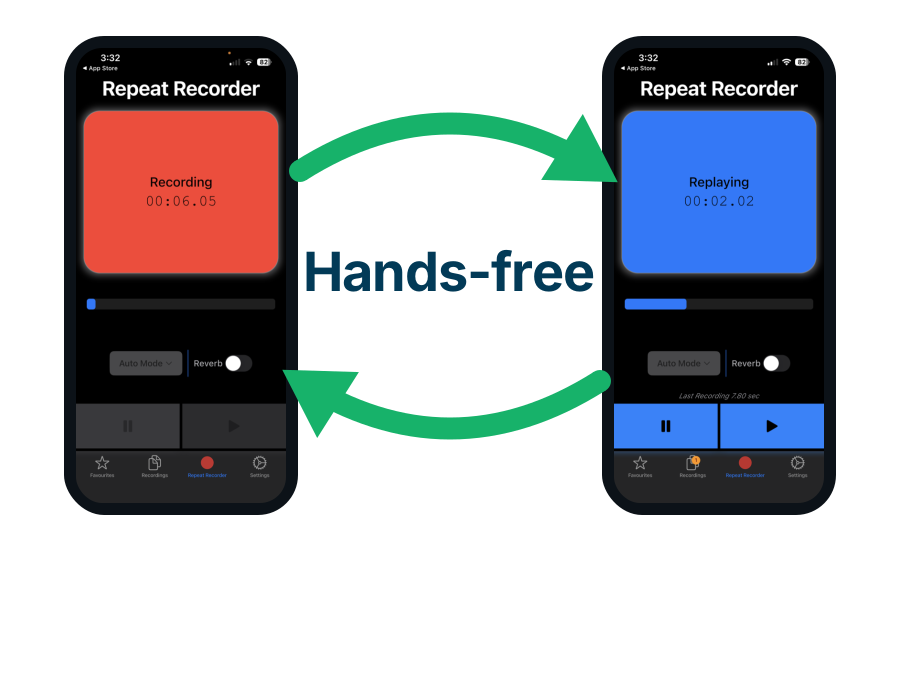
Use Repeat Recorder to rehearse the line before you film a video post
The section above says a picture or a video earns you almost nothing on its own, so if you are going to film yourself, the words have to carry it. Repeat Recorder, one of my own apps, plays a recorded phrase back to you on a loop so you can say it until it lands, without touching the screen.
- Repeat Recorder loops your recording hands free, so you can rehearse a first line while your hands are on the camera.
- You can slow the playback down, which is how you hear the words you are swallowing at the start of a sentence.
- Rehearsing the opening line matters most, because a reader tapping into your post scores 0.4 points and a video view only 0.05.

Never make a reader complain to X, because one complaint costs you the score of 468 likes
X gives every reader four buttons for getting rid of you. They can ask for less of your kind of post, they can mute you so your posts vanish from their feed without you ever knowing, they can block you so you cannot reach them at all, or they can report you, which is a complaint to X that your post breaks its rules. All four take points off, and the numbers are hundreds of times bigger than anything a like gives.
- One reader complaining to X about your post takes 234 points off it, the score of 468 likes.
- One reader hiding your posts from their own feed takes 58.8 points off, the score of 117 likes.
- One reader asking X for less of your kind of post takes 43.2 points off, the score of 86 likes.
- One reader blocking you takes 31.2 points off, the score of 62 likes, which makes blocking the gentlest of the four buttons.
- One annoyed reader costs you more than a hundred pleased ones, which is why begging for replies backfires.
- X stops paying creators who ask people to reply three or more times, on top of the ranking damage.

Understand what a repost is, because it puts your post in front of somebody else's followers
X calls this button a repost. Twitter called it a retweet, and the research below still uses that older word for the same thing.
- A repost is X's share button, and one tap copies your whole post onto somebody else's own page.
- Your name stays on the copy, so their followers see it as your post and can follow you straight from it.
- A repost and a quote post are the only two actions that put your post in front of people who have never heard of you.
- Reposting costs the person nothing and makes them look well informed to their own followers, which is why anybody bothers.
- A Reddit upvote is the opposite, because nobody ever sees who voted, so there is nothing in it for the voter.

Ask readers to repost your post, because the words "please repost" were proven to work
Almost every claim about tweet writing comes from comparing popular tweets with unpopular ones, which mostly measures who wrote them. One study got around that. Chenhao Tan, Lillian Lee and Bo Pang found 11,000 pairs of tweets where the same person shared the same link twice using different words, then asked which version got more reposts. Same author, same subject, so only the wording differs.
- The words "rt", "retweet", "spread" and "please" each raised the repost count against the same author's other wording.
- All four of those words held up when the researchers tightened the test to rule out luck, so they are not one loud account's good week.
- Writers already ask for reposts, adding the word "retweet" on 59% of second attempts.
- Asking for a repost works for anybody, because the study controlled for who wrote the post and what it was about.
- Asking works by naming the action you want, so "repost this if it saved you an hour" beats "thoughts?"
- Asking your own readers to repost one post is allowed on X, but swapping reposts with other accounts is banned as fake engagement, and so is repeating the ask three or more times.

Write a longer post and shape it like a news headline, because both beat the short version
The most repeated rule about tweet length turns out to be backwards once you control for who is posting.
- When the same person posted the same link twice, the longer post won more reposts, across all 11,000 pairs.
- More verbs, more nouns, more adjectives and more adverbs each raised the repost count on their own.
- Posts whose wording looked like a New York Times headline won more reposts.
- The old advice to keep a tweet between 71 and 100 characters comes from Buddy Media data that never controlled for who wrote the post, so it mostly measured that famous accounts write short.
- Adding filler words does not work, because what the study measured was more information and not more words.

Stop tagging accounts and stop writing the word "you", because neither one won a real test
Two habits everybody has are the two the controlled study found do nothing or worse.
- Tagging other accounts was the only wording in the study that significantly lowered the repost count.
- Writers still added more tags on 53% of second attempts, so people are actively making their posts worse.
- The word "you" had no measurable effect on reposts at all.
- Writers added more "you" on 57% of second attempts, the widest gap in the study between what people do and what works.
- Writing about other people did work, because the words "he", "she" and "they" raised the repost count.

Put a real name and a real number in the post, because both work and almost nobody adds them
These are the two easiest wins in the study, and they are easy precisely because everybody else skips them.
- Proper nouns raised the repost count, and writers added more of them on only 45% of second attempts.
- Numbers raised the repost count, and writers added more of them on only 48% of second attempts.
- Names and numbers are the widest gap in the study between what is proven and what people actually do.
- "11,000 pairs of tweets" beats "a lot of tweets" for the same reason "Chenhao Tan" beats "a researcher".
- A name and a number cost you characters you were not using for anything better.

Keep the words simple and the claim general, because plain and broad versions won the test
Four separate wording measures pointed the same way, and none of them is about being clever.
- Versions scoring higher on Flesch reading ease won more reposts, and reading ease is just a score for how easy a sentence is to read.
- Versions using "a" and "an" beat versions using "the", because a general claim fits into more conversations than a specific one.
- Wording that matched ordinary Twitter language won, measured against a model built from 558 million posts.
- Wording that matched the writer's own past posts also won, so a sudden change of voice costs you reposts.
- Sounding normal beat sounding distinctive on every wording measure the study tested.
Every wording finding above, as the version that loses and the version that wins.
| What you change | The version that loses | The version that wins | What the controlled test found |
|---|---|---|---|
| Asking for the repost | New piece on sleep. | New piece on sleep. Please repost it if it helps somebody. | Asking raised reposts |
| Length of the post | Interesting study on sleep. | A sleep study followed 4,000 shift workers for two years and found they lost 11 working days each. | Longer version won |
| Tagging other accounts | @alice @bob @carol you will want to read this. | Shift workers lose 11 working days a year to bad sleep. | Tagging lowered reposts |
| Writing the word "you" | You are losing 11 days a year to bad sleep. | Shift workers lose 11 days a year to bad sleep. | The word "you" did nothing |
| Naming a person | A researcher measured it. | Chenhao Tan measured it. | Names raised reposts |
| Using a number | Loads of tweets were tested. | 11,000 pairs of tweets were tested. | Numbers raised reposts |
| Shape of the sentence | so i read this thing about sleep last night and honestly wow | Bad sleep costs the average shift worker 11 days a year. | Headline shape won |
| General or specific claim | The mistake I made in 2019. | A mistake most new writers make. | General wording won |
| Reading difficulty | Sleep deprivation precipitates measurable cognitive degradation. | Losing sleep makes you think worse. | Easier to read won |
| Hashtags on the post | Bad sleep costs 11 days a year. #sleep #health #productivity | Bad sleep costs 11 days a year. | Hashtags did nothing |

Do not trust your own taste, because people pick the better of two tweets only 61% of the time
The same study asked real people to do the thing you do in your head every time you write a post.
- 106 people were shown pairs of tweets and asked which got more reposts, and averaged 61.3% correct.
- A coin flip scores 50%, so human judgement about which tweet will win is barely better than guessing.
- Eight of the 106 people scored below 50%, which means they did worse than a coin.
- A majority vote across many people reached 73%, so asking several friends beats trusting yourself.
- The researchers' own computer model reached 65.6%, beating the average person and still wrong a third of the time.
- Post both versions on different days instead of choosing between them in your head.

Write one high-energy feeling into the post, because awe and anger travel and sadness does not
Jonah Berger and Katherine Milkman measured every New York Times article published over three months and checked which ones got emailed on.
- Awe, anger and anxiety all made an article more likely to be passed on.
- Sadness made an article less likely to be passed on, even though it is a strong feeling.
- What separates anger from sadness is energy, not whether the feeling is pleasant.
- Positive articles were passed on more than negative ones overall, so anger is not a licence to be miserable.
- Berger and Milkman read every article published rather than asking people what they share, which is why it beats a survey.

Add one moral or emotional word, because each one raised the repost rate by 20%
William Brady and four colleagues read 563,312 posts about gun control, same-sex marriage and climate change, and counted the words.
- Each moral or emotional word added to a post raised how far it spread by 20%.
- Words that are both moral and emotional worked, and words that were only one or the other did less.
- Moral and emotional words stopped working at the edge of a political group, spreading strongly inside one side and weakly across to the other.
- A post that spreads hard inside your own political side never reaches anybody new, which is the trap in moral wording.
- One moral or emotional word is the dose, so a post stuffed with outrage words does not multiply the effect.
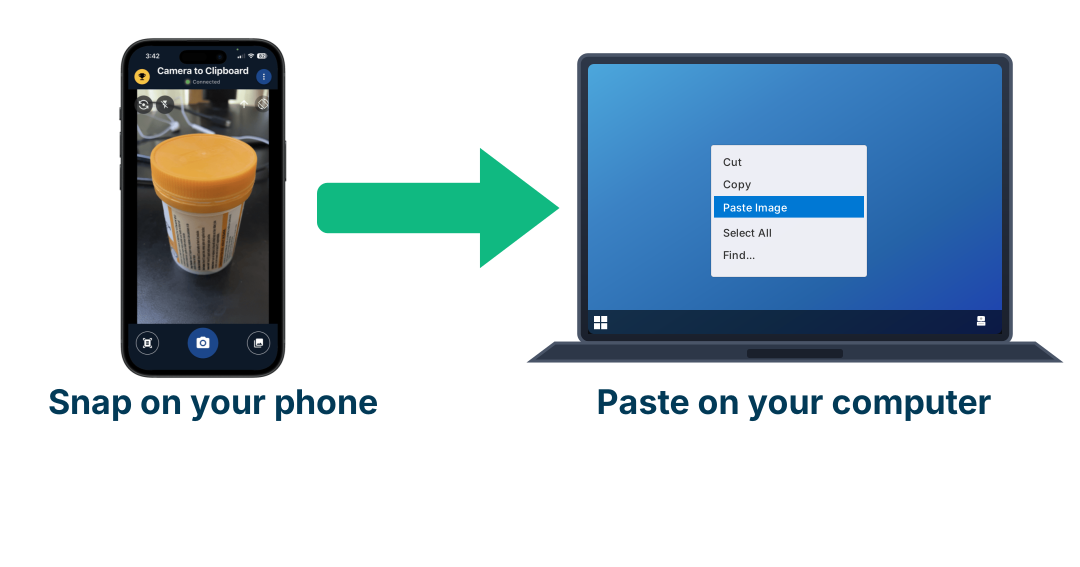
Use Camera to Clipboard to get a photo off your phone and into a post
If you write your posts on a computer, the photo you want is almost always on your phone, and emailing it to yourself is how a good post turns into tomorrow's post. Camera to Clipboard, another of my own apps, puts the photo straight onto your computer's clipboard so you can paste it into the post box.
- Camera to Clipboard sends a photo from your phone to your computer's clipboard, so you paste instead of emailing it to yourself.
- Camera to Clipboard works the same way for a screenshot, which is how most people quote somebody else's post.
- Getting the picture there in seconds matters because posts stop being eligible for X's small-account boost after 24 hours.

Know why naming an enemy works, because one out-group word raises the odds of a share by 67%
Steve Rathje, Jay Van Bavel and Sander van der Linden read 2,730,215 posts from news accounts and members of the US Congress. What they found is the strongest writing effect anybody has measured, and it explains most of what your feed looks like.
- Each word naming the group the reader dislikes raised the odds of the post being shared by 67%.
- Posts about the group readers dislike were shared about twice as often as posts about the readers' own group.
- Naming a disliked group was 4.8 times stronger than negative feeling and 6.7 times stronger than moral or emotional words.
- The out-group effect held on both political sides and on both Facebook and Twitter, so it is not one platform's fault.
- Naming an enemy is why X feels angry, because it is the wording that spreads fastest of anything measured.
- Naming an enemy brings you followers who arrived for the fight and leave when you write about anything else.
67% higher odds of a share, for every single word naming a group the reader dislikes. Measured across 2.7 million posts. It is the strongest known effect, and the worst one to build an account on.

Do not build the account on false claims, because false stories spread 70% more than true ones
Soroush Vosoughi, Deb Roy and Sinan Aral traced 126,000 news stories shared by 3 million people on Twitter over eleven years. The result is the single best argument for why the fastest-growing accounts are usually the ones that collapse.
- False stories were 70% more likely to be reposted than true ones.
- True stories took six times as long as false ones to reach 1,500 people.
- The top 1% of false stories reached between 1,000 and 100,000 people, and true stories rarely passed 1,000.
- Bots spread true and false stories at exactly the same rate, so the whole gap was made by people.
- False stories spread because they were new, not because they were false, which is the part you can copy honestly.
- A complaint takes off the score of 468 likes, so one reader reporting a false post wipes out its whole score.

Do not add a picture just to add one, because opening a photo scores a tenth of one like
Adding an image to every post is standard advice. X's own numbers say the image itself buys you almost nothing.
- A reader opening the photo on your post scores 0.05 points, a tenth of what one like scores.
- Opening your video scores 0.05 points, and watching enough of it to count as a view scores another 0.05.
- Every picture and video action on a post added together scores less than a third of one like.
- A picture earns its place by causing a reply, a quote or a send, not by existing.
- The share of a brand's followers who interact with each post fell from 0.15% in 2024 to 0.10% by mid 2026, measured by Socialinsider across 70 million posts, so no format is rescuing anybody.

Delete the hashtags and put the link back in the post, because X changed both rules
Two pieces of standard advice went out of date and most guides have not caught up.
- Hashtags had no measurable effect on reposts once the study controlled for who posted and what the post was about.
- Elon Musk asked people to stop using hashtags in December 2024, saying the system no longer needs them.
- X's ranking model now reads the words of your post directly, so a hashtag adds nothing it cannot already see.
- Links used to cost you badly, and one analysis of X's January 2026 model found posts with links got 94% fewer views.
- Musk said on 29 July 2026 that the link penalty had already been gone for over a year, and X's head of product told people to stop hiding links in the first reply.
- A reader opening your link scores 0.2 points, which is a plus and not a minus, so a link people actually open now helps you.

Do not chase one viral post for followers, because 126,000 views produced 280 followers
Tyler Hakes published every number from two months of trying to grow an account, including the post that took off.
- Tyler Hakes's post reached 126,000 people and produced 280 new followers.
- Of the 126,000 people who saw that post, 10,000 opened his profile, which is 8% of them.
- Of the 10,000 people who opened his profile, 280 followed him, which is 3% of them.
- The same writer sent 1,200 people to his profile from a Reddit post and 194 of them followed, which is 18%.
- Sending people over from Reddit turned visitors into followers six times more efficiently than going viral on X did.
- A profile visit scores 0 points, so a post that sends thousands of people to look at you earns you no extra reach for it.

Every tactic in this guide ranked by the evidence behind it
Green means the evidence is a controlled experiment or X's own published code. Amber means one large dataset that watched rather than tested. Red means one account's numbers.
| What to do | Where the evidence comes from | Size of the effect | What it costs you |
|---|---|---|---|
| Follow back people who reply to you | X's own ranking code | Their reply goes from 5 points to 20 | A few minutes a day |
| Reply to other people more than you post | X's own ranking code | A reply scores the same as 10 likes | A daily habit |
| Write posts people paste into a group chat | X's own ranking code | A copied link scores the same as 40 likes | Changes what you write about |
| Post originals while under 1,000 followers | X's own ranking code | A free slot at feed position 15 | Nothing at all |
| Post once instead of ten times | X's own ranking code | Second post cut to half, rest to a quarter | Nothing but discipline |
| Never make a reader complain or hide you | X's own ranking code | A complaint takes off the score of 468 likes | Nothing at all |
| Ask people to repost it | 11,000 controlled pairs of tweets | Raised reposts, strictest test passed | A few characters |
| Write the longer, more informative version | 11,000 controlled pairs of tweets | Raised reposts | Nothing at all |
| Put a real person's name in the post | 11,000 controlled pairs of tweets | Raised reposts | Nothing at all |
| Put a real number in the post | 11,000 controlled pairs of tweets | Raised reposts | You need a real fact first |
| Shape the sentence like a news headline | 11,000 controlled pairs of tweets | Raised reposts | A rewrite every time |
| Make the post easy to read | 11,000 controlled pairs of tweets | Raised reposts | A rewrite every time |
| Stop tagging other accounts in the post | 11,000 controlled pairs of tweets | The only wording that lowered reposts | Nothing at all |
| Add one moral or emotional word | 563,312 posts, published in PNAS | 20% more spread per word | It stays inside your own side |
| Use awe, anger or worry rather than sadness | Every New York Times article for 3 months | Raised sharing | Depends on your subject |
| Name a group your readers dislike | 2,730,215 posts, published in PNAS | 67% higher odds of a share per word | Followers who came for a fight |
| Drop the hashtags | 11,000 controlled pairs of tweets | No effect either way | Nothing at all |
| Add a picture to every post | X's own ranking code | An opened photo scores 0.1 likes | Time you could have spent writing |
| Chase one viral post for followers | One account's published numbers | 280 followers from 126,000 views | Weeks of chasing |

Conclusion: how to write a viral tweet and get followers, in one glance
Write posts to be replied to, not liked. These six are ordered by how large the measured effect is, and the table above holds the rest.
- Follow back everyone who replies to you, because their reply then scores the same as forty likes.
- Reply to other people more than you post, because one reply scores the same as ten likes.
- Write posts people paste into a group chat, because a copied link scores the same as forty likes.
- Post original posts while you are under 1,000 followers, because X saves you a slot at position 15 of a stranger's feed.
- Ask people to repost it, and put a real name and a real number in it, because all three won a controlled test.
- Never make a reader complain to X about your post, because one complaint costs you the score of 468 likes.