
Plenty of people do not want their face on the internet. They still want to teach a language, explain a piece of tech, or narrate something worth hearing. The usual advice is that YouTube punishes you for hiding, that the algorithm wants a human, and that faceless channels are stuck at a low ceiling. Almost none of that survives contact with the actual numbers, and the numbers that get quoted at you are, in a way I did not expect, mostly invented.
Short answer: yes, and the ceiling is far higher than you think. One creator reached 30.6 million subscribers with his face never shown, and a video from that period passed 113 million views. The largest confirmed faceless channel outside kids and music content has 80.6 million subscribers. Facelessness is not the constraint. Your niche is, and so is the fact that 85% of all YouTube views go to 3% of channels whether they show a face or not.
Faceless channels can reach around 80 million subscribers
The question is usually asked as though faceless is a handicap you work around. It is more useful to look at where the format actually tops out, because the answer is not modest:
- The largest confirmed faceless channel outside kids and music has 80.6 million subscribers. 5-Minute Crafts, started 15 November 2016, has 28.56 billion lifetime views across 8,290 videos. Wikipedia describes the format directly: a top-down camera on a solid-colour surface where only a person's hands appear in frame.
- At least twelve faceless channels sit above 20 million subscribers. Bright Side (44.6M), Alan Becker (33.8M), Zack D. Films (27.9M), WatchMojo (25.8M), Kurzgesagt (25.4M), TED-Ed (22.8M), TheOdd1sOut (20.8M) and Daily Dose of Internet (20.7M) among them.
- The highest view total belongs to a channel that started in 2021. Zack D. Films has 73 billion lifetime views from animated Shorts, having launched on 7 June 2021. Shorts inflate lifetime totals, so this is not directly comparable to a long-form channel, but the scale is real.
- A faceless channel has gone from nothing to 37 million subscribers in about ten months. DaFuq!?Boom!, the Skibidi Toilet channel, posted its first episode on 7 February 2023 and was at 37 million by December 2023. Its creator does not appear on camera. It was the most-viewed channel in the US in June 2023.
- Faceless explainers work, and Kurzgesagt has 25.4 million subscribers to prove it. Kurzgesagt is at 25.4 million subscribers and 3.78 billion views from only 376 videos, with no human faces shown at all.
80.6M subscribers on the largest confirmed faceless channel outside kids and music content. Facelessness is not what caps a channel.
One hidden-face creator reached 30 million subscribers
Most faceless success stories are hard to verify, because you are trusting someone's description of a format. One case avoids that problem entirely, because the transition date is public and was covered by mainstream press:
- Dream reached 30.6 million subscribers before anyone had seen his face. He began uploading regularly in July 2019 and revealed his face on 2 October 2022, a reveal covered by CNN. Everything before that date is unambiguously faceless.
- One video from the faceless period passed 113 million views and holds a Guinness World Record. "Minecraft Speedrunner VS 3 Hunters GRAND FINALE" had surpassed 113 million views by July 2022, months before the reveal. Wikipedia separately records the most-viewed video in that series at 135 million as of April 2025.
- A nine-figure organic view count from a faceless creator settles the question. A nine-figure organic view count, on a non-music non-kids video, from a creator nobody could identify. Whatever else is true about faceless channels, "they cannot go viral" is not.
- The face-reveal video drew 21.9 million views, which is its own kind of proof. The face-reveal video drew 21.9 million views and 2.5 million likes inside a day. The anonymity was an asset that could be spent, not a debt being carried.
If you only remember one data point from this article: a creator nobody could identify put up a video that passed 113 million views, and Guinness recognised it. The format did not stop him. It arguably helped.
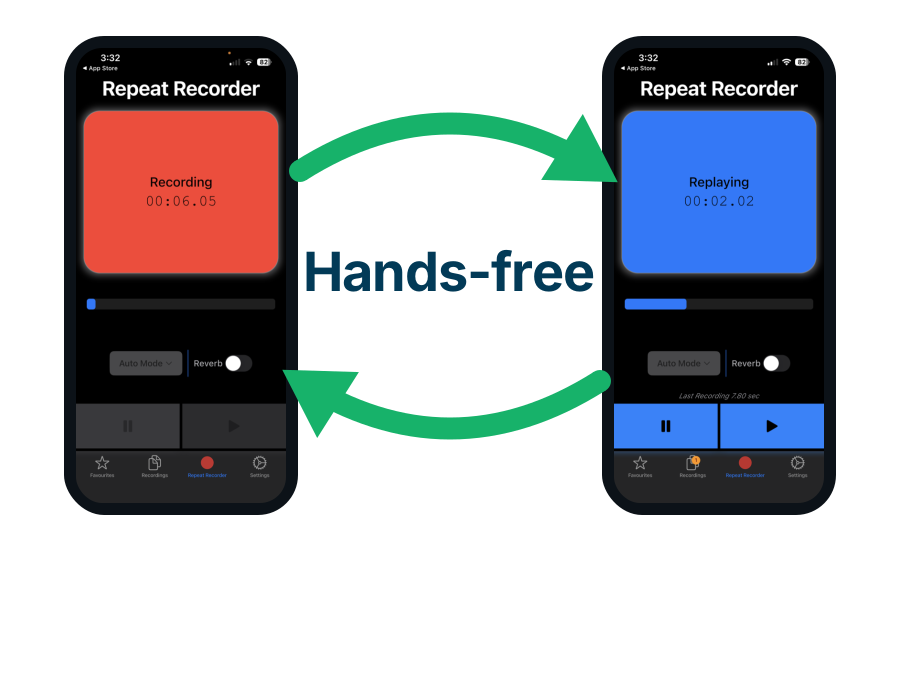
Use Repeat Recorder to practise a faceless channel voiceover
Dream reached 30.6 million subscribers before anybody had seen him, which means the only person in those videos was a voice. That is the part of a faceless channel that gets the least practice and carries the most weight, because with the face gone there is nothing else to carry it. Repeat Recorder, one of my own apps, records you, plays the take straight back, and starts recording again without you touching the phone.
- Repeat Recorder replays each take on its own and then starts recording again, so you can say the same line twenty times without picking the phone up. That is the entire app. It was built for language practice, speech rehearsal and vocal training, and narrating a video you will never appear in is the same job with different words.
- Kurzgesagt has 25.4 million subscribers with no human face on screen anywhere, so on a faceless channel the narration is the whole performance. Hearing your own opening line played back is what catches a flat delivery, and a flat delivery is the one thing a faceless video cannot hide behind a presenter.
- Takes worth keeping go into favourites and into folders you name yourself, so two readings of the same script sit next to each other. Recording a line twice and picking the better one takes about a minute, and there is adjustable reverb if you want to hear how the same take sounds in a different space.
Where faceless works and where it hits a wall, niche by niche
The real answer is not "faceless works" or "faceless does not work". It varies enormously by what you are making, and in two niches it fails badly.
| Niche | Does faceless work? | Biggest faceless channel found | Face-led comparison | What actually decides it |
|---|---|---|---|---|
| Animation and animated comedy | Yes, dominant, the format has no alternative | Alan Becker, 33.8M, plus TheOdd1sOut 20.8M | Not applicable, animation is its own category | Craft and character. Faceless comedy works through animation, never through voiceover over stock footage |
| Science and education explainer | Yes, strongly | Kurzgesagt, 25.4M, and TED-Ed 22.8M | Veritasium 21.1M, Vsauce 25.0M, roughly level | Nothing. This is the one niche where face and no-face reach the same ceiling |
| List, curation and trivia | Yes, it is the native format | WatchMojo, 25.8M, Daily Dose of Internet 20.7M | No large face-led equivalent | Volume. WatchMojo has published over 33,000 videos |
| Horror and true-crime narration | Yes, comparable per video | Mr. Nightmare, 7.12M from 584 videos | MrBallen 11.1M from 854 videos | Roughly a wash. A voice carries this genre as well as a face does |
| Geography, geopolitics, logistics | Yes | RealLifeLore, 7.93M, Wendover 4.91M | Johnny Harris 7.88M, almost identical | Nothing measurable. The two are neck and neck |
| History | Yes, but tops out lower | Kings and Generals, 4.17M | Comparable range | Topic depth. The audience is smaller for everyone |
| Tech and programming | Yes, at 8.5M, but the format matters more | 3Blue1Brown, 8.51M, Fireship 4.24M | NetworkChuck 5.34M, Linus Tech Tips 16.9M | Pacing, not face. Entertainment-paced faceless beats tutorial-paced anything |
| Language learning | Poorly, the widest gap in the data | Refold, 31.9K after 336 videos | Language Simp 1.66M from 233 videos | Personality, and possibly gesture. This is the weakest niche for faceless |
| Beauty | No large example found | Nail Career Education, 2.86M, and its host does appear | James Charles 23.7M, NikkieTutorials 15.3M | The result is the demonstration on a human face |
| Fitness | Structurally impossible | None found at any size | Chloe Ting 26.1M | The format requires a visible body performing the movement |
| Vlogging | Excluded by definition | None | The entire category | A vlog is a person's life. There is nothing to film without them |
Most big faceless channels still put a human body on screen
This is the finding that complicates the cheerful version of the story, and it is worth knowing before you commit to a format:
- 5-Minute Crafts (80.6M) shows hands. The whole format is a pair of hands working on a coloured surface.
- Zach Choi ASMR (33.7M, 15.45 billion views) shows a mouth and hands. No full face, but unmistakably a person.
- Tasty (21.3M) is overhead hands-only cooking. Same pattern.
- This Old Tony (1.22M) and Clickspring (690K) are hands plus voice, both anonymous machinists, both built entirely on watching human hands do skilled work.
The channels that show nothing human tend to be animation studios rather than individuals: Kurzgesagt, Alan Becker, TheOdd1sOut, Jaiden Animations, 3Blue1Brown. That is a real pattern and it points somewhere useful: a hand is not a face, and a hand may be enough. If your concern is being personally identifiable rather than being seen at all, filming your hands over a keyboard or a notebook costs you nothing in privacy and puts a human back in the frame.
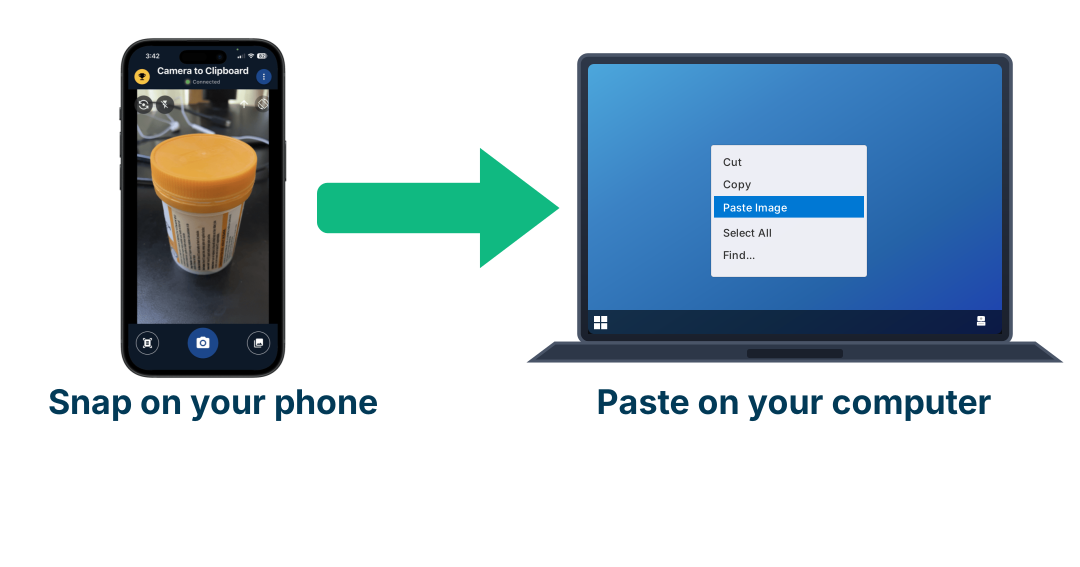
Use Camera to Clipboard to put hand photos into your video
If a hand is enough to put a person back in the frame, the pictures you need are of your own hands, your desk and whatever you are holding, and your phone already takes better close-ups of all three than most cameras. The awkward part is never taking the photo. It is getting the photo off the phone and into the thing you are editing in. Camera to Clipboard, another of my own apps, turns that into a single step.
- A photo you take inside Camera to Clipboard is ready to paste on your computer the moment you take it. There is no emailing it to yourself, no cable and no upload to somebody else's website in between. The phone and the computer find each other over your own network and send the picture directly.
- 5-Minute Crafts built 80.6 million subscribers out of a pair of hands on a coloured surface, which is a phone camera pointed at a table. Pasting one of those shots into Photoshop or GIMP drops it in as a new layer, and Word or Google Docs takes it inline, because it arrives as an ordinary picture on the clipboard rather than a file you have to go and find.
- You can send several photos at once out of your phone's library, so every version of the same hand position arrives together. That is the version of this you want after shooting one object six times, when the only way to choose is to see all six side by side on the big screen.
Faceless is two businesses and only one is a person with a laptop
Averaging "faceless channels" together produces nonsense, because the category contains two populations that have nothing in common. Compare views per video:
- Primer: 1.94 million subscribers from 24 videos. Roughly 4.1 million views per video.
- Sam O'Nella Academy: 4.81 million subscribers from 67 videos. Roughly 11.4 million views per video.
- Kurzgesagt: 25.4 million subscribers from 376 videos. Roughly 10.1 million views per video.
- Am I the Jerk?: 1.21 million subscribers from 8,380 videos. Roughly 93,600 views per video, about 120 times worse than Sam O'Nella.
Low-volume, high-craft faceless channels match or beat face-led channels per video. High-volume content farms do not. They are both "faceless" and that word is doing no useful work.
The second thing worth knowing is what the very top of the faceless market actually is:
- 5-Minute Crafts and Bright Side are owned by the same company. TheSoul Group, founded 2016 and headquartered in Cyprus, went from 550 employees in 2019 to 2,100 in 2021, publishing 1,500 videos a month across 100 brands in 19 languages.
- Kurzgesagt takes about 1,200 hours per video by its own account, with a team of roughly 70 people, and its narration is a hired voice actor rather than the founder.
- WatchMojo runs on named hired narrators and had 100 employees as of 2020.
- Zack D. Films runs a team of about 60 at 1,000 to 3,000 dollars per video.
The biggest faceless channels are not private people avoiding the camera. They are content factories where no single person's face makes sense as the brand. That is a completely different business from yours, and their numbers are not a forecast for you.
Going viral is rare for everyone, with or without a face
Before optimising for the face question, it is worth seeing the size of the effect you are arguing about, because the background failure rate dwarfs it:
- 85% of all YouTube views go to 3% of channels. From a peer-reviewed random-sample study of 19,025 channels and 5.59 million videos. For 2016 alone the figure was 89%.
- The median YouTube video in that sample got 89 views. Not 89,000. Eighty-nine.
- Only about 0.13% of channels ever reach a million subscribers, and roughly 1.3% reach 100,000, based on a mid-2026 index of 61 million channels. A separate index puts the 100,000 figure a bit lower, so treat the range as 600,000 to 800,000 channels worldwide at 100k and 75,000 to 80,000 at a million.
- A peer-reviewed crawl found 0.04% of channels above a million subscribers, and those channels held 37% of all subscribers and 37.4% of all views from just 2.3% of the videos published.
- Below the monetization threshold, the average channel has 122 subscribers.
89 views the median YouTube video in a peer-reviewed random sample. The base rate is brutal for everybody, with or without a face.
There is one variable with genuinely large-scale evidence behind it, and it is not facelessness. A study of 10.2 million channels over a twelve-month window found upload frequency tracks growth cleanly:
- Under one upload a month: 0.00% median subscriber growth. Not slow growth. Zero.
- One to three uploads: 0.10%. Four to seven: 0.39%. Eight to eleven: 0.63%.
- Twelve or more uploads a month: 0.91% median subscriber growth, roughly 11.5% a year.
- The study's own caveat is that this is correlation, not causation. Worth repeating, because it is usually dropped when this table gets quoted.
This is the strongest honest argument for faceless production: it is faster to make, and cadence is the thing that has real evidence behind it. But note that is an inference, not a measurement. Nobody has measured it directly.
How many uploads a viral video actually costs
There is no credible data anywhere on how long it takes to reach a subscriber milestone. The "15.5 months to 1,000 subscribers" figure that circulates traces back to a citation loop with no study at the end of it. What does exist is uploads to milestone, from a sample of 5.3 million channels that reached 1,000 subscribers:
- Only 5.77% got there in five videos or fewer.
- Fewer than 10% did it in under ten videos.
- 68% needed more than 40 videos. Nearly 31% needed more than 150.
The blunt read: a plan that assumes 1,000 subscribers inside ten videos is a plan to be an outlier. Most channels that got there at all needed more than 40, and the cadence data above says the fastest legitimate way to get through them is to publish more often.
The AI crackdown targets slop, not real explainer channels
There is a widespread fear that YouTube has turned against faceless channels. The policy record does not support it, and the detail matters if you are about to invest a year in this:
- On 15 July 2025 YouTube renamed "repetitious content" to "inauthentic content". The rule requires content "not be mass-produced, generic, repetitive, or manipulative", and bans "AI-generated content made with generic or unoriginal templates giving the impression of mass production".
- YouTube explicitly called it a clarification, not a new rule. Creator Liaison Rene Ritchie: "This is a minor update to YouTube's long-standing YPP policies." The policy page adds that such content "has always been ineligible for monetization".
- YouTube has never used the word "faceless" in any of it. The rules are written around templates, mass production and interchangeable episodes. Anyone telling you YouTube blessed or banned faceless channels is paraphrasing something that was never said.
- YouTube says channels using AI in their content stay eligible for monetisation. Ritchie again: "channels that use AI in their content remain eligible for monetization". Script generation, outlines, thumbnails and titles are all exempt from disclosure, and so is cloning your own voice for narration.
- The July 2026 follow-up named three targets, none of which is facelessness: template-based repetitive content, content engineered to distress, and AI personas discussing finance, legal or medical topics. YouTube's VP of Trust and Safety opened with "I'm not here today to announce any kind of a new policy."
One genuine absence is worth stating plainly, because it cuts both ways: no named legitimate faceless channel has been publicly documented as demonetized under this policy. Not one, in any credible source. The panic is unevidenced. Equally, no named faceless channel has publicly confirmed it was fine either.
Use Repeat Recorder to keep a real human voice on your channel
The rule YouTube actually wrote is against mass-produced, generic and interchangeable episodes, and the safest distance you can put between your channel and that description is a voice that is unmistakably one person doing the talking. Narrating it yourself is also the cheapest of the differences, since it costs nothing but the practice. Repeat Recorder, one of my own apps, plays each take straight back and starts recording again without you touching the phone.
- Recording yourself is the one part of a faceless video that no template produces for you. YouTube's inauthentic content rule is aimed at generic templates and mass production, and it has never used the word faceless. A script you read out in your own voice is the opposite of the thing being described.
- Repeat Recorder plays each take back on its own and then starts recording again, so a script can be run line by line without touching the phone between takes. That is the entire app, and it was built for language practice, speech rehearsal and vocal training rather than for video, which is why it does nothing except loop you back to the start.
- 68% of channels needed more than 40 videos to reach 1,000 subscribers, so narration has to get faster to survive that many. Folders you name yourself and a favourites list are what stop take nine of episode twelve from being lost, and finding a line you already recorded well beats recording it a tenth time.
You should do it if privacy is why you are hiding
Pulling the evidence together for the specific case of someone who wants to teach without being identifiable:
- Yes, if you are making tech or science explainers. This is the best-supported case in the data. 3Blue1Brown at 8.51M, Fireship at 4.24M, Kurzgesagt at 25.4M. Face-led tech channels do not systematically beat them.
- Be realistic if you are making a language channel. This is the weakest niche in the whole dataset for faceless, and the gap is large. Consider hands, gesture, or an illustrated persona rather than pure voice-over-slides.
- Step-by-step screencast channels plateau under 2.5 million subscribers. Step-by-step screencasts plateau under 2.5 million subscribers whether or not a face is present. Entertainment pacing is what breaks through, and it is fully compatible with staying hidden.
- Showing your hands costs no privacy and nearly every large faceless format does it. The largest faceless formats nearly all do, it costs you no privacy, and it puts a human back on screen.
- Publishing often is the only variable with large-scale evidence behind it. Cadence is the only variable with large-scale evidence behind it, and it is the one faceless production is best at.
- Do not model yourself on 5-Minute Crafts. That is a 2,100-person company publishing 1,500 videos a month. Model yourself on Primer: 24 videos, 1.94 million subscribers, one person's craft.
The second half of this question, what you actually give up by staying off camera, has its own article with the itemised costs: how much am I losing if I don't put a face in a YouTube explainer video? It covers what roughly 100 controlled studies found about faces and attention, the thumbnail question, and the one real cost of anonymity that nobody warns you about.
Conclusion: your subject limits a faceless YouTube channel, not your face
- Faceless YouTube channels are two unrelated businesses sharing one name, a single person with a laptop and a content factory with hundreds of staff. 5-Minute Crafts and Bright Side belong to a company that grew to 2,100 employees publishing 1,500 videos a month, while Primer built 1.94 million subscribers from 24 videos, so the biggest numbers are not a forecast for one person working alone.
- Dream reached 30.6 million subscribers before anybody had seen his face, and one video from that period passed 113 million views. He revealed his face on 2 October 2022, so everything before that date was unambiguously faceless, and the video holds a Guinness World Record. The largest confirmed faceless channel outside kids and music content has 80.6 million subscribers.
- Publish more often and put your hands on screen, because how often you post is the one thing in this question with large-scale evidence behind it. The typical channel posting twelve or more videos a month grew its subscriber count by 0.91% a month, against 0.00% for a channel posting less than once a month, and that is a pattern rather than proof. Nearly every large faceless format shows hands, and hands cost you no privacy.