
This is the growth advice you hear most often: post Reels and Shorts, the algorithm shows them to strangers, and those strangers become followers. The first half is true and confirmed on every surface. The second half is where it quietly falls apart, and that is the half that decides whether the hours pay off. This is one section of a larger piece; the full comparison table puts all nine channels side by side.

Short-form reaches strangers but converts almost none of them
This is the growth advice you hear most often right now: post Reels and Shorts, the algorithm shows them to people who do not follow you, and those strangers turn into followers. I wanted to know if the second half is true, because it is the half that decides whether the hours pay off. The short answer from the data: the reach is real and confirmed, and the conversion is where it quietly falls apart.
The reach to non-followers is real on every surface
Start with the good news, because it is genuinely good. Unlike a Facebook Page or an Instagram feed post, short-form video is built to be shown to strangers:
- YouTube Shorts: about 74% of views come from non-subscribers. The Shorts feed is a discovery feed, not a subscription feed, and it seeds each new Short to a small test pool of strangers before deciding how wide to push it.
- Instagram Reels: around 55% of views come from non-followers, with roughly 47% arriving from the Explore and recommendation surface rather than the feed. Reels is the only Instagram format that systematically reaches beyond your existing audience.
- Facebook Reels: the one Facebook format that reaches strangers at scale. While a Facebook Page reaches about 1.4% of its own followers, Facebook Reels pulls roughly 140 billion plays a day across Meta and grew about 45% year on year, the fastest-rising format on the platform. A near-dead Page and a fast-growing Reel can live on the same account.
- All of them ignore follower count for distribution. A brand-new account with almost no followers can have a single video pushed to hundreds of thousands of people, because each video is judged on its own early engagement, not on the size of your audience.
So the thing you heard is true: short-form genuinely shows you to people outside your audience, on all four surfaces (Shorts, Reels, Facebook Reels and TikTok). That is not the myth. The myth is what happens next.
A million views buys a few hundred followers, not a million
Here is where the pitch and the data part ways. Being seen by a stranger and gaining a follower are two different events joined by a very leaky funnel:
- View-to-follower conversion is roughly 0.1% to 2% of views, and the low end is far more common. A million views is commonly a few hundred to a few thousand followers, nowhere near a million.
- Views become profile visits at 0.33%, and only then become follows. Views become profile visits at roughly 0.33%, and profile visits become follows at roughly 19%. Most viewers never even tap through to your profile, because the feed is built for lean-back watching, not for curating a follow list.
- Even your own followers barely see you. Benchmark data puts brand follower growth at about 2% a month, and each video reaches only about 13 to 22 viewers per 100 followers. The algorithm serves individual videos to whoever likes that clip, giving them no particular reason to follow the account behind it.
- "Viral but no follower growth" is the norm, not a malfunction. A documented Instagram case saw a Reel hit 100,000 views while the account crept from 250 to 700 followers over six months. The view counter and the follower counter are simply different numbers.
The simulator below makes the leak concrete. Put in a view count, pick a surface, and toggle whether your profile is barebones or optimised, then watch how little of that reach turns into followers or clicks.
The followers you do get are often low quality
It gets one notch worse: not every follower a short earns is worth the same. This is best documented on YouTube, and it is worth being precise about, because two different things get muddled here:
- Subscribing and getting recommended are not the same thing. Yes, a viewer can tap subscribe on your Short and become a channel subscriber, that part works exactly as you would expect. The catch is that subscribing does not decide what YouTube shows them next. The home and suggested feeds are picked by an algorithm, not by your subscriber list, so a person who subscribed from a Short mostly keeps being served more Shorts, because Shorts are what they watched. A subscriber count pumped up by Shorts can therefore be nearly inert for your long videos.
- That is what "YouTube split the two algorithms in 2025" means. YouTube runs one recommendation system for the Shorts feed and a separate one for long-form (home, suggested and search). They used to share signals, so a viral Short could spill some of its viewers over into your long videos. Since 2025 the two are more separated, so watching, or even subscribing from, a Short no longer nudges the long-form system to start recommending your long videos to that person. Nothing is "pushed from a short into a long video"; it is about which system decides to recommend you, and to whom.
- So the hand-off has to be built by you, not the algorithm. "Engineered by hand" simply means you build the bridge yourself: use YouTube's built-in feature that links a Short to a longer video, say out loud where to find it, or make Shorts that are teasers of a longer piece. You cannot just drop a clickable link, because YouTube stripped clickable links out of Shorts descriptions and comments back in 2023 to fight spam (unlike long-form videos, where description and comment links still work). Left alone, a Shorts audience stays a Shorts audience, and even the built-in video link converts at only about 1% to 3%, so most Shorts viewers never make the jump.
- The lesson generalises to every platform. A follower won by a random entertaining clip followed the clip, not you. Whether they ever buy, click through or come back is a separate question the view count cannot answer.
A niche, a series and a reason to follow close the gap
None of this means short-form cannot grow you. It means growth comes from deliberately closing the reach-to-follower gap, and the levers that work are specific:
- An episodic follow-for-part-two series is the strongest way to convert views to follows. Episodic "follow for part two" content reframes the follow as a transaction for the ending, and it is the most reliable way to convert a one-time viewer into a follower.
- A narrow niche answers the viewer's question of what they get by following. Both the algorithm and the viewer need an obvious answer to "what do I get if I follow?". One-off virality across unrelated topics is the classic high-views, no-followers trap.
- Asking for the follow in the video and caption measurably lifts follows. Asking, in the video and the caption, measurably lifts follow-through over hoping people work it out for themselves.
- Profile optimisation is the cheapest multiplier you have, and it is not about your follower count. When a video makes someone curious, they tap your name and land on your profile page, and how that page is set up decides whether they follow or just leave. A barebones profile (a vague or empty bio, no pinned or first video that shows what you do, no obvious niche, no working link) converts about 0.2% of the people who saw your video. An optimised one (a one-line bio that says exactly what you offer, a strong pinned or first video, an obvious niche, some social proof, and a link that works) converts around 2%, roughly 10 times better on the same reach. It is about how the page is built, not how many followers it already has, and fixing it is a bigger lever than chasing more views.
Cross-posting is near-free reach if you strip the watermark
Because the surfaces do not talk to each other, the same short can run everywhere, which is the one genuine efficiency in the whole game:
- There is no cross-platform duplicate penalty. TikTok, Shorts, Reels and Facebook Reels cannot see that your clip exists elsewhere, so posting one video to all four multiplies reach for almost no extra work.
- But watermarks are penalised, and this is the real trap. Instagram makes non-Instagram-watermarked content ineligible for recommendation, and the others demote rival watermarks too. Always export the clean, watermark-free master and add captions natively on each platform.
- Instagram now excludes accounts posting ten or more reposts in thirty days. Instagram now excludes accounts posting ten or more reposts in thirty days from recommendations, identical copy-pasted captions depress engagement, and TikTok audio is not licensed to Meta, so a borrowed TikTok sound limits a Reel's reach.
- One identical clip pulled 200,000 views on TikTok and 27,800 on Instagram. One identical video pulled about 200,000 views on TikTok and 27,800 on Instagram Reels. Cross-post everywhere, but do not expect the platforms to agree on what is good.
Organic short-form is the weakest link for getting clicks
If your actual goal is clicks and customers, not vanity views, this is the part to be honest about:
- Short-form has no clickable mid-video link, so off-platform traffic stays low. No clickable link mid-video, the bio-link tax, and a passive audience mean off-platform clicks convert far worse than the view count implies. The drop from "a million organic views" to "people actually arriving on your site" is where most disappointment lives.
- The credible conversion wins are paid, not organic. Native, creator-style videos out-convert polished brand ones by roughly 3.4 times, and video campaigns routinely cut the cost per action well below static ads, but those are in-feed ads with a real click-through button that organic posts do not have.
- Judge organic short-form on niche audience growth, not on clicks out. The honest deliverable of organic short-form is a small, compounding niche audience plus the occasional conversion spike from a video that over-indexes, not a linear machine where views translate into customers.
Short-form reach is real and cheap. Short-form followers and customers are neither automatic nor proportional to the views. It is worth it as a six-to-twelve-month compounding bet if you post a niche series consistently, fix your profile, cross-post clean masters and judge it on clicks and conversions. It is a treadmill if you chase one-off virality and read the view counter as growth.
The four short-form surfaces, side by side
| Surface | Reach to non-followers | View to follower | Reach trend (is organic reach rising or falling over time?) | Link friction | Clickable link in comments? | Best for |
|---|---|---|---|---|---|---|
 YouTube Shorts YouTube Shorts | ~74% non-subs | ~0.3 to 0.8% | Scaling fast | High, no clickable link from a Short itself; only buried channel-page links | No, removed from Shorts in 2023 (plain text) | Reach, and a funnel into long-form |
 Instagram Reels Instagram Reels | ~55% non-followers | Low, content-led | Falling ~35% YoY | Highest, no comment or caption links; one bio link, and link posts get suppressed | No, never clickable, plain text (bio link only) | Brand and aesthetic discovery |
 Facebook Reels Facebook Reels | High, main FB discovery | Low, content-led | Rising ~45% YoY | Lowest, a clickable link sits right in the first comment | Yes, clickable, and Meta suggests link in first comment | Near-free upside from IG cross-posts |
 TikTok TikTok | Highest, ignores followers | Low, best follow intent | Small accounts -23% YoY | Medium, no comment links; bio link only, and it opens an in-app browser | No, not clickable, plain text (bio link only) | Cheapest cold reach from zero |
On that reach-trend column: where reach is falling (Instagram Reels, and small TikTok accounts) it is mainly because the amount of content being posted is growing faster than the audience is, so the same reach now gets split across far more videos. It is not that either platform is losing users, both are stable to growing. Instagram tightening its algorithm against reposts and low-effort clips adds to it, but oversupply is the main driver.
~34,000,000 videos uploaded to TikTok every single day (roughly 400 every second), all competing for the attention of about 1 billion daily viewers who each watch only around a hundred clips a day (about 92 on average, heavier users more) before they put the phone down. And a new post is not just up against today's 34 million, it competes with the entire back-catalogue the algorithm can resurface. The supply of content grows far faster than that fixed pool of attention, which is why any single post's odds of being shown are tiny, and why "just post more" stopped working.
Non-follower reach figures are widely cited but mostly vendor-sourced, so treat them as directional. There is no reliable published view-to-follower benchmark for any of these surfaces, which is itself part of the point: the reach is measured and promoted, the conversion quietly is not.
Say the link out loud when you cannot post it
Since a clickable link only really works on Facebook Reels, here is what actually gets people off the other three, and none of it risks a ban. The key thing to understand is that only the clickable link is blocked, everything below is allowed:
- A plain, typeable short URL is fine, not banned. A clickable link is stripped, but a plain-text branded short link like go.yourbrand.com can sit in the caption or first comment for people to type. Keep it to one clean mention (it is spammy, repeated URLs that trip the spam filters, not a single tidy one), and say it out loud in the video so it sticks. The "any link kills your reach" idea is mostly a myth: Instagram's own head has said a call to action like "link in bio" does not change reach either way.
- Naming your brand or app is completely safe, and it helps. Brand and app names carry no penalty at all. On Instagram, captions now double as search keywords, so naming yourself actually makes you easier to find rather than harder.
- "Search [name]" is the lowest-risk move of all. Telling people to search your brand on Google, or your app by name in the App Store or Google Play, uses no link whatsoever, so there is nothing for the off-platform-link suppression to bite on, and it works with the algorithm's keep-them-on-their-own-search preference. For an app this is usually the best option, because the store search does the work for you.
- TikTok is the strictest, so lean on the name there. TikTok even blocked App Store links in creator bios for non-partner accounts, so "search [app name] in the App Store" is the natural default on TikTok rather than any URL.
The rule of thumb: the clickable link is the only thing actually blocked. A typeable short URL, a brand mention, and "go and search this" are all allowed, so lead with whichever fits and, above all, say it out loud in the video, because a spoken name or URL is remembered far better than one that only appears as text.
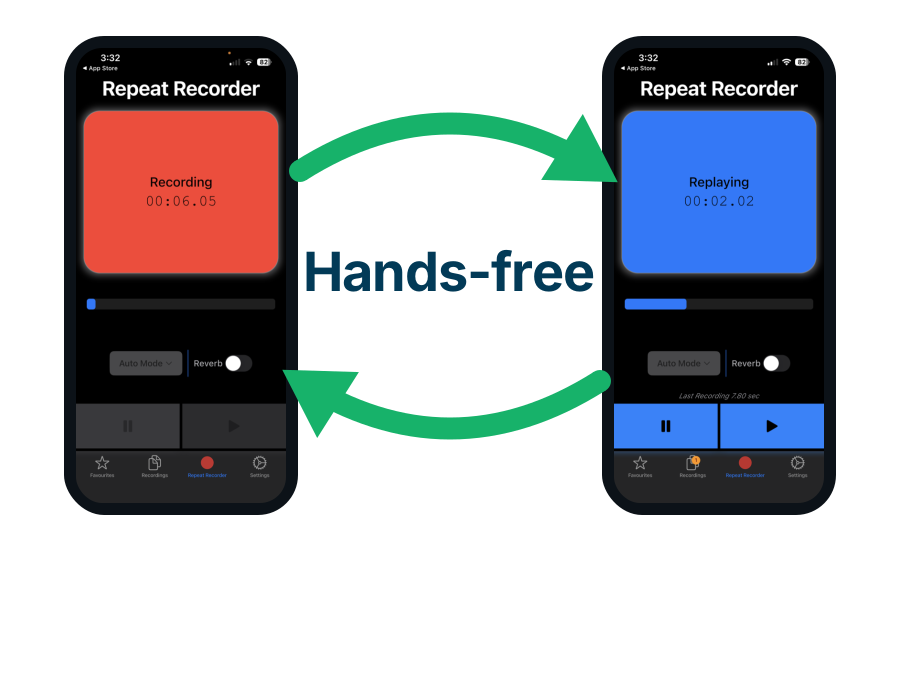
Use Repeat Recorder to practise saying your app name out loud
A spoken name is remembered far better than one that only appears as text, which is the single practical instruction this page ends on, and it is the one nobody rehearses. Saying your own app's name naturally, at the right speed, in the middle of a sentence, is harder than it sounds when there are only a few seconds to do it in. Repeat Recorder, another of my own apps, records you and plays the take straight back without you touching the phone.
- Repeat Recorder replays each take automatically and then starts recording again, so the same closing line can be run twenty times without picking the phone up. That hands-free loop is the entire app, and it was built for drilling a phrase in a new language, which is the same job as drilling a call to action with different words.
- Hearing your own take back is what catches a name said too fast to be searched for later. Since the link is suppressed on every surface here, the name and the words “search it in the App Store” are doing all the work, and they only work if a stranger can repeat them from memory.
- Two attempts at the same line can be kept as favourites and filed into folders you name yourself, so the versions sit next to each other. Folders reorder by dragging, which keeps a set of takes in the order you will actually say them rather than the order you recorded them in.
Conclusion: what Reels and Shorts really do for your growth
- Short-form video is shown to strangers on YouTube Shorts, Instagram Reels, Facebook Reels and TikTok no matter how few followers you have. About 74% of Shorts views come from people who do not subscribe and around 55% of Reels views come from people who do not follow, so one video from a brand-new account can reach hundreds of thousands of people.
- Views turn into followers at only 0.1% to 2%, so a million views buys a few hundred to a few thousand followers. Roughly 0.33% of viewers tap through to your profile at all, and one documented Instagram Reel hit 100,000 views while the account crept from 250 to 700 followers over six months.
- A one-line bio, a pinned video and one obvious subject lift followers from 0.2% of the people who saw your video to about 2%. Ten times the followers on the same reach costs one afternoon of work, which is a better use of the time than chasing more views. Pair it with an episodic series that asks people to follow for part two, the most reliable way to turn a one-time viewer into a follower.