
This is the sensible follow-up to "can a faceless channel go viral". Going viral is possible, fine. But possible is not the same as free. If you stay off camera, what is the bill? I went looking for the number and found something more interesting than a number: almost every figure published on this topic is fabricated, and the genuinely rigorous evidence that does exist points somewhere nobody expects.
Short answer: less than you fear, and nobody can tell you exactly, because it has never been measured. No analytics firm and no academic study compares faceless and face-on-camera YouTube channels at scale. The nearest rigorous evidence, roughly 100 controlled studies and four meta-analyses, says a visible presenter improves how viewers feel, measurably costs attention on your actual content, and does little or nothing to what they retain. Meanwhile the real cost of anonymity is not on screen at all. It is paperwork.
Nobody has measured this and most published numbers are invented
Before any number, you need to know why the numbers you have probably already read are worthless. This was the most surprising part of the research:
- "Faceless channels are 38% of new creator monetization ventures" is invented. It traces through three websites back to a company selling AI faceless-video generators, citing a "Creator Report" that does not exist. The proof it was back-filled: the archived version of the source page from May 2025 does not contain the figure at all. It now appears in roughly 142 indexed copies, each dating it differently.
- At least five faceless "statistics" cite an AI chatbot as a research institution. Claims are attributed to a "Genspark Authenticity Study" and "Genspark Platform Economics". Genspark is an AI agent product, not a research firm. The most likely explanation is that the article was generated by an AI agent which then cited itself.
- One source page still contains an un-actioned image prompt in its published body text, reading "Insert image of various faceless video styles in a collage format". It is verifiable in the Wayback archive.
- "86% of consumers perceive faceless content as more authentic" is a real survey about something else. The original said 86% of consumers say authenticity matters when deciding which brands they like. Nothing to do with faceless video.
- "Only 3% of faceless channels reach monetization" is a relabelled all-channel figure, derived from YouTube's 3 million partner channels against third-party totals. It is not about faceless channels at all.
- Every publisher in this chain sells faceless-video tooling. Not one neutral party appears anywhere in it.
The absence is systematic, and it was checked one company at a time. Tubular Labs, Social Blade, HypeAuditor, Sprout Social, Hootsuite, Buffer, Epidemic Sound and Kajabi have no face-versus-faceless data. "Faceless" is not a field in any commercial analytics dataset, which is precisely why marketing blogs can assert whatever they like about it.
A visible face changes how viewers feel, not what they learn
Educational-video research has been asking a near-identical question for a decade, under laboratory conditions, with control groups. It is the best evidence available and it is remarkably consistent:
- The largest and most recent meta-analysis covers 35 studies, 46 comparisons and 6,339 participants. It found a small but significant positive effect of a visible instructor on retention, no significant effect on transfer (applying what you learned), significantly better social presence, affect and motivation, and, critically, significantly reduced dwell time on the actual visual material. The attention cost of a face is real and measurable.
- A second meta-analysis of 20 experimental studies found the effects on learning and social presence were not statistically significant at all, and that instructor-present videos significantly increased cognitive load. Its moderator analysis for knowledge acquisition favoured videos showing only the instructor's hand. The faceless format won.
- A systematic review of 12 studies concluded there is "no consistent, compelling evidence that an instructor should be included on-screen", with non-significant and mixed results pervasive throughout the literature.
- Three field experiments in real university courses found no effect on learning outcomes in all three, with positive results only on affective measures. The authors' summary: no general effect of instructor presence can be shown, but there are also no detrimental effects.
- Eye-tracking shows exactly where the cost lands. In one study participants spent 41% of viewing time looking at the face, switching between face and slide every 3.7 seconds, with no significant effect on recall. A larger study of 96 participants found a talking head reduced fixations on new content and delayed how quickly viewers looked at it, again without changing learning outcomes.
- The closest analogue to a YouTube explainer studied 1,372 learners and found that "media-centric" and "balanced" video styles enhanced engagement while the "speaker-centric" style offered no advantages in any subject area.
41% of viewing time spent looking at the presenter's face rather than the content, with no measurable improvement in recall.
A face reliably improves how viewers feel about you and reliably costs them attention on what you are explaining. It does not reliably improve what they walk away knowing. For an explainer channel, that is close to the best possible news.
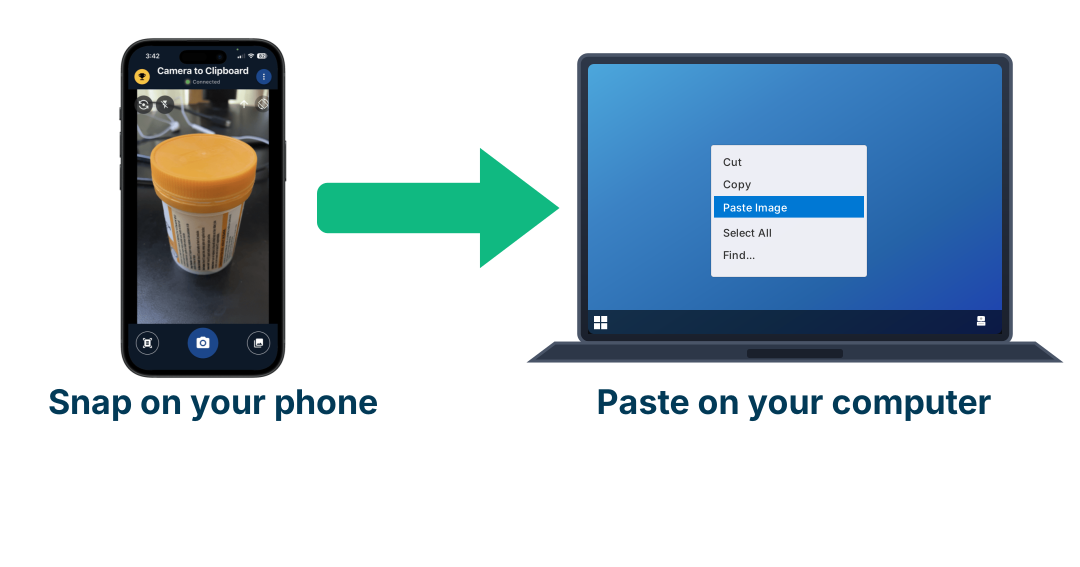
Use Camera to Clipboard to shoot what a faceless video shows
Leaving yourself out of the frame is only half a decision. The other half is what goes in the frame instead, and for most explainers that is a photograph of the real object being explained rather than a stock image somebody else is also using. The photograph is on a phone and the edit is on a computer. Camera to Clipboard, one of my own apps, closes that gap in a single step.
- A photo you take inside Camera to Clipboard is ready to paste on your computer the moment you take it. There is no emailing it to yourself, no cable and no upload to somebody else’s website in between. The phone and the computer find each other over your own local network and send the picture directly.
- Eye tracking put 41% of viewing time on the presenter’s face with no measurable gain in recall, so a faceless video has that 41% to spend on the subject itself. The cheapest thing to spend it on is a clear photograph of the actual thing, and the reason people reach for stock imagery instead is almost always that moving their own photo across took too many steps.
- You can send several shots at once out of the phone’s library, so six angles of the same object arrive together. Pasting into Photoshop or GIMP drops each one in as a new layer, and Word or Google Docs takes it inline, because it arrives as an ordinary picture sitting on the clipboard rather than a file you have to go and find.
The faces get more clicks rule is much weaker than you were told
This is the one place a faceless creator genuinely might lose something, since you can put a face on a thumbnail without ever appearing in the video. The evidence is thinner than the confidence around it:
- Across 300,000 viral videos, showing your face made no overall difference. Across more than 300,000 viral videos, 52,000 channels and 62.6 billion views of 2025 data, thumbnails with and without faces performed comparably. Its own summary line: faces amplify existing interest, they do not create it.
- Faces only helped meaningfully above about 200,000 subscribers. Which is to say, they help once people already recognise you. That is precisely backwards from how the advice is usually given to beginners.
- Faces actively hurt in health, fitness, movies and TV, including health and fitness and movies and TV, while helping in lifestyle, finance and beauty. Multiple faces outperformed single faces.
- The competing "69% of breakout thumbnails have faces" stat is a prevalence count with no control group. It comes from a company selling thumbnail tools, and it never reports the base rate for all videos. If 69% of all thumbnails have faces, the effect is exactly zero. That number cannot tell you anything and it is the cleanest example of a statistic that looks rigorous and is not.
- "Faces boost click-through rate by 20 to 30%" has no traceable source at all. It is attributed variously and vaguely, and no primary research behind it exists.
- YouTube itself has no official position on faces in thumbnails. Its one published statistic is that 90% of the best-performing videos have custom thumbnails, with no face breakdown.
- The one large study that found human presence helps was measuring paid ads. Across 90,000+ campaigns and a trillion impressions it found people in videos improved view metrics while on-screen text appearing early reduced them. That is a real warning for text-heavy faceless formats, but these were advertisements, not organic content, and "people" is not the same as "the creator's face".
The itemised bill of what you give up and get back
Every row below rests only on evidence that survived checking.
| What is at stake | Do you lose it without a face? | How good is the evidence? | What it means for you |
|---|---|---|---|
| What viewers learn and retain | No loss, and possibly a gain | Strong, four meta-analyses and ~100 controlled studies | The core job of an explainer video is unaffected |
| Viewer attention on your content | You gain it, a face pulls attention away | Strong, meta-analysis plus two eye-tracking studies | 41% of viewing time goes to the face when there is one |
| How viewers feel about you | Real loss, social presence, warmth, empathy | Strong, consistent across every review | The one clear, repeatedly confirmed cost |
| Thumbnail click-through rate | Little or none below 200K subs | Medium, one 300,000-video independent study | And you can put a face on a thumbnail anyway |
| Ability to go viral | No loss | Strong, a faceless video passed 113M views | Covered in full in the companion article |
| Monetization eligibility | No loss, no face requirement exists | Strong, YouTube's own published criteria | 1,000 subs plus 4,000 watch hours, nothing about a camera |
| The verification checkmark | No loss | Strong, YouTube's own criteria | 100,000 subscribers, no ID or face needed |
| Brand deals and sponsorship | Unknown, but large faceless channels get them | Weak, no dataset compares the rates | Anyone quoting a faceless sponsorship discount is guessing |
| Ad revenue per view | Unknown, and the published tables are manufactured | None, no dataset exists in either direction | Your niche and your audience's country matter far more |
| Monetization eligibility in some faceless formats | Real loss, compilations and loops get rejected | Strong, YouTube's reused and repetitive content rules | The modal outcome there is zero, not a low rate |
| Contesting a copyright strike | Serious loss, it costs your anonymity or a lawyer | Strong, YouTube policy and US statute | The genuine hidden cost, explained below |
| Working in fitness, beauty or vlogging | Total loss, the format needs a body | Strong, no large faceless example exists | Not your niche if you are doing explainers |
What a face is worth against what it costs you
The honest way to model this is not a single "you lose X%" figure, because that figure does not exist. It is a trade between an attention gain and an affinity loss, weighted by how much your channel depends on people liking you rather than understanding the topic. Move the sliders.
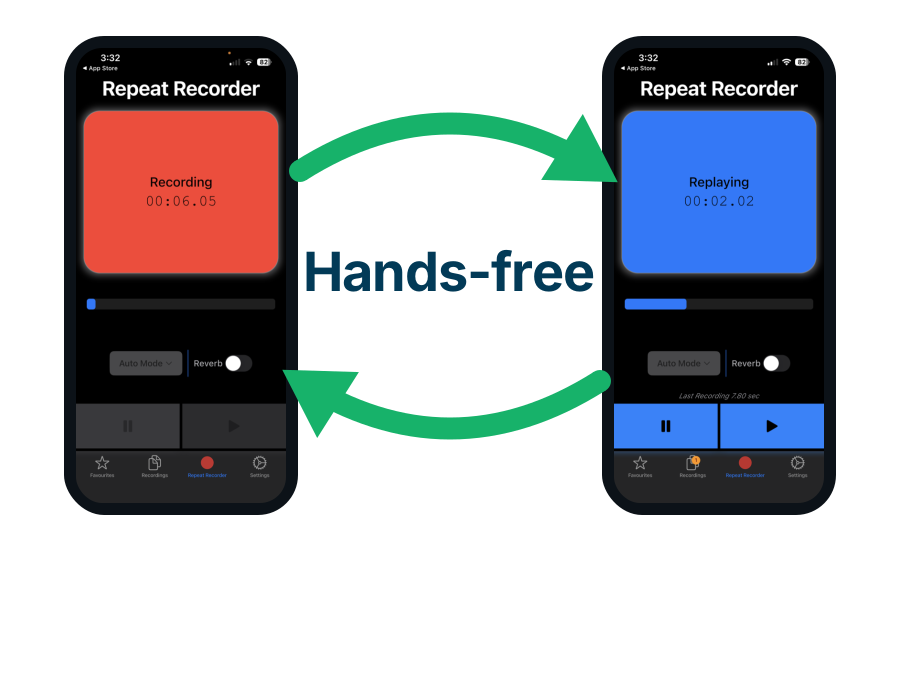
Use Repeat Recorder to rehearse a faceless video narration
Every version of this trade ends in the same place: the affinity is the part you actually lose, and with your face out of the frame there is only one thing left carrying it, which is the sound of you talking. That makes the narration the most valuable track in a faceless video, and it is the one part nobody rehearses. Repeat Recorder, another of my own apps, records you and plays the take straight back without you touching the phone.
- Repeat Recorder plays each take back automatically and then starts recording again, so you can run the same line twenty times without picking the phone up. That is the entire app. It was built for people drilling a phrase in a new language or warming a voice up, and reading a script for a video is the same job with different words.
- Hearing your own read played straight back is what catches a flat delivery before it is baked into a finished video. The one cost this article could confirm is how much viewers like and trust you, and a narrator who sounds bored is the version of that cost you can actually fix in an afternoon.
- Takes worth keeping go into favourites and into folders you name yourself, so two reads of the same paragraph sit side by side. There is adjustable reverb as well, which is useful for hearing how a line will sit once it is mixed rather than how it sounds dry in a quiet room.
The published RPM tables for faceless niches are manufactured
You will find dozens of tables ranking niches by revenue per thousand views. They are not data. Two independent lines of proof, and the second one is almost funny:
- The widely-copied faceless CPM table is arithmetic, not measured data. One widely-copied category table has a stated CPM that equals its stated RPM divided by 0.55 in all ten of ten rows. The RPM column is round editorial guesses and the CPM column is that guess divided by YouTube's revenue share. Its actual underlying dataset is 22 videos from a single channel, republished elsewhere as "compiled from YouTube analytics" and "median values".
- The suspiciously precise figures trace to one Reddit post. The numbers now everywhere ($11.88 for English learning, $10.92 for sleep soundscapes, $8.85 for weight loss) come from a single post whose author's own caveat reads: "Take the data with a grain of salt. I am still fine tuning how I collect the RPM data." It was then republished as editorial claiming verification "against at least three independent data sources", whose footnotes are eight other SEO blogs, which now cite it back.
- A major influencer-marketing site's earnings calculator runs on $18 per 1,000 views with no source, roughly eight times the measured median.
- A frequently cited "2024 RPM Creator Report" does not exist. The indexed URL simply 404s.
Figures that are real exist, from a publisher that states it verified every one against documentation. These are 2022 YouTube Studio RPMs from named creators:
- Personal finance: $29.30, from a creator whose RPM was $6.00 before he switched out of lifestyle content. A second finance creator reported $10.59.
- Education pays the most of any faceless niche, at $8.23 RPM, averaged across twelve monthly data points.
- ASMR pays $4.70 RPM, and the rest of the faceless niches pay less. True crime: $3.12. Pranks: $2.18. Lifestyle: $1.89. Stunts: $1.61.
- Language learning: roughly $2, from a single creator. Against a blog claim of $11.88 for the same niche. Treat this niche as genuinely unmeasured.
Three structural facts matter more than any of those numbers:
- Quoted CPMs overstate reality by about 5x, through three compounding steps. Advertiser CPM runs 1.5 to 2 times the CPM shown in Studio, then roughly 47% of views never serve an ad at all, then YouTube keeps 45%. A niche advertised to you as "$12 CPM" is about $2.30 RPM in your pocket.
- Your audience's country is roughly a 10x multiplier and it swamps niche entirely. Tier-one countries run $8 to $20 CPM against $0.20 to $1.50 elsewhere. Almost no published RPM table discloses audience geography, which makes them close to meaningless.
- The spread inside a niche is wider than the gap between niches. Education's own 25th to 75th percentile range runs $2.31 to $19.50, an 8.4x spread, which is wider than the distance between the top-ranked and twelfth-ranked niches. Pick your niche for the audience, not the RPM table.
Notice the shape here. It is the same as the thumbnail finding: the variable everyone argues about is not the one that moves the number. Geography and eligibility dwarf both niche and format.
And there is the part that is faceless-specific, which is not about the rate at all:
- Compilation channels risk Partner Program rejection, not a lower RPM. Compilation channels are frequently rejected from the Partner Program outright, so for that format the honest answer is $0 rather than a low rate.
- Sleep loops and ambient-audio channels run straight into the repetitive-content bar, another heavily faceless format.
- True crime collapses on advertiser suitability review rather than on policy. One creator went from about $7 to $0.50 RPM and lost roughly $2,000 on a single video.
All three are faceless-heavy formats, which is why "faceless earns less" gets repeated. The causation runs through the format's eligibility, not through the absent face.
The cost nobody warns you about is paperwork, not pixels
Everything above is about performance. The real risk to a privacy-motivated creator sits somewhere else entirely, and it is the part of this subject that is genuinely under-discussed:
- Contesting a copyright claim requires your real name, address and phone number, handed to the person claiming against you. YouTube's counter-notification page states it needs your "full legal name: first and last name, not a company name", plus a physical address and telephone number, and that "legally, we're required to share the counter notification with the claimant".
- This is statute, not YouTube policy, so nobody can waive it. US copyright law at 17 U.S.C. 512(g)(3)(D) requires the name, address and phone number, plus consent to the jurisdiction of a federal district court and agreement to accept service of process from the claimant.
- Forming a company does not keep your name off a copyright counter-notice. This is the single most repeated piece of advice in faceless-creator communities and it fails at the exact moment it matters, because YouTube explicitly refuses a company name in that field.
- Filing your own copyright complaint also exposes your real name. Filing your own copyright complaint against someone stealing your work also requires a first and last name rather than a company, and the claimant's name becomes part of the public record of the request.
- The only workaround YouTube offers costs money. Its page notes that "an authorized representative (such as an attorney) can submit on the uploader's behalf". So the realistic plan is to budget for a lawyer, or to accept that you cannot contest a strike without unmasking yourself.
The historical record backs this up in an unexpected way. Marshmello, who built a 58.4 million subscriber channel and earned 40 million dollars in 2019 behind a mask, was unmasked by Forbes in April 2017 using royalty databases, specifically an ASCAP credit. Not his face. Not his voice. The paperwork required to get paid.
How to buy back most of it without going on camera
The one confirmed loss is affinity, and it is purchasable. Every option below has a working example at scale:
- Showing only your hands is the cheapest way to stay faceless. The cheapest fix and the most common one at the top of the market. 5-Minute Crafts (80.6M) is hands. Tasty (21.3M) is hands. This Old Tony (1.22M) is hands plus a voice, from an anonymous machinist. A hand is not identifying, and it puts a human back in the frame. One meta-analysis found hand-only videos beat both alternatives on knowledge acquisition.
- Hiring a narrator is how Kurzgesagt keeps its founder anonymous at 25.4 million subscribers. Kurzgesagt, at 25.4 million subscribers, is narrated by a voice actor while its founder is not the voice. WatchMojo is built on named hired narrators. This buys you warmth and removes your voice from the risk surface at the same time.
- A licensed AI voice costs about 6 US dollars a month. A commercially licensed AI voice costs about 6 US dollars a month, and a high-quality clone about 22. Note the disclosure position: YouTube requires disclosure for synthetically generating a person's voice, but explicitly exempts "cloning one's own voice to create voice overs or dubs". Whether a generic AI narrator that imitates nobody needs disclosure is genuinely unclear, because YouTube has never addressed that case directly. Treat that as an open question, not settled policy.
- An illustrated avatar is a proven industry, with VTuber videos averaging over 5 million views. This is a large, proven industry rather than a novelty. VTuber videos have averaged over 50 billion views a year since 2022 by YouTube's own reporting, and 16 of the top 20 all-time Super Chat channels are VTubers. The biggest reached 4.62 million subscribers.
- A mask took Marshmello to 58.4 million subscribers. Marshmello reached 58.4 million subscribers. Corpse Husband reached 7.08 million, went RIAA Platinum, and has never been publicly identified. Anonymity became the brand rather than a limit on it.
- Animation has the highest ceiling and by far the highest cost. The highest-ceiling option and by far the most expensive. Kurzgesagt reports roughly 1,200 hours per video with a team of about 70. This is a studio strategy, not a solo one.
The affinity gap is the only cost the evidence actually confirms, and every one of these buys some of it back. None of them requires your face, and two of them (a hired narrator, a synthetic voice) also remove your voice from the equation.
A defensible number, with an honest error bar
Putting it as plainly as the evidence allows:
- On learning, retention and the ability to reach strangers: you lose nothing. This is well supported and it is the entire job of an explainer video.
- Going faceless gains you attention, because a face takes 41% of viewing time. A face takes 41% of viewing time and does not pay it back in recall.
- On how much viewers like and trust you: you lose something real, confirmed across every review, though never quantified in a way that translates to subscribers or revenue.
- On thumbnails: probably nothing until you are past 200,000 subscribers, and you can use a face there regardless.
- On money: nobody knows, and the published tables are fabricated. No dataset compares faceless and face-led revenue. What does move your rate is your audience's country (roughly 10x) and whether your format stays eligible at all, not whether you are in frame.
- Going faceless takes on a real legal risk, not an algorithmic one, and it is legal rather than algorithmic. Budget for a lawyer or accept you cannot contest a copyright strike.
- Against all of that, the background rate dominates. 85% of YouTube views go to 3% of channels, and the median video gets 89 views. Whatever the face effect is, it is small next to that.
The single most useful reframe: engagement is about 77% predictable from channel and topic alone, according to a study of 5.3 million videos, before format enters the picture at all. What you cover and who you cover it for explains most of the variance. Whether your face is in frame is a rounding error next to picking the right subject and publishing consistently.
Use Camera to Clipboard to shoot a thumbnail without your face
The thumbnail is the last place where the face question is still open, because you can put a face on one without ever appearing in the video. A creator who has chosen not to do that has to make the picture carry the click on its own, which usually means photographing the actual subject. Camera to Clipboard, one of my own apps, is a phone camera that pastes.
- Across more than 300,000 viral videos thumbnails with and without faces performed about the same, so the work goes into photographing the subject rather than into finding a face. Pasting into Photoshop or GIMP drops the photo in as a new layer, which is where a thumbnail actually gets built, and that is the whole distance between the phone and the design.
- The phone and the computer send the picture to each other over your own local network, so nothing passes through anybody else’s servers on the way. That is worth something to a creator who is anonymous on purpose, because emailing a photo to yourself or parking it in a cloud album leaves one more copy in one more account.
- A photo taken inside Camera to Clipboard is on the clipboard before you have put the phone down, with no cable and no file to go and find. The Windows and Mac apps behave the same way, so a thumbnail can be assembled on whichever machine the editing already happens on.
Conclusion: what going faceless on YouTube really costs you
- Nobody has ever measured what a visible face is worth on a YouTube channel, so the honest answer comes from about 100 controlled studies of educational video. Those studies and their four meta-analyses agree that a presenter on screen improves how viewers feel about you, measurably costs them attention on the material, and does little or nothing to what they retain. Most figures published about faceless channels trace back to companies selling faceless-video tools, and at least five of them cite an AI chatbot as a research institution.
- Eye tracking put 41% of viewing time on the presenter's face with no measurable improvement in recall. A video without a face keeps that time on the subject being explained. Across more than 300,000 viral videos, thumbnails with and without faces performed about the same, and faces only helped meaningfully above about 200,000 subscribers, which is after people already recognise you.
- Put your hands in frame or pay a voice actor, because how much viewers like you is the only loss the evidence confirms. One meta-analysis found hand-only videos beat both alternatives on knowledge acquisition, and Kurzgesagt keeps its founder anonymous at 25.4 million subscribers by hiring a narrator. Then budget for a lawyer, because contesting a copyright claim requires your full legal name, address and phone number, and YouTube is required to pass them to the person claiming against you.