
I went down a rabbit hole recently trying to work out how Google ads actually work, because of one flat contradiction I could not get past. Everyone agrees a Google click is about the most expensive click on the internet, a lawyer will happily pay nine dollars for a single one, and yet the same people keep swearing that Google is actually the cheapest place to get a customer. Some of them will tell you it comes out cheaper than advertising on Reddit, whose clicks cost small change. How can the priciest click also be the cheapest customer? That did not add up to me, so I went and found out, and the real answer is more interesting, and a good deal more honest, than the way it usually gets sold. I am using our own apps as the running example throughout (the small apps I build: Repeat Recorder, Paint Vlix and Camera to Clipboard). If you want to go deeper afterwards, I have also written up how Meta ad auctions and Reddit ads work, but you do not need either of them to follow this one.
The short version: A Google Search ad wins a fresh auction every single time someone searches, ranked on your bid times your ad's quality, and you pay only just enough to beat the advertiser ranked below you, so better quality really does lower your price. But the auction is not why Google can be cheap. The reason is intent: on Search the person is already looking for exactly what you sell, so even a pricey click converts often enough to become a cheap customer. That is demand you capture, not demand you create, which is the opposite of the feed platforms like Meta and Reddit, where people are there to scroll, not to buy. And the twist that undoes half the hype: Google is really two businesses. Search is the intent machine. The Display Network is the same cheap-click, expensive-customer interruption game as everyone else. So Google is not magically cheaper. Intent is cheaper, and Google happens to own the biggest pool of it.
The most expensive click on the internet
Let me start with the machinery, because it is simpler than it sounds. Every time someone types a query, Google holds a brand new auction, for that exact search, that exact person, that exact instant. No ad has a permanent spot. It is all recomputed, per search and per position, thousands of times a second.
What decides whether your ad shows, and where, is a number called Ad Rank. The simple version, the one worth carrying in your head, is this:
Ad Rank = your bid × your ad quality
Your bid is the most you are willing to pay for a click. Ad quality is Google's read on how good and relevant your ad and its landing page are, and it is summarised for you as a Quality Score from one to ten, built from three things: how likely people are to click your ad, how well it matches the search, and how good the experience is when they land on your page. Multiply bid by quality, rank everyone from high to low, and the top slots go to the highest Ad Ranks.
Now the part that matters to your wallet. You do not pay your bid. Google runs what is called a second-price auction, which means you pay only just enough to beat the advertiser directly below you, not a cent more. Roughly, what you actually pay per click is their Ad Rank divided by your own quality, plus a cent. Read that formula slowly, because it contains the whole trick:
what you pay = (Ad Rank of the advertiser below you ÷ your quality) + $0.01
Your quality is in the denominator. So higher quality does two things at once. It lifts your Ad Rank so you win a better spot for the same bid, and it divides down what you pay for that spot. Better ads are not just better, they are literally cheaper. This is why the advertiser with the biggest budget does not simply win.
One quick note before we go on, because it clears up a common confusion. The one-to-ten Quality Score you see in your Google account is really a health gauge, a summary Google shows you. The live auction does not literally read that dashboard number, it works your quality out fresh for each individual search. In practice it comes to the same thing: better quality wins a higher spot and pays less. But it raises an obvious question, one that deserves its own section: how does Google decide your quality in the first place, and how could it possibly know whether your landing page is any good?
Use Camera to Clipboard to put real photos on a landing page
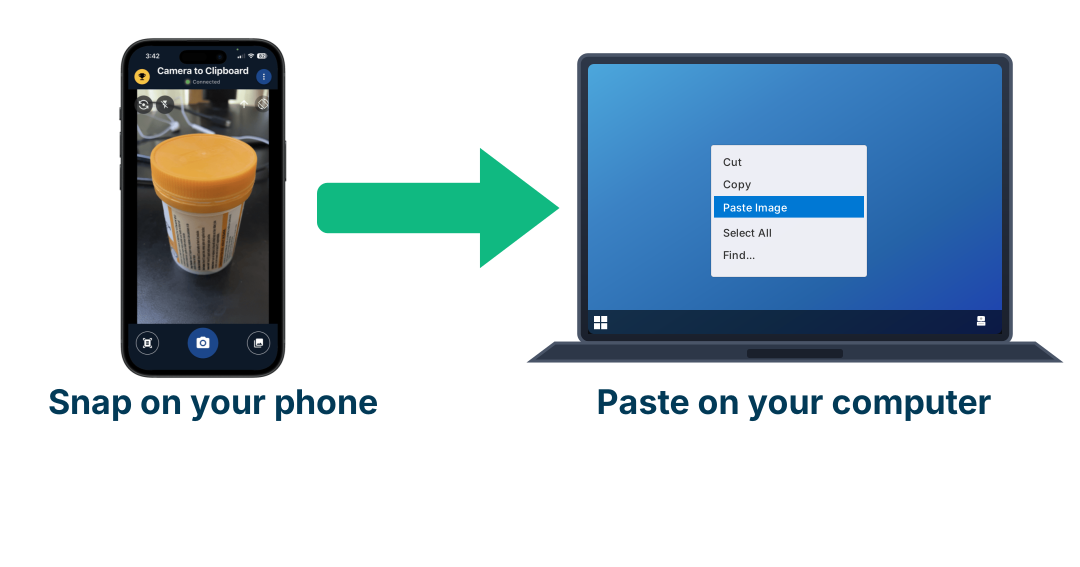
Since your quality divides down what every click costs you, the landing page stops being decoration and starts being a price. The cheapest way to prove a page really is about the thing the ad promised is a picture of the actual product rather than a stock image, and the picture is nearly always on a phone while the page is being built on a computer. Camera to Clipboard, one of my own apps, closes that gap in one step.
- A photo taken inside Camera to Clipboard is on your computer's clipboard before you have put the phone down. There is no emailing it to yourself, no cable and no upload to somebody else's website in between, because the phone and the computer find each other over your own local network and send the picture directly.
- Pasting into Photoshop or GIMP drops the photo in as a new layer, so it can be cropped and sized before it ever reaches the page. Word and Google Docs take the same picture inline instead. It arrives as an ordinary image sitting on the clipboard, so anything that accepts a pasted picture accepts this one.
- Google scores a landing page on whether the person who clicked got what they came for, and a photo of the real thing answers that question immediately. Google crawls and reads the page to check it matches the ad and the search, and it watches for people bouncing straight back to try a different result, which is the behaviour that quietly drags the score, and therefore your price per click, in the wrong direction.
So how does Google decide your quality?
Your quality is built from three ingredients. Here is what each one actually means, and, more to the point, how Google is able to judge it at all.
1. How likely your ad is to be clicked. Google has shown ads for searches like this one billions of times, so it has a very good statistical idea of whether an ad like yours tends to get clicked or ignored. Nothing mysterious here, it is just a prediction drawn from an enormous pile of past behaviour.
2. How well your ad matches the search. Google reads the words of your ad and compares their meaning to what the person actually typed. If someone searches "app to slow down speech" and your ad is plainly about slowing down speech, that is a strong match. If your ad is vague or generic, it is a weak one.
3. How good your landing page is. This is the one that confuses almost everybody, so let me be precise, because the intuition most people start with is wrong.
Here is the key thing. Google is not checking whether your page makes sales. It cannot see your revenue, and it is not asking "did this visitor buy something". Whether a visit turns into a paying customer is handled by a completely separate part of Google's system, its bidding machine, which we come to further down, and it plays no part in your quality score. So what does "a good landing page" actually mean to Google? It means one simple thing: did the person who clicked get what they came for? And Google judges that from a handful of things it genuinely can see:
- Does the page deliver what the ad promised? Google crawls and reads your page, the same way it does for ordinary search results, and checks that the content really matches the search and the ad. Send someone who searched for an accent app to a page about accents, not to your generic homepage.
- Google measures your landing page speed from real Chrome visitors. Google measures this directly, partly from real Chrome users visiting your site. A slow page is a bad experience, and it counts against you.
- A landing page broken on a phone costs you, because most searches are mobile. Most searches happen on mobile, so a page that is broken or fiddly on a small screen scores badly.
- Do people stick around, or bounce straight back? This is the big behavioural tell. When someone clicks your ad and then, a second later, hits the back button to return to Google and try a different result, that is about the clearest possible sign that your page let them down. Enough people doing that quietly drags your landing page score down. It is often called bouncing.
So in Google's eyes, "a good landing page" means a page that gives the searcher what they were looking for, not "a page that sells well". The two usually travel together, a page that answers the question tends to convert better too, but they are measured by different parts of Google, and it is worth keeping them apart in your head. Quality Score cares about relevance and usefulness. Whether the visit becomes a customer is the job of the bidding machine, which is a separate story later on.
Concretely, if we bought the search "how to improve my speaking voice" and pointed it at our Repeat Recorder page, a good landing page experience just means the page is about exactly that, loads instantly, works on a phone, and answers the question the person arrived with, so they stay and look around instead of bouncing back to Google. That is what lifts our quality, and, as the auction above showed, lowers what we pay per click.
You are not interrupting anyone
Here is the single most important idea in this whole piece, the one that quietly explains everything else.
Three ways to decide who sees your ad
There are broadly three ways an ad platform can decide who sees your ad. It can target who you are, from a long history of your behaviour, which is what a feed platform like Meta does. It can target what you are reading right now, the context of the page in front of you, which is what Reddit leans on. Or it can target what you are asking for, out loud, at this very moment, which is what Google Search does, and that last one turns out to be a different thing entirely. When someone types "app to fix my accent" or "voice recorder for practising a speech", they have already decided they have the need and they are actively hunting for the answer. Your ad does not interrupt anything. It is the answer they came for.
Capturing demand, not creating it
This is the difference between capturing demand and creating it. On Meta and Reddit nobody woke up wanting your product. They came to scroll, to read, to kill ten minutes, and your ad has to reach into that and manufacture a want that was not there a second ago. That is hard, which is exactly why those clicks are cheap: the person was not looking to buy. On Google Search the want already exists. You are not persuading a stranger to care, you are competing to be the one who sells to a person whose hand is already up. That is hard in a different way, everyone wants that person, which is exactly why those clicks are expensive.

On Meta and Reddit you pay a little to interrupt someone who was not looking. On Google Search you pay a lot to answer someone who already is. You get precisely what you pay for: cheap attention, or expensive intent.
If we were promoting Repeat Recorder, this changes the whole job. On Reddit we would go hunting for the handful of communities where people talk about their speaking voice and write something that belongs in the thread. On Google Search we would instead bid to appear the instant someone types "how to improve my speaking voice", because that person has already told Google, in plain words, that they want the thing we make. Nothing to infer, nothing to create. Just be there when the hand goes up.
The one honest limit
There is one honest limit to this, and it is worth saying out loud. Demand capture can only ever sell to people who are already searching. You cannot grow the market with it, and you cannot sell something people do not yet know to look for. That is precisely the job Meta and Reddit are good at. Hold that thought, it comes back at the end.
The expensive click that becomes the cheap customer
Now we can settle your contradiction directly, because it is really just arithmetic. A customer does not cost you one click. It costs you all the clicks it took to get one of them to convert. So the number that actually matters is not cost per click, it is cost per customer, and that is cost per click divided by the share of clicks that convert.
Watch what intent does to that division. Suppose a Google Search click costs seven times what a Reddit click does. Sounds like a rout for Reddit. But if intent makes that Search click convert seven or eight times as often, the expensive click and the cheap click land in almost the same place on cost per customer, and the Search customer often comes out ahead. The pricey click was never the point. The conversion rate hiding behind it was.
That is the entire resolution of the "how can the dearest click be the cheapest customer" puzzle. It can, whenever the click carries enough intent to convert well, and a Google search carries about as much intent as a click can. This is also why a lawyer will pay nine dollars a click without blinking. One converted client is worth thousands, so a nine dollar click that converts at a healthy rate is one of the best deals they will ever get. The headline price was never the story.
Use Repeat Recorder to improve your speaking voice
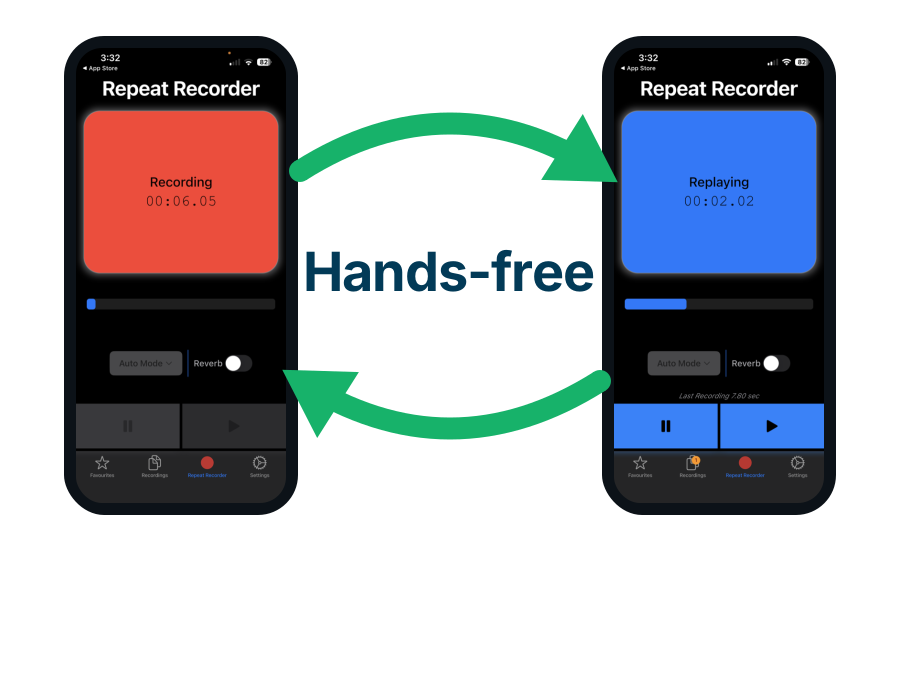
The worked example running through this whole piece is bidding on the search “how to improve my speaking voice”, and Repeat Recorder is the app on the other end of it. It is another of my own apps, and it is the reason that search keeps coming up here. It records you, plays the take straight back, and starts recording again, all without you touching the phone.
- Repeat Recorder replays each take automatically and then starts recording again, so one sentence can be run twenty times without picking the phone up. That hands-free loop is the whole app. It was built for speech rehearsal, language learning and vocal training, which are three versions of the same job, which is saying the same thing until it comes out right.
- Somebody typing “how to improve my speaking voice” is the exact demand this article calls expensive to reach and cheap to convert. They have already decided they have the problem and gone looking for the answer, which is why a Search click can cost seven times a Reddit click and still produce the cheaper customer.
- Takes worth keeping go into favourites and into folders you name yourself, and the folders reorder by dragging. There are adjustable reverb effects too, which matter if you are rehearsing for a room rather than for a microphone a foot from your face.
But Google is really two businesses
Here is the part the "Google is just cheaper" crowd tends to skip, and it is where the honesty comes in. Everything above is about Search. But most of Google's ad surface is not Search at all, it is the Display Network: banners and native units splashed across millions of other websites and apps, plus YouTube and Gmail. And Display is a completely different animal.
On Display, nobody searched for anything. They are reading a recipe or watching a video, and your banner is off to the side. That is interruption advertising, the exact same category as Reddit and Meta, and it behaves like it. Display clicks are wonderfully cheap, often a fraction of a Search click. But the click-through rate is a fraction of Search's, and the conversion rate is lower still. So a quiet trap appears, this time inside Google itself: cheap clicks are not cheap customers.
Which half of Google do you mean?
So the honest correction to your hypothesis is this. It is not that "Google" is cheaper. It is that Search is cheaper per customer, because it is made of intent, and Display is right there in the same account being exactly as expensive-per-customer as any other interruption channel. When someone tells you Google beat Reddit on cost, ask them which half of Google they mean.
Rescuing Display means putting the intent back
There is one important way to rescue Display, and it is the same rescue as everywhere else: put the intent back. Remarketing, showing Display ads only to people who already visited your site, takes that cheap inventory and points it at people who are no longer cold. Someone who opened the Repeat Recorder page yesterday and did not download it is a far better bet than a stranger on a recipe blog, and you reach them at Display's bargain prices. That is Display at its best: not creating demand, which it is bad at, but cheaply recapturing demand you already made somewhere else.
A word on Performance Max
A quick word on Performance Max, Google's newer "let the machine do all of it" campaign, since you will bump into it. It hands Google a goal and a pile of assets and lets its AI spread your budget across Search, Display, YouTube, Gmail and Maps at once, deciding everything. It can work, but it is a black box, and its favourite quiet trick is to serve on searches for your own brand name, people who were going to find you anyway, and then take the credit. So when Performance Max reports gorgeous numbers, some of that is demand it captured rather than created. Read it with a raised eyebrow.
What is Smart Bidding? The machine that bids for you
There is one more piece, and it is the part people mistake for the whole answer: Smart Bidding, Google's machine-learning bidder. It is genuinely excellent, and it is worth understanding what it actually does, because it is not what most people think.
What Smart Bidding actually does
A manual bid is one number you set in advance and apply to everyone. Smart Bidding throws that out and sets a fresh bid for every single auction, in real time, based on the full context of that one impression. Google calls this auction-time bidding, and the signals it weighs on the spot include the device, the physical location, the time of day and day of week, the browser and operating system, the language, whether the person is on one of your remarketing lists, and above all the exact words of the query. It is reading, for each individual search, how likely this click is to convert, and bidding accordingly: hard on the high-intent moments, next to nothing on the tyre-kickers.
Notice the shape of what that gives you. Every ad platform has to work out which impressions are worth paying for, and they solve it in different places. A feed platform like Meta leans on a machine to find the right person for you. Reddit hands that job back to you, to narrow the audience by hand. Google splits the difference in the most useful way: the machine narrows by intent, per auction, automatically, raising the bid when the query smells like a buyer and cutting it when it does not.
Why it is a multiplier, not a miracle
But here is the sober bit, and it is why Smart Bidding is a multiplier and not a miracle. It has to learn, and it learns from your conversions. Feed it too few (the rough rule of thumb is something like thirty conversions in a month for a cost-per-customer target, more is better) and it has no pattern to find, so it flails. Every time you change it there is a week or two of unstable "learning period" where it spends inefficiently while it recalibrates. And crucially, point it at a pure awareness campaign with no conversion to optimise toward and it has nothing to do at all, because it is a conversion engine with no fuel.
Smart Bidding amplifies intent that is already there. It does not manufacture it. Aim the exact same algorithm at cold strangers with no conversion signal and its edge quietly disappears.
So no, the algorithm is not the reason Google is cheap. Intent is the reason. Smart Bidding is the thing that reads the intent in each auction and prices it perfectly, which is a real and large edge, but it is a force multiplier on Search's structural advantage, not the source of it. For a product like Paint Vlix, the highest-leverage work is not fiddling with the bidder, it is feeding it clean conversion data so it has something true to optimise toward.
Use Camera to Clipboard to move ad screenshots off your phone
Reading a black box with a raised eyebrow means keeping your own dated record of what it claimed, and half the time you are checking the numbers on a phone rather than at a desk. Getting that screen into the note or the spreadsheet where you actually compare things is the step that gets skipped. Camera to Clipboard, one of my own apps, sends a picture from the phone straight onto the computer's clipboard.
- A screenshot already sitting in your phone's photo library can be sent to the computer and pasted, with no email to yourself and no cable. The two devices talk over your own local network, so the picture never goes to a third party on the way, which matters when the picture is your own spend and conversion numbers.
- Several pictures can be sent at once, which is what a before and after comparison needs. Every change you make to the bidder is followed by a week or two of unstable learning where it spends inefficiently, so the only readable evidence is a dated pair of pictures from either side of that gap rather than the number on screen today.
- The picture arrives as an ordinary clipboard image, so Word and Google Docs take it inline and Photoshop or GIMP open it as a new layer. Nothing has to be saved, renamed or found again first, which is the difference between keeping a running record and meaning to start one.
So is Google actually cheaper?
Here is the honest verdict, now that all the pieces are on the table. Your hypothesis was right, but for a better reason than the one you were sold. On cost per click, Google Search is usually the most expensive of the three, no contest. On cost per customer, Google Search is often the cheapest, because intent makes its clicks convert so much better that the high price per click washes out and then some. And the algorithm helps, but it is the intent doing the heavy lifting, not the magic.
The catch is that only half is made of intent
The catch is that this only holds for the half of Google that is made of intent. The Display half is the same cheap-click, expensive-customer game as everyone else, and pretending otherwise is how budgets quietly evaporate.
The real move is a funnel, not a fight
Which points at the move the good advertisers actually make, and it is the real payoff. Stop asking "Google or Reddit or Meta". They are not rivals, they are a funnel. Use Reddit and Meta's cheap, interruptive reach to create demand at the top, to make people aware of an app they were never going to search for. Then use Google Search to capture that demand at the bottom, to be standing there the day those same people finally type your name or your category into the box. Social writes the demand. Search cashes the cheque. Measured against each other they look like enemies. Measured together they are a machine.
Conclusion: how Google Ads work, in one glance
- Every Google search runs a brand new auction, ranked on your bid multiplied by Google's rating of your ad and landing page, and you pay only enough to beat the advertiser ranked below you. That rating also divides down what you are charged, so an ad and a page that genuinely answer the search cost less per click than a bigger bid buys.
- A Google Search click can cost seven times a Reddit click and still produce the cheaper paying customer, because intent makes it convert seven or eight times as often. The cost of one paying customer is the cost per click divided by the share of clicks that convert, which is why a lawyer pays nine dollars a click without blinking. That advantage belongs to Search alone. Nobody on the Display Network searched for anything, so its cheap clicks turn into expensive customers exactly like Reddit's and Meta's, and showing those ads only to people who already visited your site is the one thing that rescues them.
- Run Reddit and Meta to create demand and Google Search to capture it, rather than picking one of the three. Search can only sell to people who are already looking for what you make, so something has to make them aware of it first. Google's own bidding machine reads the intent in each auction and prices it well, but it cannot manufacture intent, so the work that pays is feeding it clean conversion data rather than fiddling with the bidder.