
I recently went down the rabbit hole of how Meta actually decides which ad you see, and it turned out to be one of those systems that looks baffling until you find the single fact it all hangs off. Once that clicks, every strange thing about it (why a smaller bid can win, why great creative makes your CPM go up, why cheap countries lose money) stops being a rule to memorise and becomes something you can just reason out. This is my attempt to explain it the way I wish someone had explained it to me, using our own apps as the running example (the small apps I build: Repeat Recorder, Paint Vlix and Camera to Clipboard).
The short version: Meta does not sell ad space, it sells human attention, and attention is a fixed, perishable supply. It cannot make more of it, so its only way to earn more is to make each slot go to the advertiser it is worth the most to. You help it do that by bidding on the outcome you want (an install, a subscription) instead of on impressions. Meta supplies the missing piece: how likely each individual person is to take that action. Multiply your bid by that probability and you get a value per impression that ranks every advertiser in the same unit. Highest value wins. That is the whole thing.
Meta is not selling space. It is selling attention.
A billboard company sells you a fixed rectangle by the road. Meta is not doing that. It is selling moments of human attention, and those moments are strictly limited.
Think about how anyone actually uses one of these apps. Someone opens Instagram, scrolls for a few minutes, and closes it. In that session there is room for only a handful of ads before the experience starts to sour. Meta cannot manufacture more attention. It could cram in more ads, but every extra ad makes the feed a little worse, sessions get shorter, and the total pool of attention shrinks. The resource punishes overuse.
So Meta has a finite, perishable, quality-sensitive inventory, and millions of advertisers fighting over it. Picture the queue for that inventory: us trying to get someone to try our free voice-practice app Repeat Recorder, someone else selling insurance, someone else selling shoes, all wanting the same three seconds of the same person's evening. Everything that follows is a consequence of that one fact.
The obvious answer, and why it breaks
The common-sense fix is a plain auction. Whoever bids the most for the slot wins it. That is how an art auction works, how eBay works, and how most people assume ad auctions work.
Meta could do this, and in fact it offers it: a reach campaign lets you bid a flat CPM (a price per thousand impressions) and the highest CPM wins. It exists and it works. But if it were the only option, three things would go wrong.
You would pay for attention that cannot convert. A flat CPM is one price applied to every person in your audience, but those people are not interchangeable. Say we run a single CPM to promote Repeat Recorder. Some of the people it reaches are quietly self-conscious about their speaking voice and would download it tonight. Some will never install a voice-practice app in their life. One price cannot tell them apart, so we pay the same for both, and most of the budget lands on people who were never going to act.
The inventory gets misallocated. If a slot goes to an advertiser whose product is irrelevant to that person, the impression is mostly wasted. Not wasted for Meta in the narrow sense (it still gets paid) but wasted in the sense that the same slot could have gone to an advertiser it was worth far more to. Over billions of impressions, that compounds into an enormous amount of value that never gets created.
Advertisers leave. Performance advertisers are ruthless about return. If a dollar on Meta produces fewer installs than a dollar on Google or TikTok, the budget moves and does not come back. Meta needs its advertisers to succeed, not out of goodwill, but because advertisers who lose money stop buying.
There is also a purely mechanical problem, and it is the one that kills flat bidding as a universal system. In any single auction, advertisers are bidding in different units at the same time. We might offer 3 dollars per Repeat Recorder install. A game studio offers 60 cents per click. A brand offers 18 dollars per thousand impressions. Those numbers cannot be ranked against each other. They are not the same kind of quantity. Something has to convert them into a common unit before any auction can even begin.
Use Repeat Recorder to rehearse the voiceover in your ad video
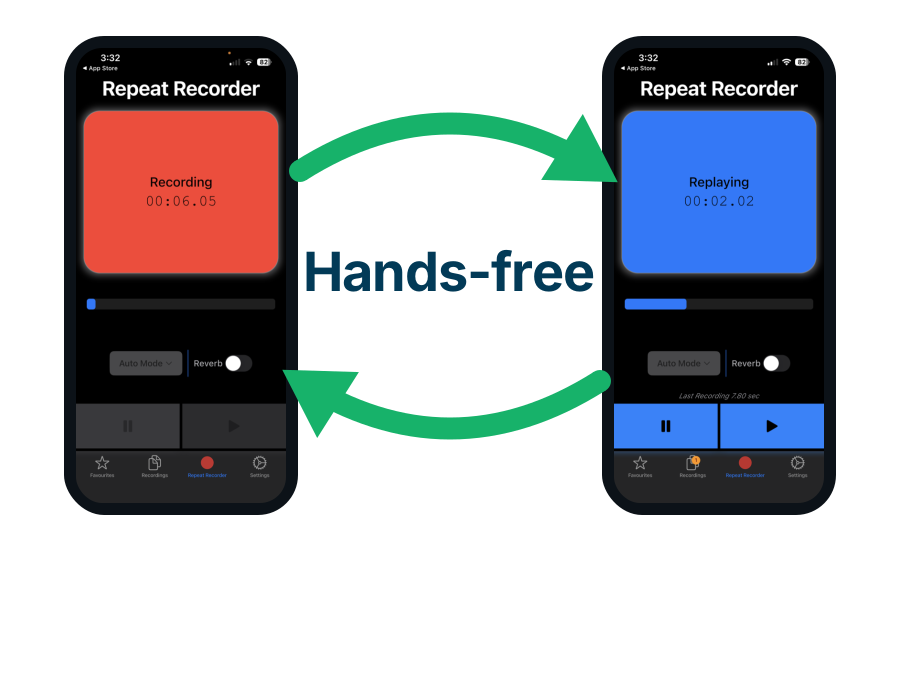
One flat price cannot tell apart the person who would install tonight and the person who never will, and the half of that exchange you actually write is the ad itself. On a video ad the spoken part is usually recorded once, late, in whatever voice you had left. Repeat Recorder is the voice practice app used as the example advertiser all the way through this page, and it is one of my own apps: it records you, plays the take straight back and starts recording again, without you touching the phone.
- Repeat Recorder plays each take back on its own and then starts recording again, so one sentence can be run ten times without picking the phone up. That hands-free loop is the whole app. It was built for speech rehearsal, language learning and vocal training, and an ad line is the same length as the phrases it was designed to drill.
- A flat price per thousand impressions pays exactly the same for somebody who was never going to act, so the money you can still influence is the money in the ad. The bid box has one number in it and the ad has thirty seconds of your voice in it, and only one of those two gets better with practice.
- Hearing your own line played straight back is what catches the sentence that reads well and sounds mumbled. The version in your head is not the version a stranger hears in a feed with the sound half down, and the gap between them is obvious within two playbacks.
Bid on outcomes and let Meta do the conversion
Instead of quoting a price for impressions, you quote a price for the thing you actually want.
You tell Meta two things. First, which action matters to you, whether that is an app install, a purchase, a lead or a click. Second, what that action is worth, as a maximum you are willing to pay for it. For a free app like Paint Vlix the action might be a download; for a subscription app like Repeat Recorder, free to download with a Pro subscription, it might be the trial start or the paid subscription itself.
Meta then supplies the piece you cannot: for each individual person, at each individual moment, how likely is that person to take that action on your ad. This is the estimated action rate, and it is the heart of the whole system.
The two numbers multiply into a value per impression.
your bid per outcome × the probability of that outcome = the value of this impression
A third factor, ad quality, adjusts this, and it is mostly a penalty. Quality reflects negative signals like hides and reports, engagement measured against what is normal for the category, and demotions for engagement bait, sensational claims, withheld information and bad landing pages. A demoted ad has its value discounted and has to bid materially more to win the same slot. So the full ranking value is roughly:
bid × estimated action rate × ad quality
That is the number every advertiser gets boiled down to, no matter what unit they bid in. Once everyone has one, the auction is the simplest thing imaginable: highest value wins.
The estimated action rate is the whole game
The prediction is made per person, not per campaign. Your campaign has an average install rate, sure, but that average is worked out after the fact from thousands of individual predictions that all differed from one another.
The model draws on two sides. From your side: the conversion events you report back through the pixel or the mobile SDK, the past performance of this creative and ones like it, and early engagement on the ad itself (watch-through, dwell time, saves, shares). From the user's side: their history of engaging with and buying from ads in this category, what they have installed, how recently they did something similar, plus device, connection quality and placement.
This is exactly why the learning phase exists. When we launch a brand-new ad for Repeat Recorder, the model has no history for it, so it falls back on weak proxies and the estimate is noisy and usually pessimistic. It settles down only as real conversion events pile up, which is why Meta keeps nudging you toward roughly fifty conversions per week per ad set. Below that, the model never gets confident, and low confidence is expensive: an uncertain prediction gets shaded down, and a shaded-down prediction loses auctions you would have been glad to win.
A new ad is not expensive because it is bad. It is expensive because Meta does not yet know whether it is good.
What actually happens when someone opens the app
A person opens Instagram. A slot in their feed comes free. That single slot, for that single person, at that single moment, is auctioned.
Every eligible advertiser is evaluated. Each one's bid is converted into a value per impression using that advertiser's own predicted rate for this specific person and their own quality score. Highest value wins.
And here is the part that surprises people: the winner does not necessarily bid the most money. Suppose we bid 5 dollars per Repeat Recorder install and, for this person, Meta predicts a 1 percent chance they install. That is 5 cents of expected value per impression. A rival bids 20 dollars per install but is a poor match for this person, predicted at 0.1 percent. That is only 2 cents. Our smaller bid wins, and Meta earns more by letting it win. This is not generosity toward the better-matched advertiser. It is plain revenue maximisation.
Use Camera to Clipboard to get product photos into an ad
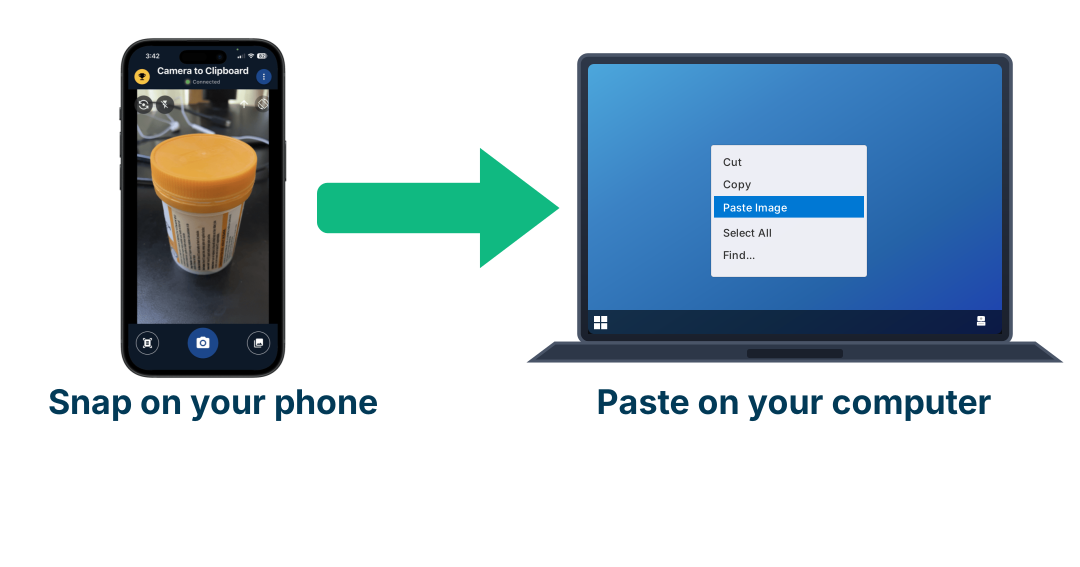
The advertiser who wins that single slot is the one with the better predicted rate, not the one with the bigger budget, and early engagement with the ad itself feeds that prediction. Which means new pictures, over and over, for as long as the campaign runs. Camera to Clipboard, another of my own apps, is a phone camera that puts what it photographs straight onto your computer's clipboard.
- A photo taken inside Camera to Clipboard is ready to paste on your computer the moment you take it. There is no emailing it to yourself, no cable and no upload to somebody else's website in between. The phone and the computer find each other over your own local network and send the picture directly.
- A 5 dollar bid at a 1 percent predicted install rate beats a 20 dollar bid at 0.1 percent, and the ad is what moves that rate. Those are the numbers in the worked example above, and the prediction behind them is fed partly by how people engage with the ad itself. Shooting a real photograph of a real thing is the cheapest way to give it something new to react to.
- Pasting into Photoshop or GIMP drops the photo in as a new layer, and several photos can be sent from the library in one go. Six shots of the same product land together, which is what makes picking one a two minute job rather than an afternoon of fetching files.
What you actually pay (and the thing everyone confuses)
Two things get muddled here, and they are worth pulling apart carefully.
The billing unit is impressions. You are charged when your ad is shown, not when the install happens. Meta carries no risk on whether the conversion actually occurs. This bidding style is even named for it: oCPM, optimised cost per mille (per thousand impressions).
The bid unit is outcomes. Your bid of 8 dollars per Repeat Recorder subscriber is not a payment. It is a cap. It means: charge me per impression, at whatever rate you like, as long as the maths works out to no more than 8 dollars per subscriber. The predicted rate is the exchange rate that turns your cap into an allowable price per impression.
Your price is set by the competition, not by your own bid. The winner pays roughly what was needed to beat the runner-up, not their full maximum. So a strong predicted rate does not only win you the impression, it tends to win it with headroom to spare. This is why bidding artificially low is usually a mistake: it does not lower the price you would have paid, it just makes you lose auctions you would have been happy to win.
Two honest caveats. Real delivery paces your bid through the day to spend your budget evenly, so the number of advertisers actually competing in any given auction is rarely the number you typed. And the exact settlement mechanics change over time and are not published. Treat "you pay about the runner-up price" as the model that explains what you observe, not as a description of the billing code.
Why better creative lowers your cost (even as your CPM climbs)
Cost per install is just the price of an impression divided by the install rate. Better creative and better product fit push the install rate up, so cost per install comes down. Simple.
What confuses people is that your CPM often goes up at the same time, and it looks like Meta is punishing you for doing well. It is not. A stronger predicted rate lets you win auctions you used to lose, and the auctions you used to lose are the contested, expensive ones. Success moves you into more expensive company. If we cut a genuinely great video for Repeat Recorder, we do not get cheaper impressions, we get better ones, and better ones cost more per thousand while costing less per install.
Two things follow. CPM on its own is a useless health metric, because it can rise from a quality penalty or from success, and you cannot tell which from the number alone. And the advantage decays: as frequency climbs your rate falls, and as competitors improve their own creative the whole price floor lifts. Creative is not a thing you finish, it is a thing you keep replacing.
Why cheap audiences are usually a trap
The price of an impression is set by what other advertisers will pay for that person. Wealthier, older, higher-intent audiences in developed markets are expensive because lots of well-funded advertisers want them. Younger audiences and low-income markets are cheap because few do.
But cost falls more slowly than value does. An install in a low-income market might cost five times less and be worth thirty times less, especially for a subscription product, because the paying rate collapses far harder than the install rate. Someone there will happily install Repeat Recorder, and will never pay a Western subscription price for it. The cheap dashboard number seduces you; the revenue behind it quietly does not show up.
Cheap traffic is cheap because a market with far better data than you already priced it correctly. The discipline is to never compare cost per install across countries. Compare each market's cost per install against that same market's revenue per install, and judge each one on its own terms.
Never ask "which country is cheapest to acquire". Ask "which country pays back what it costs".
Use Repeat Recorder to record three versions of one ad line
If there is no bargain to be found in the audience, because a market with far better data than yours already priced it, then the one input still worth improving is the ad. Recording three spoken versions of the same line and running them against each other costs minutes rather than money. Repeat Recorder, one of my own apps, is built to make those repetitions painless.
- Cost per install is the price of an impression divided by the install rate, so a better ad lowers what an install costs even while the impressions get more expensive. That is the one sum on this page where you own an input outright, and the spoken line is the part of the ad you can change before lunch.
- Repeat Recorder records, plays the take back and starts recording again on its own, so three versions of one line take about five minutes. You never touch the phone between them, which is the difference between trying three wordings and settling for the first one.
- Favourites and folders you name yourself keep the three recorded versions side by side, and folders reorder by dragging. Creative is not something you finish, it is something you keep replacing, so the line that worked in March is worth still being able to find in June.
iOS versus Android is not a fair fight, and that is fine
The same logic explains the platform gap. iOS installs cost more for three reasons: iOS users tend to spend more, so competition bids them up; iOS inventory is scarcer in most countries; and since App Tracking Transparency, measurement on iOS is noisier, which makes prediction less accurate and delivery less efficient.
None of that means iOS is worse. For most of our apps it converts to paid at a high enough rate to justify the premium. The move is not to declare a winner, it is to run Repeat Recorder on each platform separately and judge each on its own return, exactly as you would with countries. A blended cost per install across two platforms with different economics is a number that hides the truth rather than revealing it.
What you can and cannot control
You cannot target on purchase history any more. That kind of targeting was largely stripped out of the interface years ago and the detailed-targeting menu keeps shrinking. But those signals still live inside the prediction model, working on your behalf. So the levers that remain are these, and they are the ones worth all your attention.
1. The conversion event you optimise for
This decides which prediction model gets applied to you, and therefore which people you win. Optimise for clicks and Meta will dutifully find you habitual clickers, and it will learn nothing about who installs, no matter how long you run. Optimise for installs, or for subscriptions, and it goes hunting for people who install or subscribe. For a free app like Paint Vlix the install is the right event; for Repeat Recorder you likely want to optimise deeper, toward the subscription, once you have the volume to support it. This is the single most consequential setting in the whole campaign.
2. Signal quality
Your conversion tracking is your half of the bargain. Broken, delayed or badly configured events leave Meta's estimate of you pessimistic, and you pay a premium for that uncertainty indefinitely. Getting the pixel and SDK events clean for something like Paint Vlix is not admin work, it is pricing work.
3. Custom audiences and lookalikes
Uploading your actual paying customers and building a lookalike from them is the closest thing to a purchase-intent filter you will ever get now, and it is better than the old filter would have been, because it is defined by your own payers rather than a generic category. A lookalike of people who paid for Repeat Recorder beats any interest checkbox you could tick by hand.
4. Creative
The highest-leverage variable in the entire system, because it moves the predicted rate, and the predicted rate is a multiplier on everything else. This is where the effort should go. It is also why we treat the visuals across our products, from Repeat Recorder to Camera to Clipboard, as something to keep iterating rather than ship once.
5. Knowing what an outcome is worth to you
This is the one number nobody else can supply. Meta cannot see your revenue per install by country and cohort. Only you can. Without it, cost per install tells you nothing, and you will chase whichever segment looks cheapest in the dashboard while quietly losing money on every one of them.
Conclusion: how Meta ad auctions work, in one glance
- Meta sells a fixed, perishable supply of human attention, so every slot goes to whichever advertiser it is worth the most to. That worth is your bid for an outcome multiplied by how likely that one person is to take it, discounted if the ad has picked up penalties for hides, reports or demotions. It is the only way a bid of 3 dollars per install, 60 cents per click and 18 dollars per thousand impressions can be ranked against each other at all, and the highest number wins.
- A 5 dollar bid at a 1 percent predicted install rate beats a 20 dollar bid at 0.1 percent, so the bigger bid loses the slot. Five cents of value per impression against two cents, and Meta earns more by letting the better-matched advertiser through. You are billed per impression either way, and your bid per outcome is only a cap on what the maths is allowed to work out to.
- The ad itself is the one thing worth your effort, because it changes how likely people are to act, and that probability multiplies everything else in the auction. Purchase-history targeting is gone, so what is left to you is the ad, clean conversion tracking, and knowing what an outcome is worth to you. Never compare cost per install between countries either: an install in a low-income market can cost five times less and be worth thirty times less, so judge each market against its own revenue per install.