
If you post on Threads, X, LinkedIn and Reddit, you do not have one audience. You have four audiences you cannot contact, held by four companies that can each remove you tomorrow. The fix is to collect people somewhere of your own, and the argument is over where. This page tests every option on the only question that matters, which is whether you can take the audience with you.

Send every post to one place, because a follower on five platforms is five people you cannot reach
A follower count is not an audience. An audience is a set of people you can put a message in front of whenever you decide to.
- A follower on Threads, X or LinkedIn only sees you when that platform decides to show you, so you are asking permission every single time.
- Splitting the same 5,000 people across five platforms leaves you five small audiences instead of one, and none of them can be messaged.
- Every platform here can remove your account without warning, and the ones that hide your follower list take the whole audience with them.
- Collecting people costs you nothing extra, because it is one line at the end of a post you were writing anyway.

Judge each option on whether you can export it, because export is what makes an audience yours
Read rates and follower caps get all the attention. The question that actually decides this is much simpler.
- An email list can be downloaded as a file and uploaded to a different provider the same afternoon, so no company can hold it hostage.
- A WhatsApp Channel gives you no follower list at all, so there is nothing to download and nothing to move.
- A YouTube subscriber count is a number on a page you do not own, and you can never contact any of those people directly.
- A phone number you collected yourself is exportable in the same way an email address is, which is why a WhatsApp group beats a WhatsApp Channel on this one point.
- Read rates and size caps are details next to export, because a list you cannot download is a list you are renting.

Ignore the claim that nobody opens email, because 20.7% of marketing emails sent are opened
The belief that email is dead is the main reason people reach for WhatsApp instead. The measured numbers do not support it.
- About 20.7% of marketing emails sent are opened, which is roughly one reader in five for every send you make.
- Figures of 34% to 43% opened are inflated by 15 to 20 percentage points, because Apple's Mail Privacy Protection loads the tracking image whether the person read the email or not.
- A sender with a decent reputation gets 95% or more of their emails past the spam filter, but the Gmail Promotions tab counts as delivered in that figure, so 95% delivered is nowhere near 95% seen.
- One in five readers of a list you own beats one in five readers of a list you cannot see, because you can email the same list again next week.
- The spam folder is a solved problem for anyone who follows the rules, and the Gmail Promotions tab is the one that is not.
- Keeping spam complaints under 0.30% of the emails you send to Gmail is what keeps that 95% intact, and the article on emails going to spam covers the rest.

Do not write off the Promotions tab, because 21% have no tab and another 20% check theirs daily
The Promotions tab is worse than the old figures claim and nowhere near the dead end it gets called. The survey splits Gmail users into three groups and only one of those groups is genuinely lost to you.
- 21% of people do not have a Promotions tab turned on at all, so your email arrives in their ordinary inbox with nothing sitting between you and them.
- 20% of people check their Promotions tab every single day, so a fifth of Gmail users are actively looking through what is in there.
- 25% of people say they never check their Promotions tab, so a quarter of your Gmail readers really are out of reach in that tab.
- Roughly four Gmail users in ten therefore either have no tab at all or read the one they have daily, which is a long way from nobody.
- The comforting older figures, 19.2% read in Promotions against 22% in the main inbox, come from Return Path and were published before 2019, so treat them as history rather than as today.
- Asking a new subscriber to drag your first email into their main inbox is the one action that moves you out of the tab for that person, and it is worth putting in your welcome email.

Never make a WhatsApp Channel your only list, because you cannot see or export a single follower
A WhatsApp Channel is Meta's one-way broadcast product, launched in 2023. It is the most visible option here and the one you own least.
- A WhatsApp Channel admin cannot see who follows the channel, cannot export a contact list and cannot message any follower directly.
- The only numbers a WhatsApp Channel gives you are the total follower count, the view count per post and the reaction count, with no idea who any of them are.
- Followers cannot reply to a WhatsApp Channel post, only add an emoji reaction, so it is a noticeboard rather than a conversation.
- A WhatsApp Channel has no way to send one message to some followers and a different message to others, so everyone gets the same thing forever.
- A WhatsApp Channel is the Facebook Page trap again, because losing the account loses every follower with no way to rebuild the list.

Expect 60 to 68% of a WhatsApp broadcast to be read, not the 95 to 98% everyone quotes
The number that makes WhatsApp sound unbeatable is repeated everywhere and is not what gets measured.
- Measured read rates across 355 WhatsApp business accounts put a typical account at about 63% of its broadcasts read, in a range of 60 to 68%.
- The 95 to 98% figure quoted all over the internet is not a measurement anybody publishes, so treat it as marketing rather than data.
- 63% read still beats email's 20.7% opened by roughly three times, so WhatsApp genuinely is the higher-reach channel.
- A free WhatsApp Business broadcast list is capped at 256 contacts, and every one of them has to have saved your number first.
- Saving your number is a far bigger ask than typing an email address, so a broadcast list is slower to fill than it looks.

Keep a WhatsApp group under 1,024 people, because that is the hard cap Meta enforces
A WhatsApp group is the option where you do get the phone numbers. It has a ceiling and a noise problem.
- A WhatsApp group holds a maximum of 1,024 members, and a WhatsApp Community lets you run several groups under one roof with a total that sources report as anything from 2,000 to 5,000.
- Every member of a WhatsApp group can see and post to the whole group, so one loud member can drive everyone else to mute it.
- You can see every member's phone number in a WhatsApp group, which is the one thing a WhatsApp Channel refuses to give you.
- A muted WhatsApp group is worse than an email list, because a muted group looks full and delivers nothing.
- Use a WhatsApp group when you want people talking to each other and a Channel when you only want to announce things.

Post a group invite link in your Channel, because that is the only way to learn who follows it
A Channel gives you followers you cannot name and a group gives you phone numbers you can. Running one into the other is the best use of a Channel there is.
- A WhatsApp Channel post can carry a link, and a WhatsApp group invite link works there like any other, so the step from Channel to group is a real one you can build.
- Anybody who joins your group from that link becomes a phone number you can see, which is the only way a Channel ever hands you a person you can contact.
- A WhatsApp group stops at 1,024 members, so this step stops working long before a large Channel runs out of followers.
- Anybody holding a group invite link can forward it, so people you never invited can walk in and you have to be willing to remove them.
- Expect only a small share of Channel followers to join, because joining a group where strangers can message you is a far bigger ask than following a channel.
- Point the same Channel at your own signup page as well, because an email list has no cap and a WhatsApp group has 1,024.

Do not make subscribe on YouTube your main ask, because you can never message a subscriber
A subscription is worth something on YouTube. It is worth nothing as a way to collect people, and those are two different questions that get answered as one.
- Subscribing is a real signal to YouTube's recommendation system, so a subscriber genuinely does get shown your videos more often than a stranger does.
- Subscribers still bring only 5 to 20% of a typical channel's views, because about 70% of all YouTube watch time comes from what the algorithm recommends rather than from the Subscriptions tab.
- YouTube ranks each video on how viewers respond to that video rather than on how many subscribers the channel has, so a large subscriber count does not carry a weak upload.
- YouTube stopped sending push notifications to subscribers who have not watched your channel recently, so even the notification bell is now conditional.
- You cannot export a YouTube subscriber list or message one subscriber directly, so it is the only option here that leaves you nothing to take away.
- Ask for the subscription on YouTube itself where it does help you, and ask for the email everywhere else where you need somebody you can reach.
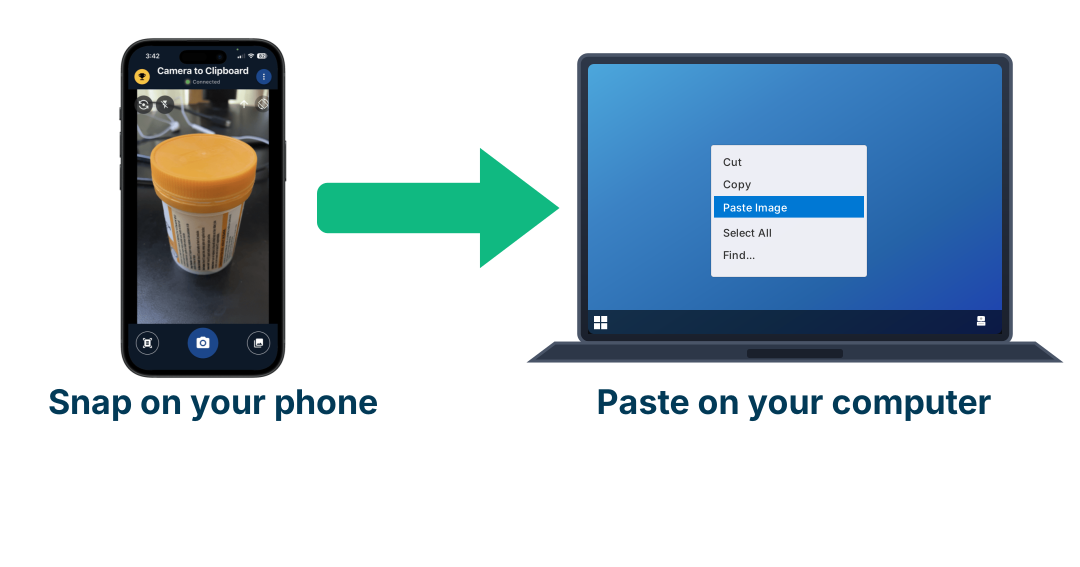
Use Camera to Clipboard to put a phone photo into the post that asks people to join
The post that asks people to join almost always needs a picture, and the picture is on your phone while the post is being written on your computer. Camera to Clipboard, one of my own apps, closes that gap with no cable and no email to yourself.
- You snap a photo on your phone and it lands on your computer clipboard, so you paste it straight into the Threads, LinkedIn or Reddit composer.
- A photo of a real thing outperforms a stock graphic in the one post where you are asking somebody to hand over their email address.
- It works the same way for a screenshot of your signup page, which is the picture this particular post usually wants.

Put one call to action on every post, because more than two of them cuts your click rate
The evidence says the number of asks matters as much as which one you pick.
- Emails carrying three or more calls to action get a lower click rate than emails carrying fewer than three.
- 43% of marketers use exactly one call to action per email and 30% use two, so one is already the majority practice.
- The figures floating around claiming a single call to action lifts clicks by 371% have no published study behind them, so ignore the size and keep the direction.
- Use the same call to action on every post rather than rotating it, because a reader who ignored it four times still knows exactly where to go on the fifth.
- Offering both email and WhatsApp inside one post is two asks, which is why the choice belongs on the page you send them to instead.

Send that one call to action to a page you own, then offer email and WhatsApp on it
This is the answer to the whole question, and it settles the email against WhatsApp argument by refusing to pick.
- Point every post at one address on your own website, so the link never changes and no platform can break it.
- Put the email box first on that page and the WhatsApp Channel link under it, so the option you can export is the default.
- Collecting the email address means you still hold the audience if Meta closes your WhatsApp account, which a Channel alone would not survive.
- Sending everybody to your own page also gives you a number nobody else will give you, which is how many people clicked and how many finished.
- A page you own works for every platform at once, so Threads, X, LinkedIn and Reddit all feed the same list.
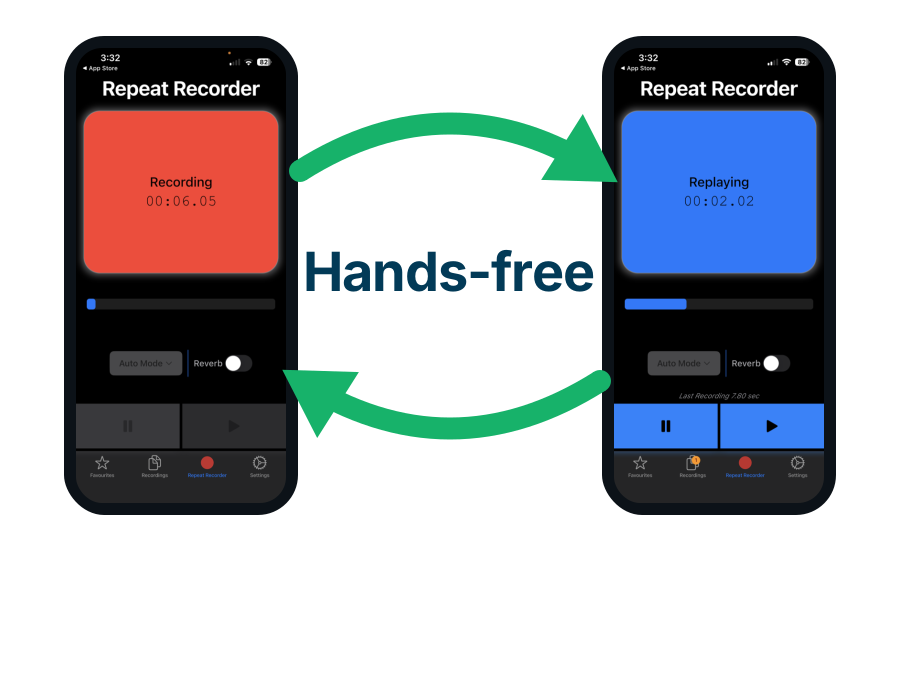
Use Repeat Recorder to rehearse the one line that asks people to join your list
If your one call to action is ever spoken out loud, in a video or a voice note, it is the line worth getting right, because you will say it hundreds of times. Repeat Recorder, another of my own apps, records a line and loops it back until it stops sounding like a script.
- You record the line and hear it looped back hands-free, so you catch the version that sounds like a person asking rather than an advert.
- The same line gets repeated on every post you make, so a few minutes of practice is spread across everything you publish afterwards.
- It costs minutes rather than the hours a filmed take would, which matters when the line is 8 words long.

Budget for WhatsApp if you scale, because one marketing message costs $0.01 to $0.14 to deliver
A WhatsApp Channel and a small group are free. The moment you want to send to a real list programmatically, WhatsApp starts charging per message.
- Meta has charged per delivered template message since July 2025, priced by message type and by the country the reader is in.
- A WhatsApp marketing message costs roughly $0.01 to $0.14 to deliver depending on the country, so 10,000 people can cost $100 to $1,400 per send.
- Utility messages cost about $0.006 each in the United States and replies inside a 24 hour service window are free, so the price depends heavily on what you send.
- Sending an email to the same 10,000 people costs a few dollars at most, which is the part of this comparison nobody mentions.
- A free WhatsApp Channel avoids all of that cost and gives you none of the ownership, so cheap and yours are two different things here.

Ask for the sale on WhatsApp and not by email, because 3 to 7 people in 100 do what it asks
Reading is not buying. Once you measure what people actually do rather than what they open, the gap between the two channels gets wider rather than narrower.
- A WhatsApp broadcast gets 3 to 7% of the people it reaches to do what it asked, and a WhatsApp message sent because of something that person just did gets 10 to 25%.
- An email campaign is clicked by about 3.96% of the people it is sent to, and only a fraction of those clicks turn into a purchase.
- WhatsApp messages carrying tappable buttons are reported at 45 to 60% clicked, which is roughly ten times an email's click rate.
- Most of those WhatsApp figures come from companies that sell WhatsApp tools, so treat the direction as reliable and the exact numbers as generous.
- A WhatsApp Business message lands in the same chat list as a person's family, which is exactly why people act on it and exactly why it annoys them if you send too many.

Email one person when they join, because it brings $1.94 in sales and a mass email brings 11 cents
This is the largest number in the whole comparison, and it has nothing to do with which channel you picked. It is about when you press send.
- Every person you email the moment they do something spends $1.94 with you on average, and every person on an email you send to the whole list on a set day spends 11 cents.
- Text messages do the same thing, getting 3.81% of people to act when the message is sent because of something they did and 0.97% when it goes to everybody at once.
- WhatsApp does it a third time, getting 10 to 25% of people to act when the message follows something they did and 3 to 7% when it goes to everybody.
- Emailing one person at the right moment beats emailing everybody by far more than WhatsApp beats email, so when you send matters more than where you send.
- Set up three of these and nothing else at first, one when somebody joins, one when somebody looks at your product and does not buy, and one when somebody stops opening your messages.

Compare every way to collect people on reach, ownership, size cap and cost
Seven places to put your one call to action, scored on the four things that decide whether it was worth asking.
| Where you collect them | Share who see each message | Can you export the audience | Cap on size | What it costs to send |
|---|---|---|---|---|
| Email list | 20.7% of emails sent are opened | Yes download it and move provider the same day | No cap | A few dollars for 10,000 people |
| WhatsApp Channel | High but Meta publishes no per-follower figure | No you never learn who a single follower is | No cap | Free |
| WhatsApp broadcast list | 60 to 68% read, measured across 355 accounts | Yes you hold every phone number | 256 and each must have saved your number | Free |
| WhatsApp group | High until people mute it | Yes every member's number is visible | 1,024 members, or 2,000 in a Community | Free |
| WhatsApp Business API | 60 to 68% read | Yes you hold every phone number | No cap | $0.01 to $0.14 per marketing message |
| YouTube subscribers | 5 to 20% of a channel's views come from subscribers | No and you cannot message anyone | No cap | Free |
| Nothing, leave them on the platform | The platform decides every single time | No nothing to export | No cap | Free |
Conclusion: how to build an email list and where else to collect people
WhatsApp does get read more than email. It is still not the better place to collect people, and the reason is ownership rather than reach.
What is true and what is not about email against WhatsApp
- WhatsApp really is read more. 60 to 68% read against 20.7% of emails opened.
- The 95 to 98% WhatsApp figure is not real. Nobody publishes a measurement that high.
- The Promotions tab is not a dead end. 21% have no tab at all and another 20% check theirs daily.
- A WhatsApp Channel hides its followers from you. No list, no export, no direct message, ever.
Do these nine things
- Put one call to action on every post and never change it. Three or more asks lowers your click rate.
- Point that call to action at one page on your own website. No platform can break your own link.
- Put the email box first on that page. It is the only audience you can download and take with you.
- Put the WhatsApp Channel link under it as the second option. It gets read three times more often.
- Send the reading on email and the asking on WhatsApp. 3 to 7 people in 100 do what a WhatsApp message asks, and about 4 in 100 even click an email.
- Email people one at a time as they join or buy, not everybody on a set day. Each of those people spends $1.94 with you, against 11 cents.
- Use a WhatsApp group only if you want members talking to each other. It caps at 1,024 and people mute it.
- Post your group invite link inside your WhatsApp Channel. It is the only way a Channel ever gives you a number you can contact.
- Never make "subscribe on YouTube" your main ask. You can never message a subscriber or take them with you.