
Every guide to cold email is a list of writing tips, and every list is roughly the same list. Keep it short. Ask a question. Use their name. Almost none of them says how much any of it is worth, and two of the numbers they are built on stopped being real years ago.
So here is the same subject with numbers on it, so you can see which advice survives. This page is about what to write. Whether the email arrives at all is a separate job, covered in how to stop your emails going to spam.

A cold email reply rate of 8.5% beats every other cold channel
The largest published count comes from Backlinko and the outreach platform Pitchbox. It is usually quoted as bad news.
- Of 12 million outreach emails sent, 8.5% got a reply back from the person who received it. For every 1,000 sent, about 85 people wrote back.
- A cold email is answered roughly 100 times more often than a display ad is clicked.
- A posted letter to a bought list gets 2.0% to 4.4%, which cold email beats for free.
- Emails between colleagues who already know each other got only 13.58% in my own test.
- The 8.5% figure is the high end for cold email, not the average. Two sales-focused counts put it at 2.09% and 3.43%.
- The 12 million email study publishes no date range, no definition of a response and no method. I quote it because nothing bigger exists, not because it is strong evidence.
| How you reached the person | How often they respond | How good the evidence is |
|---|---|---|
| A LinkedIn message | 18% to 25%, claimed | Vendor claims with no stated method |
| An email to a colleague who knows you | 13.58% | My own test on 35,480 emails |
| A cold email to a blogger or journalist | 8.5% | 12 million emails, method not published |
| A posted letter to a bought list | 2.0% to 4.4% | Industry survey, seen through other sites |
| A cold email selling something | 2.09% to 3.43% | 2 million and 20 million emails |
| A display ad, averaged across every type | 0.46% click | Ad platform reporting |
| A display ad on the open web | 0.05% to 0.08% click | Ad platform reporting |

Nearly half of cold email replies are out of office notes
So 8.5% is a good reply rate. The problem is that a reply and an interested person are not the same thing.
- A study of more than 2 million cold emails across 161 campaigns sorted its 61,770 replies into what they actually said. It ran from 2024 to early 2026.
- 45.1% of all replies were automatic out of office notes.
- 29.9% of replies were refusals from someone not interested.
- Only 14.1% of replies came from someone who was actually interested. So roughly one reply in seven is worth having.
- Applying that 14.1% interested share to the 8.5% headline reply rate leaves about 1.2% of emails producing a real lead. About one interested person for every 85 emails.
- A further 2.1% of replies were referrals passing you to somebody else.

Sending a second email beats writing a better first one
The strongest evidence here comes from two United States government teams who test the wording of official messages and kept every result.
- Stefano DellaVigna and Elizabeth Linos collected all 126 randomised trials run by those two teams, covering more than 23 million people. 87% of the results had never been published, so nobody could quietly drop the failures.
- Reminders and prompts to make a plan moved the outcome by 2.54 percentage points, the largest of any approach they tested. A percentage point means people out of every hundred.
- Making the message simpler and clearer moved the outcome by 1.19 percentage points, less than half as much.
- Appealing to the reader's own motivation landed in between at 1.77 percentage points. So the order is contact them again, give them a reason, then polish the words.
- The 12 million outreach emails point the same way, with one follow-up raising replies by 65.8%. Nobody was assigned to follow up or not, so it cannot prove the follow-up caused it.
- Those 126 government trials were about paying fines and claiming benefits, not about buying anything. The ranking transfers, the exact sizes do not.
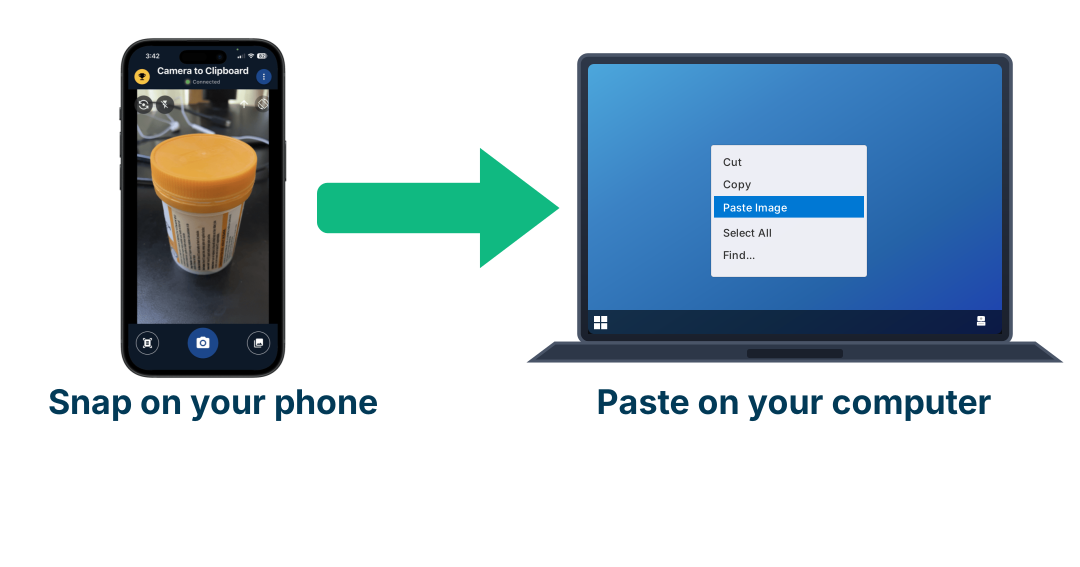
Use Camera to Clipboard to give your follow-up something new to say
Following up is the strongest thing on this page, and the hard part is having anything to add the second time. A photograph is the cheapest new thing you can put in one. Camera to Clipboard, one of my own apps, takes a picture on your phone and puts it straight onto your computer's clipboard.
- A follow-up that only says you are checking in gives the reader nothing to answer. That is the same failure as an email with no question in it, which nearly halved replies in my own test.
- A photo of the thing you are writing about turns a reminder into a second reason to reply. It also proves the email is not a template, which is most of what you are fighting at a 1.2% interested reply rate.
- The picture arrives on your computer the moment you take it, so it takes seconds rather than a detour through email or a cable.

Putting the reader's name in a subject line lifted opens 20%
Every guide says the first-name slot is dead. The one randomised test of it says the opposite.
- Navdeep Sahni, Christian Wheeler and Pradeep Chintagunta ran randomised experiments with three organisations, sending to millions of people. Published in Marketing Science in 2018.
- Adding the recipient's own name to the subject line raised opens from 9.05% to 10.80%, a lift of 20%. Same email, same offer, one extra word. That was measured in 2018, before Apple's Mail app made open rates unreliable, so it is a real number rather than a modern one.
- Sales enquiries rose 31%, from 0.39% to 0.51% of everyone emailed.
- Unsubscribes fell 17%, from 1.2% to 1.0%. The usual worry is that using a name feels creepy. Measured, it did the opposite.
- The name tells the reader nothing about the product, so it works by catching attention.
- The claim that deep personalisation gets 17% replies against 7% for basic templates has no experiment behind it anywhere. Researching the person properly is still a good idea, just not a measured one.

Emails of 50 to 125 words got the most replies
The length rule comes from one source, a 2016 Boomerang analysis of more than 5.3 million messages.
- Anything between 50 and 125 words got a reply more than half the time.
- Messages under 50 words dropped to 44%, the same rate as messages of 500 words. Too short is as costly as five times too long.
- A subject line with an empty body got a reply 11% of the time.
- Past 2,000 words the reply rate fell below 35%.
- Boomerang is a plugin for chasing your own sent mail, so this is mostly email between people who know each other. Their replies run at around 50% because these people already know each other.
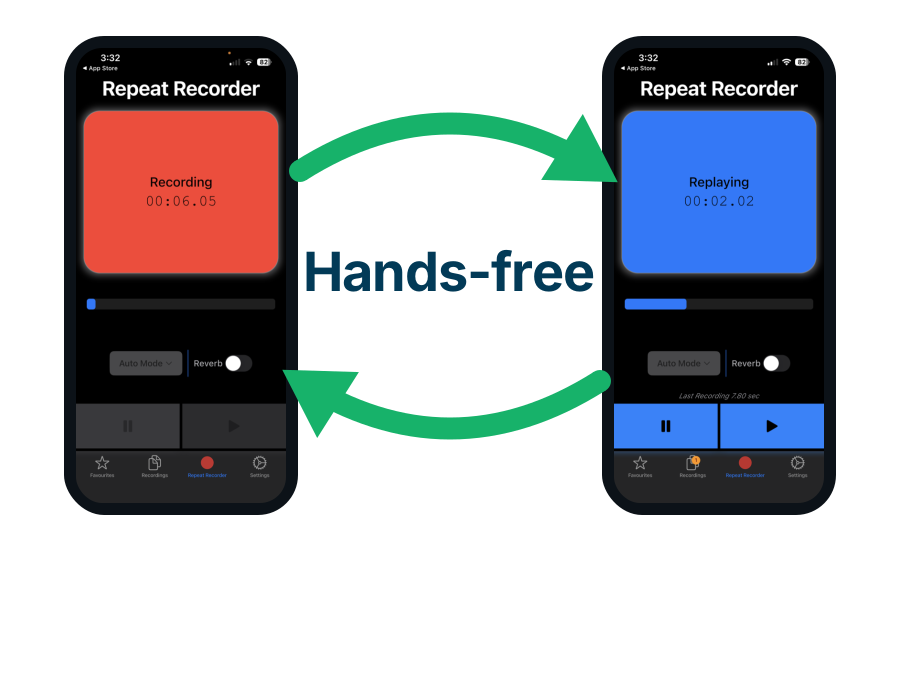
Use Repeat Recorder to practise the call your email asks for
A cold email is only trying to start a conversation, and the conversation decides the outcome. Repeat Recorder, one of my own apps, plays your own voice back to you so you hear yourself before they do.
- Repeat Recorder plays your recording back about a second after you stop speaking.
- Automatic mode starts recording when you speak and replays when you stop, without you touching the screen. That is what makes it usable while driving or walking.
- You can save the takes worth keeping into folders you name yourself and replay any of them on a loop.

Replies kept rising past 125 words and only fell past 500
That rule has never been rechecked, because the 5.3 million messages behind it are private. So I ran the same tests on emails anyone can download.
- The Enron collection is a public set of real company email, released by a US federal investigation in 2003. I read 207,369 messages from 64 of its mailboxes, covering 1999 to 2002.
- A message counts as answered if a recipient later replied under the same subject line. Quoted history is cut off first, so the word counts describe only what the sender typed.
- That left 35,480 emails people sent with a readable body, of which 13.58% got a reply.
- Emails of 50 to 125 words did beat emails under 50 words, 16.90% against 12.40%. Reaching 50 words won 36% more replies.
- Emails of 126 to 500 words beat the recommended length as well, 19.31% against 16.90%. Replies only fell past 500 words, dropping to 13.24%.
- Emails sent to more than one person got 16.89% against 11.93% for emails to one person.

Asking a question in the email nearly doubled the reply rate
Where you put the question matters as much as asking one, so I counted the subject line and the email text separately.
- Emails that asked one to three questions got a reply 21.22% of the time, against 11.40% for emails that asked nothing. Asking four or more did not help any further, at 19.69%.
- This is not just because short emails are the ones that ask questions, since asking won at every length. Under 25 words it nearly doubled replies, and past 250 words it was still worth 44% more.
- A question mark in the subject line, with no question in the email itself, did nothing at all. Those emails got 12.42% against 11.38% for asking nothing anywhere.
- Adding a question mark to the subject line as well may add a little more, at 27.49% against 20.82% for the email alone. That rests on 251 emails and nothing published anywhere else supports it, so treat it as the weakest number on this page.
- Ending with a line like looking forward to hearing your thoughts does not count as asking anything.
- Somebody who had a real question to ask was in a different situation from somebody sending an update.
Use Camera to Clipboard to put real proof in a cold email
That randomised test showed attention is what a name buys you, and a photograph catches it too. Camera to Clipboard, another of my own apps, puts a phone photo straight onto your computer's clipboard.
- The photo arrives on the computer clipboard the moment you take it, with no cable and no upload. You pair the phone and the desktop once by scanning a code on screen.
- A photograph of the thing you are writing about proves the email is not a template.
- Camera to Clipboard works for anything physical that would otherwise need a scanner.

Writing at third grade level beat college level by 36%
The same 5.3 million messages were scored for reading difficulty.
- Messages pitched at a third grade reading level got a reply 53% of the time, against 39% for college level. High school level landed between them at about 46%.
- A third grade reading level means short sentences and common words, not a childish tone.
- Slightly positive or slightly negative wording beat completely neutral wording by 10 to 15%. Boomerang warns its tone scoring is unreliable, so treat this as the weakest thing here.
- My own test found 14.93% for below grade 7 against 11.96% for college level and above. That is 25% more replies rather than 36%.
- The very simplest writing was not the best, and grade 4 to 6 beat anything below it. So plain and short is the target, not stripped back to nothing.
- The reading level figures are a pattern across messages, not proof that simplifying your own draft will do the same.

Give a stranger a longer subject line than someone who knows you
The two biggest counts disagree about subject line length. Both measured replies, not opens, and they disagree because one measured strangers and the other measured colleagues.
- Boomerang found 3 to 4 word subject lines drew the most replies across 5.3 million messages. Those messages are mostly between people who already know each other.
- Backlinko found 36 to 50 character subject lines did best across 12 million outreach emails. Those 12 million emails are cold approaches to strangers.
- Use about 6 to 8 words when writing to a stranger and about 4 when writing to someone who knows you. A stranger needs to be told who you are and why you are writing.
- Neither subject line figure came from an experiment.
- Between colleagues, subject lines of 1 to 4 words got 13.98% against 12.29% for 5 or more.
- The specific advice to use 3 to 4 words has nothing behind it, and 1 to 2 words did just as well. The rule is keep it short, not hit a number.

Every cold email rule ranked by the evidence behind it
The same rules you have read everywhere, with what those lists leave out, the evidence and the size.
| The rule | How good the evidence is | How much it is worth | What happened when I retested it |
|---|---|---|---|
| Send a follow-up | 126 randomised trials, 23 million people | 2.54 points, the largest of any approach | Not retested, my data cannot separate a follow-up |
| Put the person's name in the subject line | Randomised experiment, millions of emails | 20% more opens and 31% more enquiries | Not retested, opens are not visible in my data |
| Ask one to three questions in the email text | 5.3 million messages, no experiment | 86% more replies in my own test | Confirmed, and larger than the original claim |
| Email more than one person | 12 million outreach emails, no experiment | 42% more replies in my own test | Confirmed independently |
| Keep the email to 50 to 125 words | 5.3 million messages, no experiment | Passing 50 words won 36% more replies | Failed, 126 to 500 words did better still |
| Write at a third grade reading level | 5.3 million messages, no experiment | 25% more replies in my own test | Partly, grade 4 to 6 beat anything simpler |
| Use a 3 to 4 word subject line | 5.3 million messages, no experiment | No better than a 1 to 2 word subject line | Failed, the specific number does nothing |
| Send it on a Wednesday | One count of emails, no experiment | 2 points over the worst day of the week | Not retested, send days are not comparable |
| Research each person deeply instead of using their name | Vendor claims with no stated method | Never measured against a control group | Not retested, my data has no cold approaches |
Use Repeat Recorder to read your cold email out loud
Two of the rules above are about how the writing sounds, which is hard to judge by eye. Repeat Recorder, one of my own apps, plays your voice back a second after you stop.
- A sentence you run out of breath reading is too long for the reading level rule.
- Reading a draft aloud takes about 25 seconds at the 50 to 125 word length that got the most replies. If your draft takes a minute, it is roughly double.
- You can set the app to record hands free and loop the playback as many times as you want.

Ten cold email openings rewritten to ask something
Each rewrite gives the subject line and the one question the email exists to ask.
| Who you are emailing | What the usual version breaks | The subject line most people send | The subject line and the question to replace it |
|---|---|---|---|
| A blogger you want to be mentioned by | Asks nothing at all | Quick question | Your Perth cycling routes guide. Is the new Kwinana path worth adding to it? |
| A podcast host you want to be a guest of | Asks nothing at all | Podcast guest | Guest idea on what small apps charge. Would that fit your run of solo founders? |
| A professor you want to research with | Asks nothing at all | Research opportunity | Your 2025 paper on tidal sediment. Are you taking students this year? |
| Someone who ignored your first email | Never gets sent at all | Nothing, because most people never follow up | Following up on the Kwinana path. Still worth sending you the photo? |
| A journalist who covers your industry | Subject line means nothing to a stranger | Story idea | Figures on WA rental listings you may want. Do you cover the quarterly numbers? |
| A hiring manager with no job advertised | Subject line means nothing to a stranger | Application | Your team's Android rewrite. Are you hiring for it yet? |
| A supplier you want a price from | Subject line means nothing to a stranger | Enquiry | 500 sheets of your 3mm marine ply. Can you quote for August delivery? |
| A person you met once at an event | Subject line names nothing specific | Great to meet you | The Fremantle meetup and your caching problem. Did the second approach work? |
| A customer at a company you researched | Subject line is far too long | Helping your company streamline operational efficiency and reduce overheads | Your three Perth warehouses. Who counts the stock in them now? |
| A conference organiser | Subject line is far too long | Speaking proposal submission for your upcoming annual developer conference | Talk idea on apps that work offline. Is that track still open? |
Conclusion: how to write a cold email that gets replies
Ordered by size, best first.
- Make sure the email arrives before you rewrite it. One in six never does.
- Send a follow-up. It beat every rewrite ever tested against it.
- Ask one clear question in the email itself. It nearly doubled replies in my own test.
- Email more than one person at the organisation. Worth 42% more replies.
- Put their name or their own specific thing in the subject line. Worth 20% more opens.
- Write between 50 and 500 words. Too short costs far more than too long.
- Use short sentences and common words. Worth 25% more replies.
- Give a stranger 6 to 8 subject line words, and someone who knows you 4. A stranger needs to be told who you are.
- Count interested replies, not replies. Nearly half of all replies are automatic.
- Do not judge any of it by open rate. Apple's Mail app fires most opens by itself.