
UGC means paying somebody to film a short video about your product. The price of that one video sits anywhere between $25 and $1,200, and which end you pay depends entirely on which corner of the market you walk into. Almost every rate guide published on the subject is written by a company that sells UGC, sells a course to creators, or runs a creator marketplace. This page uses the platforms' own price pages, one named benchmark study, and four people who have actually run these campaigns.

Decide which of the two UGC markets you are buying from, because their prices differ 7 times
Two completely different things are sold under the name "UGC". Confusing them is the single commonest way a brand overpays.
- A UGC marketplace sells you a finished video file for $25 to $99, with the usage rights already included in that price.
- A creator you hire direct sells you a video of the same length for $150 to $500, and charges extra on top for the usage rights.
- Neither of those two creators posts the video anywhere, so you still need advertising money to put the file in front of anybody.
- A third arrangement has the creator post the video themselves on a brand new account, which costs $10 to $30 and buys you free views rather than a file.
- No published rate guide says which of the three it is quoting, so a guide that gives one number is describing one market and ignoring the other two.

Pay $25 to $57 a video on a marketplace, because that is what the price pages themselves charge
These are not estimates from a blog. They are the numbers printed on the platforms' own pricing pages in August 2026.
- JoinBrands lists UGC videos from $25 and UGC images from $10, and states that buying any content gives you unlimited usage rights.
- Influee's pricing page puts the average 30 second UGC video in the United States at $57.
- Influee then charges a 10% fee on creator payments on top of a subscription starting at $229 a month for up to 10 creator collaborations.
- JoinBrands takes 15% of creator payments on its free tier and 8% on its $499 a month tier, so the fee falls as the subscription rises.
- Billo is reported at about $99 a video with no subscription at all, though its own pricing page now sits behind a login, so that figure comes from comparison sites rather than from Billo.
| Marketplace | What one video costs | Fee on top of the creator payment | Usage rights | Subscription before you buy anything |
|---|---|---|---|---|
| JoinBrands | $25 and up, images from $10 | 8% to 15% depending on your tier | Unlimited and included in the purchase | $0 on the free tier |
| Influee | $57 average for a 30 second video in the US | 10% flat on every plan | Included on every plan | $229 a month for up to 10 collaborations |
| Billo | $99 reported, not confirmed on their own page | None the margin is inside the price | Included in the price | $0 no subscription |

Expect $150 to $500 a video hiring direct, and treat every published rate guide as an advert
Hiring a creator yourself costs several times the marketplace price, and the published numbers agree on the shape while disagreeing on the size.
- Published guides put a beginner creator at $75 to $150 a video, a middle creator at $150 to $300, and an experienced one at $300 to $1,200.
- The single most quoted figure across 2026 guides is a median of about $175 a video.
- That is roughly 3 to 7 times the marketplace price for the same length of video, and what the extra buys you is a person you picked rather than one a platform matched to you.
- Melanie, a creator who made $15,000 in her first five months, charged $100 to $150 a video and took $5 jobs at the start purely to put a brand logo on her portfolio.
- Every one of those published guides sits on the blog of a company that sells UGC, sells a course to creators, or runs a creator marketplace.

Distrust a rate guide with no method, because Influee's own two pages disagree by 3 times
The clearest test of a rate guide is whether the company publishing it can keep its own story straight.
- Influee's pricing page says the average 30 second UGC video in the United States is $57.
- Influee's own rate guide says the median is about $175 a video.
- A median three times higher than an average is the wrong way round, because a handful of very expensive creators pulls an average up above the middle value, not down below it.
- Influee runs a marketplace of more than 140,000 creators and published no sample size, no date range and no method behind the $175.
- A platform selling cheap access has a reason to publish a low price, and a guide written for creators has a reason to publish a high one, which is why the two numbers point in opposite directions.

Budget for about 17 videos to find one winner, because only 4 to 8% of Meta ads ever scale
The price of one video is the wrong number to budget with. The number that decides your bill is how many videos you have to buy before one of them works.
- Only 4 to 8% of the ads run on Meta ever become winners, so 92 to 96% of what you pay for will never scale.
- At a 6% win rate you need about 17 videos before one of them works.
- Seventeen videos costs $425 on JoinBrands at $25 each and $2,975 from a direct hire at $175 each.
- Brands testing 10 or more video ideas a month get a 31% lower cost per customer than brands testing fewer than 5 a month.
- A brand spending under $10,000 a month makes about 2.8 new videos a week, and a brand spending over $1 million a month makes about 18.85.
| Where you buy the video | Price of one video | Cost of the 17 videos it takes to find one winner | Videos you get for $1,000 |
|---|---|---|---|
| JoinBrands marketplace | $25 | $425 | 40 |
| Influee marketplace | $57 | $969 | 17 |
| Billo | $99 | $1,683 | 10 |
| Direct hire at the quoted median | $175 | $2,975 | 5 |
| Experienced creator hired direct | $500 | $8,500 | 2 |

Check whether usage rights are included, because JoinBrands puts unlimited rights in a $25 video
Usage rights are the permission to run a creator's video as a paid advert. Without them you own a file you are not allowed to use, and this is where the two markets differ most.
- JoinBrands states that buying any content on its platform gives you unlimited usage rights at no extra charge.
- Direct hire guides add 30% to 150% of the base price for those same rights.
- The published add-on figures range from 20% to over 150%, which is wide enough to prove that no standard rate exists.
- Running the advert from the creator's own account rather than from yours costs a further 20% to 100% of the base price for every month you run it.
- A marketplace that includes rights against a direct hire that charges 100% extra for them is a doubling of the real price of the same video.

Write "per published video" in the contract, never "per post", because a post can be a still photo
The word "post" is the cheapest hole in a UGC contract, and a creator will drive straight through it.
- The word "post" does not say whether you are buying a filmed video or a single photograph.
- JoinBrands prices a UGC image at $10 and a UGC video at $25, so the two are not the same product even on the same platform.
- Write down the minimum length of the video, the minimum number of separate camera shots, and whether the creator has to appear on camera.
- Write down who supplies the script, because a creator who has to invent the idea charges more than one who is handed it.
- One operator quotes $10 to $30 per post and says the $10 end applies only when the content is very easy to film, so that range is a difficulty scale rather than a market price.
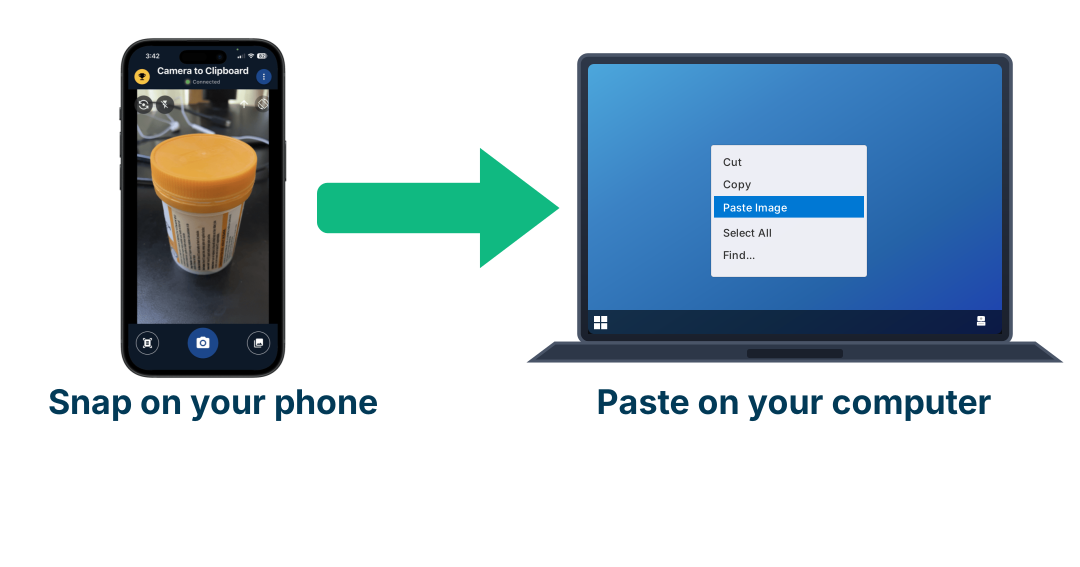
Use Camera to Clipboard to get product photos off your phone and into a creator brief
Every creator brief needs pictures of the product, the packaging and the screen you want filmed, and those pictures are on your phone while the brief is on your computer. Camera to Clipboard, one of my own apps, closes that gap without emailing yourself anything.
- You take a photo on your phone and it lands on your computer's clipboard, ready to paste straight into the brief.
- You pair the phone and the computer once by scanning a code on screen, and after that the two just talk to each other.
- Since a brief has to be written before you pay anybody, and 92 to 96% of the videos you buy will never scale, the cheapest place to spend effort is the brief rather than the creator.

Find the winning format yourself first, because that is not what you are hiring a creator for
All four operators arrived at this independently, and it is the one point they never disagree on.
- An app founder running this at scale says you hire creators to film content, not to work out how to go viral, and calls those two different jobs.
- She and her co-founders filmed the first viral videos themselves because they had no money, and only started paying creators once a format worked.
- A second founder posted 50 videos a week across several accounts until one took off, then made variations of the one that won.
- A third team built the moment that looks good on camera into the product itself, which was a photo of food turning into a calorie count.
- Paying a creator to find your format costs you 17 videos at their rate, and finding it yourself costs you your own time.

Pay a small base plus a bonus for views, because that moves the risk of a flop onto the creator
Three separate operators arrived at the same shape of deal without copying each other, which is the strongest signal in this whole subject.
- One operator pays a base of $10 to $30 a post and pays nothing at all unless the video passes 500 views.
- A second put a minimum view clause in every deal, asking the creator how many views they get and then setting the paid floor a little below the number they had just claimed.
- A third buys view retainers, paying about $500 for 250,000 views or $1,000 for a million.
- All three move the cost of a flop onto the person who filmed it, which is the one thing a flat fee per video can never do.
- A flat marketplace fee is the opposite trade, because you pay the same $25 whether the video works or not, and you keep the file either way.

Set the top bonus so a million views costs about $500, because that is 50 cents per thousand views
The bonus should get cheaper per view as the view count climbs, so your biggest payout is also your cheapest audience.
- Paying $500 for a million views works out at 50 cents for every thousand views.
- Paying $50 for 50,000 views works out at $1 for every thousand views, so the rate halves as the video gets bigger.
- Two separate operators independently name $1 to $2 for every thousand views as the going rate for influencer deals, and both say that rate is now hard to get.
- Write down that only the highest tier reached is paid and that the tiers never add together, because that is the exact clause people argue about afterwards.
- Four videos a month with one of them reaching a million views costs you about $600 in total under this shape, against the $20,000 a month one team paid a single large influencer.
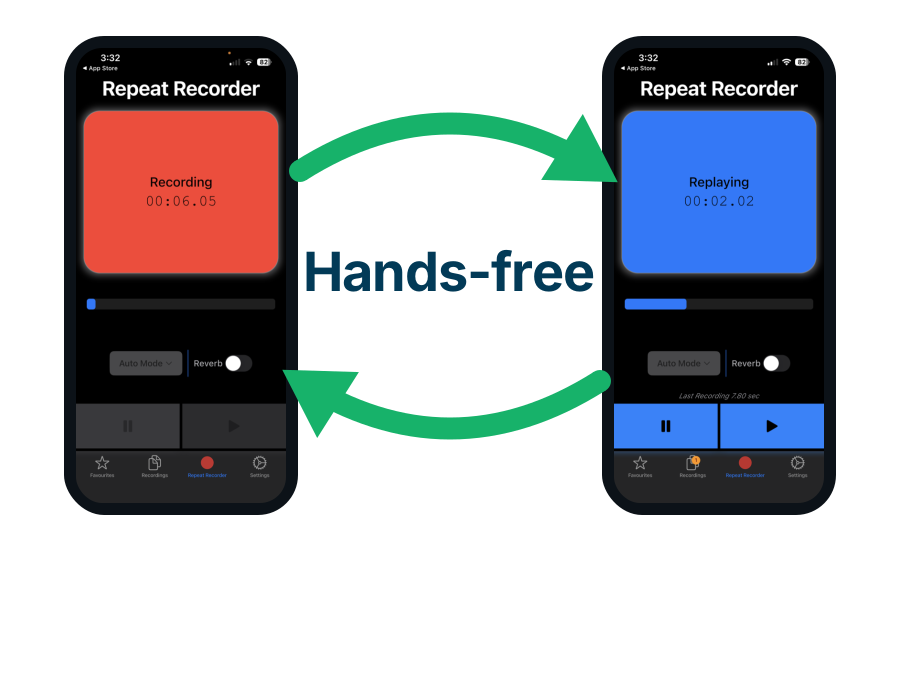
Use Repeat Recorder to rehearse the first 15 seconds before you pay anyone to film them
The first 15 seconds decides whether a UGC video works, and you have to know your own opening line before you can put it in a script for somebody else. Repeat Recorder, another of my own apps, plays back what you just said on a loop so you can hear it the way a viewer will.
- You record one line and the app replays it back to you on a loop, so you hear your own opening the way a stranger hears it.
- Repeat Recorder runs hands free, so you can rehearse a line while holding the product you are going to film.
- Rehearsing your own opening line costs nothing, while the 17 videos it takes to find a winner cost $425 on a marketplace and $2,975 from a direct hire.

Give each creator a new account and three days of warm-up, because a fresh account aims better
This only applies to the third arrangement, where the creator posts the video rather than sending you a file.
- One operator has every creator open a brand new account rather than post from their existing one.
- A brand new account carries no history, so it is easier to steer toward the audience you actually want.
- The warm-up takes three days of following and resharing chosen accounts before the first video goes out.
- Follow small accounts rather than famous ones, because everybody on earth follows the famous ones and the algorithm learns nothing about you from that.
- None of this applies to a marketplace order, because there the creator never posts anything and you are buying a file to run as an advert.

Show your app inside the first 15 seconds, because a video that never shows it barely converts
One founder published the numbers from two of his own videos, and the gap between them is the largest single finding in this subject.
- His funny video that never showed the app at all took 40 million views and produced roughly 7 installs.
- His video that was entirely about the app took 1.2 million views and produced roughly 2,400 installs.
- That is 33 times fewer views and more than 300 times more installs.
- A separate team's hard rule was that the app had to appear within the first 15 seconds of every video they paid for.
- That same team said their best videos barely mentioned the app, which does not contradict the rule, because showing a thing is not the same as selling it.

Write a shot and an emotion for every line, because watch time is what buys you free reach
The operator who gets the most free views out of UGC writes her scripts the way a film is written rather than the way an advert is written.
- She gives each sentence in the script an emotion as well as words, so the delivery changes as the video runs.
- She specifies long shots, middle shots and close shots so that the picture keeps changing rather than holding still.
- Her stated reason is that the algorithm rewards watch time, and a person talking flat into a phone with nothing changing loses it.
- She films the example videos herself and swaps her own example out for a creator's version whenever the creator's performs better.
- A creator posting on a brand new account welcomes a detailed script, while a well known influencer with their own audience will refuse one, so script exactly as much as the creator's own name is not involved.

Cap revisions at two rounds and skip exclusivity, because exclusivity adds 20 to 40% for nothing
These are the terms that quietly add money to a deal without adding anything you can measure.
- Published contract guidance settles on 1 to 2 rounds of small changes, turned around within 48 to 72 hours each.
- Extra rounds beyond that limit are charged at $50 to $150 each.
- Exclusivity stops a creator working for your competitors for 30 to 90 days and adds 20 to 40% to the price of the deal.
- Buying exclusivity from a beginner creator buys you very little, because your competitor was unlikely to approach them anyway.
- Name the specific competitors rather than a whole industry if you do buy it, because a broad clause is what makes creators refuse the deal.
Use Camera to Clipboard to move competitor screenshots onto the computer you write briefs on
Finding your own format means scrolling your competitors on a phone and then explaining what you saw on a computer. Camera to Clipboard, one of my own apps, carries the picture across so the screenshot does not get stranded on the phone.
- A photo taken on your phone arrives on your computer's clipboard, so you can paste it into a brief without emailing it to yourself.
- It works over your own network between two apps you have paired, so nothing has to be uploaded to a shared folder first.
- The operator who gets the most free views keeps a bank of example videos for her creators, and a bank is only useful if you can actually get things into it.

Test one AI video against one real creator, because AI costs $2 to $15 and lands within 5 to 20%
AI generated UGC is the newest thing in this market and the hardest to get honest numbers on, because everyone publishing numbers is selling it.
- AI generated UGC videos are quoted at $2 to $15 each, and under $5 each when they are made in bulk.
- A campaign of five video variations is quoted at $100 to $285 with AI against $1,100 to $2,950 with real creators.
- Vendors report AI landing within 5 to 20% of a real creator on the numbers that matter, and one reported test had AI matching click rate and beating cost per customer by 18%.
- Every one of those figures comes from a company that sells AI video, so treat them as sales claims rather than findings.
- The cheap way to settle it is to run one AI video against one real creator video on the same audience and read your own numbers instead of theirs.

Compare every way to buy a UGC video on price, usage rights, risk and free views
Seven ways to get a video made, scored on the four things that decide what it actually costs you.
| How you buy the video | Price of one video | Usage rights to run it as an advert | Who pays when a video flops | Free views included |
|---|---|---|---|---|
| JoinBrands marketplace | $25 and up | Unlimited and included | You the fee is the same either way | None you buy ads to show it |
| Influee marketplace | $57 average in the US | Included on every plan | You plus $229 a month minimum | None you buy ads to show it |
| Billo | $99 reported | Included in the price | You the fee is the same either way | None you buy ads to show it |
| Creator hired direct | $150 to $500 | 30% to 150% extra on top | You paid up front per video | None you buy ads to show it |
| Creator who posts on a new account | $10 to $30 plus a view bonus | Not needed they post it themselves | The creator no views means no bonus | Yes whatever the video earns |
| Influencer with their own audience | $100 to $200 for a video reaching 100,000 views | Usually extra and negotiated | Shared if you set a view floor | Yes from their own followers |
| AI generated video | $2 to $15 | Not needed nobody is filmed | You but the loss is a few dollars | None you buy ads to show it |
Conclusion: what to pay a UGC creator and how to run the campaign
The price of one video is not the question. The question is what 17 videos cost you, because that is how many it takes to find one that works. Here is the answer in two parts, largest effect first.
What to pay
- Pay $25 to $57 a video on a marketplace, because that is what the price pages charge.
- Pay $150 to $500 only when you are choosing the person yourself.
- Budget for 17 videos, not one, because only 4 to 8% of Meta ads ever scale.
- Check that usage rights are included before you compare any two prices.
- Refuse to pay 30% to 150% extra for rights a marketplace gives away.
- Skip exclusivity, because it adds 20 to 40% and buys almost nothing.
- Cap revisions at two rounds, charged at $50 to $150 beyond that.
- Trust no rate guide that publishes no method.
How to run it
- Find the winning format yourself before you pay anybody.
- Write "per published video" in the contract, never "per post".
- State the minimum length, the number of shots, and who writes the script.
- Show your product inside the first 15 seconds of every video.
- Show the product, never sell it.
- Pay a small base plus a view bonus when the creator posts it themselves.
- Set the top bonus so a million views costs about $500.
- Write down that only the highest bonus tier is paid.
- Give a posting creator a new account and three days of warm-up.
- Give every script a shot and an emotion for each line.
- Test one AI video against one real creator and read your own numbers.