
Almost every rule about writing headlines comes from a marketing blog quoting another marketing blog. I found a public archive of 27,616 randomised headline experiments and measured the rules myself. Most of the popular advice does nothing, and the most expensive habit is one nearly everybody uses.
The archive is every A/B test the publisher Upworthy ran from 2013 to 2015. Each test showed the same article in the same place on the same day and changed only the wording. I kept the 10,592 tests where the picture was identical as well, so the words are the only thing that moved.

Every headline element ranked by measured effect
Each row is one thing you can do to a headline, measured inside the same test against versions that did not do it.
| Element in the headline | Effect on clicks | What to do | Example |
|---|---|---|---|
| Names a person as "he", "she" or "they" | Up 5.7% | Write about a person, not a subject | She lost 40% of her traffic overnight |
| Hints at it with "this" or "these" instead of naming it | Up 4.7% | Use sparingly, it wears out fast | This one setting was costing me money |
| Contains a digit | Up 4.5% | Write 7, never seven | I wasted 3 years on the wrong idea |
| Negative word such as "worst" or "nothing" | Up 4.2% | Say what failed, not what worked | Nobody warned me about the second year |
| First person singular, "I" or "my" | Up 3.3% | Tell it as your own story | I shut down my app after 3 years |
| Odd number rather than an even one | No effect | Ignore the rule entirely | 7 rules and 8 rules perform alike |
| Second person, "you" or "your" | No effect | Use it if it reads better | What your audience really wants |
| Positive superlative such as "best" | No effect | Drop it, it is filler | The best tool I ever used |
| The word "why" | Down 3.8% | State the reason instead | Why my launch failed |
| First person plural, "we" or "our" | Down 6.4% | Swap we for I, or name the person | We are excited to share our news |
| One word in capital letters | Down 6.5% | Never, and Google re-cases it anyway | My BEST year yet |
| Two or more words in capitals | Down 12.5% | Worse than one, avoid entirely | My BEST YEAR yet |
| Quotation marks | Down 8.3% | Paraphrase rather than quote | "It changed everything," says founder |
| The phrase "how to" | Down 8.8% | Name the outcome, not the instruction | How to grow an audience |
| A colon | Down 9.5% | Rewrite as one sentence | Launch day: what went wrong |
| A question mark anywhere | Down 10.5% | Turn the question into its answer | Is this the end of organic reach? |
| An exclamation mark | Down 12.1% | Delete it | We finally shipped it! |
| Ends with a question mark | Down 13.5% | The most expensive habit, stop it | Does upload frequency matter? |
Note the middle band. Three of the most confidently taught rules in copywriting sit there, returning nothing at all. Every row below gets its own section.

Ending a headline with a question mark costs 13% of clicks
Start with the row at the bottom of that table, because it is the largest effect measured in either direction. It is also the habit most headline guides actively recommend.
- A headline ending in a question mark lost 13.5% of its clicks against the same headline written as a statement. That is across 2,857 separate tests, which makes it the most certain finding in the whole set.
- A question mark anywhere in the headline cost 10.5%. Moving it into the middle does not rescue it, so the problem is asking rather than telling.
- Write the answer instead of the question, keeping the same words. "Does upload frequency matter?" becomes "Upload frequency is not a ranking factor".
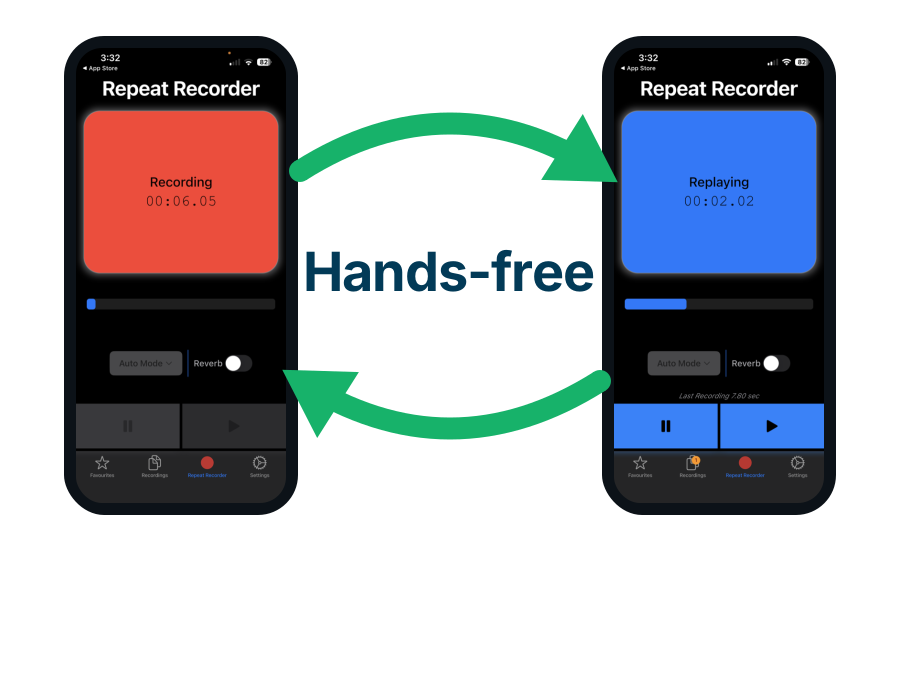
Use Repeat Recorder to practise saying your lines out loud
Every rule so far is about words on a screen, and writing is only half of marketing yourself. The same words end up spoken in a video, a podcast intro, a pitch or a talk, and that takes practice. Repeat Recorder, one of my own apps, is a recorder built around a loop: you speak, it replays what you said, and it records your next attempt.
- Repeat Recorder runs hands free, so you can rehearse while holding a camera or standing at a whiteboard. You speak, it plays your take back, and it records the next one without you touching the phone.
- Repeat Recorder lets you set how many times it replays before recording again. Hearing your own take is what exposes the words you stumble on, and those are usually the ones to cut.
- Repeat Recorder works with headphones or a Bluetooth microphone and supports practice in a range of languages. The loop is the same whichever language you are rehearsing in.

A colon costs 9.5% and an exclamation mark 12.1%
The question mark is not the only punctuation that costs you. Five of the most expensive things measured are punctuation or packaging rather than content, and they all do the same thing: they announce the shape of the sentence instead of saying what happened.
- A colon cost 9.5% across 1,475 tests. It splits the headline into a label and a payload, and readers skim past the label to get to the point. "Launch day: what went wrong" loses to "What went wrong on launch day".
- An exclamation mark cost 12.1% across 845 tests, the second worst thing measured after ending on a question mark. "We finally shipped it!" is doing the shouting that the sentence itself should be doing. Delete it and change nothing else.
- Quotation marks cost 8.3% across 403 tests. A quoted fragment hands the reader somebody else's words before they know why those words matter. Paraphrase it instead, so "It changed everything," says founder becomes The founder never expected it to fail this way.
- The phrase "how to" cost 8.8% across 482 tests, which is the most surprising loser in the set. It is the single most common way to open a headline in this trade. Name the outcome instead of the instruction, so "How to grow an audience" becomes "I grew an audience with 3 posts a week".
- The word "why" cost 3.8% across 2,198 tests, for the same reason as the rest. "Why my launch failed" promises an explanation without giving it, so state the reason instead: "My launch failed because nobody wanted it".
- All five announce the format of the headline rather than its content, which is the pattern worth taking away. A colon promises a list, an exclamation mark promises excitement, quotes promise a person talking, "how to" promises instructions and "why" promises a reason. None of them says what actually happened, and the version that does beats all of them.

Writing "I" gains 3.3% and writing "we" loses 6.4%
Personal voice works, but only in the singular. The two forms of first person were measured separately and they move in opposite directions.
- A headline using "I", "my" or "me" gained 3.3% across 3,569 tests. "I shut down my app after 3 years."
- A headline using "we", "our" or "us" lost 6.4%. "We are excited to share our news." This is the more certain of the two results.
- Naming a person as "he", "she" or "they" beat both, at 5.7%. "She lost 40% of her traffic overnight." This was the strongest element in the whole dataset.
- Nobody ran a test that swapped one pronoun straight for the other, so the gap between the two is arithmetic rather than a measured result. Each was measured against headlines that did not use it, which is why the two numbers are quoted separately instead of added together.

A digit in a headline is worth about 4.5% more clicks
Half of the popular numbers rule is real. Putting an actual figure in a headline does measurably help, and the form you write it in matters too.
- A headline containing a digit gained 4.5% across 3,703 tests. "I wasted 3 years on the wrong idea."
- Write the digit, never the word. A live ad campaign measured 1.92% against 1.35% for the spelled-out version, so write 7 rather than seven.

Odd numbers beat even numbers by nothing at all
The other half of the rule is invented, and unusually for headline folklore the invention has a traceable origin. Nobody has ever produced the study it rests on.
- Odd numbers won 51.4% of the time, which is what a coin flip looks like. "7 rules" and "8 rules" perform alike.
- The rule comes from one 2011 blog post whose author was the ad network's own blog editor. It contains a single hyperlink and it points at an unrelated article about thumbnails. A commenter asked for the study in 2011 and was never answered.
- An analysis of 100 million headlines found nine of the top twenty numbers were odd and eleven were even. That is what no effect looks like.

Negative words beat positive words in every dataset
Emotional wording does work, but the direction matters far more than the intensity. Every dataset that measured both halves found the negative half pays and the positive half does not.
- Words like "worst", "never", "nothing" and "nobody" gained 4.2%. "Nobody warned me about the second year." "The worst advice I ever took." "Nothing I tried worked for 3 years."
- Words like "best", "always", "amazing" and "perfect" measured as nothing. "The best tool I ever used" performs like the same headline with no adjective in it.
- A study of 105,000 headlines found each negative word added 2.3% and each positive word cost 1.0%. Sadness won the clicks and anger did nothing, which is the opposite of the usual outrage advice.

Anger and curiosity beat every other feeling tested
Feelings are the part of a headline nobody measures, so I ran ten of them through the same 10,592 randomised tests. Each one means the feeling the headline provokes about the thing it describes, not how the reader feels about your writing. The answer is not the one the advice gives you: the unpleasant feelings win and the pleasant ones lose.
| Feeling the headline provokes about its subject | Effect on clicks | Example |
|---|---|---|
| Disgust, words like "gross", "awful" or "horrible" | Up 7.5% | The most awful advice I ever paid for |
| Anger, words like "outrage", "furious" or "shameful" | Up 7.0% | The unfair rule nobody voted for |
| Curiosity, a vague pointer like "this", "what" or "here" | Up 6.2% | This is what nobody tells you about year 2 |
| Surprise, words like "shocking" or "unexpected" | Up 2.8% | The result was not what I expected |
| Sadness, words like "died", "tragic" or "alone" | No effect | The year I lost everything |
| Fear, words like "scary", "dangerous" or "warning" | No effect | The risk nobody warned me about |
| Urgency, words like "now", "today" or "finally" | No effect | Do this today, before it closes |
| A moral push, words like "should", "must" or "everyone" | Down 2.0% | Everyone should stop doing this |
| Awe, words like "amazing", "incredible" or "beautiful" | Down 2.9% | An incredible thing happened to me |
| Hope, words like "hope", "better", "win" or "help" | Down 8.5% | How I finally got better at this |
- Curiosity is the most certain result here, gaining 6.2% across 7,162 tests. Pointing at something without naming it works, so "This is what nobody tells you" beats naming the thing outright.
- Curiosity only pays while you are vaguer than the headlines around you. A meta-analysis of 8,977 experiments found that adding detail helped the vaguest headlines by 5.5% and cost the already-specific ones 9.9%. Being vague is a relative move, not a free one.
- Anger and disgust at whatever the headline is about measured strongest, at about 7% each. Those two sit on the smallest samples in this table, roughly 400 tests each, so trust the direction more than the size.
- Hope is the worst feeling you can reach for, at 8.5% fewer clicks across 2,586 tests. Awe and a moral push both measured slightly negative too, so "amazing", "beautiful" and "everyone should" are all working against you.
- Urgency did nothing at all, which kills the most common piece of copywriting advice there is. "Now", "today" and "finally" measured 1.6% worse across 2,591 tests, close enough to zero that chance explains it.
- Sadness and fear both came out as nothing, and sadness is genuinely unresolved. A study using a properly validated word list found sadness did lift clicks, while my simpler word list found nothing, so treat that one as an open question rather than a settled answer.
- Getting shared is a different question from getting clicked. Across 6,956 New York Times articles, anger was the strongest driver of forwarding at 34% above average while sadness was the only feeling that reduced it, at 16% below. People click what disgusts them and forward what enrages them.

Putting the word "you" or "your" in a headline changes nothing
Addressing the reader directly is the single most repeated instruction in headline writing. It was measured on more tests than almost anything else here, and it did nothing at all.
- The words "you", "your" and "you're" measured 0.9% worse, close enough to zero that chance alone explains it. That is across 5,611 tests, so this is not a case of too little data to see an effect.
- "What your audience really wants" performs like "What audiences really want". Use the second person if it reads better and expect nothing from it.
- A pre-registered study on 24,333 headline pairs also failed to confirm it. Two datasets, two methods, same answer.

Emoji win the glance but lose the click
An emoji is an attention trick rather than a persuasion one, and the two come apart cleanly in the data. It buys the look and then costs you on everything after it.
- An emoji only works while it is rare in the list the reader is scanning. Where emoji were scarce they took 33% of choices against 9%. Once everyone uses one, the advantage is gone.
- Adding an emoji to the same subject line did not increase how often it was chosen. It raised negative feeling towards the message by 26%, and a repeat test on 847 people found emoji make you look warmer and less competent.
- A matching emoji can help and a decorative one costs you. A cocktail emoji on drink recipe pages gained 11.3%, while a generic star emoji across 56,730 pages lost 5.1%.

Using capitals as a highlight costs 6.5% of clicks
Capitals are the one device people reach for on purpose, either to emphasise a word or to shout. It is the clearest loser in the whole dataset, and using more of them makes it worse rather than better.
- One word in capitals cost 6.5% across 1,473 tests. "My BEST year yet" loses to "My best year yet". Using capitals as a highlight does not work, it just costs you.
- Two or more words in capitals cost 12.5% across 257 tests, nearly double the damage. So it is not a threshold you can stay under. The penalty scales with how much you shout.
- A whole headline in capitals cannot be measured here, because only 3 of 128,217 headlines did it. A publisher that tested almost everything else never seriously tried it, which is its own kind of answer.
- Even a two-letter acronym cost 7.2% across 528 tests, though this one deserves caution. Swapping "US" for "America" changes the tone as well as the case, so some of that is probably the word rather than the capitals.
- Reddit agrees, at a much larger scale. Across 24.1 million posts, capitals showed up in 24.4% of winning titles against 25.7% of losing ones, and the researchers suggest capitals read as unprofessional or spam-like.
- The one place capitals look like a winner is search, and it is a mirage. Two split tests measured 17.5% and 7% more traffic from capitalising a title, then checked the live results and found Google had quietly re-cased the titles, so no searcher ever saw the capitals that supposedly caused the lift.

On Reddit the title is very nearly the whole product
Reddit is the hardest case for a headline because there is so little else. No thumbnail worth looking at, no description, and one line of text competing with every other line on the page.
- Roughly 73% of Reddit votes are cast without the voter ever opening the post. Researchers logged about 2 million interactions from 309 users over a year. The title is usually the entire basis of the vote.
- Reddit caps a title at 300 characters and you cannot edit it after posting. It is the one irreversible decision in the post.
- The title matters most where there is no picture. Across 769,698 matched pairs, a model reading only the title picked the winner 75.6% of the time on r/relationships and 58.0% on r/funny.
- Longer Reddit titles beat shorter ones, which is the opposite of the usual advice. An analysis of 24.1 million posts found the winning post had more words and longer sentences. The popular rule to stay under 60 characters has no dataset behind it and was borrowed from Google's search result limit.
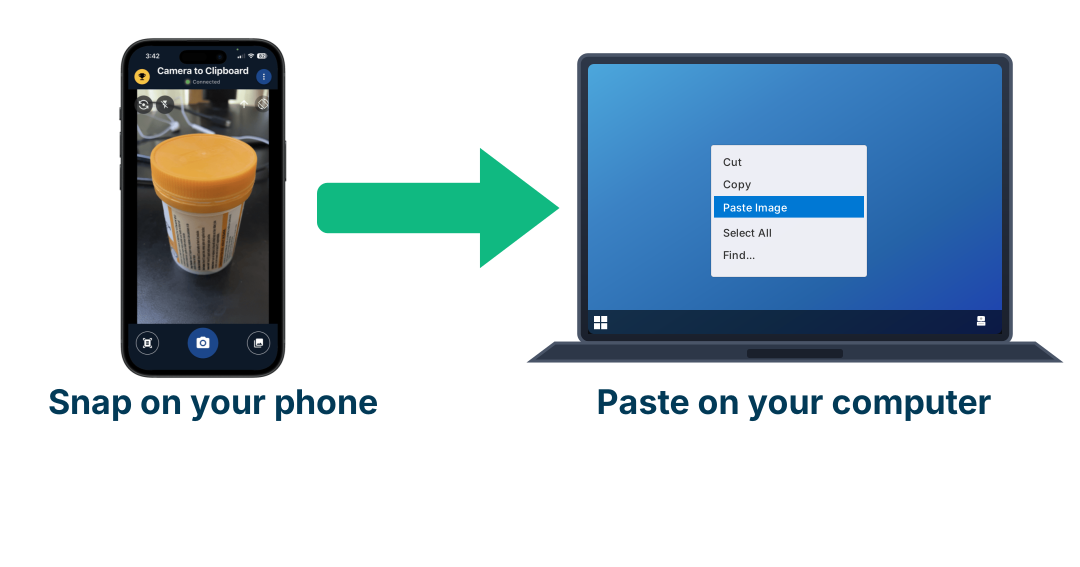
Use Camera to Clipboard to collect headlines you see in print
The most searched thing about this subject is not a rule, it is examples. Newspapers and magazine covers are still where the best headlines are, written under a hard space limit, and they are on paper rather than on your screen. Camera to Clipboard, another of my own apps, gets a photo of one onto the computer you are writing on.
- A photo you take in Camera to Clipboard is on your computer's clipboard the moment you take it. No emailing it to yourself and no cable, because the phone and the computer talk over your own network.
- You can send several photos from the phone's library at once. A single magazine page is a dozen headlines, and collecting them is how you get a feel for the wording that measured well above.
- The photo arrives as an ordinary image on the clipboard rather than a file you have to go and find. A notes app takes it, a document takes it inline, and an image editor opens it as a new document.

Ten headlines rewritten using only the measured elements
Each row takes a headline written the way the popular advice teaches, then removes the parts that measured negative and adds the ones that measured positive.
| Original headline | What was wrong with it | Rewritten | Clicks the rewrite wins back |
|---|---|---|---|
| Why Does Upload Frequency Matter? | Ends in a question mark, and uses why | Upload frequency is not a ranking factor | About 17% |
| You Won't Believe What We Found! | Exclamation mark, plus we | I found 8 broken images on my own site | About 19% |
| How To Write A Headline: 7 Amazing Tips | How to and a colon, plus a superlative | 7 headline rules that measured as nothing | About 18% |
| Tips: How To Grow Your Audience | A colon and how to | I grew an audience with 3 posts a week | About 18% |
| Our BEST Product Ever Is Here | Capitals, plus we and a superlative | I rebuilt the thing I got wrong last year | About 14% |
| Is This The End Of Organic Reach? | Ends in a question mark | Organic reach fell to almost nothing this year | About 14% |
| "It Changed Everything," Says Founder | Quotation marks | The founder never expected it to fail this way | About 8% |
| We Are Excited To Announce Our News | We twice, and nothing specific | I shut down the product after 3 years | About 6% |
| Why You Should Care About This | Uses why, and names nothing | She lost 40% of her traffic in one update | About 4% |
| The Ultimate Guide For You | Superlative and you, both measured as nothing | Nobody warned me about the second year | About 3% |
The last column adds up the measured effect of the parts that were swapped out, so treat it as a rough guide rather than a promise. Every rewrite is shorter, names something specific, and says what happened instead of promising that something happened.
Conclusion: every measured rule as one checklist
Every element that measurably moved the click rate, in one place. The numbers are the median change against the same headline without that element, across the same randomised tests.
Put these in the headline
- Describe a situation the reader will find disgusting. Up 7.5%
- Describe a situation that will make the reader angry. Up 7.0%
- Provoke curiosity with a vague pointer like "this" or "these". Up 6.2%, the most certain gain measured
- Name a person as he, she or they. Up 5.7%
- Put a digit in it, written as 7 rather than seven. Up 4.5%
- Use a negative word such as worst, never or nothing. Up 4.2%
- Write "I" or "my" rather than a company voice. Up 3.3%
- Say the outcome was unexpected. Up 2.8%
Take these out of the headline
- A question mark at the end. Down 13.5%
- Two or more words in capitals. Down 12.5%
- An exclamation mark. Down 12.1%
- A question mark anywhere at all. Down 10.5%
- A colon. Down 9.5%
- The phrase "how to". Down 8.8%
- Hopeful words such as hope, better, win or help. Down 8.5%
- Quotation marks. Down 8.3%
- Even one word in capitals. Down 6.5%
- The words "we", "our" or "us". Down 6.4%
- The word "why". Down 3.8%
- Awe words such as amazing, incredible or beautiful. Down 2.9%
- A moral push such as should, must or everyone. Down 2.0%