
X is the platform whose economics changed most quietly. Free reach has collapsed to almost nothing, posts die in about 43 minutes, and links are buried. Paying lifts you roughly tenfold, but from a very low base. Here is which tier is actually worth it and who X still makes sense for. This is one section of a larger piece; the full comparison table puts all nine channels side by side.

 X is now pay-to-reach and a free account hits a wall
X used to be the quickest place on the internet to be heard. Reach there now follows the payment rather than the post.
- About half of what people see on X comes from accounts they do not follow, so cold reach does still exist. The algorithmic For You tab replaced the chronological Following tab as the default.
- A free X account gets under 100 median impressions per post, a Premium account about 600 and Premium+ over 1,550. Buffer measured 18.8 million posts from about 71,000 accounts between August 2024 and August 2025.
- By March 2025 the median engagement rate for a free X account had fallen to 0%, so at least half of all unpaid posts get no likes, replies or reposts at all.
- A post on X loses half its engagement in about 43 minutes, against roughly 48 hours on TikTok and months on YouTube. It has the shortest shelf life of any platform in this comparison, so staying visible means posting many times a day.
- X now sends only about 1.2% of the referral visits arriving at outside sites, and that share keeps falling.
On X the reach now belongs to whoever pays for it, not to whoever writes the best post.

X gives nearly all its reach to accounts that are already big and already paying
X still says the best post wins, and its own ranking code says otherwise.
- X's own open-sourced ranking code confirms paid verified status as a positive ranking signal, so a free account is actively pushed down rather than merely un-boosted.
- Paying accounts average roughly ten times the reach of free ones, at about 600 impressions a post against under 100.
- X paid creators about $415 million in 2025, up from $260 million in 2024, and the pool skews heavily to the largest accounts. Payouts follow how fast a post gathers replies and reposts, which favours accounts that are already big and already paying.
- A 100-follower account can still hit a million views on TikTok and mostly hits a wall on X, because the way through the wall is a credit card rather than a better post.
X Premium at about $8 a month is the only tier worth buying
Reach on X is for sale and it is only a few dollars a month, so the obvious move is to pay. The catch is that the tiers are not priced in line with the reach they buy.
| Tier | Price / month (web) | Boost X promises | Reach you actually get (median impressions per post) | Worth it for a small brand? |
|---|---|---|---|---|
| Free | $0 | None | Under 100, near-invisible | No, you will barely be seen |
| X Basic | ~$3 | Slight reply boost | Barely above free in the data | No, buys features (edit, longer posts), not reach |
| X Premium | ~$8 | Larger reply boost, blue check | ~600, about 10x free | Yes, the minimum tier that moves reach |
| X Premium+ | ~$40 | Largest boost, ad-free, Grok | 1,550+, roughly 2x Premium | Only if you live on X, 5x the price for ~2x the reach |
| Premium Business | ~$200 (full tier ~$1,000) | No extra reach claim, gold check | No public data it out-reaches Premium+ | No, not for reach, it buys trust and impersonation defence |
Prices are web rates in USD (about $3, $8 and $40 a month in 2026). In-app and Australian prices run higher: expect roughly AUD $6, AUD $13 and AUD $35 or more, which is likely the pricing you are seeing. Reach figures are median impressions per post from Buffer's study of 18.8 million posts, not X's own numbers.
- Skip X Basic, which barely beats a free account on reach. You are paying for editing and longer posts.
- X Premium at about $8 a month is the tier that works, at roughly ten times a free account's reach. If you are going to pay for X, this is the one.
- X Premium+ at about $40 a month costs five times more for roughly double Premium's reach, which is worth it only if you post constantly and live on the platform.
- The $200-plus X business tiers are not a reach product, and there is no evidence they out-distribute a $40 Premium+ account.
- Even at the top tier a Premium+ post reaches about 1,550 people, against 2,000 to 4,000 for one post in a 10,000-member Facebook Group. Paying takes you from almost invisible to a few hundred people, which is not the same as competing with those platforms.
- Paying buys impressions and not sales, because the link penalty still bites for payers, whose link posts limp along at about 0.25 to 0.3% engagement.
Paying for X Premium cannot buy you the reach that a large account already has
This is the question that decides whether the subscription is worth anything to you. A subscription raises a floor, and it does not close the gap to an account people already follow.
- A subscription multiplies the followers you have and cannot give you followers, so a Premium+ post tops out near 1,550 impressions however good it is.
- The average post on X gets 2,711 impressions, measured by Metricool across 1,123,528 posts from 15,116 accounts, so the top paid tier sits below the platform's own average post.
- Buffer's 1,550 is the middle of paying accounts and Metricool's 2,711 is an average across all accounts, so the two are not the same statistic. The gap between them is itself the answer, because an average that far above the middle means large accounts are pulling it up.
- The tenfold figure compares two groups of accounts rather than one account before and after it subscribed. Buffer did not control for follower count and admits it in a single line, so part of that gap is simply that subscribers tend to be larger accounts already.
- A free account with a few thousand real followers already reaches 500 to 5,000 people per post, which overlaps the top paid tier without paying anything.
- Several growth blogs claim a Premium account under 1,000 followers beats a free account with several thousand, and that sentence is not in the study they cite.
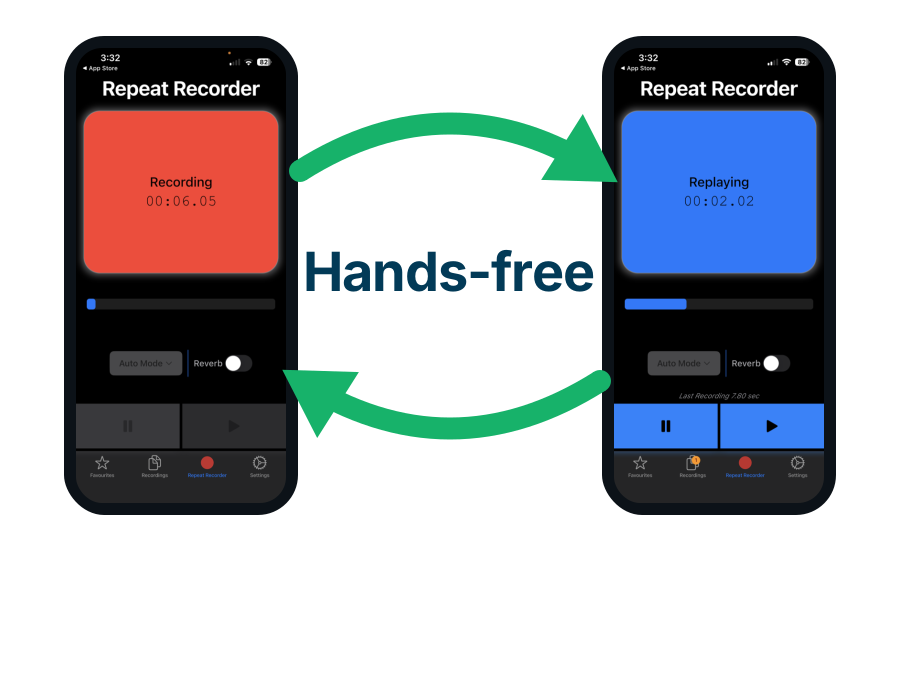
Use Repeat Recorder to rehearse a video post X will not bury
A subscription takes you from almost invisible to a few hundred people and no further. Links stay suppressed even for payers, and what is left is native content, which increasingly means saying something out loud to a camera. Repeat Recorder, one of my own apps, records you and plays the take straight back without you touching the phone.
- Repeat Recorder replays each take automatically and then starts recording again, so you can run the same opening sentence twenty times without picking the phone up.
- A post on X loses half its engagement in about 43 minutes, so a clip has to be right when it lands rather than fixed afterwards.
- Takes worth keeping go into favourites and into folders you name yourself, dragged into whatever order you want.

The link penalty makes X a weak bet for driving clicks
X fights the exact posts that drive customers, and the audience itself is shrinking underneath it.
- A link post from a regular X account runs at 0% engagement against 0.40% for a plain text post, and even a Premium account's link post manages only 0.28% against 0.90% for its text, across the same 18.8 million posts.
- X said in October 2025 that it had dropped its link penalties, and observers report the suppression continuing through engagement-based demotion. Treat any "links are fine again" claim with caution.
- Keep the post itself link-free and put the URL in the first reply, which is the workaround Musk endorsed and which nobody has ever measured. Buffer calls the trick "not foolproof" and publishes no figure for it, and a reply is only seen by people who open the thread.
- X's mobile daily active users fell about 13% in a year, from roughly 148.5 million in October 2024 to 128.8 million in October 2025. Threads overtook X on daily users in late 2025.
- X still earns its keep for B2B, tech, finance and news, where journalists, founders, investors and developers set the conversation. The win there is authority and inbound messages rather than measurable clicks.
- Skip X entirely for a broad consumer brand chasing clicks, because the link penalty, the collapsed referral traffic and the price of being seen stack on top of each other.
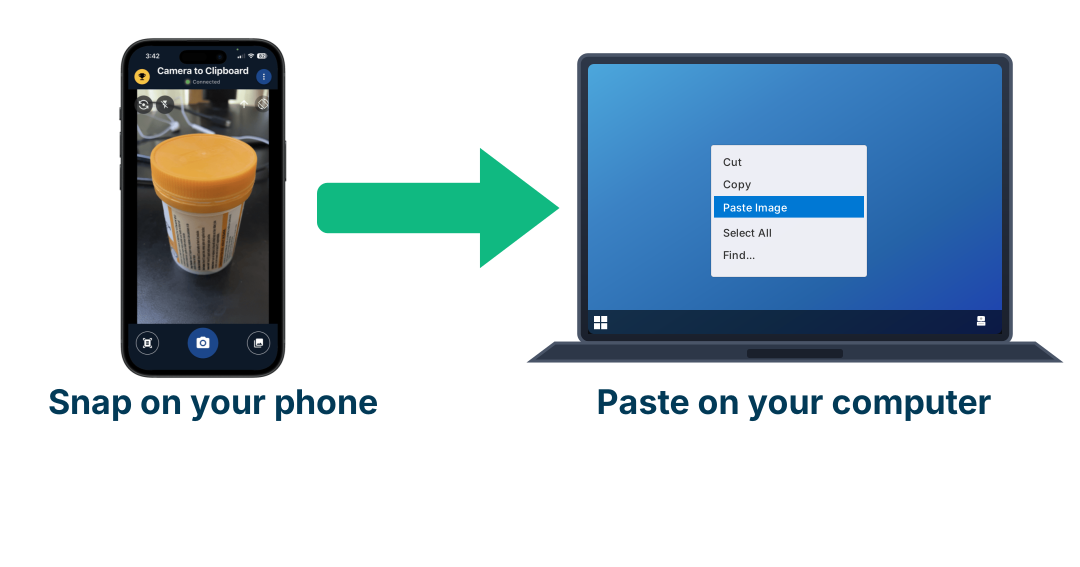
Use Camera to Clipboard to post a photo instead of a link
Building in public is the one thing X still rewards, and it means showing the thing you made rather than linking to it. The awkward part is that the picture is on your phone and the post is being written on your computer. Camera to Clipboard, another of my own apps, closes that gap in one step.
- A photo you take inside Camera to Clipboard is ready to paste on your computer the moment you take it. The phone and the computer find each other over your own local network, with no cable and no upload in between.
- A photo is not decoration on X, it is the version of the post that gets seen, because link posts from regular accounts have run at roughly 0% median engagement since March 2025.
- Several photos can be sent at once out of the phone's library, so a week of build-in-public shots moves across in one batch.
Conclusion: X is worth growing only if you pay for Premium
Reach on X is for sale, and the honest question is not whether to grow there but whether to pay the entry fee.
- Reach on X follows the subscription you pay for rather than the quality of the post.
- Paying cannot buy the reach a large account already has, because it multiplies followers rather than giving you any.
- A free X account gets under 100 impressions on a typical post, and Premium accounts average about ten times that.
- Pay about $8 a month for X Premium or leave X alone, and skip both Basic and Premium+.
- Skip X if your goal is clicks to your own site, since link posts have run at roughly 0% engagement since March 2025.
- X still earns the entry fee for recognition among founders, investors, journalists and developers.
- Keep the post native and put the URL in the first reply.