
I keep seeing the same advice: run meme ads, they are cheap, they go viral, look at Duolingo, look at Liquid Death. I build small apps, so I badly wanted this to be true, and I went looking for the hard numbers behind it. What I found was more interesting than the pitch: meme creative genuinely does something powerful, but it does it at the top of the funnel, and the closer you get to an actual sale the more the magic drains out, and past a certain point it starts working against you. This piece is what the evidence actually says, using our own apps as the running example (the small apps I build: Repeat Recorder, Paint Vlix and Camera to Clipboard). If you want the platform mechanics first, I have written up how Meta ad auctions, Reddit ads and Google ads work, but you do not need any of them to follow this one.
The short version: Meme and humour-led ads reliably win attention, reach and sharing, and fade or even backfire as you move toward the sale. Almost every famous "meme brand" win you have heard about was organic, not paid, so it is weak evidence that paying to push meme creative works. The best-measured fact in this whole field is blunt: engagement does not predict sales. The joke can also eat the brand (the "vampire effect"), which is why the winning meme ad keeps the brand loud, not hidden. And humour only lands in a narrow band, too tame and it is ignored, too far and it gets you roasted, which is brutal on Reddit where authenticity is a credential you cannot fake. So meme ads are a real tool: cheap reach with real backfire risk, not a conversion engine.
The famous meme brands went viral organically, not with ads
Start with the brands everyone cites, because they quietly mislead. Their meme fame was earned reach on their own accounts, not money poured into ads:
- Duolingo says about 90% of its growth is word of mouth, not paid ads. The unhinged owl is real, but the company says roughly 90% of its growth is word of mouth, with paid marketing only a small slice of revenue.
- Liquid Death has openly said it barely spends on media at all.
- Ryanair, Steak-umm and Slim Jim all grew on organic posts, not paid meme ads. Same story: organic posts on their own social accounts, not paid meme ads.
So watch the sleight of hand:
- “Meme ads work” quietly swaps two different things. People point at organic meme success and assume it transfers to paid meme advertising.
- Virality proves reach, not sales. Free spread on your own feed shows memes can travel; it does not show that paying to distribute them buys customers efficiently.
- Clean measured returns on paid meme ads are almost never published. Clean, independently measured returns on paid meme ads sit inside advertisers' ad accounts, so the “proof” you are shown is almost always the organic kind.
Keep the two apart from the start: memes clearly earn attention. Whether they earn sales is the real question, and it has a real answer.
Humour wins attention, fades toward the sale, dents credibility
Here is the finding that organises everything else. The single most-cited academic study of humour in advertising, a meta-analysis pooling hundreds of results, is blunt about what humour does and does not do:
- It reliably makes people like the ad. That part is real and strong.
- It warms people to the brand about half as much. The lift on brand feeling is roughly half the lift on liking the ad.
- The humour effect shrinks the closer you get to somebody actually buying. The closer you get to someone actually buying, the less of the effect survives.
- It reduces the advertiser's credibility. People enjoy the joke, but trust the brand behind it a little less.
Picture the funnel as three steps that leak into each other:
- Step 1, getting noticed: a funny, relatable meme is fantastic.
- Step 2, liking the brand: roughly half as good.
- By the buying step, most of the humour lift has drained away. most of the lift has drained away, and the credibility hit is now quietly working against you.
The creative that stops your thumb is not the same creative that opens your wallet.
None of this says humour is useless. It says humour's job is the top of the funnel, and you should measure it there, on attention and reach and recall, not on last-click sales where it was never going to shine. The mistake is not using memes. The mistake is expecting the thing that wins attention to also close the sale, and then judging it on the sale.
Use Repeat Recorder to practise saying what your product does
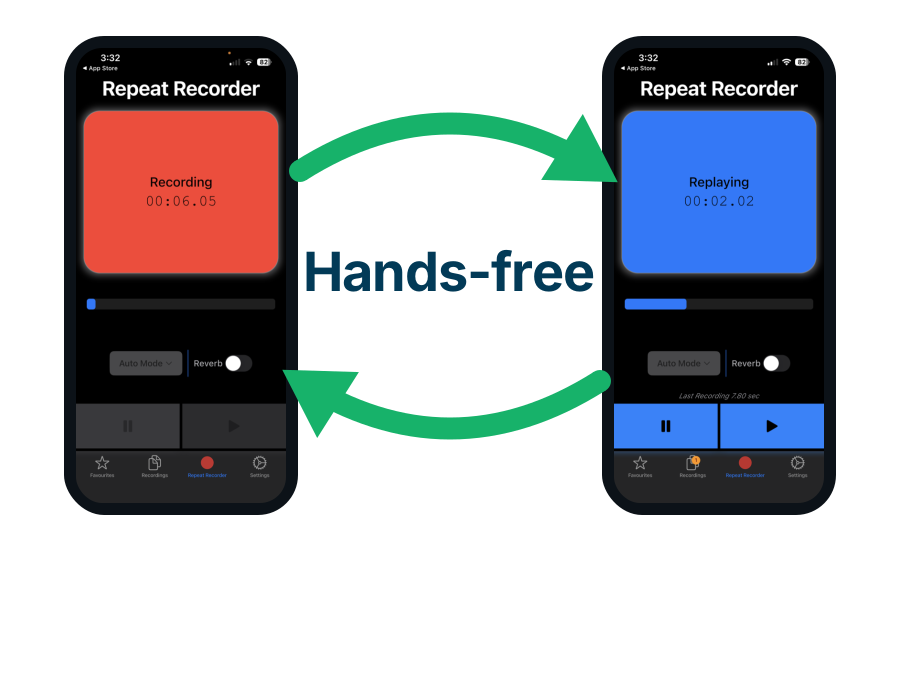
If the joke wins the attention and then hands the audience over with the advertiser looking slightly less trustworthy, something has to arrive next that sounds like a person telling you the truth about a product. That is one or two spoken sentences, and almost nobody rehearses them. Repeat Recorder, one of my own apps, records you and plays the take straight back without you touching the phone.
- Repeat Recorder replays each take automatically and then starts recording again, so you can run the same two sentences twenty times without picking the phone up. That hands-free loop is the whole app. It was built for speech rehearsal, language learning and vocal training, and describing a product plainly is the same drill with a script you wrote yourself.
- The most-cited meta-analysis of humour in advertising found that humour lowers the advertiser's credibility, so the plain sentence about the product is the one carrying all the trust. The joke is allowed to be careless. The sentence underneath it is not, and the only way to find out whether yours sounds convincing or sounds like marketing copy read aloud is to hear it played back.
- Adjustable reverb means a take recorded in a bare room does not have to sound like a bare room. That matters when the recording is going under a video rather than staying on your phone, because a voice that sounds thin reads as amateur before anybody has processed a word of it.
Engagement does not predict sales
This is the best-evidenced part of the whole subject, and the one the meme-agency pitch decks quietly skip. The number they lead with, engagement, is precisely the number that does not predict revenue. Three separate lines of research all point the same way:
- Liking a brand does not make people buy. The famous "What's the Value of a Like?" study ran 23 experiments across tens of thousands of people. Getting someone to like or follow a brand produced no change in their purchasing in the large majority of them. Liking is not buying.
- Engagement and sales run on different engines. A marketing meta-analysis of social content found the split outright: the content that maximises engagement is not the content that maximises sales. Emotional, funny, meme-y content wins engagement; functional, product-led content wins the sale.
- High-sharing videos do not convert, because most buyers never engage. The reach-and-sharing research (thousands of videos studied for what goes viral) found that high-energy emotion drives sharing, but a share with the brand not firmly attached is close to wasted budget, and in real campaigns the overwhelming majority of sales came from people who never touched the ad. Likes capture a small, unrepresentative sliver of who actually buys.
Put simply: the applause and the receipts are two different numbers, and the first does not quietly become the second. The simulator below makes the trade concrete. Move the creative mix and watch engagement and sales slide in opposite directions.
A meme ad can rack up thousands of likes and shares and move almost no product, and a boring product ad can do the reverse. Likes are a measure of how much people enjoyed the content, not how much they wanted the thing. Never read the applause as a receipt.
The vampire effect is when the joke eats the brand
Here is the failure mode that catches good, funny ads, and it has a name in the research: the vampire effect.
- The joke drinks the attention. A striking device, a gag, a celebrity, a meme, can be so entertaining that it leaves nothing for the brand. Everyone remembers the joke; nobody remembers whose ad it was.
- A mismatched joke goes negative. The meta-analysis is stark: when the funny device does not clearly fit the product, the effect on the brand can turn strongly negative, not just drop to zero.
- The antidote is loud branding. Studies find brand-prominent memes, logo and product front and centre, beat “subtle” ones on both attitude and engagement.
- Reddit's own data agrees. Its large analysis of Reddit ads found that simply having a brand logo present roughly doubled conversion.
So “native” and “meme-y” must never be allowed to mean “unbranded”. Put the brand front and centre, or you are feeding the vampire your own budget.
For a product like Paint Vlix, this is the difference between a funny screenshot that makes people laugh and scroll on, and a funny screenshot that makes people laugh while the Paint Vlix name and the thing it does are impossible to miss. Same joke, completely different outcome. The humour buys the attention; the branding is what converts the attention into memory you can bank.
Use Camera to Clipboard to put your product inside the joke
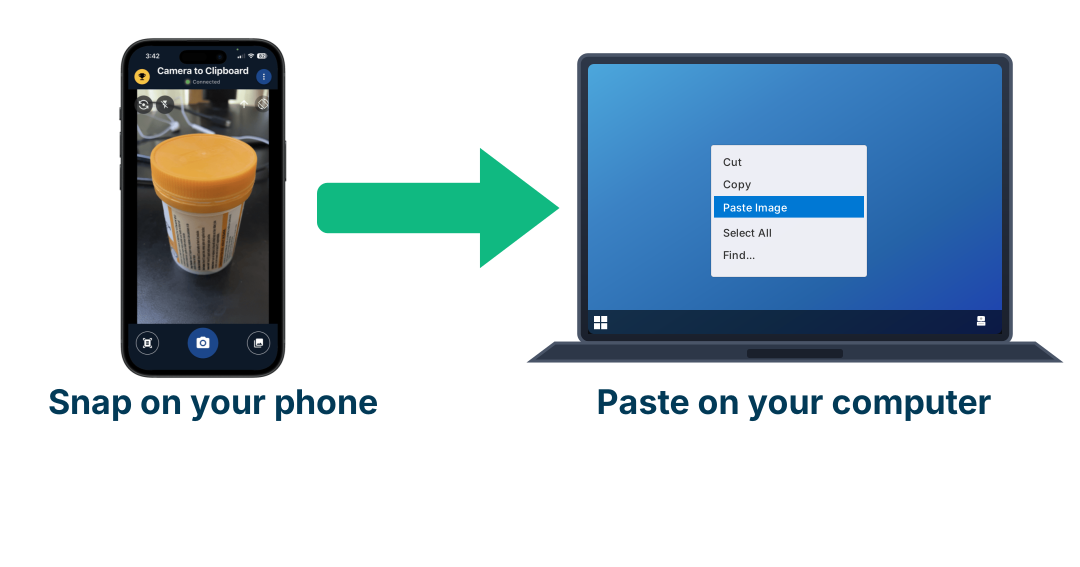
The defence against the vampire effect is having the product unmistakably in the picture, which means the meme has to be built on top of a real photograph or a real screenshot of the thing you sell rather than a stock template. Those pictures get taken on a phone and the meme gets made on a computer. Camera to Clipboard, another of my own apps, joins the two in one step.
- A photo you take inside Camera to Clipboard is ready to paste on your computer the moment you take it. There is no emailing it to yourself, no cable and no upload to somebody else's website in between. The phone and the computer find each other over your own local network and send the picture directly.
- Pasting into Photoshop or GIMP drops the photo in as a new layer, which is where the caption goes on top of it. Reddit's own large analysis of Reddit ads found that simply having a brand logo present roughly doubled conversion, so the layer holding your actual product is the part of the meme doing the work.
- You can send several photos at once out of the phone's library, so six angles on the same product arrive together. Choosing between them side by side is how you end up with the version where the product is impossible to miss, rather than the version where the joke ate it.
Brand meme ads get roasted because authenticity cannot be faked
There is a reason corporate meme attempts so often end up as a meme about the corporate meme attempt. Two things are going on.
Humour only lands in a narrow band
The cleanest theory of why jokes work, benign violation theory, says a joke has to be both a violation (surprising, a little wrong) and benign (safe to laugh at) at once. That leaves a narrow band:
- A meme that is too tame has no violation in it, so so it is not funny, just an ad nobody notices. This is how most corporate memes fail.
- A meme that goes too far stops being benign, so so it offends and damages the brand. This is how the memorable disasters fail.
- The sweet spot is surprising enough to be funny and safe enough to share.
On Reddit, authenticity is a credential you cannot fake
This is where Reddit is unforgiving. “Native” there does not mean “brand does a meme”, it means “sounds like a real person who actually belongs here”, and that is a credential, not a coat of paint:
- Communities spot a brand performing slang it has not earned instantly. A brand performing slang or memes it has not earned gets screenshotted, and the cringe label sticks, that is literally what r/FellowKids exists to collect.
- Reddit's most-downvoted comment ever was a corporate reply that misread the room. The most-downvoted comment in Reddit's history was a corporate reply that misread the room.
- Reddit runs automated systems to catch brand content posing as honest opinion. Reddit runs automated systems to catch inauthentic brand content dressed up as honest opinion, so getting caught costs far more than the wasted spend.
The rule that falls out of this is simple. A human, plain-spoken tone is a style any brand can safely adopt anywhere. Meme-fluency is a credential you either have in a specific community or you get punished for imitating. Borrow the tone freely; borrow the memes only where you have genuinely earned the right to.
Meme ads pay off when you judge them on who noticed
After all that, here is the honest yes, because there is a real one. Used for the right job, meme creative genuinely works, and the evidence for it is specific:
- The real edge is authenticity, not memes as such. Meta's own studies found that lo-fi, phone-shot, real-person creative beats polished studio ads a clear majority of the time, and a very large independent study found that simply putting a real human in the ad lifts effectiveness enormously.
- It helps small and challenger brands the most. Research on user-generated content is consistent: it wins on awareness and trust for emerging brands, while polished, brand-made content tends to win later, at the purchase stage. That is exactly the kind of business I run.
- Meme-page placements sell at very low cost per thousand views. Meme-page placements have historically sold at very low cost per thousand views, and Reddit's clicks run well under half the price of Meta's.
So use meme ads exactly where the evidence says they are strong: to create cheap awareness, judged on reach and recall. Then let a capture channel like Google Search close the sale when that awareness turns into someone actively looking. Memes write the demand; search cashes the cheque. That is the whole funnel argument from the Google piece, and meme ads slot neatly into the top of it.
Use meme ads to be seen, cheaply, by people who were never going to search for you yet. Do not use them to be bought from. Point them at reach and recall, put a capture channel underneath to catch the demand they create, and they earn their keep honestly.
Use Repeat Recorder to rehearse the ad you film on a phone
The honest case for meme creative turns out not to be about memes at all. It is that a real person filmed on a phone beats a polished studio ad most of the time, which quietly moves the entire production budget onto how you sound. Repeat Recorder, my own app, records you and plays the take straight back without you touching the phone, which is the cheapest rehearsal there is.
- Repeat Recorder plays every take back to you automatically instead of leaving you to remember how it went. Then it starts recording again on its own, so twenty attempts at the same line cost you twenty attempts and no button presses. Hearing the take is the whole point, because nobody can judge their own delivery from memory.
- Meta's own studies found phone-shot, real-person creative beats polished studio ads a clear majority of the time, so your delivery is the production value. There is no lighting rig or edit to hide behind in that kind of ad. What separates a good one from an awkward one is a person who sounds comfortable, and that is a rehearsal problem rather than a budget problem.
- Takes worth keeping go into favourites and into folders you name yourself, which you can reorder by dragging. One folder per campaign means the six attempts at this week's script sit together, and the line that worked last time is still there to listen back to before you record the next one.
Never use them on serious, trust-dependent products
There is a whole category where I would leave meme ads well alone, and the data is what convinced me:
- Memes backfire on serious messaging. Recent research found they actually reduce engagement when attached to serious or cause-related content, the tone clash reads as trivialising.
- Humour dents credibility, which is fatal for any product sold on trust. Humour's measured dent to credibility conflicts directly with any product whose whole value is trust, dignity and a high-stakes decision, think health, money, grief, safety, anything life-changing.
- Context flips the very same joke. A meme that is perfect for a cereal brand is actively corrosive there.
That does not mean cold and corporate, warm, human and gently humorous is fine and probably necessary. But “brand does a dank meme” for a trust-dependent, high-stakes service is the exact configuration the evidence warns against. The lesson generalises: the funnier your category can safely be, the more meme ads offer; the more your product trades on trust and gravity, the more they cost you.
So, do meme ads work?
The honest verdict, with all the pieces on the table: yes as a cheap reach and brand-building tool, no as a conversion engine.
- Meme ads reliably win attention, reach and sharing. they reliably win attention, reach and sharing; authentic lo-fi creative beats polished, especially for small brands; and it is cheap. A real, defensible edge.
- Meme ads lose their effect toward the sale, and humour dents credibility. the effect shrinks toward the sale, humour dents credibility, the joke can eat the brand unless the branding stays loud, and the humour only lands in a narrow band that punishes both timidity and overreach, savagely so on Reddit.
So the question is not “meme ads or not”, it is where in the funnel, and measured how. Run them at the top, keep the brand front and centre, match the humour to the room, judge them on reach and recall rather than last-click return, and put an intent-capture channel underneath. Do that and they work, for what they are actually good at. Ask them to be your closer and they will quietly cost you money while racking up likes you cannot spend.
Conclusion: do meme ads actually work, in one glance
- Meme ads reliably win attention, reach and sharing, then fade or backfire closer to the sale. Almost every famous meme brand became famous organically rather than by paying to push a joke, so those wins are weak evidence that paid meme advertising does the same thing.
- Engagement does not predict sales, the best-measured fact in meme advertising. The content that wins likes is not the content that wins purchases, and most buyers never engaged with the ad at all, so likes and shares cannot tell you whether a meme ad sold anything.
- Run meme ads for cheap reach with the brand kept loud, never to close a sale. Reddit's own analysis found that simply having a brand logo present roughly doubled conversion, so judge a meme ad on how many people noticed and remembered it, and put a Google search ad underneath to catch the buyers it created. On serious, trust-dependent products, skip memes altogether.