
Somebody in your suburb searches for what you sell. Google answers with two separate lists on one page, and almost nobody realises they are ranked by two different sets of rules. This page is the 2026 guide to winning both, ordered by a survey that scored 187 ranking factors.
The short version. Your Google profile is 32% of what decides the three map results, and your website is 33% of what decides the blue links below them, so the work that wins one list barely touches the other.

Learn that a local search returns two lists, the map results and the blue links under them
Search for "plumber Perth" and Google draws a small map with three businesses under it, then an ordinary list of website links below that. Those are two separate rankings on one page.
- The block with the map and three businesses in it is called the local pack, and it appears on 93% of searches that are looking for a nearby business.
- The local pack takes about 44% of every click made on a local search page, and the blue links underneath take about 29% of them.
- The other 27% of those clicks go to the paid adverts and the other blocks Google puts on the page, which is why the two lists do not add up to 100%.
- Those shares only count the searches that produce a click, and about 68% of Google searches in the United States now end with no click at all.
- Only businesses with a Google Business Profile can appear in the local pack, and any website at all can appear in the blue links.
- The first business inside the local pack is often a paid advert marked "Sponsored", so the three ranked results start underneath it.
Winning both lists puts your business on the page twice, which is why the two jobs are worth doing separately rather than choosing one.

Understand your Google profile decides the map results and your website decides the blue links
The 2026 Local Search Ranking Factors survey asked around 50 local SEO specialists to score 187 factors, then grouped them and scored the two lists separately. A ranking factor is one thing that can move a business up or down in local search, such as your business category, your opening hours or the words on your website, and the survey scored 187 of them. Every percentage below is a share of the decision, meaning how much of Google's choice that group accounts for. None of them is a share of the space on the page.
- For the three map results, your Google Business Profile accounts for 32% of the decision and your website pages account for 15%.
- For the blue links that order flips, and your website pages account for 33% of the decision while your Google Business Profile accounts for only 7%.
- Links pointing at your website add another 24% to the blue links decision and only 8% to the map results decision.
- Your Google reviews are 20% of what decides the map results, up from 16% in the same survey in 2023.
- A business that only fills in its Google profile wins one list, and a business that only builds website pages wins the other.

Compare the work that wins the map results against the work that wins the blue links
Every rank below is that factor's own position in the 2026 survey of the 187 ranking factors, scored separately for each of the two lists.
| What you do | How much it moves the three map results | How much it moves the blue links below | How long before it moves |
|---|---|---|---|
| Set your primary Google Business Profile category | 1st strongest of 187 | Outside the top 20 | Days |
| Write a dedicated page for each service you sell | Outside the top 20 | 1st strongest of 187 | Weeks |
| Be physically close to the person searching | 2nd strongest | Barely, and only through your location | Only by moving premises |
| Use the suburb name across your pages | 18th strongest | 2nd strongest | Days |
| Earn links from other websites | 8% of the ranking | 24% of the ranking | Months |
| Collect Google reviews | 6th and 9th strongest | Outside the top 20 | Months |
| Link your own pages to each other | 110th strongest | 6th strongest | Days |
| Set correct opening hours on your profile | 5th strongest | Not in the scored list | Immediately |
| Put keywords in the title of your landing page | 17th strongest | 4th strongest | Days |
| Make your website work properly on a phone | Outside the top 20 | 16th strongest | Weeks |
| Switch your website to HTTPS | Outside the top 20 | 18th strongest | A day |
| Keep your website focused on one trade | Outside the top 20 | 9th strongest | Months |
| Add extra code spelling out your address and hours | Outside the top 20 | 69th strongest | A day |
| Write Google Posts every week | 148th strongest | Not in the scored list | No measured effect |

Claim and complete your Google Business Profile, it is 32% of what decides the map results
A Google Business Profile is the free listing Google holds for your business, the one carrying your map pin, your star rating, your phone number and your opening hours. It is what fills the three map results. Claiming it takes an afternoon and nothing else on this page pays back as fast.
- Search Google for your own business name, because Google often creates a profile for a business before the owner does and it sits there unclaimed.
- Google now verifies most new profiles with a video, filmed outside, showing a street sign, a permanent sign carrying your business name, and you unlocking the door.
- How complete the profile is comes 16th of the 187 ranking factors, so the empty fields are costing you a real position.
- Filling in the services list on the profile comes 22nd, having risen from 81st in the same survey in 2023.
- Show a real street address rather than hiding it, because showing it is the 7th strongest factor and hiding it is the setting for businesses customers cannot visit.
- Drag the map pin onto your own front door, because Google measures distance from that pin and often drops it on the road behind you.

Set your primary category to the exact thing you sell, the biggest thing you can change
Out of the 187 ranking factors the specialists scored, the primary category dropdown on your Google Business Profile came first, ahead of even distance from the searcher.
- Choose the category that names exactly what you sell, so a shop selling kebabs picks "Kebab shop" rather than "Restaurant".
- A broad category makes you compete with every restaurant in the city instead of every kebab shop in your suburb.
- Search Google Maps for the words you want to rank for, then check what category the top three businesses have set.
- Add three or four extra categories as well, because BrightLocal measured 1,050 businesses and found those with four averaged position 5.9 against 7.6 for those with none.
- The gain from extra categories stops at about four, and every category must be something you genuinely do.

Write a dedicated page for every service you sell, it is the strongest factor in the blue links
Out of the 187 ranking factors scored for the ordinary search results, a separate page for each service came first. It also comes 2nd in whether an AI answer names your business, so one job pays twice.
- A plumber needs a blocked drain page, a hot water page and a burst pipe page, rather than one page called Services listing all three.
- Somebody searching "blocked drain Perth" is matched against a page about blocked drains, and a combined services page matches it far more weakly.
- How much real content sits on those service pages comes 17th of the 187 ranking factors for the blue links.
- How narrowly your whole website sticks to one trade comes 9th, so a plumber who also sells car parts weakens both.
- Put your prices on the service page, because searches like "average cost of dental implants in Perth" show a Google AI Overview 97% of the time and that box has to quote somebody.

Write one page for every suburb you serve, because the suburb name is the 2nd strongest factor
Using the name of a place through your pages came 2nd of the 187 ranking factors for the blue links. This is the one job that lets a business rank in a suburb it has no premises in.
- You cannot appear in the three map results for a suburb you have no premises in, and you can appear in the blue links for it.
- Write one page per suburb, and put something real on it such as your travel time, the jobs you have finished there and photographs of them.
- A suburb page with nothing on it but a swapped suburb name is the exact pattern Google's spam systems look for.
- Name the suburbs, not the whole city, because "Fremantle" and "Joondalup" are searched separately from "Perth".
- Build one locations page that links to every suburb page, so each of them sits one click from your homepage.
- A real second premises is the only way into the map results for a second suburb, and it needs its own profile, its own permanent sign and its own staff.

Put every suburb page in a folder on one website, never on its own subdomain
Giving each suburb its own web address, such as "victoria-park.example.com", looks like a way to rank a separate site in every suburb. It is the most expensive mistake on this page.
- Google treats a subdomain like "victoria-park.example.com" as close to a separate website, so it starts with none of the trust your main site has already earned.
- Backlinko checked 11.8 million Google results and found pages sitting in a folder consistently outranked the same content sitting on a subdomain.
- Splitting 20 suburbs across 20 subdomains divides every link pointing at you 20 ways, and the quality of links to your domain is the 3rd strongest factor in the blue links.
- Linking your own pages to each other is the 6th strongest factor, and a link between two subdomains does not count as one of your own internal links.
- Google's spam rules name this exact plan, and a set of subdomains or separate domains built to catch similar searches and feed one business is called doorway abuse.
- Write "example.com/victoria-park" instead, so every suburb page inherits the trust the whole website has built, and note that a separate domain per suburb is worse again because it starts with no trust at all.

Point your Google profile at a suburb page, not your homepage, and put the suburb in its title
Your Google Business Profile has a field called Website. Most businesses paste their homepage into it and never look at it again. That field accepts any page address on your site, not only the homepage, and Google reads three of its strongest ranking factors off whichever page you put there.
- The Website field accepts any page address on your site, so "bentleykebabs.com/bentley" is as valid to put there as "bentleykebabs.com".
- Keywords in the title of whichever page the Website field points at are the 4th strongest of the 187 ranking factors for the blue links, and the 17th for the map results.
- Keywords in that same page's headings are the 8th strongest for the blue links and the 20th for the map results.
- The name, address and phone number printed on the page your profile links to matching that profile is the 15th strongest for the map results.
- A business with one shop points the field at its homepage, and a business with three shops points each profile at that branch's own page.
- Keeping your page title under 60 characters is the 184th strongest of the 187 ranking factors and the report calls that rule an outright myth, so write the title the reader needs.

Link your own pages to each other, because a controlled test lifted organic traffic 25%
An internal link is simply a link from one page of your own website to another page of your own website. It sounds too small to matter, and it has been tested properly with control and variant pages on live sites.
- Google's John Mueller calls it "one of the biggest things you can do on a website to guide Google and visitors to the pages that you think are important".
- SearchPilot split tested it on a grocery website by adding links from its main category pages down to its sub-category pages, and organic traffic across those pages rose 25%, about 9,200 extra visits a month.
- A second split test on a directory with about 8,000 regional pages added a link from each page to its nearest regions, and traffic to the linked pages rose 7%.
- One of their tests lifted only the pages doing the linking and did not clearly help the pages being linked to, so the gain is real and its size is not guaranteed.
- The 2026 survey puts it 6th of the 187 ranking factors for the blue links, and it needs no money, no waiting and nobody else's permission.
- Link every service page to the suburb pages where you do that service, and write the link text as the thing being linked to rather than "click here".
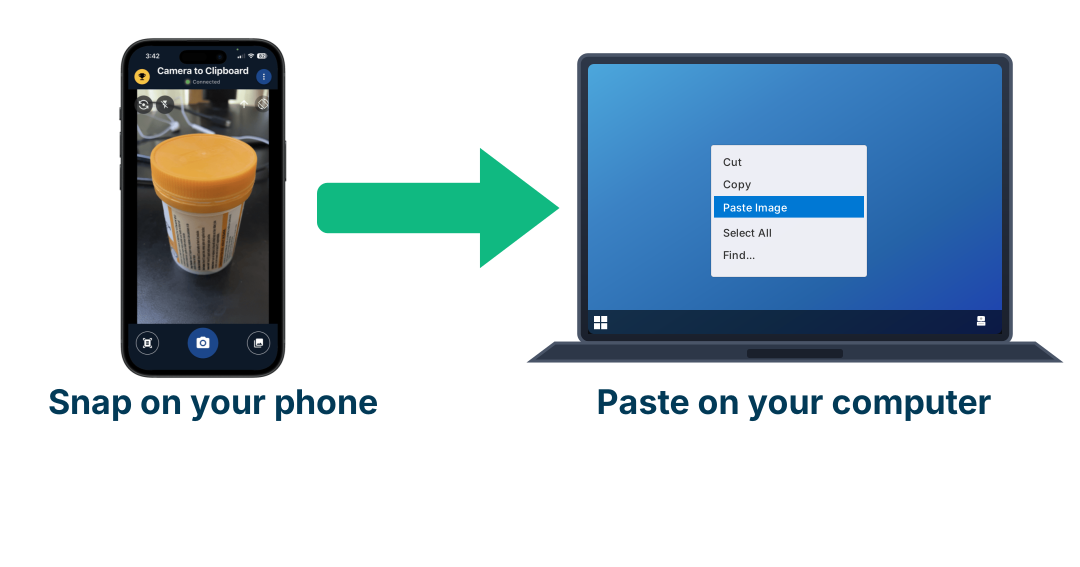
Use Camera to Clipboard to put job photos on the suburb pages you are building
A suburb page needs proof that you work there, and that proof is photographs of finished jobs taken on a phone. Camera to Clipboard, one of my own apps, moves each picture onto the computer you are building the page on.
- A photo you take on your phone at the job pastes straight into whatever is open on your computer.
- Pairing Camera to Clipboard is a one-time QR code scan, so there is no account to create and no folder to sync.
- Camera to Clipboard also runs on Windows, so the computer you build the pages on does not have to be a Mac.

Get links from local and trade websites, because they are 24% of what decides the blue links
Links from other websites are 24% of what decides the blue links and only 8% of what decides the map results. They are the slowest job on this page and the one that separates page one from page three.
- How good the websites linking to you are comes 3rd of the 187 ranking factors for the blue links.
- Links from websites in your own trade come 5th, so a plumbing directory is worth more than a general business directory.
- Links from websites in your own town come 13th, so the local newspaper, the school newsletter and the sports club you sponsor all count.
- The words somebody uses when they link to you come 10th, so ask for your service and suburb in the link text rather than your web address.
- Sponsor something local, supply a quote to a local reporter, or join a trade association, because those three produce the link types scored highest.
- Buying a hundred cheap directory listings does nothing, because directory listings are only 7% of what decides the blue links and quality is what is scored.

Expect a Facebook mention to bring you customers and almost no Google ranking
Somebody recommending your business in a Facebook group feels like it should count for the same as a link. Google treats the two very differently, and the survey scores them separately.
- Facebook puts a "nofollow" tag on every link posted on it, which is an instruction telling Google not to count that link towards the ranking of the site it points at.
- Being named on Facebook with no link is the 126th strongest of the 187 ranking factors for the three map results, and the 73rd strongest for the blue links.
- That same unlinked mention is the 12th strongest factor in whether an AI answer names your business, so it counts for most in the place Google counts for least.
- Google cannot read a post inside a private Facebook group at all, so a recommendation in your suburb's residents group is invisible to every ranking, while a post on a public Facebook Page can be read.
- The mentions the survey scores highly are newspaper articles, blog posts, government sites and industry association pages, which together are the 4th strongest factor in AI answers.
- A Facebook recommendation still puts a paying customer in front of you that day, which is worth more than one ranking position, so keep asking for them.

Ask for a Google review every week, because 74% of customers ignore anything older than 3 months
BrightLocal surveyed 1,002 adults in February 2026 and asked how old a review can be before they stop counting it. The answer got much harsher in one year.
- 74% of people said they only consider reviews written in the last 3 months.
- 32% said they only consider reviews written in the last 2 weeks, up from 20% a year earlier.
- How recent your reviews are is the 11th strongest ranking factor for the map results, and a steady flow over time is the 14th.
- 200 reviews that all arrived two years ago now count for less than 40 reviews that arrive at one a week.
- 78% of people had been asked to write a review, and 83% of those asked went on to write one, so asking is almost the whole job.
- Google reviews are the only reviews that move the map results, so a wall of five-star reviews on Facebook changes nothing there.

Get past 20 reviews and 4 stars, because 47% of customers reject anything below 20 reviews
Ranking on the page and being chosen from the page are two different problems. The same survey of 1,002 adults measured the second one.
- 97% of people read reviews before choosing a local business.
- 47% will not use a business that has fewer than 20 reviews.
- 68% will not use a business rated below 4 stars, up from 55% a year earlier.
- 31% will not use a business rated below 4.5 stars, up from 17% a year earlier.
- 89% expect the owner to reply to reviews, and 80% are more likely to use a business that replies to every one.
- 50% dislike a reply that is obviously a template, so writing the same sentence under every review works against you.
Use Repeat Recorder to practise the sentence you say when you ask for a review
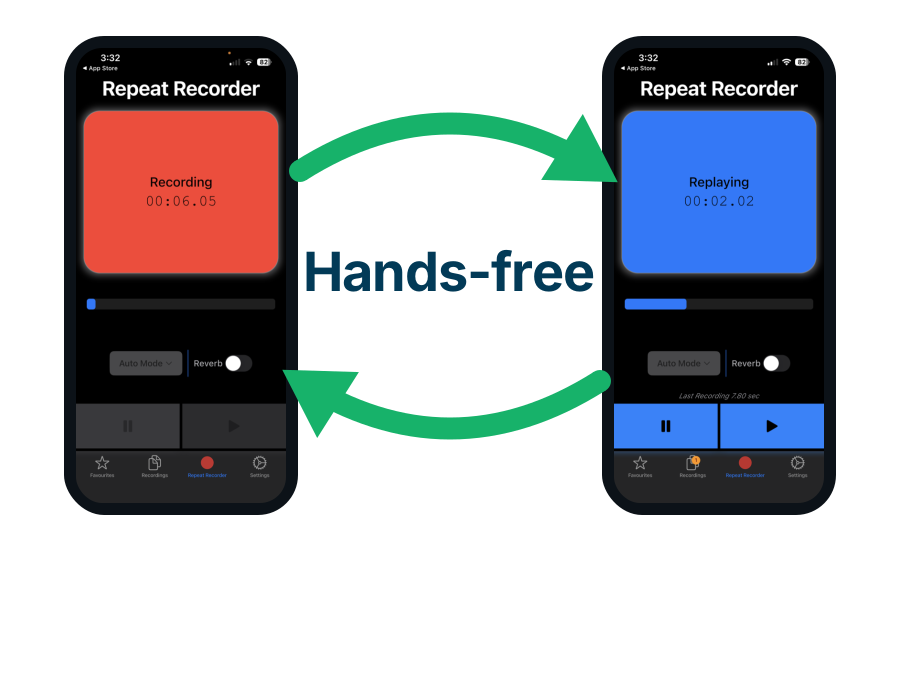
83% of customers who get asked for a review write one, so the sentence you say at the counter is the highest paid sentence in the business. Repeat Recorder, another of my own apps, records you and plays it straight back so you can hear how the ask lands.
- Repeat Recorder plays your own voice back about a second after you stop speaking, so you hear the awkward part while you still remember saying it.
- Automatic mode starts when you speak and replays when you stop, so you can drill the same sentence while driving without touching the screen.
- Saving a take into a named folder keeps the wording that worked, which matters when you are training staff to ask the same way.

Make your website work on a phone and run on HTTPS, the 16th and 18th strongest factors
Two boring jobs sit inside the top 20 for the blue links, above almost everything sold as an SEO service.
- A website that works properly on a phone comes 16th of the 187 ranking factors for the blue links.
- A website served over HTTPS by default comes 18th, and a free certificate takes about a day to install.
- How fast your pages load comes 44th, so speed matters and it matters less than the two jobs above it.
- Open your own website on your own phone and try to book or call, because that is the test that finds the real problem.
- Most local searches happen on a phone, so a site that only works on a desktop loses the customer before the ranking matters.

Leave the extra code that spells out your address and opening hours until last, it barely helps
Some agencies sell a job that means pasting an extra block of code into your pages. A visitor never sees it. It spells out your business name, your address, your phone number and your opening hours in a form built for machines to read rather than people. It is sold hard and the survey scores it low.
- The code that spells out your address and hours is called "schema markup", or sometimes "structured data", and those are the names to listen for when somebody quotes you a price.
- It is the 69th strongest of the 187 ranking factors for the blue links, far below writing a service page or earning a link.
- Every job in the top 20 of this article is worth more than adding the address and hours code, so do all of them first.
- Adding the code once is still worth doing, because it takes about a day and never has to be repeated.
- Paying somebody a monthly fee to maintain your address and hours code is paying a recurring price for a one-off job scored 69th.
- The version worth adding carries your business name, address, phone number and opening hours, and it must match your Google profile exactly.

Rank for near me searches and for suburb searches separately, Google scores them differently
"Kebabs near me" and "kebabs in Perth" look like the same search and are ranked by two different measurements.
- Google reads "near me" as an instruction to use the phone's own location, so it ranks by how far you are from that exact spot.
- Google reads a city or suburb name as an instruction to use that place's centre point instead, and being close to that centre point is the 12th strongest factor for the map results.
- The words "near me" almost never need to appear on your website, because Google replaces them with a location before it ranks anything.
- The suburb name does need to appear on your website, because that is the search where your page text is doing the work.
- A business on the edge of a city can win every "near me" search around it and still lose every search that names the city.

Write the same name, address and phone number everywhere, and give each branch its own page
Google cross-checks the details on your website against the details on your Google Business Profile, and a mismatch costs you more than a match gains you.
- Having the name, address and phone number on your website match your Google Business Profile exactly comes 15th of the 187 ranking factors for the map results.
- Write the address the same way in both places, so "Unit 3, 12 Smith St" and "3/12 Smith Street" cannot both be live.
- Put the details in real text in the page footer rather than inside an image, because Google cannot read text in a picture.
- Use one phone number everywhere, because a separate tracking number on the website is the most common cause of a mismatch.
- Google's rule is one profile per real premises, so three shops means three profiles and three branch pages, because each profile has only one website field and three of the top 20 factors are read off whichever page it points at.
- A business with no shopfront gets exactly one profile, and creating a second one for the same business breaks Google's rules and gets both merged or removed.

Open a real second shop to reach a second suburb, and expect it to start with zero reviews
Opening premises in five suburbs to get five profiles looks like the fast way to cover a city. It is the only way into the map results for those suburbs, and it is the slowest and most expensive route on this page.
- A real second premises is the only way into the three map results for a second suburb, because Google ranks the map results by distance from a verified address.
- Google's rule is that the premises has its own permanent sign, its own staff during the hours you publish, its own customer entrance, and customers who can walk in.
- A virtual office, meaning a mailing address you do not actually work from, is not eligible for a Google Business Profile at all.
- A desk in a coworking space qualifies only if it meets every one of those rules, and Google suspends coworking listings faster than any other kind.
- Reviews belong to one profile and never transfer between them, so a new branch opens with zero reviews while reviews are 20% of what decides the map results.
- A suburb page on your existing website is the cheap route, and it reaches the blue links in that suburb without ever reaching the map results.

Run your business from home, because your hidden address is still what decides where you rank
Google supports this, and the rule is about what you display rather than where you work.
- Google keeps your verified address on its back end and measures distance from it even while the public cannot see it, so a hidden home address is still your ranking location.
- Where you live therefore decides where you rank, so a plumber living in Belmont ranks best around Belmont and fades a few suburbs away.
- The service areas you list change nothing in the ranking, because they exist only to tell a customer where you are willing to travel.
- Google's guidelines use a plumber at a residential address as their own example, so a home business is allowed and simply must not display the address.
- Showing a home address on a profile customers cannot visit is the violation that gets profiles suspended, while a yard or depot with a permanent sign and staff on site can show its address.
- Sterling Sky hid the address on a live home services business and its map results vanished for its main searches, then came back when the address was restored.

Accept one Google listing per place customers can visit, and one only if they cannot visit any
Google does not allow two addresses on one Google Business Profile. Two rules follow from that, and mixing them up is the commonest mistake here. A business with places customers can visit gets one listing for each of those places, which is why McDonald's holds thousands of listings rather than one. A business with no place customers can visit has none to count, so it gets exactly one listing however many addresses it has.
- A Google Business Profile has one address field and no second slot, so no business of any kind can put two addresses on one listing.
- A shop, a clinic or a restaurant gets one listing for each branch customers walk into, so a chain legitimately holds hundreds of listings.
- A plumber, a mobile mechanic or anyone else customers never visit gets one listing in total, because there is no place to count.
- Two genuinely different businesses can also hold two listings, and Google requires each to have its own name, its own phone number, its own category and its own visible sign at the address.
- One plumbing company wearing five suburb-flavoured names is not five businesses, and Google removed 7 million such fake listings in 2021 and now finds a repeated address or phone number automatically.
- A soft suspension makes the listing unverified, a hard suspension deletes it and every review on it, and an account restriction freezes every listing tied to that Google account.

Know the three tests a second address must pass, which your own home listing never faces
Your own home listing never faces the tests below, because it hides its address. Google only checks that you really run the business, and for a service business that video means opening your work van or showing the tools you use. The three tests below apply to an address you want Google to display, and displaying an address is what a second listing means.
- Test one is a permanent sign carrying your business name fixed at that address, which is the thing video verification actually films.
- Test two is your own staff being at that address during the hours you publish on the listing.
- Test three is customers being able to come to that address during those same hours.
A house fails all three, whether you own it or your employee lives in it. That is the whole difference between the one listing you are allowed and a second one you are not. Google calls a listing at a displayed address failing these tests a fake listing, which is why Sterling Sky's count includes plenty of real addresses, and renaming it "Perth Plumbing Belmont" does not help because a suburb belongs in the name only when it is part of the official real-world name.

Understand that Google decides what counts as one business, and you do not
Home businesses are allowed, so the next idea is to spawn several of them and funnel every call back to one operation. Because customers visit none of them, each one is capped at a single listing, and the whole question becomes where one business ends and the next begins. That is not your call.
- A shared phone number, a shared website, a shared owner account and shared staff are what tell Google that several listings are really one business.
- A set of home businesses that funnel every call back to one operation is one business by that test, whatever names they carry.
- Giving each one a subdomain of your own domain hides nothing, because subdomains of one domain are one shared website and Google reads the connection straight off the address.
- Making them genuinely separate means separate names, phone numbers, staff, customers and money, at which point they are real businesses that no longer feed yours.
- The moment the arrangement sits inside the rules it stops being useful, and the moment it is useful it breaks them.
- The tactic does work for a while, which is why 87.6% of garage door repair listings in Sterling Sky's study were removed as fake once somebody reported them.

Get named in a best-of list somebody else wrote, it is the strongest factor in AI answers
The 2026 survey scored AI visibility for the first time, and the order is nothing like either of the two Google lists. Being written about by other people beat everything a business can do to its own pages.
- Appearing in an expert list such as "the 10 best kebab shops in Perth" is the strongest single factor in whether an AI answer names your business.
- A dedicated page for each service is the 2nd strongest, which is the same job that comes 1st in the blue links.
- Being mentioned on the big websites in your own trade is the 3rd strongest.
- Being mentioned in plain text, with no link and no listing form, is the 4th strongest, because the AI is reading sentences rather than counting links.
- A directory listing is not the same thing as a mention, and the survey scores a mention in an article, a blog post or a trade association page as the 4th strongest AI factor while a plain directory entry sits far below it.
- Email the local food bloggers, the suburb Facebook groups and the trade directories, because getting listed by them is the actual task.

Get named in somebody else's Reddit thread, because that thread often outranks your website
Two different jobs get muddled together here. Writing posts on accounts you own is one job. Being named by somebody else in their thread is a completely different one. The survey scored them separately and they are worth very different amounts.
- Writing posts on your own Facebook, Instagram or Reddit account is the 172nd strongest of the 187 ranking factors for the map results, and how many followers you have is the 186th, so treat your own posting as worthless for ranking.
- Being named by somebody else with no link is stronger and still not strong for Google, at 126th for the map results and 73rd for the blue links.
- Being named by somebody else is the 12th strongest factor in whether an AI answer picks your business, which is the one place it genuinely counts.
- The real prize is different from ranking, because Reddit is the second most search-visible website in the United States behind only Wikipedia.
- A Reddit thread naming plumbers in your city often outranks every plumber's own website, so being inside that thread puts you in front of the searcher while your own site ranks nowhere.
- YouTube did not appear among the sources local AI answers quoted, so treat a YouTube channel as brand building rather than local ranking work.

Claim Yelp, Bing Places and Apple Maps, because that is where AI assistants get their list
An AI assistant answering "best kebabs in Belmont" has to get its list of businesses from somewhere. It does not get it from Google, because Google does not share its business data with rivals. Each assistant buys or licenses that list elsewhere, and 45% of consumers now use one to find a local business, up from 6% a year earlier.
- OpenAI signed a licence with Yelp on 23 July 2026, so ChatGPT now answers local questions using Yelp reviews, ratings, photos and business details.
- Yelp retreated to the United States and Canada after its overseas push failed, and over 90% of its traffic is American, so outside North America claiming it is a ten minute job rather than a priority.
- ChatGPT also draws local business listings from Foursquare and falls back to Bing's own search results, and both of those work everywhere.
- Apple Maps and Siri take their details from Apple Business Connect, Bing Places feeds both Bing and Microsoft Copilot, and both are free, global and separate from Google.
- Outside North America your own country's directories carry more weight than Yelp does.
- Write the same name, address and phone number on every one of them, because matching details across platforms is what these tools use to decide the business is real.
| Where you list | Australia | Canada | United Kingdom | Does it feed the AI assistants |
|---|---|---|---|---|
| Google Business Profile | Essential | Essential | Essential | Only Google's own AI answer |
| Foursquare | Worth doing | Worth doing | Worth doing | Yes, ChatGPT's main list |
| Bing Places | Worth doing | Worth doing | Worth doing | Yes, Bing and Copilot |
| Apple Business Connect | Worth doing | Worth doing | Worth doing | Yes, Siri and Apple Maps |
| Yelp | Barely used, 0.64% of its traffic | Strong in Toronto, Vancouver, Calgary and Montreal | Present and little used | Yes, licensed to ChatGPT |
| The national Yellow Pages | Yellow Pages, still used | YellowPages.ca, high authority | Yell.com, the household name | No |
| TrueLocal | An Australian staple | Does not operate there | Does not operate there | No |
| Localsearch | An Australian staple | Does not operate there | Does not operate there | No |
| Canada411 | Does not operate there | A basic Canadian listing | Does not operate there | No |
| Thomson Local and FreeIndex | Does not operate there | Does not operate there | Names British customers recognise | No |
| Trustpilot | Used by some | Used by some | Widely read in Britain | No |
| Checkatrade | Does not operate there | Does not operate there | The one British trades use | No |
Use Camera to Clipboard to keep your search ranking screenshots on your computer
Checking your position from different suburbs means searching on a phone and recording what you saw, while the record you are building lives on a computer. Camera to Clipboard, one of my own apps, moves each screenshot across as you take it.
- A screenshot taken on your phone in one suburb pastes straight into the document open on your computer.
- Nothing is uploaded to an account, so a run of twenty screenshots does not fill a photo library you then have to clear out.
- Camera to Clipboard runs on Windows as well as Mac, so it fits whatever the office computer is.

Measure your position suburb by suburb, because it changes from one street to the next
Searching for your own business tells you almost nothing, because Google is ranking for the spot you are standing on and the account you are signed into.
- Searching from your own shop shows you a ranking almost nobody else sees, because you are standing at the point Google measures distance from.
- A map grid tool runs the same search from dozens of coordinates around your shop and draws every result as a heat map.
- Local Falcon and BrightLocal both do this, and BrightLocal's own study used a grid of 49 points spaced 500 metres apart.
- Track the blue links separately from the map results, because a suburb page can be winning the blue links while the map results ignore you completely.
- Google Search Console is free and tells you which searches already reach your website, so start there before buying a tool.
- Record where you stand before you change anything, so the next run has something to compare against.

Keep doing all of this, because Google puts an AI answer on only 15% of local searches
Google now writes its own answer at the top of some results pages, above the blue links and above the map. That block is called an AI Overview. It is not the same thing as asking ChatGPT, which is a separate app with its own sources. Whitespark ran 540 real searches on Google in Houston, Phoenix and Denver across plumbers, injury lawyers, dentists, optometrists, medical clinics and real estate agents, and counted how often that block appeared.
- Google showed an AI Overview on 15% of searches looking for a nearby business, and showed the three map results on 93% of them.
- Google showed an AI Overview on 92% of searches asking a question, and showed the three map results on only 6% of them.
- AI has taken the searches that ask things and left the searches that buy things, which is why local search is still worth the work.
Conclusion: local SEO for a small business, in order
A local search returns two lists ranked by two different sets of rules. Here is every job on this page as a numbered checklist, in the order to do them.
- Claim your Google Business Profile and fill in every field, because it is 32% of what decides the three map results.
- Set your primary category to the exact thing you sell, the strongest of all 187 factors.
- Add three or four extra categories, worth about 1.7 places in the map results.
- Show a real street address and drag your map pin onto your own front door.
- Set correct opening hours, because being open when somebody searches is the 5th strongest factor, and never publish hours you do not keep.
- Write one page for every service you sell, the strongest factor in the blue links.
- Write one page for every suburb you serve, because the suburb name is the 2nd strongest factor.
- Put every suburb page in a folder on one website, never on its own subdomain.
- Point your Google profile at the right page on your site, and put the suburb in that page's title.
- Link your own pages to each other, the 6th strongest factor and the only free one in the top ten.
- Earn links from local and trade websites, because they are 24% of what decides the blue links.
- Do not count on your own social posting, because it is the 172nd strongest of the 187 ranking factors.
- Ask every customer for a Google review, because 83% of people who are asked write one.
- Keep the reviews arriving weekly, because 74% of customers ignore anything older than 3 months.
- Get past 20 reviews and 4 stars, because 47% of customers reject a business below 20 reviews.
- Make your website work on a phone and run on HTTPS, the 16th and 18th strongest of the 187 ranking factors.
- Write the same name, address and phone number everywhere, and give each branch its own page.
- Open a real staffed second premises to reach a second suburb in the map results, and expect it to start with zero reviews.
- Work from home if you want and hide the address, because that is Google's own rule for a business customers do not visit.
- Do not add houses as extra listings, because they work for a while and are then removed with every review on them.
- Do not spawn proxy businesses, because a shared phone, website and owner account make them one business to Google.
- Target near me searches and suburb searches separately, because Google scores them differently.
- Get named in other people's best-of lists, the strongest factor in whether AI names you.
- Get named in other people's Reddit threads, because those threads often outrank your own website.
- Claim Yelp, Bing Places and Apple Maps, because ChatGPT and Siri cannot read your Google profile.
- Measure your position suburb by suburb, because it changes from one street to the next.