
More and more people no longer type a question into Google and pick from ten blue links. They ask ChatGPT, or they read the AI answer Google now writes at the top of the results without clicking anything. I build small apps, so this scares me a little: if the assistant never mentions you, you are invisible in a way that a page-two ranking never was. So I went looking for how these systems actually choose what to cite, what really moves your odds, and how people are already quietly gaming it. This is what the evidence says, using my own apps as the running example (Repeat Recorder, Paint Vlix and Camera to Clipboard). The one-line name for all of this is AI SEO, or generative engine optimization (GEO), and most of it is not what classic SEO taught you.
The short version: Getting into an AI answer is a different game from ranking on Google, and the two big surfaces, ChatGPT and Google's own AI answers (the AI Overview box and the newer AI Mode tab), play it by opposite rules. ChatGPT runs on Bing, leans on Wikipedia and Reddit, and barely cares about your Google ranking. Google's AI runs on Google's own index, so your classic SEO matters far more there. The strongest measurable predictor of visibility on both is not backlinks or a pile of pages, it is off-site brand presence, above all YouTube and branded mentions. On your own pages the proven levers are boring and legitimate: quote real numbers, answer the exact question, and write in self-contained chunks a machine can lift whole. There is a dark side, planted thirteen-word snippets on Reddit can steer AI answers, but it is a trap the platforms are hunting, not a strategy. For a small site or app, the honest playbook is: earn genuine mentions where the models already look, make your pages quotable, and target the long-tail question people actually type.
Page one on Google no longer means being in the answer
The reason AI SEO is suddenly its own discipline is that the thing you are trying to win has changed shape. It is not a ranked list any more, it is a single written answer with a few sources attached, and the old signal that got you into that list no longer reliably gets you into the answer:
- An AI answer replaces the ten blue links with one written reply. A classic Google result gives ten links and lets the reader choose. An AI answer reads a handful of pages and writes one reply, so there is room for a few sources, not a page of them. Being tenth is the same as being invisible.
- Ranking no longer guarantees citation. For Google's own AI Overviews the overlap with the top-ten organic results fell from about 76% in July 2025 to 38% by March 2026 (Ahrefs, same method both times), as Google started pulling passages from deeper pages. For ChatGPT the link is weaker still: its citations show almost no correlation with Google rank, and roughly four in five pages it cites do not rank in Google's top results at all.
- The classic SEO signals barely move it. In a study of 75,000 brands, backlinks, the currency of old-school SEO, correlated only weakly with AI visibility, and total page count correlated with almost nothing. You can do everything the 2015 playbook told you and still never appear.
- So it is a separate game, played on top of SEO, not instead of it. Good classic SEO still helps, more for Google's AI than for ChatGPT, but it is the floor now, not the strategy.
The old question was “how do I rank on Google?”. The new one is “when an assistant writes the answer, is my page one of the few it reads?”. Those are not the same question, and as you will see, they are not even the same for ChatGPT and for Google's own AI.
ChatGPT runs on Bing and Google’s AI runs on Google
The single most useful thing I learned is that there is no such thing as “the AI answer”. The two surfaces most people meet, ChatGPT and Google's AI answers, retrieve and cite sources in almost opposite ways, so the same page can win in one and vanish in the other. You have to aim at both, on purpose.
ChatGPT borrows Bing’s index and ignores your ranking
- It has no search index of its own. When ChatGPT decides a question needs the live web, it sends sub-queries to Bing to find candidate URLs, then reads those pages. If Bing cannot find you, ChatGPT usually cannot either, which is why being indexed in Bing, not just Google, matters here.
- An AI answer cites around fourteen sources, which is many slots for a small site. Because it retrieves aggressively, there are many slots. That is good news for a small site: you do not need to be the single best page, just one of a dozen useful ones.
- It leans on Wikipedia most, and on Reddit. Encyclopedic and community pages are disproportionately what it reaches for, roughly half of its sources are Wikipedia-grade, which is why so much of the gaming later in this piece targets those.
- Your Google ranking barely matters to it. ChatGPT's citations correlate almost not at all with where you rank on Google, so winning Google Search does close to nothing for ChatGPT directly. The flip side is that it is comparatively open to smaller, newer brands that have not yet earned top rankings.
Reddit is one of the most-cited sources on both ChatGPT and Google’s AI, so how do they read it if its API is paywalled? Here is the full answer →
Google’s AI runs on its own index and still rewards ranking
- It grounds in Google's own index. Both the AI Overview box and AI Mode are built on the same machinery as Google Search, so unlike ChatGPT they lean toward pages that already rank well. Position one carries roughly a 53% chance of being cited, position ten about 37%, so ranking still tilts the odds even though it no longer dominates.
- AI Mode breaks your question apart, “query fan-out”. Instead of one search, AI Mode fires off many related sub-searches at once (commonly estimated at 8 to 12, and “hundreds” for its deep-research mode) and stitches the answer together. It pulls a passage from each, so a single strong section of your page can get cited for one narrow sub-question even if the whole page does not rank.
- It cites fewer sources than ChatGPT, roughly nine or ten. Fewer slots than ChatGPT's fourteen, so the competition to be one of them is sharper, and ranking-plus-relevance is how you earn a slot.
- It leans on Reddit, YouTube and its own properties. In Google's AI answers, Reddit is actually the single most-cited site (around 21%), ahead of YouTube, with Google's own pages cited most of all. So being discussed on Reddit and YouTube feeds Google's AI even more directly than it feeds ChatGPT.
These two profiles are why the same content lands differently in each. The simulator below makes it concrete. Pick an engine, set where you rank on Google and how much your brand is talked about, and watch your Google ranking do real work on Google's AI and almost nothing on ChatGPT.
Confused about AI Overview vs AI Mode vs the Gemini app? Three products, one brain, and only two matter for AI SEO. Here is the difference →
The practical split is simple: for ChatGPT, get indexed in Bing and build Wikipedia-grade authority and mentions. For Google’s AI, keep ranking on Google and get discussed on Reddit and YouTube. The same brands tend to win on both, so you are not really choosing, you are stacking.
Use Camera to Clipboard to collect AI answers from your phone
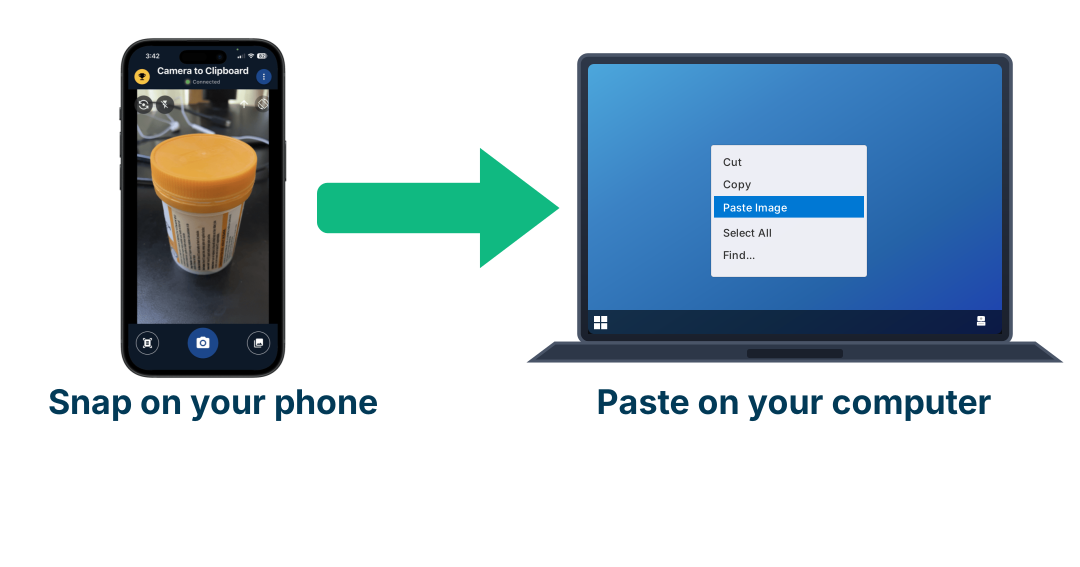
Both halves of that split are worth checking rather than assuming, and most people do the checking on a phone, because that is where they ask ChatGPT and Google anything else. An AI answer is rewritten every time you ask it, so the only way to tell whether the work moved anything is a dated pile of what it said before. Camera to Clipboard, one of my own apps, gets those screens off the phone and onto the computer you keep the notes on.
- Anything already sitting in your phone's photo library can be sent to the computer, several at once, so a week of captured answers lands in one go. The alternative most people use is emailing pictures to themselves, which is how a record of what an assistant said last Tuesday ends up buried in an inbox instead of in a folder.
- ChatGPT cites around fourteen sources and Google's AI nine or ten, so what you are tracking is whether your page is one of them on any given day. A picture pasted straight into a Word or Google Docs page keeps the whole answer and its citation list together, which a copied paragraph of text does not.
- The phone and the computer send the picture to each other over your own network, with no upload to anybody else's website in between. There is no cable and no third party holding a copy, which matters more than usual when what you are filing is competitive research.
YouTube and brand mentions predict AI visibility, backlinks do not
This is the result that reorganised how I think about the whole thing. When Ahrefs looked across 75,000 brands to see what correlates with showing up in AI answers, measuring ChatGPT, Google AI Mode and AI Overviews together, the winners were not the things SEO people spent a decade chasing:
- YouTube mentions were the single strongest correlate. Being talked about in video, on the platform Google owns and indexes, tracked AI visibility more closely than anything else measured (a correlation around 0.74), and it was the top signal on all three engines alike.
- Branded mentions across the web came next. Simply being named on other people's pages, with or without a link, correlated strongly (roughly 0.66 to 0.71). The models seem to treat “lots of people mention this thing” as a signal that it is worth mentioning too.
- Backlinks correlated only weakly. The prize of classic SEO, other sites linking to you, sat down around 0.22, barely moving the needle by comparison.
- Raw page count correlated with almost nothing. Pumping out hundreds of thin pages, the content-farm strategy, showed close to no relationship with AI visibility.
- And the same brands win everywhere. Visibility on one engine overlapped ~0.75 to ~0.82 with the others, so this is not three separate races. Build genuine brand presence and it pays off across ChatGPT, AI Overviews and AI Mode at once.
The honest caveat, which I will come back to at the end, is that this is correlation, not proof of cause, and Ahrefs sells visibility tools. But the direction is echoed across several independent studies, and it points somewhere very practical: spend your effort on being mentioned and talked about, not on link-building and mass-producing pages. The estimator below lets you feel the weighting. Drag the levers and watch how little the classic-SEO ones move the score.
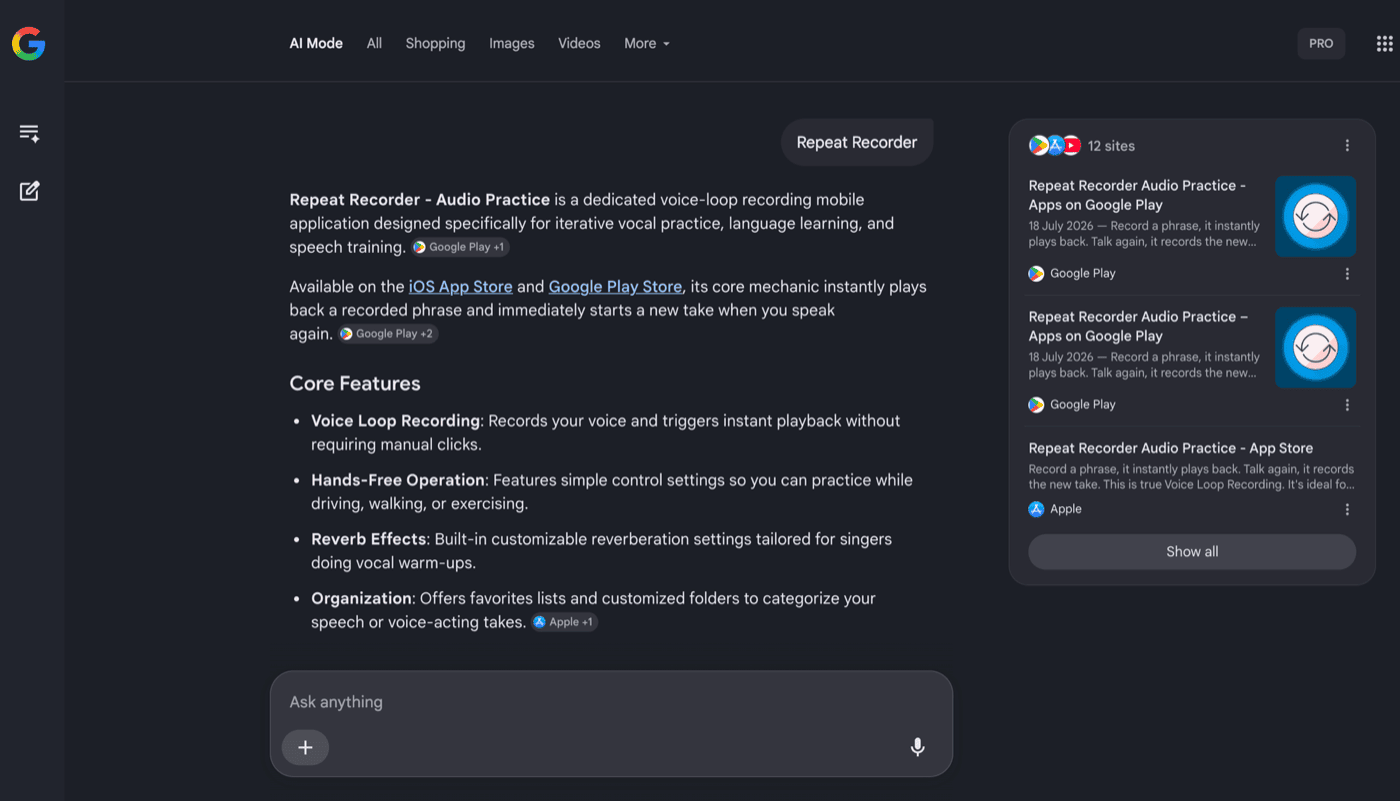
For my own apps this reframes everything, and I have watched it happen. Ask Google’s AI about repeat recorder and it already pulls Repeat Recorder in, describing the app and citing the App Store and Google Play across a dozen sources, as the screenshot below shows. That is the whole finding in one picture: a handful of store, review and community mentions did more than a month of the link-building I would once have done. The goal is not to be linked. It is to be talked about, in the places the models are reading.
Quote real numbers and answer the exact question
Off-site presence gets you into the running, but your own pages still decide whether an assistant can comfortably use you. The best evidence here is a peer-reviewed study, the Princeton GEO paper, which tested specific edits and measured which ones increased a page's visibility in generative answers. The winners were concrete:
- Add a clean quotable sentence the model can lift verbatim. Giving the model a clean, self-contained sentence it can lift verbatim was one of the strongest single edits, worth up to roughly a 40% visibility lift on their measure.
- Specific numbers with a citation attached make a page far likelier to be quoted. Specific numbers with a citation attached made a page markedly more likely to be used. Assistants prefer to build an answer out of concrete, checkable claims.
- State the point directly, because buried claims are harder for a model to extract. Writing that states the point directly, rather than burying it, was easier for the model to extract and reuse.
This matters even more for Google's AI Mode, because of that query fan-out: it is hunting for a passage that answers one specific sub-question. Notice that this article is doing exactly that to itself, numbered claims, cited statistics, a clear answer under each heading. That is not an accident, it is the technique. Practically, for a small site:
- Make each heading answer one question, and answer it in the first sentence. One
H2per discrete question, with a tight direct answer (aim for 40 to 60 words) right underneath, then the detail. Fan-out rewards pages that cleanly answer a sub-question. - Write short sections that make sense without the paragraph before them. Aim for short sections that make sense on their own without the paragraph before them, because the model often pulls one chunk out of context.
- Put one quotable, specific fact in each section. A real number, a concrete claim, a clear definition, something an assistant can quote and attribute.
- Add a plain-language FAQ and structured data. A genuine question-and-answer block, ideally marked up with FAQ schema, matches how people phrase things to an assistant. Google has been clear that schema is not a magic citation button, it helps it understand your entity, so use it to be understood, not as a trick. This page ships one.
- Update the date and the numbers, because assistants lean toward recent pages. Update the date and the numbers. Assistants lean toward recent pages when the question is time-sensitive (more on what “fresh” really means, and whether you can fake it, just below).
Wondering whether “keeping it fresh” matters, and whether you can fake it by changing the date? The full freshness guide →
Get mentioned where the models already look
If the correlation data says mentions beat links, the practical question is where to earn those mentions. The answer follows directly from how the engines retrieve: go to the sources they already trust and reach for.
- Get onto YouTube, even indirectly. Given it is the single strongest correlate on every engine, a real review, demo or mention on video is disproportionately valuable. One creator covering your app can outweigh a lot of on-page effort.
- Be genuinely present on Reddit. It is one of the most-cited sources on both ChatGPT and, even more, Google's AI. That does not mean spam, it means actually participating in the subreddit for your niche so a real thread about you exists to be found.
- Earn a Wikipedia-grade footprint, especially for ChatGPT. You usually cannot and should not write your own Wikipedia page, but being referenced by the kind of independent, authoritative sources Wikipedia and ChatGPT both trust is the same work.
- Get into the roundups and comparison articles. “Best free image editor for Mac”, “best app for practising a speech”, these listicles are exactly what an assistant reads to answer a recommendation query. Being in them is the lever.
Thinking of hiring a YouTuber for AI visibility? It works, if you match the language to your market, understand that views matter less than breadth, and know what the AI can actually see. The full creator guide →
A hundred of your own videos still count as one source
This is the first thing I thought too: if mentions are the currency, why not just manufacture a pile of them, upload fifty videos, drop your product into thirty Reddit threads? It is the obvious move, and it mostly does not work, for one structural reason: the systems reward being talked about across many independent sources, and everything you make yourself is still one source. Can Google or ChatGPT tell it is all coming from you? Not by reading your mind, but the signals they actually reward are exactly the ones a single owner cannot fake at volume:
- About 78% of AI citations come from pages the brand does not own. One analysis of more than 23,000 AI citations found roughly 78% came from pages the brand does not own, and only about 23% from the brand's own content. Your own channel and site sit in that smaller slice by definition, so self-produced volume is competing for the minority of slots.
- Volume from one place barely correlates; breadth across sites does. In the 75,000-brand study, sheer page count correlated with almost nothing (~0.19), while branded mentions across many different sites correlated strongly (~0.66 to 0.71). Ahrefs' own summary is blunt: it is “not just a content-creation arms race”, what matters is being mentioned across a broad scope of sites.
- When ten of your pages say the same thing, the model quotes only one. When ten of your videos or posts say the same thing, the model pulls one representative passage, not ten separate votes. Ten near-identical mentions from one owner behave more like one signal than ten.
- Assistants name you when several independent sources agree, not when one does. The thing that makes an assistant confident enough to name you is several independent sources agreeing, and one person repeating themselves is the opposite of independent agreement.
On YouTube specifically, the self-upload farm fails twice over:
- Zero-view uploads add close to nothing. The YouTube mentions that track with visibility are weighted by how much they are actually watched, so a wall of videos nobody views barely registers. Views are the part you cannot self-produce.
- YouTube now polices exactly this. In July 2025 it renamed its “repetitious content” rule to “inauthentic content”, aimed squarely at mass-produced, templated video, and has terminated channels over it. A self-upload farm is both invisible (no views) and against policy.
On Reddit the trap is sharper still, because it is the most-hunted surface of all:
- One account pushing its own product across threads is a trivial pattern to catch. The repeated account-to-brand link is exactly what Reddit's spam systems and human moderators are tuned to flag. Most subreddits either ban self-promotion outright or cap it (the informal “one promo per nine genuine posts” rule), and new or low-karma accounts are auto-filtered. The usual result is a quiet shadowban: your posts look normal to you and are invisible to everyone else, so you can spend weeks seeding into a void.
- Scaling it with fake accounts makes it worse, not safer. Coordinated posting or voting escalates the penalty from a single removed post to suspension of every linked account, and can get your whole domain blocked across Reddit. You convert a small per-post risk into a brand-wide one.
- Reddit is now hunting this on purpose. It says it blocks around 23 million spam views and removes about 25,000 spammy posts a day, revokes roughly 2 million fake votes a day, and now uses its own AI to spot the coordinated patterns older filters missed.
- Cornell showed thirteen planted words can steer an assistant, briefly. Cornell researchers showed in lab tests that as few as thirteen planted words can steer an AI answer, but only if the post becomes one the assistants retrieve often, and that is precisely the post most likely to get moderated away. Marketers doing it admit they must keep replacing removed posts. You are renting a result, and the rent keeps rising.
One honest caveat: no study has run the exact experiment of spinning up a pile of owned mentions and measuring the discount, so this is a convergent case, third-party citations dominate, raw volume barely correlates, and the platforms actively strip inauthentic content, rather than a single smoking gun. But the direction is consistent, and it lands in the same place as the rest of this piece: you cannot manufacture your way in, you have to be worth mentioning. One genuine creator review, or one real thread where people actually engage, beats a hundred of your own, because it is the one thing self-production can never be: independent. For the fuller version of how people try to cheat this anyway, and why it backfires, see the dark side below.
Reviews and roundups beat your store page
People ask an assistant for an app before they open a store, so it reads reviews, roundups, YouTube and Reddit, not your listing.
Use Repeat Recorder to rehearse the demo video you film
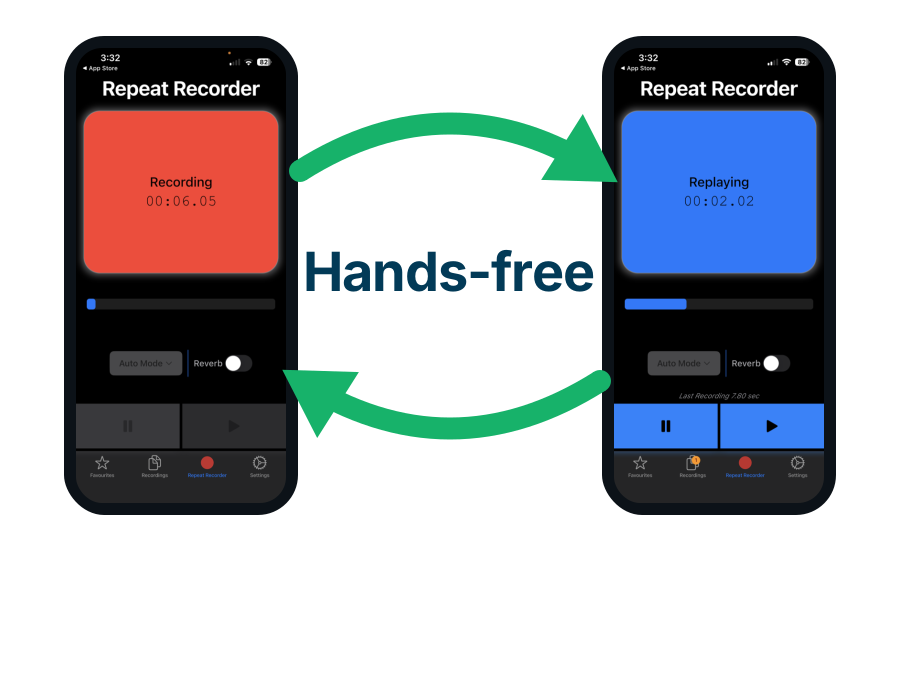
An assistant reads reviews, roundups, YouTube and Reddit before it ever reads your store listing, and YouTube mentions are the strongest thing anybody has measured here. The catch is that those mentions count in proportion to how much a video is actually watched, so a demo nobody finishes is worth close to nothing no matter how many you upload. Repeat Recorder, another of my own apps, records you, plays the take straight back and starts recording again without you touching the phone.
- Repeat Recorder replays each take on its own and then starts recording again, so the same opening sentence can be run twenty times without picking the phone up. That is the entire app. It was built for language practice, speech rehearsal and vocal training, and saying what your product does until it comes out in one clean line is the same job with different words.
- Uploads nobody watches add close to nothing to AI visibility, so the sentence that decides whether people keep watching is the one worth rehearsing. Views are the part of a YouTube mention you cannot produce yourself, and the first ten seconds of a demo are where most of them are lost.
- Takes worth keeping go into favourites and into folders you name yourself, so two ways of explaining the same product sit next to each other. The wording you settle on is also the wording you send a creator when you ask them to cover it, and 78% of AI citations come from pages you do not own.
Never write your own Wikipedia page, but a real one is gold
Creating your own page is discouraged and usually deleted, yet a legitimate one is arguably the best AI asset you can own, for ChatGPT specifically.
YouTube is the single strongest lever for getting cited
YouTube mentions are the strongest measured correlate of AI visibility, and long-form videos beat Shorts by a wide margin. Here is why, and how to earn the mentions that count.
Quora is a low-risk lever, strong on Google’s AI
Quora is one of the most-cited sources in Google’s AI answers, and unlike Wikipedia you are allowed to take part, if the answer is genuinely useful.
LinkedIn is a real 2026 lever, but only for B2B
LinkedIn surged to around the second most-cited domain in AI answers, but its strength is professional/B2B queries, and an Article gets LinkedIn cited, not your own site.
Use Camera to Clipboard to put real photos in a Reddit post
Wikipedia, YouTube, Quora and LinkedIn all have the same catch in common: each one is somewhere you have to actually publish something, and a post carrying a picture of the real thing is harder to mistake for the templated promotion those platforms are busy removing. The picture is usually on your phone and the post is usually being written on a computer. Camera to Clipboard, one of my own apps, is the step between the two.
- A photo you take inside Camera to Clipboard is ready to paste on your computer the moment you take it. There is no emailing it to yourself, no cable and no upload to somebody else's website first. The phone and the computer find each other over your own network and send the picture straight across.
- Reddit is the single most-cited site in Google's AI answers at around 21%, and a real thread about you is the thing being cited. The picture arrives as an ordinary image on the clipboard, so anywhere that accepts a pasted picture takes it, whether that is a browser reply box, a Google Doc or Photoshop.
- You can send several photos at once out of your phone's library rather than one at a time. That is what you want when a genuinely useful answer needs three pictures of the same thing at different stages, which is the sort of post that survives moderation because somebody clearly did the work.
The Medium article that links to you is not a hack
A self-written Medium post is still your own content on someone else’s domain: the links are nofollow, the citation goes to medium.com, and Medium is a rounding error in AI citations.
How AI answers get gamed, and why it is a trap
Planted thirteen-word snippets, hidden instruction injection, content farms and paid Reddit seeding: the same mechanisms that earn a mention let people fake one, briefly, before the platforms strip it.
Almost every number here comes from companies selling tools
I would be doing the thing I criticise if I handed you these statistics as settled fact, so here is the health warning, plainly:
- Most headline numbers are vendor studies. The correlations, the citation splits, the ranking-overlap figures come from firms like Ahrefs, Semrush and others that sell AI-visibility products. Their methods are not independently audited, and they have a reason to make this feel urgent.
- The strongest evidence is narrower. The genuinely peer-reviewed or first-party work, the Princeton GEO paper, Google's own description of query fan-out, the university security research, is solid, but it covers the mechanisms, not the tidy percentages.
- Every AI-visibility figure here is correlation and a fast-moving snapshot. None of the visibility findings prove that doing X causes visibility, and every figure is an early-2026 reading of systems that change monthly, sometimes disagreeing with each other. Treat the specific percentages as directional, not durable.
None of this makes the playbook wrong, the direction is consistent across independent sources, but it does mean you should hold the exact numbers loosely and watch your own results, not chase a leaderboard someone is selling you.
Conclusion: how to rank in ChatGPT and Google AI, in one glance
- ChatGPT runs on Bing and ignores your Google rank, while Google's AI answers run on Google's own index and still reward ranking. ChatGPT reaches for Wikipedia and Reddit and cites around fourteen sources an answer, while Google's AI cites nine or ten and gives position one roughly a 53% chance of being cited. Aim at both, because the same brands tend to win on both.
- YouTube mentions and being named on other people's sites predict AI visibility, and backlinks barely do. Across 75,000 brands, YouTube mentions tracked visibility more closely than anything else measured, backlinks trailed far behind, total page count tracked almost nothing, and about 78% of AI citations come from pages the brand does not own. That is a pattern rather than proof, and most of these figures come from firms selling visibility tools, so hold them loosely and watch your own results.
- Quote real numbers and answer each question in the first sentence, so an assistant can lift a passage whole. Google's AI Mode splits one question into 8 to 12 sub-searches and takes a passage from each, so a short self-contained section carrying one specific cited number can be used even when the page itself does not rank. Earn the mentions rather than planting them, because a planted snippet works briefly and the platforms are hunting it.