
“Keep it fresh” is advice everyone gives and nobody defines, and the first question is always: can I just change the date? Here is how freshness actually works, and why the cheap versions of it do not.
How an AI knows your page is fresh, and why the date alone fails
“Keep it fresh” is advice everyone gives and nobody defines, and the first question is always the same: can I just bump the date? The honest answer is that freshness is real but narrower than it sounds, and the cheap version does not work.
How they actually judge it:
- Search engines read several dates on a page and trust no single one. Google reads the visible “last updated” date and the date in your structured data, but it also keeps its own record of when your page really changed, by comparing one crawl to the next. If the date says today but the words are identical to last year, it is the date that gets ignored.
- Lying about it can cost you the signal entirely. Google has said that if a site stamps a fresh date on pages that did not change (a common auto-generated habit in sitemaps), it simply stops trusting that whole site's dates. You do not just fail to gain, you lose the signal.
- Language models pick the more recent of two otherwise identical pages. A peer-reviewed 2025 study found that language models, shown two otherwise-identical passages, tend to favour the one with the newer date, a genuine recency bias. And AI answers skew hard to recent sources: one study found roughly two-thirds of AI citations came from the past year, strongest of all in Google's AI Overviews.
The catch, and the gaming:
- Freshness only matters for questions that deserve a fresh answer. Google's long-standing idea of “query deserves freshness” still holds: news, prices, trends and “best X in 2026” reward recency, but an evergreen how-to or a definition does not. A fresh date on a timeless page does almost nothing.
- Bumping the date alone is, in Google's own words, “just noise and useless.” Google's Search team has called date-swapping “an old trick” the engine already handles. Changing the year in your title to 2026 will not lift your ranking either, though it can nudge how many people click.
- Marking a page updated without changing it can quietly backfire. Because the engines diff your content, a page marked “updated” with an unchanged body can end up trusted a little less, not more.
- And spinning up a new page each year does not fix it, it is worse. Republishing the same guide at a fresh
...-2026slug, then...-2027, changed only a little, is the losing version of the trick. The new URL starts from zero authority, with none of the old page's accumulated links or history. Google reads two near-identical pages as duplicates and quietly consolidates or ignores one (or, if you change enough to avoid that, makes your own two pages compete and split your ranking). And the AI engines dedupe near-copies back to the older, more authoritative URL, the one you just abandoned. You pay a real, permanent cost to rent a small, temporary freshness bump.
So the trick is that there is no trick: real freshness means genuinely changing the same page, new numbers, corrected facts, an added section or example, updated links, not spawning a new URL and not touching the timestamp. Keep one stable address, update it where recency actually matters, leave your evergreen pieces alone, and you earn the freshness benefit honestly. The one tension worth naming: at the pure model level that recency bias means a date can sway an AI, but Google's live search checks your date against its own crawl history, so the cosmetic version does not survive where it counts. (None of this is a named “penalty”, exactly, it is just quietly ineffective, which is why so many sites keep doing it.)
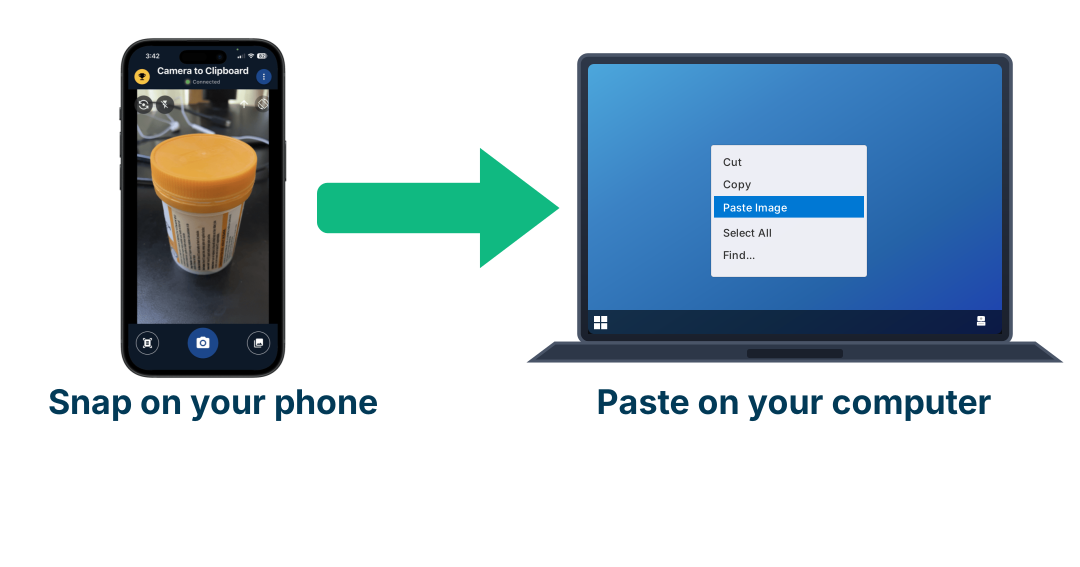
Use Camera to Clipboard to add new photos to an old page
Google keeps its own record of when your page really changed by comparing one crawl to the next, so the only freshness that counts is material that was not on the page before, added to the same address. A new photograph is one of the fastest things to add and one of the slowest to actually get in place, because the picture is on your phone and the page is on your computer. Camera to Clipboard, one of my own apps, removes the step in between.
- A photo taken inside Camera to Clipboard is sitting on your computer's clipboard by the time you put the phone down. There is no emailing it to yourself, no cable and no upload to somebody else's website in between. The phone and the computer find each other over your own local network and send the picture directly.
- A photograph that was not there at the last crawl is exactly the kind of change Google's crawl-to-crawl comparison can see. Google's Search team called swapping the date “an old trick” and “just noise and useless”, and a site caught stamping fresh dates on unchanged pages loses the trust in all of its dates. New material on the same address is the version of freshness that survives the check.
- You can send several photos out of your phone's library at once, so a whole set of new examples arrives on the computer together. Pasting puts the picture into Word or Google Docs inline and into Photoshop or GIMP as a new layer, because it arrives as an ordinary image on the clipboard rather than a file you have to go and find.
Conclusion: how content freshness really works for AI answers
- Google decides your page is fresh by comparing one crawl to the next, not by reading the date you display. It does read the visible “last updated” date and the date in your structured data, but it also keeps its own record of when the words really changed, and where the two disagree it is the date that gets ignored.
- Google's Search team calls swapping the date “just noise and useless”, and a site that stamps fresh dates on unchanged pages loses the trust in all of its dates. One study found roughly two-thirds of AI citations came from the past year, so recency is worth real traffic, which is what makes the cosmetic version of it such a bad trade.
- Add new numbers, corrected facts and extra examples to the same address, and leave your evergreen pages alone. Republishing the same guide at a fresh
...-2026URL starts from zero authority, carries none of the old page's links or history, and gets folded back by the AI engines into the older URL you just abandoned. Freshness only pays on questions that deserve a fresh answer, such as news, prices, trends and “best X in 2026”.