
A popular theory among app developers says a subscription app should show its paywall every time the app opens, because a person who sees the price every day will eventually give in and pay. The theory leans on a real finding that psychologists call the "mere exposure effect": people tend to like things more after seeing them more often. This article tests the theory against 208 psychology experiments, 30 randomised advertising experiments covering 2.8 billion ad views, and the subscription industry's own data from Adapty, RevenueCat and Superwall.
The short version: showing a paywall more than once does help, because only 44.5% of app purchases happen on install day. Showing it on every launch, every day, does not keep helping. Repeated viewing raises liking only a little, the rise stops somewhere between 3 and 20 views, and it does not lift something the viewer already dislikes. The advice to show a paywall on every launch comes mostly from companies that sell paywall software, and even their own tools offer a limit of once a day or once a week. Nobody has published what a paywall on every launch does to ratings or uninstalls.

55% of app purchases happen after install day, so a second paywall view is worth having
The every launch theory starts from something true.
- Adapty's 2026 data on 16,000 apps puts 44.5% of app purchases on install day, so 55.5% of purchases happen on a later day.
- Free trial starts behave differently from purchases, because 89.4% of free trial starts happen on install day in the same Adapty data.
- The video app Mojo earns more than half of its revenue after a user's first day, according to RevenueCat's David Barnard on the Sub Club podcast.
- One developer who tested a forced paywall against a paywall people could close found that 84% of their buyers bought after closing the first paywall, covered in how to design a high converting app paywall.
So the real question is not whether to show the paywall again. It is how many times, and when.

Seeing something more often makes people like it only a little, and the rise stops within 20 views
Psychologists have tested repeated viewing for more than 50 years, and the effect is smaller than the every launch theory needs.
- Across 208 experiments reviewed by Robert Bornstein in 1989, seeing something more often raised how much people liked it by only a small amount.
- Liking for something seen again and again usually peaks within 10 to 20 views and then starts to fall, confirmed in 2017 by Montoya and colleagues across 268 measurements from 81 published papers.
- Repeated viewing raises liking most when people do not notice they saw the thing, and a paywall is impossible not to notice.
- Repeated viewing pushes people further in whichever direction they already leaned, so it did not raise liking for disliked things in Mrkva and Van Boven's 2020 study.
- No published study has tested repeated viewing on a price or a subscription offer, because all of them used words, faces, shapes, music or brands.

Repeated adverts stopped persuading people after about 3 to 10 views in every large study
Advertising researchers have measured repetition directly, which is much closer to a paywall than faces and shapes.
- In Cacioppo and Petty's 1979 study, agreement with a message rose from one hearing to three and fell by the fifth, because people got bored and started arguing back in their heads.
- A 2015 review of advertising experiments by Schmidt and Eisend found people liked an advert most at about 10 views, while only their memory of the advert kept rising.
- Randall Lewis studied 2.8 billion Yahoo ad views across 30 randomised experiments, and 4 of the 30 campaigns stopped working after 1 or 2 views.
- The adverts people clicked most in Randall Lewis's Yahoo study were the ones that stopped working fastest.
- People early in deciding whether to buy were annoyed after as few as 3 views of the same advert, against 7 views for people close to buying, in work by Todri, Ghose and Singh.
A new app user who has not yet felt the app work is, by definition, early in deciding whether to buy.

Charts where users who saw more paywalls paid more mislead, because keen users open the app more
This one mistake can make a paywall on every launch look like it works when it may not.
- A user who opens an app 40 times a week sees more paywalls and is also far more likely to pay, because that user already likes the app.
- Comparing users who saw many paywalls with users who saw few shows that keen users pay, not that the extra paywalls made them pay.
- Randall Lewis found that comparing heavy viewers with light viewers makes repeated adverts look like they slowly start working, and the effect vanished once he compared randomly chosen groups.
- The only fair test of a paywall on every launch shows it to one randomly chosen group of new users and shows fewer paywalls to another, then compares the two groups as a whole.

Seeing the same price over and over makes the price feel normal, not cheap
The second half of the theory is about the price itself.
- Every price a buyer sees feeds the price they expect to pay next time, found by Kalyanaram and Winer in 1995 from supermarket purchase records.
- A price above what the buyer expects hurts more than an equal saving pleases, in the same research.
- The price a user expects to pay for an app they think of as free is $0, so every paywall view shows them a price above what they expect.
- The first number a person sees pulls their later judgements toward it, and people given high random numbers valued items 57% to 107% higher in Ariely's 2003 experiment.
- A larger repeat of Ariely's experiment in 2014 found a much smaller pull from the first number, and no study shows that seeing the same first price again makes the pull stronger.
Showing the same price every time is what this research supports, and how often to show it is a separate question.

A paywall that blocks what the user opened the app to do teaches them to close it without reading
A paywall on every launch is not only repeated. It also interrupts, and interruption has its own measured cost.
- In Edwards, Li and Lee's 2002 experiment with 379 people, pop-up adverts felt more intrusive to people busy with a task, scoring 4.42 out of 7 against 3.70.
- Pop-up adverts unrelated to what the person was doing also felt more intrusive, scoring 4.24 against 3.64 in the same experiment.
- Feeling interrupted made people avoid the pop-up before they even felt annoyed, so users can learn to close a paywall long before they would call it annoying.
- A pop-up lasting 10 seconds felt no less intrusive than one lasting 20 seconds, so a shorter paywall does not fix the interruption.
- A survey of 7,000 mobile game players for Deloitte and Google AdMob found one disruptive full-screen advert raised the share of players who quit by 6% to 7%, though that measured other companies' adverts, not an app's own paywall.
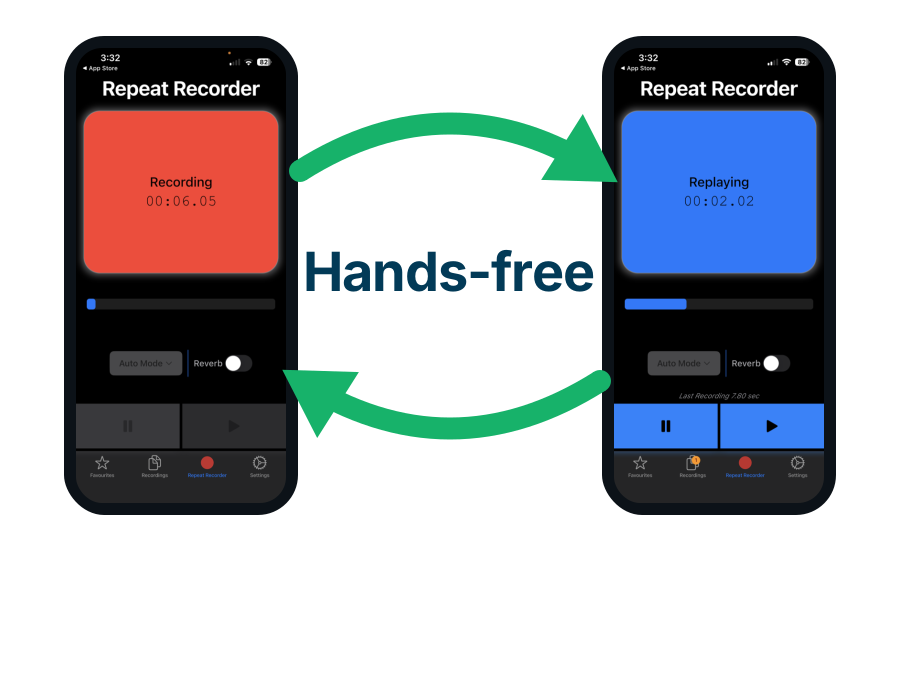
Use Repeat Recorder to hear how your paywall's sales line sounds by the tenth repeat
The advertising studies above are easy to feel for yourself. Repeat Recorder, one of my own apps, records a short clip and plays it back on a loop, so you can hear your paywall headline or your app's video pitch over and over, the way a daily user meets a paywall shown on every launch.
- Repeat Recorder plays your recording on a loop with no button to press between plays.
- Repeat Recorder can play a recording a set number of times, so you can stop at exactly ten plays.
- Hearing one sales line ten times in a row shows which words start to sound irritating first, which is the same pattern the advertising studies measured after 3 to 10 views.

The advice to show a paywall on every launch comes from companies that sell paywall software
Search for this question and almost every answer traces back to the same few sources.
- Superwall co-founder Jake Mor posted in 2022 that apps should show a paywall on every app open and send daily notifications so every open becomes another paywall view, in a widely shared thread.
- Jake Mor also claimed Superwall saw no drop in paywall results until about the 7th view, without saying how that was measured.
- Another paywall company, Nami ML, claims paywall sales start falling after about 2 views per user, also without publishing its data.
- Jake Mor's rule for removing a paywall placement is to stop when sales drop, which counts this week's money and ignores users who leave and one star reviews.
- The video app Mojo says a paywall shown at app open produced 15% of its new iOS revenue "with minimal complaints", which is a share of revenue and not a comparison against users who never saw it (RevenueCat).
Two paywall companies give two different limits, 2 views against 7, and neither shows its working.

The biggest paywall wins came from showing it once in onboarding, not from showing it every day
The success stories most often quoted for paywalls on every launch are about something else.
- The plant care app Greg raised the share of new users starting a free trial from 3% to 15% by moving its paywall into onboarding, reported by RevenueCat.
- The anxiety app Rootd made five times the revenue after moving its paywall to the start of onboarding.
- One developer on Indie Hackers moved a paywall out of the settings menu and into onboarding, and free trial starts doubled from 2.5% to 5% of new users.
- Greg, Rootd and the Indie Hackers app each went from almost nobody seeing a paywall to everybody seeing it once, which says nothing about anyone seeing it a thirtieth time.

Even paywall companies limit a launch paywall to once a day or once a week
The firms that recommend a paywall at launch build limits into their own products.
- Superwall's own documentation offers once a day and once a week limits on paywalls shown at app open, to balance paywall views against users leaving the app.
- Duolingo shows its free users a paywall at launch only about once a week, according to RevenueCat's David Barnard.
- Mojo has never published how often its 15% app open paywall appeared, so that figure cannot be quoted as support for a daily paywall.
- A reasonable starting rule is a paywall in onboarding, a launch paywall no more than once a week after that, and a paywall on every tap of a locked feature.
- Skip the launch paywall for a few sessions after someone closes it, because asking again straight after a no is what regulators call "nagging".
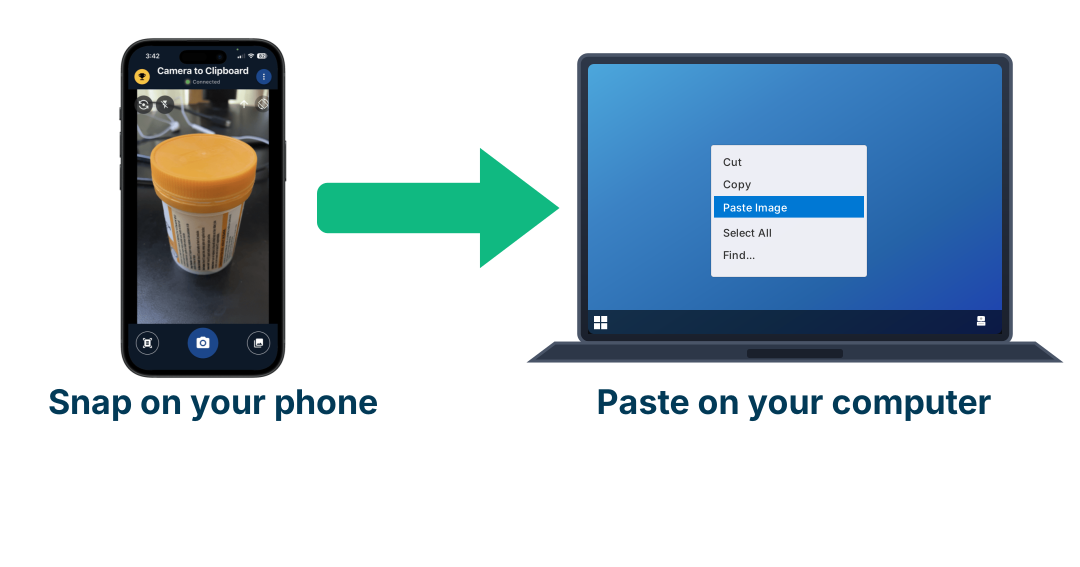
Use Camera to Clipboard to record how often rival apps show their launch paywall
The cheapest research on this question is watching what the apps in your category already do. Opening a rival app every morning for two weeks and photographing each paywall it shows gives you a record no vendor report will. Camera to Clipboard, another of my own apps, puts what your phone camera sees straight onto your computer's clipboard, so each photo lands in your notes in one step.
- Photograph a rival app's paywall off a second phone, because many apps block screenshots on payment screens.
- Camera to Clipboard lets you paste each photo straight into a dated document, with no email to yourself and no cable.
- Two weeks of photos shows whether a rival app shows its paywall on every launch, once a day or once a week.

Apple and Google allow a paywall on every launch, but regulators call repeated asking "nagging"
Nothing in the app store rules stops a paywall on every launch. The regulators' wording is where it looks exposed.
- Neither the App Store nor Google Play bans showing a paywall every time an app opens.
- Google Play's subscription policy lists a missing or hard to see close button on a subscription offer as a violation.
- Apple's guideline 3.1.2 requires a paywall to state clearly what the user gets for the price, and guideline 5.6 bans manipulative practices.
- The US Federal Trade Commission's 2022 staff report on dark patterns defines "nagging" as repeated requests for an action, or denying people a way to permanently say no.
- The EU Digital Services Act, Article 25, names "repeatedly requesting" a choice the user has already made, especially through pop-ups.
- Article 25 of the Digital Services Act covers online platforms, which most standalone subscription apps probably are not, so for a small app the risk today is mostly to its reputation.

Nobody has published what a paywall on every launch does to ratings, so test it on your own app
Every public number on launch paywalls counts sales, and none counts what they cost.
- No public study measures uninstalls, star ratings or the share of users still opening the app a week later for apps that show a paywall on every launch.
- Split new users at random between a paywall on every launch and a launch paywall once a week.
- Compare revenue per install, the share of users still opening the app on day 7 and day 30, and the star ratings left by each group.
- Wait for at least 200 subscriptions in each group before trusting the result, because results from smaller groups are mostly chance.

Every argument for and against a paywall on every launch, graded by its evidence
| Claim about repeated paywalls | What the evidence says | Type of evidence | How well the claim holds up |
|---|---|---|---|
| A few views beat one view | Liking and agreement rise for the first 3 to 10 views | Reviews of many experiments plus randomised field data | Holds up |
| More views keep raising the chance to pay | Every large study found a rise, then a flat line or a fall | Reviews of many experiments plus randomised field data | Contradicted |
| Seeing something often makes people like it | A small effect, weakest for things people notice or dislike | 208 experiments, none on prices | Weak for a paywall |
| Seeing a price often makes it feel normal | Past prices set the price people expect | Supermarket purchase records | Holds up for a steady price, says nothing about how often |
| Repeating the first price strengthens its pull | No study shows it | None | Unsupported |
| Interrupting screens get avoided | Feeling interrupted drove avoidance before annoyance | One experiment, 379 people | Moderate |
| A paywall on every launch raises sales | Mojo's 15% of new iOS revenue, one founder's 7 view claim | Paywall company figures and one founder | Weak |
| A paywall on every launch hurts ratings or uninstalls | Nothing has been published | None | Unknown |
The only claim with strong evidence behind it is that a few views beat one, and the same evidence says the gain stops early.

Conclusion: should you show your paywall every time someone opens your app
No, but show it more than once. These five points are ordered by the strength of the evidence behind them.
- Show the paywall more than once, because 55.5% of app purchases happen after install day.
- Do not expect repeated paywall views to keep working, because liking and agreement stop rising somewhere between 3 and 20 views.
- Ignore charts showing users who saw more paywalls paid more, because keen users open the app more.
- Limit the launch paywall to about once a week, which is what Duolingo does and what Superwall's own tool offers.
- Test a paywall on every launch against a launch paywall once a week on your own users, because nobody has published the cost in ratings or uninstalls.