
Almost everything written about launching on Product Hunt optimises the wrong thing. The guides tell you how to get upvotes, but upvotes are not the gate: being featured is, and an unfeatured launch is not ranked at all, no matter how many votes it collects. They also inflate the numbers badly. I sampled five real leaderboard days in 2026 and the #1 product of the day needed between 356 and 643 upvotes, not the 800 to 1,500 you will read everywhere. And the question most people actually have, whether a three-year-old or five-year-old app is even allowed to launch, has a clear answer that almost nobody states: there is no age rule anywhere in the guidelines.
The short version: Product Hunt is small. About 4.6 million monthly visits, which is roughly 0.3% of Reddit's monthly reach. You launch there for intent, credibility and one permanent search result for your brand name, not for volume. The real gate is being featured by a human moderator, judged on four criteria (useful, novel, high craft, creative) where you only need to spike on one or two. Since January 2024 the featured rate has collapsed from a reported 60 to 98% down to roughly 10%, and unfeatured launches are invisible: no homepage, no mobile app, no rank. Old apps are fine - the guidelines require the product to be live, which an established app passes trivially, and say nothing about age. The two things that will actually stop you are a previous post on the same root domain within six months, and a product that is a waitlist rather than a working thing. My measured 2026 numbers: median #1 of the day was 411 upvotes, the top ten started at 110, and a weekend #1 cost about 40% fewer votes than a midweek one. On outcomes, be sceptical of every guide you read: Plausible Analytics published its real figures for a genuine #2 of the day and got 1,490 visitors and 22 trial signups, against the 5,000 to 15,000 visitors the launch-guide industry promises for a top-three finish.
Product Hunt is 0.3% the size of Reddit
Before deciding whether to spend a month preparing a launch, it helps to know exactly how big the prize is, because it is far smaller than its reputation:
- It is one leaderboard, reset daily. Product Hunt is a site where people post new tech products and other people upvote and comment on them. Every submission enters a 24-hour window that opens at 12:01am Pacific, and at the end of it the day's ranking is frozen into a permanent leaderboard with daily, weekly, monthly and yearly views.
- The whole site gets about 4.6 million visits a month. That is the third-party estimate for March 2026. To put it in context, that is roughly 0.3% of Reddit's estimated monthly reach and about a quarter of one percent of Facebook Groups. Product Hunt is not a mass channel and never was.
- The daily newsletter is the real distribution. Product Hunt puts its tech roundup at more than 500,000 subscribers. Being featured means appearing in front of that list; not being featured means appearing in front of nobody.
- It is not a forum, despite often being grouped with them. The famous half of Product Hunt is a one-shot launch event, not an ongoing place to hang out. It does now run genuine discussion forums alongside the leaderboard, but the launch is what people mean when they say "Product Hunt", and a launch is an event: one day, then it is over.
- Posting to Product Hunt is free, including winning the day. There is no fee to create an account, submit a product, or win the day. Paid options exist but are separate from launching, and one of them is unavailable to you precisely when you would want it, which is covered further down.
Side note: where the 4.6 million figure comes from, and how much to trust it
It is a traffic-panel estimate, not a disclosure. Product Hunt does not publish its own visitor numbers, so the 4.6 million monthly visits comes from third-party measurement services that model traffic from browsing panels and clickstream data. Those tools are directionally reliable for a site of this size but routinely disagree with each other by 20 to 40%.
Treat it as an order of magnitude, which is all the argument needs. Whether the true number is 3.5 million or 6 million does not change the conclusion: Product Hunt is a low-millions site competing for attention against platforms measured in billions. The reason to launch there has nothing to do with size, which is the next section.
A small audience with the right shape for intent and credibility
A 4.6 million visitor site sounds like a rounding error next to the platforms in the forum comparison. It is worth launching on anyway, for reasons that have nothing to do with headcount:
- The visitors are pre-qualified in a way almost no other traffic is. People are on Product Hunt for the express purpose of finding new software to try. You are not interrupting them, you are answering the question they arrived with. That is why conversion rates from Product Hunt traffic tend to beat social traffic even though the volume is tiny.
- You get a permanent page that ranks for your brand name. Your launch page keeps existing, and Product Hunt is a strong enough domain that it often outranks small sites for their own product name. For a new app with no search history, having a credible third-party page describing it is worth more than the launch-day traffic.
- A Product of the Day badge keeps working on your landing page for years. A "#1 Product of the Day" badge on your landing page, in a store description, or in a cold email does work long after the day ends. This is the single most durable output of a launch and it is not traffic.
- The comments are the cheapest structured feedback available. A featured launch typically draws dozens of comments from people who build software for a living. Makers in Product Hunt's own 2026 discussion on whether it is still worth it consistently rate the feedback and credibility above the revenue.
- Newsletters and roundups scrape the Product Hunt leaderboard afterwards. Newsletters, aggregators and "best new tools" roundups scrape the leaderboard. Several makers report that the newsletter mentions and reposts that followed their launch sent more traffic over the following months than launch day itself.
- What it is not: a growth channel. Every honest account converges on the same conclusion. Plausible's founders, after a #2 finish, wrote that Product Hunt "is not the holy grail" and warned against treating a one-day spike as a substitute for continuous marketing. Treat it as an event you do once, well, then return to the channels that compound.
You do not launch on Product Hunt for the traffic. You launch for the badge, the permanent page and the comments, and the traffic is a bonus that will be smaller than you were told.
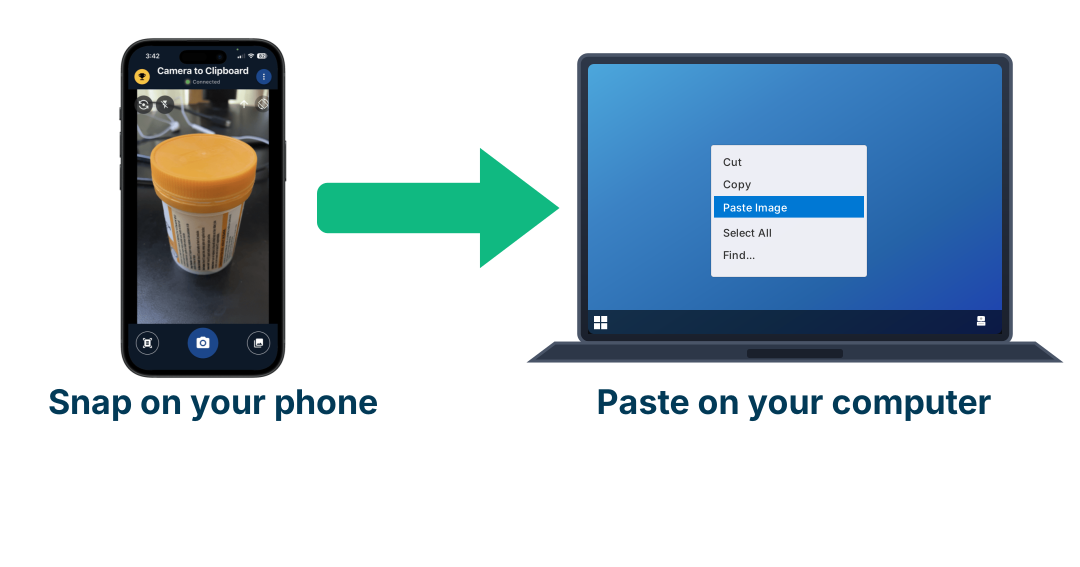
Use Camera to Clipboard to move app screenshots off your phone
The permanent page is the output that outlives launch day, and it is a page made almost entirely of pictures: the gallery, the thumbnail, and the badge you paste on your own site afterwards. If the product is a phone app, every one of those pictures starts life on a phone and has to reach the computer you are writing the submission on. Camera to Clipboard, one of my own apps, makes that a single step.
- Screenshots already sitting in the phone’s library can be sent to the computer several at a time, so a whole gallery arrives in one go. There is no emailing them to yourself, no cable and no upload to somebody else’s website in between. The phone and the computer find each other over your own local network and send the pictures directly.
- A Product Hunt launch page keeps existing and often outranks a small site for its own product name, so the screenshots on it are what strangers see for years. Getting them off the phone quickly is the difference between shipping the gallery you meant to ship and shipping the three pictures that happened to already be on the desktop.
- A picture from Camera to Clipboard arrives as an ordinary clipboard image, so Photoshop and GIMP open it as a new layer and Word and Google Docs take it inline. Anything that accepts a pasted picture accepts this one, which matters when the same screenshot has to be cropped once for the gallery and again for the thumbnail.
Getting featured is the real gate, not getting upvotes
This is the fact that reorders everything else, and most launch checklists bury it or skip it entirely:
- Product Hunt has two tiers, and only one of them is visible. Every submission lands in the "All" list. A curated subset is "Featured", and featured is what appears on the homepage, in the mobile app and in the daily newsletter.
- Unfeatured means unranked, not just less visible. This is the part people get wrong. If you are not featured, you do not appear on the leaderboard at all, so your upvote count is irrelevant. You can collect hundreds of votes and place nowhere, because there is no position to place in.
- The featured rate collapsed in early 2024. Reporting on the change puts it at 60 to 98% of daily launches featured between 2020 and 2023, dropping to roughly 10% during 2024. One count found about 16 products featured per day in September 2024 against 47 per day in September 2023, a fall of around two thirds.
- Featuring is a human decision, not an algorithm. Product Hunt says its team "carefully reviews each submission" and does so more than once. There is no threshold you can hit mechanically and no way to appeal your way in: the company notes that reaching out is "rarely necessary" and that supplying more context "does not guarantee" a feature.
- Aim first at clearing the featuring bar, and only second at winning the day. Everything you do to prepare should be aimed first at clearing the featuring bar, and only second at winning the day. A polished, obviously-working product with a clear tagline that gets featured and finishes eighth beats a heavily promoted launch that never gets featured at all.
~10% the reported share of Product Hunt submissions that get featured since the 2024 tightening, down from 60 to 98% in 2020 to 2023. An unfeatured launch is not ranked at all, so its upvotes do nothing.
Side note: how solid is the "10% featured" number?
Less solid than its confident repetition suggests. Product Hunt has never published a featured rate. The 60-to-98% and 10% figures, and the 47-to-16 per-day counts, come from third-party analyses of scraped leaderboard data, and they are then quoted back and forth between launch-guide sites until they read like official statistics. I am repeating them because the direction is corroborated from several independent angles, not because the precision is trustworthy.
What is independently verifiable is the consequence. You can check the daily leaderboard yourself and count how few products are listed, and makers describing unfeatured launches consistently report the same outcome: no homepage placement, no ranking, a few hundred visitors at most. Plan for "featuring is a genuine filter that most submissions fail" and you will be planning correctly, whatever the exact percentage is.
You only need to spike on one or two of the four criteria
Product Hunt states its featuring criteria openly, and reading them properly changes what you should emphasise in the listing:
- Useful means the product does something practical for a real person. This is the easiest of the four for a small utility app to satisfy convincingly.
- Novel means the approach is innovative or unusual. This is the criterion people assume is mandatory, and it is not.
- High craft means the product is well designed and pleasant to use. For a mature app with years of polish behind it, this is the strongest card in your hand and the one to lead with.
- Creative means the product is fun, engaging or imaginative. A niche category that rewards personality over feature lists.
- Product Hunt says a launch only needs to spike on one or two of the four criteria. Product Hunt's own wording is that "featured launches don't need to score high in every category - often they spike in one or two of these." This single sentence is why an old app is viable: you can fail "novel" completely and still be featured on craft and usefulness.
- What this means for your listing copy. Pick the one or two criteria you genuinely win on and make them unmissable in the tagline, the first gallery image and your first comment. Do not write a listing that gestures weakly at all four; write one that is undeniable on one.
The exclusion list disqualifies a lot of listing plans
Before writing any copy, check that your product is even eligible. Product Hunt's featuring guidelines name the exclusions explicitly:
- Product Hunt only features digital products, so most hardware is out. Hardware without a prominent digital component is out, and so are most Kickstarter projects.
- Product Hunt only features products that work right now, so no waitlists. The wording is blunt: "We only feature products that are currently available." Waitlisted products are excluded and vaporware is rejected. This one rule is the reason an established app has an advantage over a pre-launch startup.
- Product Hunt does not accept directories, nor templates, boilerplates, podcasts, courses, reports, events, books, services, commerce sites and deal sites. If your plan was to launch a curated list or a Notion template, this is where it ends.
- Product Hunt rejects thin, undifferentiated products built to monetise fast. Its wording is "minimal, undifferentiated products that seem primarily focused on immediate monetization rather than providing long-term value." This is the clause aimed at thin AI wrappers, and in 2026 it is the clause most likely to catch you.
- Off-topic submissions are removed. Product Hunt is a tech-product audience; a general consumer brand with no software surface has nothing to launch here.
- Where a mobile app sits: comfortably inside the rules. A phone app is a digital product, it is live in the stores, and a new mobile app is explicitly named by Product Hunt as an example of a significant launch. If you make apps, you are in the accepted core of the platform rather than at its edges.
A five-year-old app can launch, and being live helps it
This is the question that stops most people from launching something they already have, so it is worth being precise about what the rules do and do not say:
- No Product Hunt rule anywhere sets a maximum age for a product. Read the featuring guidelines and the posting instructions end to end: neither contains any requirement that a product be recently released, newly built, or previously unlaunched elsewhere. "New to Product Hunt" is the relevant kind of new, not "new to the world".
- The one hard timing rule is about previous posts, not about age. The six-month gap applies "between posts for the same product or from the same company", and to products sharing the same root domain. If your app has never been posted, that clock has never started, and a five-year-old app is in exactly the same position as one shipped yesterday.
- The currently-available rule favours an old app over a brand-new one. Product Hunt only features products that work right now, and rejects waitlists and vaporware. An app with five years of App Store reviews, a real changelog and actual users passes that test more convincingly than a startup with a signup form.
- Novelty is one of four Product Hunt criteria, not a gate you must pass. Because you only need to spike on one or two, an established app can be featured on high craft and usefulness and simply not compete on novelty. Years of refinement are an argument for craft, not against it.
- The honest caveat: novelty is what the audience rewards, even if the rules do not require it. Featuring gets you onto the board; upvotes decide where you place, and voters do skew towards things that feel new. An old app can absolutely be featured. Winning the day with one is harder, and the practical fix is to hang the launch on something genuinely new about it - a major version, a platform it did not previously support, a rebuild - rather than presenting it as a five-year-old app finally showing up.
- What does not work is presenting an old thing as brand new. Reviewers can see your store listing, your changelog and your domain history in seconds. Being straightforward about what the app is and what is new about it costs you nothing; being caught overselling costs you the launch.
A human checks every submission more than once
The user question behind "will they check" is usually "can I get away with it", so here is what the review actually consists of and what it is looking for:
- Every submission is reviewed by a person. Product Hunt's own wording is that the team "carefully reviews each submission", and that it happens multiple times before the launch gains visibility. This is not a spam filter you can slip past.
- The reviewer's first check is simply whether your link works. The reviewer follows your link. If it is a waitlist, a dead page, a login wall with no way in, or a demo that does not function, you are not featured. Give them a route to the working product, and for a paid app make sure there is something usable without a purchase.
- Check two: has this been posted before? The six-month rule is enforced against the product, the company and the root domain. Submitting inside that window triggers a prompt asking what has changed, and a manual audit follows.
- Check three: is it inside the accepted categories? The exclusion list above is applied here. A directory or a template does not get in on presentation quality.
- Check four: is this a thin product built to monetise attention? The "minimal, undifferentiated" clause is a judgement call made by a human who looks at a great many launches per day and has seen your genre before.
- What they do not check: your product's age, your company's size, or whether you have launched elsewhere. None of these appear in the guidelines and none of them are grounds for rejection.
- Practical consequence: submit early and schedule. Because review takes time and happens before your window opens, prepare and schedule the launch days ahead rather than posting on the morning. A rushed submission is a rejected submission far more often than a badly-timed one.
Claim an existing page before you plan anything else
This step gets skipped constantly and it can invalidate an entire launch plan, so do it first:
- Anyone can post anyone's product. For most of Product Hunt's history, third parties routinely submitted other people's software. If your app has existed for a few years, there is a real chance a page for it already exists with a launch date you had nothing to do with.
- Search Product Hunt for your name and domain before planning anything. Search Product Hunt for your product name and your domain. An existing post starts the six-month clock and changes your submission from a first launch into a relaunch, with the extra scrutiny that carries.
- Claiming a page makes you the verified owner. Claiming gives you control of the page's content and its permissions, which means you can fix a stale description, wrong screenshots and a dead link that have been representing your product to the world unsupervised.
- The process is an email verification. Submit an email address on the same domain as the product and go through verification. Most requests are reviewed in under 24 hours; some need extra evidence, and you are told by email whether the claim was approved or rejected.
- Do this even if you never launch. A claimed, accurate page that ranks for your brand name is worth having on its own. An unclaimed page with three-year-old screenshots is a liability you did not know you had.
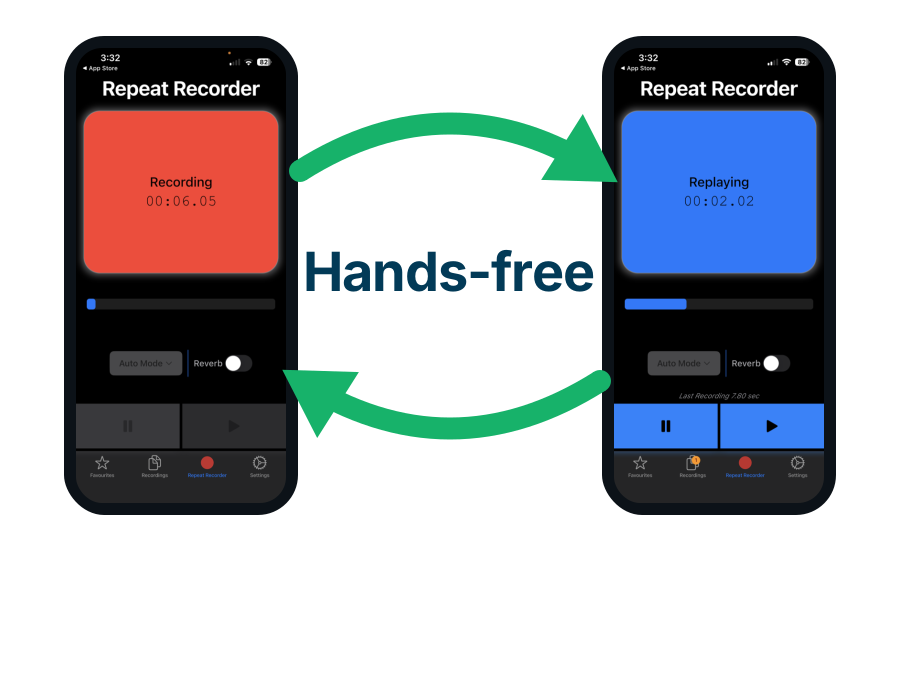
Use Repeat Recorder to rehearse your demo video narration
A claimed page is permanent, public and frequently the first result for your product’s name, which makes everything on it, including the demo video, a long-term asset rather than a launch-day one. The part of that video people quit on is the talking at the start of it. Repeat Recorder, one of my own apps, records you and plays the take straight back without you touching the phone, so you can run the same opening line twenty times before you record the real thing.
- Repeat Recorder plays every take back automatically and then starts recording again, so an opening line can be run twenty times hands-free. It was built for speech rehearsal, language learning and vocal training, and narrating a product demo is the same job with different words.
- A Product Hunt page keeps existing and often outranks a small site for its own product name, so a video narrated badly in one rushed afternoon represents the product for years. An unclaimed page with three-year-old screenshots is the version of that problem you inherit; a rushed video is the version you create yourself.
- Takes worth keeping go into favourites and into folders you name yourself, so two versions of the same opening sit next to each other. Recording a line twice and picking the better one takes about a minute, and it is one of the few parts of a launch you can settle before the day rather than during it.
Six months between posts, and a new interface is not an update
If your product has been posted before, or if you plan to launch more than one thing, these are the constraints you are working inside:
- Six months, minimum, between posts. Product Hunt's relaunch guidance requires you to "wait at least six months between posts for the same product or from the same company".
- The rule follows the root domain, which catches people by surprise. "Products that share the same root domain must adhere to a six-month submission gap." If you ship several tools from subpaths or subdomains of one site, they are treated as one queue, and launching tool B two months after tool A is a relaunch request rather than a fresh launch.
- A relaunch also needs a genuinely significant update. Waiting out the six months is necessary but not sufficient: "there also needs to be a significant update to the product".
- A significant update means a new mobile app or a full redesign with new functionality. Product Hunt's wording is "a new mobile app or a complete product redesign with new functionality". A phone app for a product that was web-only is a textbook qualifying launch.
- A visual refresh does not count as a Product Hunt launch. Its wording is "New UIs, pricing plan changes, etc. are not considered significant updates." A visual refresh is not a launch. Product Hunt will also only consider updates that "serve a substantially different use case or user".
- Relaunching early is possible but audited. Submit inside six months and the system prompts you to describe what changed; the team reviews that before approving. Waiting past six months lets you skip that manual audit, and approval never guarantees homepage featuring anyway.
- Planning implication for a small studio with several apps. Space your launches at least six months apart, and if the apps share a domain, give each one its own product domain so they are not competing for one slot in the same queue.
The mandatory fields and the exact image sizes
These are the concrete requirements from Product Hunt's posting instructions.
| Listing item | What Product Hunt asks for | Mandatory? | Where it catches people out |
|---|---|---|---|
| Account type | A personal account. "Company accounts cannot hunt or post products." | Yes | Catches teams who set up a brand account first and have to start again |
| Account readiness | Onboarding completed. Historically a one-week wait before posting, skippable by subscribing to the newsletter | Effectively | Do not create the account on launch morning |
| Product URL | A direct link to the product. "Avoid links to press or blogs" | Yes | Store links work, but a real landing page converts better |
| Name | "Only the product's name, no description or emojis" | Yes | Taglines stuffed into the name field get edited out for you |
| Tagline | A "very short description of the product (make it catchy!)" | Yes | Does most of the work: on the leaderboard it is nearly all anyone reads |
| Description | Maximum 260 characters | Yes | Much shorter than people expect, so write it last and cut hard |
| Topics | The topics most relevant to the product | Yes | Wrong topics put you in front of the wrong voters |
| Pricing tag | Free, paid, or paid with a trial: "the option that correctly describes your product" | Yes | Simple: just be accurate, since misdescribing it reads as a bait |
| Thumbnail | 240x240 recommended. GIFs allowed "under 3MB", no strobing | Yes | Tiny: check it at actual size, not zoomed in your editor |
| Gallery images | 1270x760 recommended. "The gallery will need 2+ images before it is viewable" | Effectively | One image means no gallery renders at all |
| Video | YouTube, full URLs only. "Shortened links will not load" | Optional | Short youtu.be links fail silently, so paste the full URL |
| First comment | "Kick off the conversation with a comment about the product" | Expected | An empty comment section reads as an abandoned launch |
| Product is live | "We only feature products that are currently available" | Yes | Waitlists and vaporware are rejected outright |
| Makers | Add the people who built it to the listing | Optional | Worth doing: each maker added is another network notified |
| Launch time | Scheduled posts go live at 12:01am Pacific | Fixed | Your 24 hours start then, whatever timezone you live in |
The number one product scored 356 to 643 upvotes
Launch guides quote #1 as needing 500 to 1,200, 800 to 1,500, or 800 to 1,200 upvotes. None of them say which days they measured. So I pulled the actual leaderboard for five days in July and August 2026 and read the counts off it. Green here means cheaper to win:
| Day sampled | Upvotes for #1 | Upvotes for #3 | Upvotes for #5 | Upvotes for #10 |
|---|---|---|---|---|
| Sat 25 July 2026 | 356 lowest in the sample | 293 | 168 | 110 |
| Tue 28 July 2026 | 643 highest in the sample | 397 | 219 | 158 |
| Thu 30 July 2026 | 632 | 535 | 345 | 165 |
| Sun 2 August 2026 | 411 | 242 | 150 | 110 |
| Mon 3 August 2026 | 387 | 265 | 187 | 127 |
What that sample says, and what it lets you stop believing:
- The median #1 was 411 upvotes and the mean was 486. Three of the five days had a #1 under 420. The commonly quoted "800 to 1,500 to win the day" overstates the real requirement by roughly two times.
- The top ten is far more reachable than the top one. Tenth place cost between 110 and 165 upvotes, median 127. For a small app with a modest network, "top ten of the day" is a realistic target and "#1" usually is not.
- Third place cost between 242 and 535. The gap between #1 and #3 was often small, which matters because "Top 3 Product of the Day" is a badge too and costs meaningfully fewer votes.
- Comment counts were high relative to votes on the winners. The 30 July winner had 320 comments against 632 upvotes, and second place that day had 211 comments. Whatever the algorithm weighs, the products at the top are consistently the ones with real conversations, not just votes.
- Every day in the sample was dominated by AI and developer tooling. That is the current competitive reality: if you are launching into the AI category you are fighting the busiest part of the board, and makers in Product Hunt's own forums now report actively skipping launches with "AI" in the tagline out of fatigue.
Side note: nobody can tell you how the algorithm works, and anyone who says otherwise is guessing
Product Hunt refuses to publish it, explicitly. Its official explanation of how the site works says the leaderboard "changes throughout the day based on the number of upvotes, comments, time since submission, and other factors", followed by: "We can't give the exact details of how our algorithm works because doing so would make it easier to be gamed."
So treat precise claims with suspicion. The guides that tell you to maintain "45 to 55 upvotes per hour on weekdays", or that an upvote from a three-year-old account carries a specific multiple of a new one, are describing a system whose owner has stated it will not disclose those details. The general shape is credible - velocity matters, comments matter, fresh accounts voting in a bloc gets filtered - but the numbers attached to it are invented precision.
What you can rely on instead: the observable leaderboard, which is what the table above is, and Product Hunt's own stated rules about featuring and about promotion. Those are checkable. Hourly upvote quotas are not.
Launching midweek costs about 40% more upvotes
The same five days, grouped, produce a clear and actionable split:
- Tuesday and Thursday averaged 638 upvotes to reach number one. Tuesday and Thursday averaged 638 upvotes for #1, and Thursday's third place (535) cost more than the weekend's first place.
- Saturday and Sunday averaged 384 upvotes for number one, about 40% fewer. Saturday and Sunday averaged 384 upvotes for #1 and both had tenth place at exactly 110. The same badge, for roughly 40% fewer votes.
- Monday sat with the weekend, not the midweek. Monday's #1 was 387, essentially identical to the weekend average. That is one day of data so treat it lightly, but it suggests Monday is underrated.
- A weekend win is an easier badge attached to a smaller audience. Weekend traffic on Product Hunt is lower across the board, so a weekend #1 is an easier badge attached to a smaller audience. Midweek is a harder rank for more total eyeballs.
- Launch on a weekend for the badge, midweek for the traffic. If you want the badge for your landing page and store description, launch on a weekend. If you want maximum launch-day traffic and are relaxed about placing fifth rather than first, launch midweek.
- These upvote figures come from five days of data, not five hundred. This is five days, not five hundred. The direction (weekends cheaper) is consistent with everything else written about Product Hunt and with the traffic pattern of a work-tools audience, but do not treat 638 and 384 as constants. Pull the leaderboard yourself for the fortnight before you launch; it takes ten minutes and it is the only current data that exists.
Side note: Product Hunt itself knows the leaderboard is unfair
In late March 2026 it ran a "Randomized Leaderboard Day". For one day, the homepage order was randomised for 25 minutes out of every 30, vote counts were hidden from public view, and votes cast during the randomised windows counted double. The stated goal was to give smaller launches the visibility that normally goes to whatever got an early lead.
Read it as a signal, not a mechanic. It was an experiment on a single day, not a standing feature, so do not plan around it. What it tells you is more useful than the event itself: Product Hunt is aware that early momentum compounds into position regardless of merit, which is exactly why the first few hours of your window get so much attention in every guide, including this one.
A real number two made 1,490 visitors and 22 signups
This is where the gap between published advice and reported reality is widest. Every row below with a green source is a named launch whose owner published the figures; every red row is a launch-guide range with no named launch attached.
| Launch | Rank | Upvotes | Day-one visitors | Signups | Source quality |
|---|---|---|---|---|---|
| Plausible Analytics | #2 of the day | 601 in 24h | 1,490 | 22 trials | First-hand, published from their own analytics |
| Plausible, one week later | #7 of the week | 850+ | 2,560 total | 36 trials | First-hand, same source |
| Statistical Product (E. Sturm) | #9 | not stated | 1,755 | 481 onward clicks | First-hand blog write-up |
| Commit Club v2 (E. Sturm) | #2 | not stated | 570 | 85 users | First-hand blog write-up |
| Speek (E. Sturm) | #8 | not stated | 590 | not stated | First-hand blog write-up |
| Commit Club v1 (E. Sturm) | #5 | not stated | 286 | 10 users | First-hand blog write-up |
| ProdShort (2026) | not stated | not stated | 746 | 32 signups, 12 active | Maker post in Product Hunt's forums |
| Typical guide claim, top 3 | top 3 | 800 to 1,500 | 5,000 to 15,000 | 100 to 400 | No named launch, agency or aggregator blog |
| Typical guide claim, top 10 | top 10 | not stated | 1,000 to 3,000 | 30 to 100 | No named launch, agency or aggregator blog |
The pattern is hard to miss once the sources are separated:
- Every first-hand top-three finish in this set delivered under 2,000 day-one visitors. The guides promise 5,000 to 15,000 for the same rank. The published reality is roughly three to ten times lower.
- Signups are the number that really deflates. A real #2 of the day produced 22 trials. The guide range for a top-three launch is 100 to 400. If your plan depends on the upper end of that, your plan depends on a number nobody has shown evidence for.
- Rank correlates with traffic only loosely. A #9 finish produced 1,755 visitors while a #2 produced 570 and another #2 produced 1,490. Category, day, and how big an audience the maker brought all matter more than the position itself.
- One maker reported only about 5% of Product Hunt signups became paying users. One maker in Product Hunt's forums reported "only about 5% of those users actually converted into paid plans". Apply that to 22 trials and the launch-day revenue is approximately one customer.
- Which is why the durable outputs are the point. Makers who say the launch was worth it almost never cite revenue; they cite feedback, credibility, the badge, the permanent page, and the newsletter pickup that followed. Set your expectations there and Product Hunt is a good use of a week. Set them on the guide numbers and it will feel like a waste.
1,490 day-one visitors from a genuine #2 Product of the Day, published by Plausible Analytics from its own analytics, alongside 22 trial signups. Launch guides quote 5,000 to 15,000 visitors for a top-three finish.
Asking for upvotes or paying for traffic gets you banned
These are stated rules with stated consequences, and they are the reason most "growth hack your launch" advice is a liability:
- You cannot ask people to upvote. Product Hunt's guidance is explicit: do not directly ask for upvotes. You may ask people to visit the launch and to comment. So your launch-day message to your own audience says "we are live on Product Hunt today, come and tell us what you think", never "please upvote us".
- You cannot pay for hunts or traffic. The wording is unusually blunt: "do not pay anyone to hunt or send traffic to your product - it goes against our guidelines and will result in us taking action to remove your product, and you could be permanently banned from the site."
- Upvote rings get filtered. Coordinated voting from a cohort of fresh accounts is the pattern detection is built for. The specific detection intervals quoted in launch guides are guesswork, but the outcome is not in dispute: paid upvote services are a way to lose the launch and the account together.
- Do not create the account and the votes on the same morning. Whatever the exact weighting, a launch whose supporters all registered within an hour of voting is the exact signature the system exists to catch.
- Product Hunt's Promoted Products cannot be bought for launch day itself. Product Hunt sells Promoted Products, clearly badged as ads on the homepage and newsletter, but states that they "are not available for brand-new launches". You cannot buy your way onto the board on launch day. Self-serve display campaigns start in the $5,000 to $10,000 range, which puts them outside the reach of most of the people reading this.
- There is no shortcut on Product Hunt, only a good product and a complete listing. There is no shortcut. The legitimate levers are: a product good enough to be featured, a listing that is complete and clear, an audience you built before launch day, and a real conversation in the comments. That is the whole toolkit.
Most launch-day traffic is the audience you brought yourself
Every credible account of a successful launch describes the same preparation, and the most honest ones explain why it matters:
- Build a list of real people who will show up. The consistent advice is a few hundred committed supporters gathered from email, X, LinkedIn, Discord and niche communities, contacted directly rather than broadcast at. Against a median #1 of 411 upvotes, a genuine 150 to 200 first-hour visitors is a large fraction of a winning day.
- Have an account with history before you need it. Comment on other launches, upvote things you actually like, and be a recognisable participant for a few weeks first. Plausible's launch is instructive here: they built roughly 1,000 Twitter followers over four months beforehand and then launched with almost no other preparation, self-submitted, and finished second.
- Write the tagline before you write anything else. On the leaderboard your tagline is nearly the whole listing. Everything else, the 260-character description, the gallery, the video, exists to convert someone the tagline already interested.
- Prepare the first comment properly. Say what you built, why, who it is for, and what you would like feedback on. It sets the tone for a comment thread, and the comment thread is the part that visibly separates the top of the leaderboard from the middle.
- Then answer every comment, all day. This is the highest-return activity of launch day and the one most makers underdo. It is also the only lever you can pull that is unambiguously within the rules.
- Now the uncomfortable part. If nearly all your launch-day traffic comes from your own audience, what did Product Hunt actually provide? One long-term critic makes this argument directly: the traffic bump "is largely due to all the activities that you do in order to get upvotes and comments", not to platform discovery. On that reading a launch is a forcing function - a hard deadline that makes you polish the product, write clear copy, and finally message the people who said they were interested.
- Judge a Product Hunt launch against what you would have shipped anyway. Judge the launch against "what would I have shipped and written this month without a deadline", not against "a marketing channel that sends me customers". And do not skip the genuinely platform-provided outputs, which are the featuring, the badge, the permanent page and the newsletter pickup.
Side note: the SEO value is real but it is not link equity
Product Hunt applies nofollow to product links, so the link itself passes no ranking signal to your site. Any guide telling you a launch will lift your domain authority is describing something that does not work that way.
The actual search benefit is the Product Hunt page, not the link. Your launch page is on a strong domain and frequently ranks for your product name, which for a new or obscure app can mean an independent, credible-looking result sitting alongside your own site. The secondary pickup matters too: the newsletters, roundups and aggregators that copy from the leaderboard often do link normally.
Use Camera to Clipboard to save the comments your launch draws
The comments are the output makers consistently rate above the revenue, and answering them all day means spending launch day on a phone rather than at a desk. The ones worth keeping get screenshotted and then never leave the camera roll, which is how the cheapest structured feedback available quietly turns into nothing. Camera to Clipboard, one of my own apps, sends pictures from the phone straight onto the computer clipboard.
- Screenshots in the phone’s library can be sent to the computer several at a time, so a day of comments moves across in one batch. There is no emailing them to yourself, no cable and no upload to somebody else’s website in between. The phone and the computer find each other over your own local network and send the pictures directly.
- A featured launch typically draws dozens of comments from people who build software for a living, and that is the part makers rate above the traffic and the revenue. A folder of screenshots pasted into one document is what that feedback still looks like a week later, once the leaderboard has moved on and the page has gone quiet.
- A picture from Camera to Clipboard arrives as an ordinary clipboard image, so Word and Google Docs take it inline and Photoshop or GIMP open it as a new layer. Anything that accepts a pasted picture accepts this one, so the launch-day record can live in whatever you already write notes in.
Estimate your own launch before you commit a month to it
The model underneath this is built from the measured leaderboard numbers in this article, not from launch-guide ranges. Tell it how many people you can genuinely get to turn up, which day you would launch, and whether your product clears the featuring bar. It will tell you where that lands you, and it will tell you honestly when the answer is "nowhere", because being unfeatured makes every other input irrelevant.
Conclusion: a Product Hunt launch is decided before launch day
- Being featured by a human moderator is the gate on Product Hunt, not upvotes, and an unfeatured launch is not ranked at all however many votes it collects. Since January 2024 the featured rate has fallen from a reported 60 to 98% down to roughly 10%, and the moderator is judging four things (useful, novel, high craft, creative) where you only need to stand out on one or two.
- The number one product of the day needed 356 to 643 upvotes across five sampled 2026 leaderboard days, not the 800 to 1,500 the launch guides quote. Tenth place cost 110 to 165 upvotes, so the top ten is the realistic target for a small app, and a weekend win cost about 40% fewer votes than a midweek one. The traffic is smaller than advertised too: a real number two of the day drew 1,490 visitors and 22 trial signups, against the 5,000 to 15,000 the guides promise.
- Launch an app that is three or five years old, because nothing in the Product Hunt rules is about age. The requirement that a product actually work is the one thing an established app passes better than a startup with a waitlist, and the only real constraint is whether it has been posted before, which brings a six month gap and a significant update requirement. Spend the month before launch on a Product Hunt account and a list of people who will turn up rather than on the listing page, then ask for visits and comments and never for upvotes, because asking for upvotes or paying for traffic can get your product removed and your account permanently banned.