
Facebook timing advice is usually a list of hours with no explanation of which audience it assumed, which makes it impossible to adapt. This guide derives the answer instead: what the largest published timing study actually measured, where Facebook's high-value audience lives, why Facebook's ranking forgives a mistimed post in a way Reddit never does, and the awkward fact that America and Britain only overlap for about four good hours a day. There is a free day-and-hour grid below so you can see any slot, and a plain recommendation at the end.
The quick answer: post Tuesday to Thursday, 12 to 3 PM US Eastern, which is 5 to 8 PM in Britain. That window sits inside the highest-engagement band in the largest published study and is also the widest stretch where the American and British audiences are both awake.
Avoid the weekend. Saturday and Sunday are the lowest-engagement days of the week, and Sunday has no reliable peak hour at all.
The day and hour grid in your own local time
Every cell is one hour of one day. Colour is how much of your chosen audience is awake at that hour, multiplied by the day-of-week engagement pattern from the Sprout study, so the darkest cell is always the best cell for whatever you picked. The grid reads your time zone from your browser and opens on the best slot for the American audience, on your clock. Switch the radio to "optimise for both" to recolour it for the hours that keep Britain in the room as well. Click any cell for the full readout. Everything runs in your browser and nothing is sent anywhere.
Interactive Facebook posting day and hour grid
Click any hour to see the audience split and the verdict for that slot.
Weakest Strongest
US audience awake0%
UK audience awake0%
Slot score0
How this is calculated. Cell colour is the share of your chosen audience that is awake at that hour, multiplied by a day-of-week weight taken from the published Sprout Social pattern (Monday to Thursday strongest, weekends weakest). Choosing "optimise for both" scores each slot on whichever of the two countries is doing worse, which is what stops the grid recommending an hour that is excellent for one side and useless for the other. The hourly curve is a typical waking and phone-checking pattern applied to each region's local time, not measured Facebook data, so treat the shape as reliable and the exact numbers as indicative. All conversions use real time-zone rules for today's date, so daylight saving is already accounted for.
Post Tuesday to Thursday, 12 to 3 PM US Eastern
Two independent lines of evidence point at the same window, which is why this recommendation is more confident than the equivalent one for Reddit.
- The engagement data says midweek middays. Sprout Social's analysis of nearly two billion engagements across roughly 307,000 social profiles, measured between late November 2025 and late February 2026, found Monday to Thursday consistently strongest, with Tuesday and Wednesday running hot from midday through to 8 in the evening in each user's local time.
- Midday US Eastern is the only hour when most of the American audience is awake. Midday US Eastern is the only stretch of the day when roughly three quarters of the American audience and four fifths of the British audience are awake simultaneously. Nothing else comes close on both counts.
- 1 PM Eastern is the single best hour if you want one number to schedule against. Around 78% of the American audience and 88% of the British audience are active at that moment.
- Saturday and Sunday produce the lowest Facebook engagement of the week. Saturday and Sunday produce the lowest engagement of the week, and Sunday in particular shows no dependable peak. If you must post at a weekend, 10 in the morning to 6 in the evening local is the usable stretch.
- Technology audiences engage several hours earlier than everyone else on Facebook. Technology audiences engage several hours earlier than everyone else, and food engages at lunch. The industry section below has the specifics.
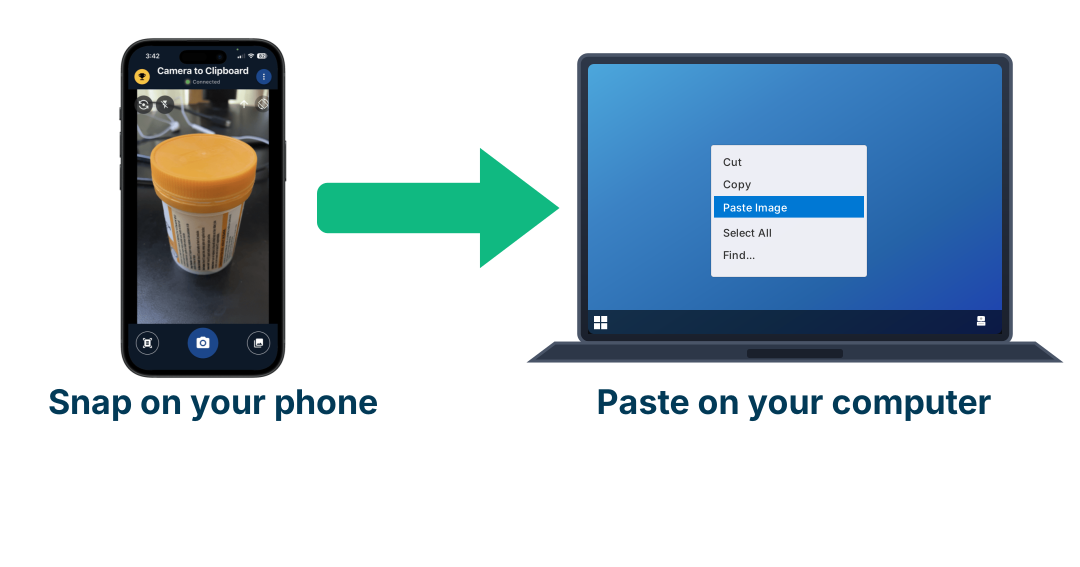
Use Camera to Clipboard to post a photo inside the midday window
Knowing that 1 PM Eastern is the hour to aim at only helps if the post is finished when the hour arrives, and the part that is usually not finished is the picture, because it is still sitting on a phone. Camera to Clipboard, one of my own apps, is a phone camera that puts what it photographs straight onto your computer's clipboard.
- A photo taken inside Camera to Clipboard is ready to paste on your computer the moment you take it. There is no emailing it to yourself, no cable and no upload to somebody else's website in between. The phone and the computer find each other over your own local network and send the picture directly.
- The whole shared plateau between America and Britain is about four hours long, so a photo stuck on a phone can cost you the day. Both audiences sit at roughly 76% or better only between 12 and 4 PM Eastern, and after 5 PM Eastern the British half is gone. Anything that turns picture wrangling from a ten minute job into a ten second one buys back a real part of that window.
- Several pictures can be sent from the phone's library at once, so a week of posts can be loaded onto the computer in one go. Scheduling a run of posts in a single sitting is what stops the timing advice on this page from depending on you being at a desk at 1 PM every day.
Facebook is a slow burn, so the ranking forgives a late post
This is the structural difference that changes the whole answer, and it is why the best hour for Facebook is later in the day than the best hour for Reddit.
- Facebook has no shared new-post queue, so posts do not compete head to head. Reddit has a single new tab per subreddit, so every post competes with every other post submitted in the same minutes. Facebook assembles each person's feed individually, so there is no equivalent bottleneck and no penalty for posting at a busy hour.
- Posts resurface for hours or days. A Facebook post that is holding engagement keeps being shown to more of your audience long after it was published, including to people who were asleep when you posted. Reddit's Hot score decays on roughly a twelve and a half hour scale whatever you do.
- The consequence is that you optimise for audience, not for competition. On Reddit there is a real argument for posting into an empty early-morning queue with a smaller audience. On Facebook that argument disappears completely, so you simply pick the hour with the most valuable people awake.
- Early engagement still matters, it is just less brutal. The first hour of reactions, comments and shares is the signal that tells Facebook the post is worth distributing further. A slow start caps how far it travels, but it does not kill the post outright.
- Aim at the middle of the shared waking window and ignore competition on Facebook. aim at the middle of the shared waking window and do not try to be clever about competition. The clever move on Reddit is the wrong move here.
Reddit rewards you for posting when nobody else is. Facebook just rewards you for posting when everybody is.
A North American user is worth three times a European one
If your goal is app installs, sales or leads rather than vanity reach, the value of an impression varies enormously by geography, and it should shape which clock you optimise for.
- Meta's own revenue per user tells the story. For full-year 2024, average revenue per user ran at roughly $233 in the United States and Canada, about $68 in Europe, around $21 in Asia-Pacific and about $14 across the rest of the world.
- A North American Facebook user is worth roughly three European ones, and closer to eleven to one against Asia-Pacific. Advertisers bid that much more for those eyeballs because those users spend that much more.
- User counts point the other way, which is the trap. India has the largest Facebook audience at roughly 582 million users against about 254 million in the United States. Optimising for headcount alone would send you to an audience worth a fraction as much per person.
- Britain is small but valuable and free to include. It is English-first, sits in the high-value European band, and costs you nothing extra if you choose the right hour. That is the entire argument for the midday Eastern window over the American evening.
- Facebook has roughly 3.07 billion monthly and 2.11 billion daily users. Facebook reports roughly 3.07 billion monthly and 2.11 billion daily active users, so even a narrow high-value slice is an enormous audience in absolute terms.
America and Britain share only about four good hours a day
Five hours of separation sounds manageable until you overlay two waking curves. Reading in US Eastern time, here is what happens across the day.
- Before 8 AM Eastern, America is missing. At 6 AM Eastern only about 12% of the American audience is active, even though Britain is already at 74%. Unlike on Reddit there is no compensating advantage, because Facebook has no queue to beat.
- 8 to 11 AM Eastern is the ramp. The American share climbs from roughly 37% to 69% while Britain holds between 74% and 80%. Usable, and this is where technology audiences actually peak.
- 12 to 4 PM Eastern is the shared plateau. Both countries sit at roughly 76% or better across the whole window. This is the only stretch where neither audience is being sacrificed.
- 1 PM Eastern is the peak of the plateau, at roughly 78% American and 88% British active at once.
- After 5 PM Eastern, Britain collapses. By 6 PM Eastern it is 11 PM in London and British activity is down to about 28%. When America finally peaks around 8 PM Eastern at roughly 91%, Britain is at 6%.
Note that the American evening is genuinely excellent if you only care about America, and the Sprout data supports it: Tuesday and Wednesday stay strong through to 8 PM local. The midday recommendation is specifically the price of keeping Britain in the room.
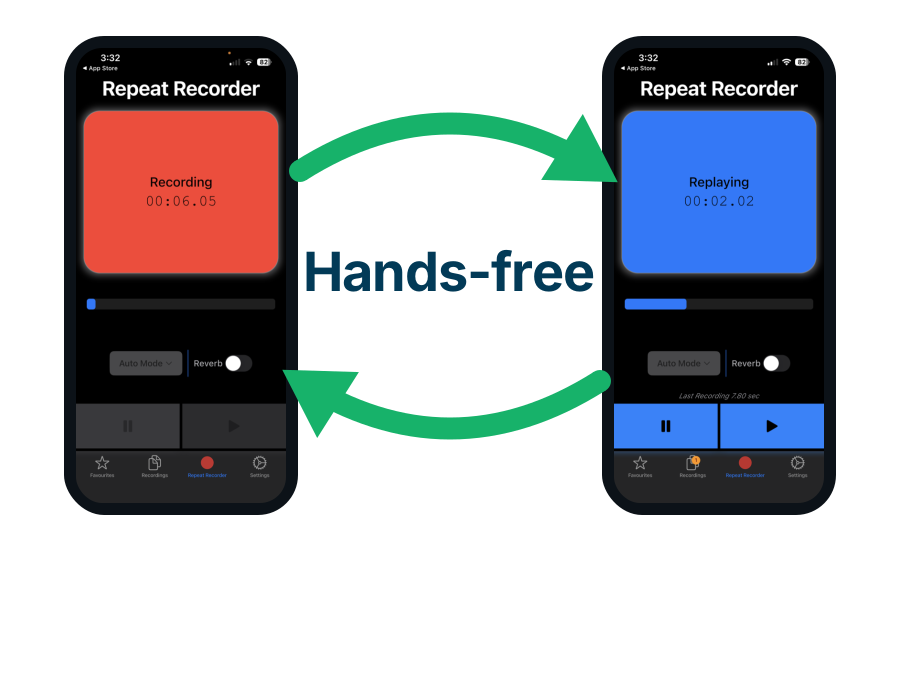
Use Repeat Recorder to rehearse the video you post at midday
Keeping Britain in the room costs you the American evening and leaves about four usable hours a day, which means a post has to be made before its window rather than during it. A short video of you talking is the kind of post most likely to still be unfinished when the hour arrives, because the words get rewritten between takes. Repeat Recorder, another of my own apps, records you and plays each take straight back without you touching the phone.
- Repeat Recorder plays each take back on its own and then starts recording again, so you can run the same thirty seconds ten times without picking the phone up. That hands-free loop is the whole app, and it was built for speech rehearsal, language learning and vocal training.
- Settling the wording before you film is what lets a post be scheduled rather than published live. Only about four hours a day have both the American and the British audience awake at once, and 1 PM Eastern is the single best of them, so a video still being re-shot at half past one has already missed the hour it was written for.
- Takes worth keeping go into favourites and into folders you name yourself, reorderable by dragging. A month of weekly posts can sit in one folder in the order they go out, so the wording you settled on for last Tuesday is still there when you film the next one.
Everyone misreads the largest timing study by ignoring local time
Most published timing tables trace back to the same handful of studies. It is worth knowing what the biggest one measured, because one methodological detail changes how you should apply it.
- The Facebook timing data covers nearly two billion engagements across 307,000 profiles. Nearly two billion engagements across about 307,000 social profiles, gathered between 27 November 2025 and 27 February 2026. That is large enough for the day-of-week pattern to be trustworthy.
- Facebook peaks at noon Monday and stays broad through Tuesday and Wednesday. Monday peaks narrowly at 12 to 1 PM. Tuesday and Wednesday are broad and strong from 12 through to 8 PM. Thursday runs 12 to 2 PM with a second spike at 8 PM. Friday drops off after midday. Saturday has no peak, and Sunday is universally low.
- The critical caveat: those are local times per user, not one global clock. The study aggregates each profile's own audience in its own time zone, so "12 PM" means "noon wherever your followers are", not noon in New York.
- Use local Facebook times for a single-country audience, US Eastern for a split one. If your audience is genuinely single-country, use the local times directly. If it is split across the Atlantic, as most English-language pages are, you cannot satisfy two local noons at once, which is exactly why the overlap analysis above is needed.
- Midday US Eastern satisfies both the local-time peak and the geographic one. Midday to mid-afternoon US Eastern is simultaneously inside the American local-time peak and the British early-evening peak, so the compromise costs less than you would expect.
Your industry moves the window by several hours
Industry variation in the same dataset is larger than the day-of-week variation, so if your category is listed here it should outrank the platform average.
- Technology and software: 7 to 11 AM on weekdays. The earliest peak of any industry. If you are marketing an app or a developer tool, the general midday advice is genuinely too late for you, and the early window has the pleasant side effect of overlapping the British afternoon.
- Food and beverage: 10 AM to 3 PM, strongest Tuesday and Friday. Tracks meal planning rather than working patterns, and Friday is an exception to the usual weekday decline.
- Healthcare: 10 AM to 1 PM, Monday to Wednesday. A tight window at the start of the week, with little to gain from posting later.
- Financial services: 9 to 10 AM and again 3 to 6 PM on weekdays. Two distinct peaks around the trading and working day rather than one broad band, so a single daily post should pick one.
- Everything else: fall back to 12 to 3 PM Eastern, Tuesday to Thursday, and then measure your own page rather than trusting any of this indefinitely.
Reddit and Facebook need two opposite posting strategies
Copying your Reddit schedule onto Facebook, or the reverse, quietly costs you reach.
| Factor | What it means for your schedule | ||
|---|---|---|---|
| Best US and UK window | 12 to 3 PM ET Tue to Thu | 12 to 2 PM ET Tue to Thu | Same slot one post time serves both |
| Competition penalty for busy hours | None no shared queue | Severe shared new queue | Differs only Reddit rewards posting early |
| Content shelf life | Hours to days keeps resurfacing | 1 to 3 hours then decays out | Differs Facebook forgives a late post |
| Damage from posting at the wrong hour | Moderate slower, still seen | Severe effectively invisible | Prioritise Reddit get that timing right first |
| Worst day of the week | Sunday no reliable peak | Friday PM weekends are flat but usable | Differs Reddit tolerates weekends better |
| US share of the audience | Minority 254M of 3.07B users | About half of all traffic | Differs Reddit is far more US-centric |
| Value gap, North America vs elsewhere | About 3x Europe, 11x Asia-Pacific | About 4x international average | Same lesson optimise for the US clock |
| Being present after posting | Helpful comments feed distribution | Critical first hour decides rank | Differs block out the hour for Reddit |
Sort by the last column to see where the two platforms agree and where they genuinely diverge.
The first hour matters on Facebook, just less than on Reddit
Facebook forgiving a mistimed post is not the same as Facebook ignoring timing. Early engagement is still the signal that decides how far a post travels.
- Facebook reads engagement in a post's first minutes as evidence to show it wider. The system reads engagement in the first minutes as evidence the post is worth showing to more of your audience, then to friends of engagers.
- Comments and shares outweigh reactions. A comment is a much stronger signal than a like, and a share stronger still. Posting when your most engaged people are awake is more valuable than posting when the largest number are technically online.
- Reply quickly and the post keeps moving. Answering comments in the first hour extends the window in which Facebook is willing to keep distributing it, which is a genuine free lever.
- A cold start caps the ceiling rather than killing the post. This is the real difference from Reddit. A Facebook post that starts slowly can still recover if something makes it interesting later.
- Which is why the schedule should be sustainable. A post at a slightly worse hour that you are around to engage with beats a perfectly timed post you publish and abandon.
Use Camera to Clipboard to answer a comment with a photo
Replying inside the first hour is one of the few free levers on this page, and the reply that settles a question is often a picture rather than a paragraph. The picture is nearly always on your phone while the comment box is open on your computer. Camera to Clipboard, another of my own apps, closes that gap in one step.
- Answering comments in the first hour extends how long Facebook keeps distributing a post, and a photograph answers some questions in one go. A comment is a stronger signal than a like and a share is stronger still, so the hour after publishing is the hour worth spending, not the hour to be away photographing something.
- A photo taken in Camera to Clipboard lands on your computer's clipboard immediately, which is where the comment box already is. It arrives as an ordinary image on the clipboard, so any box that accepts a pasted picture accepts this one, and nothing has to be saved, found or attached first.
- Pictures already sitting in the phone's library can be sent to the computer's clipboard too, one at a time or several at once. A photo from last week's shoot reaches the reply just as fast as one taken while the comment is still on screen.
Your own Insights beat every published average
Everything above is a starting hypothesis. Facebook hands you the real answer for your specific audience for free, and it takes a few minutes to read.
- Open Professional Dashboard, then Insights, then your audience. Facebook reports the times your followers are actually online, in your own time zone, based on your real followers rather than a study average.
- Read your page's geography tab before optimising to any clock at all. Top countries and cities tell you whether the American clock is even the right one to optimise for. A page whose audience is 70% British should ignore the Eastern-time framing entirely and post at 5 to 9 PM UK time.
- Compare your top posts by publish hour. Sort your best-performing posts and note when each went out. A cluster is worth more than any external benchmark.
- Test the same format at two hours across several weeks, changing only the hour. Test the same format at two hours across several weeks. Changing hour and content together tells you nothing about either.
- Recheck your posting time quarterly, because audience geography drifts. Audience geography drifts as a page grows, and daylight saving moves the US and UK relative to each other twice a year, including a few weeks each spring and autumn when the usual five-hour gap is temporarily four or six.
Conclusion: the best time to post on Facebook, in one glance
- Post to Facebook on Tuesday to Thursday between 12 and 3 PM US Eastern, which is 5 to 8 PM in Britain. 1 PM Eastern is the single best hour, with about 78% of the American audience and 88% of the British audience active at the same moment, and Saturday and Sunday are the weakest days of the week.
- Facebook has no queue of new posts to beat, so it forgives a late post in a way Reddit never does. Reddit rewards posting when few other people are posting, while on Facebook the only thing that decides your reach is how many of your followers are awake, so there is never a reason to trade audience for a quiet hour.
- Read your own Facebook Insights before adopting any hour on this page, starting with the geography tab. A page whose audience is 70% British should ignore the Eastern-time framing entirely and post at 5 to 9 PM UK time.