
A normal social media post does best in the middle of a working day. A short form video does not. Every large study of TikTok, Instagram Reels and YouTube Shorts puts the winning hour in the evening or later, and on Instagram the single best hour measured across 24 million posts was midnight. The map below scores all seven days and all 24 hours for whichever of the four platforms you pick, converted into your own time zone, and it can mix in the country of whoever posts it, for the early viewers who see a video first.
Interactive short form video posting time heat map by platform, day and time zone
my local time
0%
| Region | Their local time | People awake there | Worth posting |
|---|
How this is calculated
The score for a slot is how many of that audience are scrolling divided by how many other short form videos were uploaded in the hours just before, so it rewards attention and punishes competition. That second half is the whole reason the answer differs from ordinary feed posts.
Each platform gets its own pair of curves and its own balance between the two halves. On TikTok the audience half counts for more, which is why the map peaks in the evening and collapses between 2 and 4 in the morning. On Instagram Reels the competition half counts for more, which is why the map peaks around midnight. On YouTube Shorts both halves are dialled down, because a Short keeps collecting views for weeks and search can revive it long after the hour you chose.
Ticking the home country box adds the poster's own time zone to the scoring as an extra region, because a video reaches the people you are aiming at only after it has cleared the people nearest whoever posted it. How much weight it takes follows how good the evidence is on each platform, so it is 60% on TikTok, 45% on Instagram and Facebook Reels, and 25% on YouTube Shorts. Untick it once your followers are already in the country you are aiming at, and the box switches itself off when you are only scoring your own zone anyway.
"Who am I posting as?" decides which country those first viewers sit in. It exists because somebody else can do the posting for you, and a person who genuinely lives in the country you want is the only version of this that breaks no rule. The starred options are the other version, and the note beside them says what they cost.
Each region is scored on its own local day and its own local hour, so a region can be wide awake and still be a poor place to post at that moment. "People awake there" is a plain count and carries no judgement, which is why its bar is always the same colour. "Worth posting" is the judgement, and it uses the same five words and colours as the map.
Weekends use a separate audience curve and a lower upload curve, because people wake later and far fewer businesses publish. Sunday scores highest on every platform, which is what the published short form studies found and is the opposite of what they found for feed posts.
The upload curves are modelled on the published hourly upload shares rather than on one measured data set, so treat the ranking of the slots as reliable and the exact percentages as indicative. All conversions use real time zone rules for today's date, so daylight saving is already handled. Everything runs in your browser and nothing is sent anywhere.

Post short form video later than you post anything else, because every study agrees on that
Four large studies, run on different data by companies that compete with each other, disagree about the exact hour and agree completely about the half of the day it sits in.
- Metricool measured 2,314,756 TikToks from more than 92,000 accounts and found the heaviest concentration of views between 6 and 8 in the evening.
- Buffer measured 1.8 million YouTube videos and found Shorts peak between 6 and 11 in the evening while long YouTube videos peak in the morning.
- Metricool measured 24,364,803 Instagram posts from 375,118 accounts and found the best hour for a Reel is midnight, at 25,159 average views.
- A separate study of 20,247 Reels from 149 large accounts found 3 in the morning averaged 22.2 million views against 10.6 million at 9 in the evening.
- The usual advice to post between 9 in the morning and 1 in the afternoon comes from ordinary feed posts, and no short form study supports it.

Post when nobody else is uploading, because that is what really wins you views at night
Night does win on Instagram Reels and YouTube Shorts. It does not win for the reason it looks like it wins.
- More people scroll at night, and more people also upload at night, so the extra audience is shared out between more videos.
- Instagram received 34,131 Reels in the midnight hour against 119,705 in the 6 in the evening hour, which is three and a half times as many.
- The midnight hour, carrying under a third of the uploads, produced 25,159 average views per Reel against 15,928 at 6 in the evening.
- Nearly one in ten TikToks is uploaded in the 6 in the evening hour, making it the single most crowded hour on the platform.
- The advantage of a late slot comes from how many other videos were uploaded, not from how many people are scrolling.
- Low competition does not explain everything, because noon is Instagram's most crowded hour at 9.0% of all Reels and it still ranked second for views.
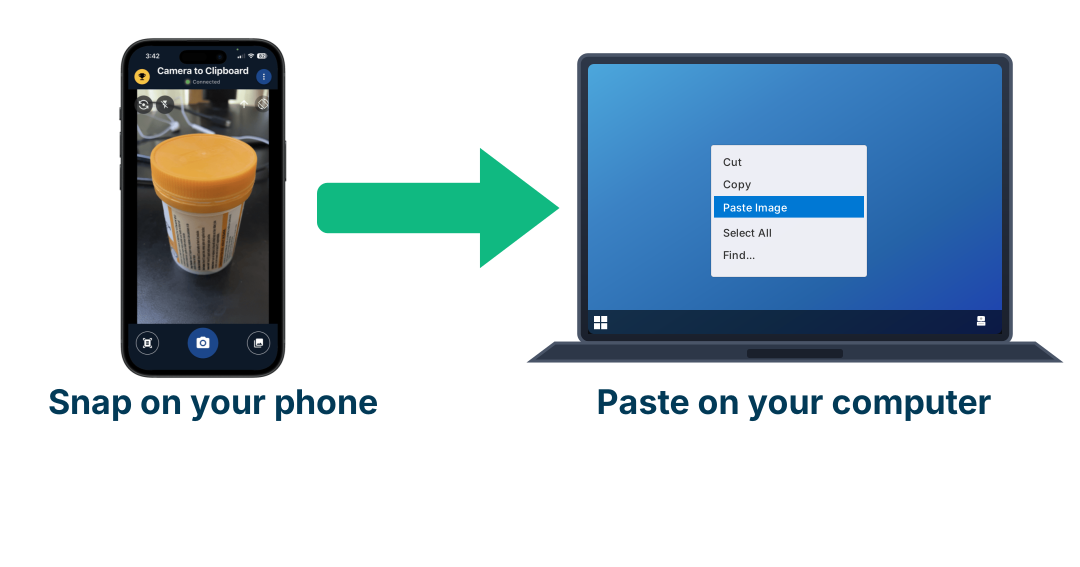
Use Camera to Clipboard to move a cover photo to your computer before you schedule
The map above will usually tell you to publish at midnight or in the small hours, which means loading the video and its cover image into a scheduler the day before, at a computer. The cover image is almost always stuck on a phone. Camera to Clipboard, one of my own apps, puts a photo you have just taken straight onto your computer's clipboard.
- Camera to Clipboard sends the photo over your own Wi-Fi, with no cable and no emailing pictures to yourself.
- The photo arrives on your computer's clipboard ready to paste, so it goes straight into the scheduling tool.
- Scheduling the night before is the only way to publish a Reel at midnight without being awake at midnight.

Post on TikTok between 6 and 8 in the evening, and never between 2 and 4 in the morning
TikTok is the one platform in this article where the small hours are a real risk rather than an opportunity.
- Metricool measured 2,314,756 TikToks and put the heaviest concentration of views between 6 and 8 in the evening on almost every day of the week.
- Sunday at 8 in the evening was the strongest single TikTok slot in Metricool's whole week.
- Metricool found the hours between 2 and 4 in the morning are TikTok's lowest traffic point of the entire day.
- Buffer measured 7.1 million TikToks and disagrees, putting the best slot at 9 on Sunday morning and the weakest window from noon to 5 in the afternoon.
- Metricool and Buffer both agree Sunday is TikTok's strongest day, which is the opposite of what they found for ordinary feed posts.

Post on your own country's clock on TikTok, because your first viewers are usually local
Every hour above assumes the platform shows your video to the audience you are aiming at. Early on it may not, and TikTok is where that bites hardest.
- TikTok's own documentation says it checks whether the viewer and the creator are in the same country, and calls that one of its weakest clues.
- A University of Zurich audit found two TikTok accounts in the United States were shown more of the same videos than a United States account and a Canadian one were, even with the same language setting. It measured what a viewer is shown rather than where a new video goes first, so treat it as a strong hint rather than proof.
- A brand new TikTok account has no audience for TikTok to aim at, so its first viewers are usually the people nearest to it.
- Meta names no location anywhere in its published list of what decides an Instagram Reel's reach, but Instagram shows your Reel to people like your existing followers, so a local following still brings you a local audience.
- The posting hour costs you least on YouTube Shorts, because search can revive a Short weeks after the hour you picked for it.
- Leave the "my followers are still mostly in my own country" box ticked on the map above while that is true, because it mixes your own clock into the answer, and untick it once your followers have moved abroad.

Never fake your country to reach another one, because it does not work and risks the account
The usual workaround is a VPN or a second account registered abroad. Neither survives contact with how these platforms actually check.
- A VPN will not reliably move you, because TikTok also reads your SIM card country, your account history and your device fingerprint, which is the mix of settings that makes one phone identifiable.
- Researchers auditing YouTube found that feeding it false map coordinates changed nothing at all, and only a real network address inside the other country changed what YouTube served them.
- Never register an account in a country you do not live in, because TikTok's terms require your account details to stay accurate and it can ban an account with no notice at all.
- TikTok's Creator Rewards pays in eight countries only, so a false country ends up attached to your payout details and your tax details as well as your posts.
- The one safe way to be seeded into another country is to have somebody who genuinely lives there post the video from their own account, which breaks no rule because nothing about it is false.

Post Instagram Reels around midnight, when uploads drop by two thirds and views go up
Instagram Reels give the cleanest version of the whole argument, because the emptiest hour of the day is also the best one.
- Metricool measured 24,364,803 Instagram posts and found midnight is the best hour for a Reel, at 25,159 average views.
- The midnight hour received 34,131 Reels against 119,705 at 6 in the evening, so the winning hour is the emptiest one.
- A separate study of 20,247 Reels found 3 in the morning averaged 2.1 times the views of 9 in the evening.
- Sunday is the best day for a Reel, averaging 22,096 views.
- Instagram photos and carousels behave differently from Reels and still peak between 6 and 9 in the evening.
- Treat the 3 in the morning Reels figure carefully, because it rests on roughly 600 Reels and the study reported no test of significance.

Post YouTube Shorts in the evening, never at the hour you post your long videos
YouTube is the only platform here that hosts both formats, and the two want opposite halves of the day.
- Buffer measured 1.8 million YouTube videos and found Shorts and long videos have almost opposite peak hours.
- Shorts peak between 6 and 11 in the evening, and Friday at 4, 6 and 7 in the evening were the three strongest slots.
- Long YouTube videos peak in the morning, with Sunday at 10 in the morning the strongest slot of the week.
- Metricool found 1 in the morning produced the highest average views per Short, at 3,184.
- Most YouTube creators publish their Shorts between 2 and 6 in the afternoon, which is neither of the two winning windows.
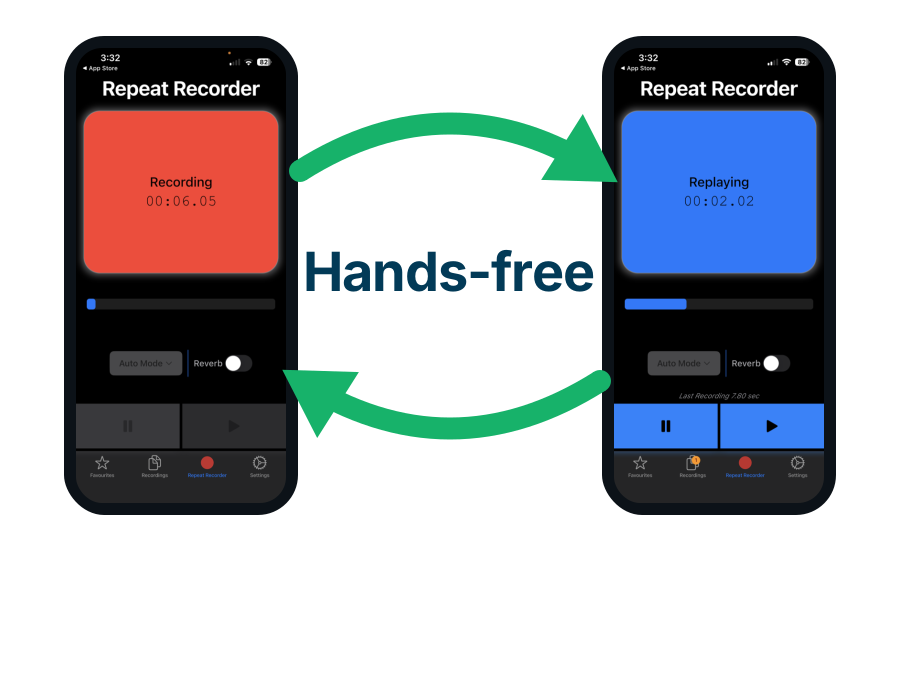
Use Repeat Recorder to turn a voice recording into a video these platforms accept
Every platform in this article takes a video file and none of them takes an audio file, which is a problem the moment the thing you want to post is a recording of your voice. Repeat Recorder, another of my own apps, exports a recording as an MP4 at 1080 by 1920, and that is the exact vertical frame TikTok, Instagram Reels and YouTube Shorts are built around.
- Repeat Recorder's Share as video option writes an MP4 at 1080 by 1920, which is the vertical frame TikTok, Instagram Reels, Facebook Reels and YouTube Shorts all use.
- Most voice recorder apps export audio only, and an audio file cannot be uploaded to TikTok, Reels or Shorts at all.
- The exported video is one still frame carrying your recording's audio, so it uploads and plays like any other Short or Reel.

Chase the hour on TikTok and ignore it on Shorts, because Shorts collect views for weeks
Measure Studio tracked how long a video keeps collecting views on each platform after it is published.
| Platform | Days it keeps collecting views | Where most of the views land | How much the posting hour can gain you |
|---|---|---|---|
| TikTok | About 35 days, the shortest of the four | First 3 to 7 days | The most, because a TikTok is nearly finished within a week |
| Instagram Reels | About 75 days, the longest of the four | Spread over several weeks | Some, and less than on TikTok |
| Facebook Reels | About 65 days of slow steady growth | Spread over several weeks | Some, and less than on TikTok |
| YouTube Shorts | About 35 days, then search can revive it | First 24 to 48 hours | The least, because a Short can be found in search months later |
- A TikTok collects most of its views in its first 3 to 7 days, so the hour it lands in decides most of the result.
- An Instagram Reel keeps collecting views for about 75 days, which is the longest run of the four platforms.
- A YouTube Short appears in Google and YouTube search, so it can sit still for weeks and then be found again.
- Spend the most effort on TikTok's posting hour and the least on a YouTube Short's.

Trust your own analytics over these studies, because the big ones disagree by twelve hours
These are the five studies this article is built on, with what each of them actually counted.
| Study | Sample size | What it counted | Best hour it found |
|---|---|---|---|
| Metricool Instagram 2026 | 24,364,803 posts from 375,118 accounts | Average views per Reel | Midnight |
| Buffer TikTok | 7,100,000 posts | Median engagement rate | Sunday at 9 in the morning |
| Metricool TikTok 2026 | 2,314,756 posts from over 92,000 accounts | Where views concentrate | 6 to 8 in the evening |
| Buffer YouTube | 1,800,000 videos | Median engagement | Friday at 4 in the evening for Shorts |
| Social Blade top accounts | 20,247 Reels from 149 accounts | Average views per Reel | 3 in the morning |
- The five biggest short form posting time studies name best hours twelve hours apart, so no single published hour is safe to copy.
- Studies counting average views per video favour the empty night hours, and studies counting engagement rate favour the busy day hours.
- A study of 20,247 Reels is more than a thousand times smaller than one of 24 million posts, so weigh the two differently.
- TikTok, Instagram and YouTube each show you your own audience's active hours inside the app, and that beats any published average.
- Test one new posting hour for two weeks before you commit to it, because a single video tells you nothing.
Conclusion: the best time to post TikTok, Reels and YouTube Shorts, in one glance
Every hour below is the local time of the people you want to reach, not your own. The list runs from the change that gains the most to the change that gains the least.
- Post short form video later in the day than you would post anything else.
- Post on TikTok between 6 and 8 in the evening, best of all on Sunday.
- Use your own country's clock on TikTok until your followers have moved abroad.
- Never fake your country with a VPN or a second account, because it does not work.
- Post Instagram Reels around midnight, when uploads drop by two thirds.
- Post YouTube Shorts between 6 and 11 in the evening, best of all on Friday.
- Never post to TikTok between 2 and 4 in the morning.
- Never post a YouTube Short at the hour you post your long videos.
- Pick the emptiest hour your audience is still awake in, not the busiest one.
- Spend the most effort on TikTok's posting hour and the least on a YouTube Short's.
- Check your own in-app analytics, because the five published studies disagree by twelve hours.