
A microsite is a small website built to win one search in one town, and AI coding tools have made one cost about the price of a coffee. The pitch that follows is that a local business should stop maintaining one website and start running fifty. This page checks that pitch line by line against what Google publishes, and says what a local business should build instead.
The short version. Google has written rules against this exact strategy, and a site that breaks them can drop out of Google completely. Even when it works, your website can never appear in the map results, which is the list local customers look at first.

A microsite empire is one small website for each job in each town, each with its own phone number
The strategy has a fixed shape, and every version of it teaches the same six moves.
- Split one trade into its separate jobs, so a plumbing business becomes one website each for water heaters, drain cleaning, sewer lines and leak detection.
- Multiply those jobs by every suburb in the city, which turns five jobs across twenty suburbs into one hundred separate websites.
- Buy a domain name that spells out the job and the place, such as a domain reading "water heater repair" followed by the city name.
- Build every website with an AI coding tool, because one hundred hand built websites is a year of work and one hundred AI built ones is an afternoon.
- Give each website its own tracking phone number, so the owner can see which of the one hundred websites produced the call.
- Never link the websites to each other, on the reasoning that Google cannot find a network if there are no links joining it up.
The whole thing is cheap because flat HTML pages host for free and only the domain name carries a bill.

An AI coding tool builds one hundred local websites in an afternoon instead of a year
Nothing about the idea is new. What changed is how long it takes to do, and Google noticed the change before most people did.
- Building one hundred different local websites by hand was close to a year of work, which is why almost nobody built them.
- An AI coding tool builds one hundred whole websites in an afternoon, so the effort that used to stop anyone doing this has gone.
- Flat HTML pages host for free, so one hundred websites carry no server bill at all.
- Google announced three new spam policies on 5 March 2024 against what it called "bad practices we've seen grow in popularity".
- One of those three new policies is scaled content abuse, and it is the one that covers building many pages in order to rank.

Building one website per town is against Google's rules, and Google can drop you from its results
Google publishes its rules in writing, and this exact strategy is not merely covered by them, it is used as the example.
- Google's written rules list "having multiple domain names or pages targeted at specific regions or cities that funnel users to one page" as something it acts against.
- Google's rules also list "having multiple websites with slight variations to the URL and home page to maximize their reach for any specific query".
- Google's rules also list "generating pages to funnel visitors into the actual usable or relevant portion of a site", which is what a microsite pointing at one business does.
- Google says a site that breaks these rules "may rank lower in results or not appear in results at all", so it can disappear from Google completely.
- Google's own name for a website built only to catch a search and send the visitor elsewhere is a "doorway", which is the term to search for if you want to read the rule yourself.

The trick of keeping the websites unlinked is written into Google's rules as a banned practice
The advice to keep the websites unlinked is the part most people assume is the clever bit, and it is the part Google wrote down.
- Google defines scaled content abuse as "when many pages are generated for the primary purpose of manipulating search rankings and not helping users".
- Google's listed examples of scaled content abuse include "creating multiple sites with the intent of hiding the scaled nature of the content".
- Splitting one hundred pages across one hundred domains so no network can be traced is precisely the behaviour Google's scaled content wording describes.
- Google added scaled content abuse to its written spam policies on 5 March 2024, alongside expired domain abuse and site reputation abuse.
- Google says the policy applies "no matter whether content is produced through automation, human efforts, or some combination of human and automated processes".
So the strategy breaks two separate Google rules, and unlinking the websites triggers the second rule rather than escaping it.

Google does not need to connect your websites, because it ranks each page on its own
The advice to keep the websites apart assumes Google's problem is finding the network. Finding the network is not the problem Google has to solve.
- Google says its "core ranking systems are primarily designed to work on the page level, using a variety of signals and systems to understand how to rank individual pages".
- Each of your one hundred pages therefore has to beat every other page competing for that one search, whether or not Google ever connects it to the other ninety-nine.
- Google's own instructions for spotting copied writing are to paste a sentence from the page into Google and see what else comes back, which finds a near-identical page on a different website with no link between the two.
- Google tells its reviewers to give a website the worst score after reading several pages on that one website, so a single website can fail on its own with the other ninety-nine never opened.
- Google does not publish how it decides that separate websites belong to one owner, so nobody outside Google can promise you either that it will join them up or that it will not.
- The one thing that joins the websites in public is where they all end, because every one of them hands its caller to the same business.
So the question worth asking is not whether Google catches the network. It is whether any one of those hundred pages is good enough to win its search on its own.

The people Google pays to score websites give the worst score on suspicion alone
Google employs people to read websites and score them, and the handbook they follow is published, so what they are told to do is not a guess.
- Google's Search Quality Rater Guidelines say pages made of content created at scale with no original content "should be rated Lowest, no matter how they are created".
- The guidelines tell a rater to apply the Lowest rating "when you strongly suspect scaled content abuse after looking at several pages on the website", even when unsure whether AI was used.
- The test a rater applies is effort, defined as "the extent to which a human being actively worked to create satisfying content".
- The guidelines rate content Lowest when it is "copied, paraphrased, embedded, auto or AI generated, or reposted from other sources with little to no effort".
- A rater who opens three of your one hundred websites and finds the same page with a different suburb name has the evidence the handbook asks for.
These raters do not directly move any single website up or down, but their scores are how Google trains and checks the systems that do.

Google allows a page written by AI and bans making pages in bulk just to rank
The two get treated as one worry, and separating them is the single most useful thing a business owner can do here.
- Google's published position since 8 February 2023 is titled "rewarding high-quality content, however it is produced".
- Google says its "focus on the quality of content, rather than how content is produced, is a useful guide that has helped us deliver reliable, high quality results to users for years".
- Google's rater guidelines state that "the use of Generative AI tools alone does not determine the level of effort or Page Quality rating".
- Google's actual rule is that "use of automation, including generative AI, is spam if the primary purpose is manipulating ranking in Search results".
- Writing one genuinely useful page about the work you actually do with an AI tool breaks nothing, and generating ninety-nine copies of it with the suburb swapped breaks the scaled content policy.
The banned thing is the purpose and the volume, not the tool.

Google removed 45% of the copied and low quality pages from its results in one year
Google published a target for this clean-up and then published the result, which is unusual and worth reading as a measurement rather than a warning.
- Google said on 5 March 2024 it expected the work to "reduce low-quality, unoriginal content in search results by 40%".
- Google reported on 26 April 2024 that the rollout finished on 19 April and delivered "45% less low-quality, unoriginal content in search results".
- Google's own description of what it was targeting includes "sites created primarily to match very specific search queries".
- A microsite is by definition a site created primarily to match one very specific search query, which is the sentence written by Google's director of product management for Search.
- Google's clean-up removed nearly half of the low quality unoriginal pages in search in six weeks, so the risk is a completed action rather than a threat.

Google measures effort and originality, not page length or what your site is built with
Google publishes exactly what it means by low quality, and none of it is about length or technology.
- Google says the quality of a page "can be determined by the amount of effort, originality, and talent or skill that went into the creation of the content".
- Google defines effort as "the extent to which a human being actively worked to create satisfying content".
- Google defines originality as "the extent to which the content offers unique, original content that is not available on other websites".
- Google says "the length of the content alone doesn't matter for ranking purposes" and that there is "no magical word count target, minimum or maximum".
- Padding a page out to look substantial counts against you, because Google says filler "can artificially inflate content, creating a page that appears rich but lacks content website visitors find valuable".
- Nothing in Google's published quality rules mentions what a website is built with, so a flat HTML page and a WordPress page are judged by exactly the same tests.
So a short page that answers the question with something only you know passes, and a long one padded out to look thorough does not.
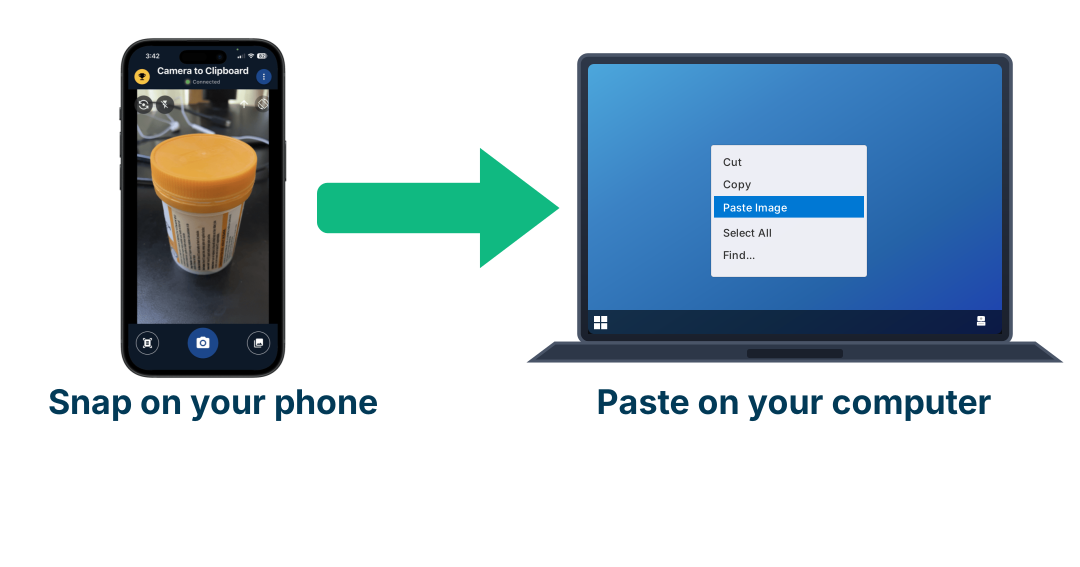
Use Camera to Clipboard to put real job photos on the pages you build
The one thing an AI written page cannot copy from anywhere is a photograph of the job you finished on Tuesday, and that photograph is sitting on a phone while the page that needs it is open on a computer. Camera to Clipboard, one of my own apps, moves it across in one step.
- A photo taken inside Camera to Clipboard is on the computer clipboard the moment you take it, ready to paste straight into the page you are building.
- The phone and the computer find each other over your own local network and send the picture directly, with no emailing it to yourself, no cable and no upload to somebody else's website in between.
- Google's rater guidelines score a page on "the extent to which a human being actively worked to create satisfying content", and a photograph of your own finished work is the cheapest proof of that you can produce.

Your website can never show up in the map results, because those rank Google profiles
This is the point that settles the question for a local business, and it has nothing to do with spam policy.
- A local search returns two lists, the map results with the pins at the top and the ordinary blue links underneath them.
- The map results rank Google Business Profiles, so the thing being ranked is a listing inside Google rather than a website anywhere on the internet.
- Not one of the five strongest map results factors in Whitespark's 2026 survey of 47 local search specialists is a website.
- Those five are your main Business Profile category, how close you are to the searcher, keywords in your Business Profile name, your street address being in the city searched, and whether you are open at that moment.
- Building one hundred websites therefore changes nothing about the list a customer looks at first.

Google allows one Google profile per address, so extra websites win no extra map pins
The obvious next move is to give each microsite its own map listing, and that is the move Google explicitly forbids.
- Google's Business Profile guidelines state "there should only be one profile per business".
- Google also states "do not create more than one page for each location of your business, either in a single account or multiple accounts".
- A business that drives out to its customers is a service area business, and Google says such a business "should have one profile for the central office or location with a designated service area".
- Google forbids listing a phone number or web address that "redirect or refer users to landing pages or phone numbers other than those of the actual business", which is what a tracking number on a microsite does.
- Google states it "reserves the right to suspend access to Business Profiles" for guideline violations, and a suspension removes the listing that was producing the phone calls.

A rented mailbox or a virtual office cannot have a Google profile at all
The obvious way around the one profile rule is to rent an address in every town. Google's rules name every version of that idea, and how easily you get caught depends on which check Google happens to hand you.
- Google says "P.O. boxes or mailboxes located at remote locations aren't acceptable" as a business address.
- Google says a rented mailing address you do not work from, "also known as a virtual office", is not "eligible for a Business Profile".
- Google allows a desk in a shared office only if it "maintains clear signage, receives customers at the location during business hours, and is staffed during business hours by your business staff".
- Google picks which check you get and you cannot choose it, because "verification methods are automatically determined by Google and can't be changed".
- Most businesses get a code by phone, text, email or a posted card, and only some are asked for a video of the place instead.
- A video check asks you to show "outside signs, nearby businesses, or a street sign", then "products, branded equipment, marketing materials, or tools you use to serve customers", and to open the place with your own keys.
- A posted card does arrive at a rented mailbox, so the real risk is not the first check but the complaint a competitor or a customer files afterwards.
Opening real branches in ten towns is completely allowed and it does win ten map pins. It just costs what ten branches cost, because a sign, staff in opening hours and customers walking in is a branch.

Google says putting the job and the town in your web address barely helps at all
Buying a domain that spells out the job and the town is the foundation the whole strategy is built on, and Google lists it under things not to bother with.
- Google's SEO Starter Guide has a section called "things we believe you shouldn't focus on", and domain keywords are in it.
- Google states that "keywords in the name of the domain (or URL path) alone have hardly any effect beyond appearing in breadcrumbs".
- A domain that spells out the job and the city therefore buys close to nothing that the same words in a page title would not.
- The same guide says subdomains versus folders is a business decision rather than a ranking one, so splitting content across separate addresses buys nothing either.
- Google publishes nothing that makes the age of a domain a ranking factor, so "the sites get stronger as they age" is an untested claim rather than a documented one.

Only one of the seven claims behind the microsite pitch survives Google's own rules
Each claim below is set against the sentence Google publishes on that exact point.
| The claim | What Google publishes | Does it hold up |
|---|---|---|
| Write the page text with an AI tool | "Rewarding high-quality content, however it is produced" | Holds the tool has never been the rule |
| Buy a domain that spells out the job and the city | "Keywords in the name of the domain (or URL path) alone have hardly any effect" | Fails listed under what not to focus on |
| Build one website per service per city | Doorway abuse names "having multiple domain names or pages targeted at specific regions or cities" | Fails it is the written example |
| Never link the websites to each other | Scaled content abuse names "creating multiple sites with the intent of hiding the scaled nature of the content" | Fails it is the written example |
| Google cannot tell whether AI wrote a page | Raters apply the Lowest rating "when you strongly suspect scaled content abuse", with no need to establish AI | Fails suspicion is the stated test |
| Give every website its own tracking phone number | Business Profile rules forbid a number that refers people somewhere other than the actual business | Mixed fine on a website, banned on a profile |
| Websites get stronger as they age | Google publishes no documentation making the age of a domain a ranking factor | Unproven neither confirmed nor denied |

Somebody with 100 websites can lose 60 and still earn, and a local business has one to lose
The strategy and the risk look identical from the outside, and they are not the same risk at all.
- Somebody holding one hundred websites and no shop of their own can lose sixty and still have forty bringing in customers.
- The people who teach this strategy are usually in that position, which is why the risk sounds small when they describe it.
- A local business running the same strategy has one business, one Google Business Profile and one reputation, all attached to the same name and phone number.
- Google's manual action for major spam problems can apply to a whole site, and Google states that "some or all of that site will not be shown in Google search results".
- The website worth protecting is the one your Google Business Profile points at, and that is the one a spam network puts within reach of the same penalty.

100 microsites cost about $3,500 a year before a single phone number is connected
The strategy is sold on being nearly free, and adding up the parts it names gives a different number.
- A domain name costs roughly $11 a year, so one hundred domains is about $1,100 a year and that bill repeats every year forever.
- The AI subscription used to build the websites runs about $200 a month, which is $2,400 a year and is the larger of the two costs.
- Every website needs its own tracking phone number, and each number carries a monthly rental plus a per minute charge, with Twilio charging $0.0085 a minute to receive a call.
- An AI agent that answers the tracking numbers around the clock is a further monthly bill, and it is the part that turns a ranking into a booking.
- Hosting genuinely is free, because flat HTML pages sit on free hosting, so the free part of the pitch is true and it is the smallest part of the bill.
The real cost is not any of these. It is that one hundred websites need one hundred sets of original writing to survive a quality rater, and producing that is the work the strategy claims to have removed.
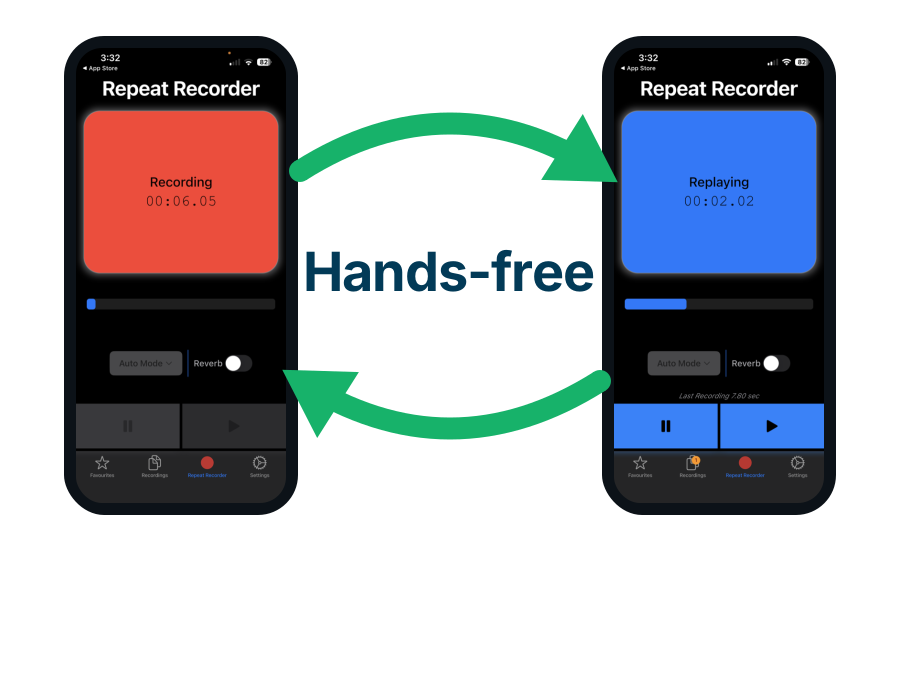
Use Repeat Recorder to practise what you say when a stranger rings about a job
Every version of this strategy ends at the same place, which is a stranger ringing a phone about a job they have not decided to book yet, and the person who wins that job is the one who has said their opening line before. Repeat Recorder, one of my own apps, records that line and plays it straight back without you touching the phone.
- Repeat Recorder plays each take back automatically and then starts recording again, so the same opening line can be said ten times over without picking the phone up.
- Repeat Recorder was built for speech rehearsal, language learning and vocal training, and quoting a price out loud is the same loop with your own words in it.
- Google's rater guidelines measure "the extent to which a human being actively worked", and the phone call is the one part of local search that no amount of generated text can do for you.

One page for each job you do is the strongest thing you can build, on the website you own
The idea underneath the microsite strategy is correct, and only the delivery is wrong.
- Splitting a trade into its separate jobs is genuinely how local search works, because people search for the exact job they need and not for the name of the trade.
- A dedicated page for each service you sell is the single strongest factor in the blue links, scoring 210 in Whitespark's 2026 survey of 47 local search specialists.
- A service page ranks the same whether it sits on its own domain or in a folder on the website you already own.
- Putting a service page on your own website also feeds every link anyone has ever given you, and a brand new domain starts with none.
- Five service pages on one website is an ordinary useful website, and five service pages on five domains is the pattern Google's spam policy describes.
The full ordered list of what to build is in local SEO for small businesses.

Put a page for each suburb in a folder on your own website, not on a separate domain
The suburb half of the idea is also right, and it has a documented safe form.
- The suburb name on the page is the second strongest factor in the blue links, so writing one page per suburb you serve is real work with a real payoff.
- Those pages belong in folders on the website you already own, so every one of them inherits the trust that website has already earned.
- A suburb page becomes a doorway when it is the same page with the suburb name swapped, which is what Google's policy describes and what a rater is told to look for.
- A suburb page stays legitimate when it names jobs you actually did in that suburb, prices for that suburb, and the streets you actually cover.
- Point your Google Business Profile at the suburb page rather than your homepage, because that gives the profile and the website the same subject.

A network of small websites has to pass six checks and fails three of them outright
Each row is a separate system, so passing one of them says nothing about the next.
| The check | What it looks at | Can a microsite network pass it |
|---|---|---|
| Doorway abuse policy | Whether websites exist to be the entrance rather than the destination | No one website per city is the written example |
| Scaled content abuse policy | Whether many pages exist mainly to rank rather than to help anybody | No unlinked sites are the written example |
| Google Business Profile rules | Whether a business is claiming more than one profile per location | No extra websites earn no extra map listing |
| Human quality rater | Whether a person rates the content Lowest after reading several pages | Only with genuinely original writing on every page |
| Core ranking systems | Whether pages feel made for search engines instead of for people | Only with genuinely original writing on every page |
| Reader behaviour | Whether people stay on the page or go straight back to Google | Yes a phone answered fast keeps people there |

A person at Google can remove your whole website from search, and bulk pages is a listed reason
Two separate things can happen to a website, and only one of them arrives with a message.
- An algorithmic demotion arrives with no notice, no message and no appeal, and the only symptom is that the traffic falls.
- A manual action is a decision by a Google employee who looked at the site, and it does arrive as a notice in Google Search Console.
- Google's manual action called "major spam problems" covers "aggressive spam techniques such as scaled content abuse, cloaking, and/or other repeated or egregious violations".
- Google's separate manual action for "thin content with little or no added value" covers doorways, thin affiliate pages and scraped content.
- Google states that when a manual action applies, "some or all of that site will not be shown in Google search results".

Getting a penalty removed takes weeks, and Google never promises your ranking comes back
The way back exists, and it is slower and less certain than the way in.
- Getting a manual action lifted needs a reconsideration request, which is a written explanation of the problem, the fix and the result.
- Google states that "most reconsideration reviews can take several days or weeks", so the traffic stays gone throughout.
- A reconsideration request is only available for a manual action, so a site quietly demoted by the ranking systems has nothing to appeal to.
- Fixing scaled content abuse means deleting or rewriting the pages, which for one hundred generated websites means undoing the entire build.
- Nothing Google publishes guarantees a site returns to its old position after a successful reconsideration, only that the action is removed.

Google checks your phone, your address and your staff, and never your company registration
Setting up a company is cheap in most countries, so the obvious move is to set up ten of them and give each one a website and a profile. Here is every check Google actually runs, and not one of them touches a company register.
- Google verifies a new profile by sending a code to the phone number, the email address or the postal address you gave it, so all three have to be real and reachable by you.
- Some businesses are asked for a video instead, showing the tools they serve customers with and opening the place with their own keys.
- Google requires a permanent fixed sign of your business name at the address, but only from businesses that show an address on Google at all.
- Google's rule is one profile per address rather than one per company, so ten companies registered at one address still share one profile between them.
- Nothing in Google's Business Profile rules asks for a company registration, a trading name certificate or any other document from a government register.
- After you are verified anyone can report the listing, including a competitor, and Google says it "reserves the right to suspend access to Business Profiles" for breaking these rules.
So ten certificates cost a few hundred dollars and change nothing Google looks at. Ten phone lines, ten reachable addresses and ten sets of staff cost what ten businesses cost.

A business working from home hides its address and gets exactly one Google profile
Most local trades have no shop and no sign, which changes what Google can check but not how many profiles you are allowed.
- Google says a business that "doesn't have a storefront with clear signage but travels to customers at their physical locations" is "allowed one service-area Business Profile".
- Google's own worked example is a plumber, and it says "if you're a plumber and run your business from your residential address, clear the address from your Business Profile".
- A hidden address means no sign is needed and nobody films anything, so the check falls back to a code sent to your phone, your email or that address.
- One profile already covers many suburbs, because you draw a service area instead of showing an address, and Google caps it at "about 2 hours of driving time from where your business is based".
- Google does allow a second profile for a service business, but only where there are "separate service areas and separate staff at each location".
- How close you are to the searcher is still the second strongest thing deciding the map results, so drawing a wide service area does not make you rank across all of it.
So a plumber working from home already reaches every suburb within two hours on one profile. A second profile costs a second place with different staff working in it.
Use Camera to Clipboard to keep your search ranking screenshots on your computer
Deciding whether any of this worked means comparing where you ranked last month with where you rank now, and a search result is checked on a phone while the record of it lives on a computer. Camera to Clipboard, another of my own apps, moves the screenshot across without the trip through your own inbox.
- Several photos can be sent out of the phone's library at once, so a month of dated ranking screenshots arrives in one go instead of one email at a time.
- Anything that accepts a pasted picture accepts a Camera to Clipboard photo, because it arrives as an ordinary image sitting on the clipboard rather than as a file you have to go and find.
- A local ranking changes from one street to the next, so the screenshot has to record where you were standing, which a phone screenshot does and a desktop check does not.
Conclusion: do AI microsites work for local SEO
Building one small AI built website for each job in each town works far better for somebody holding one hundred websites than for a business holding one. These are the findings, largest first.
- A website cannot enter the Google map results, so microsites cannot win the list customers look at first.
- The microsite strategy breaks two separate Google rules, and a site that breaks them can vanish from Google.
- Google removed 45% of the copied and low quality pages from its results by 19 April 2024.
- Google allows one Google profile per address, so extra websites win no extra map pins.
- Google says putting the job and the town in your web address barely helps at all.
- Google allows a page written by AI and bans making pages in bulk just to rank.
- The people Google pays to score websites give the worst score on suspicion alone.
- Somebody who loses 60 of 100 websites still has 40 earning, and a local business has one.
- One page for each job you do is the strongest thing you can build, on the website you own.
- Write one page per job and one page per suburb, in folders on the website you already own.