
A local business that cannot be found on Google does not get the phone call. The page that decides whether it is found sits on somebody else's website, strangers are allowed to suggest changes to it, and the person who loses the money is not the person who approves them. This page lists what a competitor can actually do to that page, what Google does about each one, and what to do first.
The short version. A competitor cannot delete your business with one report, and a suggested change to your hours, phone number or website is approved by Google rather than by you, so how exposed you are depends on how much Google already trusts your listing.

97% of consumers read reviews for a local business and 68% will not use one under four stars
Everything a competitor can do to a local business is worth doing because of these numbers.
- 97% of consumers read online reviews for local businesses, and 41% say they always read them before choosing one, up from 29% in 2025.
- 68% of consumers will only use a local business rated at least four stars, up from 55% in 2025.
- 31% of consumers will only use a local business rated 4.5 stars or higher, up from 17% in 2025.
- 71% of consumers use Google to find and judge a local business, down from 83% in 2025.
- Falling from 4.5 stars to 4.4 stars puts a local business outside the range that 31% of consumers will consider at all.
All five figures are from BrightLocal's Local Consumer Review Survey, published on 11 February 2026.

Relevance, distance and popularity decide local ranking, and a stranger can try to change all three
Google publishes what its local ranking is made of, which is also the list of what an attacker aims at.
- Google's own documentation says "Local results are mainly based on relevance, distance, and popularity".
- Relevance is set by your business category, and your business category is one of the fields a stranger is allowed to suggest a change to.
- Distance is measured from your map pin, and the position of your map pin is one of the fields a stranger is allowed to suggest a change to.
- Popularity is partly your reviews, and Google says "More reviews and positive ratings can help your business's local ranking".
- Google also says "There's no way to request or pay for a better local ranking on Google", so a competitor who wants to move up has to move somebody else down.

A competitor has thirteen ways to reach your Google listing and most of them cost nothing
Every one of these thirteen is a real action available today to any person with a free Google account.
| What a competitor does | How easy it is for them | Damage to you | How fast you can undo it |
|---|---|---|---|
| Marks you permanently closed | One tap, but closure reports get extra review | Anyone looking you up reads that you shut down | Same day, you edit it back yourself |
| Changes your opening hours | One tap, and hours edits are routine | You drop out of the map results whenever it says closed | Same day, once you notice |
| Changes your phone number | One tap, and Google runs a fraud form for exactly this | Your calls go somewhere else and nothing warns the caller | Same day, once you notice |
| Changes your website address | One tap, and Google runs a fraud form for exactly this | Your clicks go somewhere else, your calls still work | Same day, once you notice |
| Moves your map pin | One tap, and pin moves get checked | Google measures distance from the wrong front door | Same day, once you notice |
| Requests ownership of your profile | One form, then a verification they must pass | They control the whole listing, not one field of it | 3 days to refuse, then you are appealing |
| Leaves one-star ratings with no words | One tap per Google account | Your average falls, and one rating alone moves little | Never, Google does not remove them |
| Writes fake negative reviews | Needs accounts with a believable history | Your average falls and the words are read as well | About 3 business days to a decision, often refused |
| Reports you as spam or as not existing | One form, open to anybody | Starts a review that can end in a suspension | Reinstatement took 5 to 6 weeks in early 2025 |
| Buys five-star reviews in your name | Costs real money and takes planning | Risks your own reviews being blocked from publishing | A review block ran 6 to 8 months |
| Stuffs keywords into their own business name | One edit to their own listing | They outrank you and your listing is untouched | A redressal complaint, weeks with no guarantee |
| Buys five-star reviews for their own listing | Costs money and needs many Google accounts | They outrank you and your listing is untouched | Flag their reviews, weeks with no guarantee |
| Reports you for faking your own reviews | One report, open to anybody | None by itself, Google checks your review pattern | Nothing to undo unless the pattern is genuinely bad |
- Ten of these thirteen attacks need nothing but a free Google account and about ten seconds, and those ten seconds buy an attempt rather than a result.
- The five edits through Suggest an edit are the fastest to undo, because you change the field back yourself.
- The three slowest attacks to undo are an ownership transfer, a one-star rating with no words, and a suspension.
- Not one of the thirteen attacks in this table is aimed at your website, which is where most businesses spend their protection money.

Anyone with a Google account can mark your business permanently closed without asking you
This is the attack people picture first, and it is real, but it is not the worst one on the list.
- Google Maps lets any signed-in user suggest an edit to any business listing, and one of the options is "Mark this business as permanently closed".
- The fields a stranger can suggest a change to include the business name, the category, the address, the opening hours, the phone number and the website.
- Google says "To make sure Maps is accurate and up to date, we review all the edits you make", so the edit is checked by Google and not by the business it belongs to.
- Google Maps takes about 20 million contributions a day across 250 million places, which is the volume that review has to run at.
- Closure reports are treated by Google as sensitive edits, so they are routed to its most experienced reviewers instead of being published on one tap.
- A listing that does get marked permanently closed still appears in search results with the closure written across it, so the people who look you up read that you have shut down.
- The owner can change a wrong permanent closure back the same day, which is why marking a business closed does less damage than the quieter edits below it.

Changing your opening hours to closed removes you from the map pack while you are open
This is the quiet version of the same attack, and it is worse because nothing about the listing looks wrong.
- Whitespark's 2026 Local Search Ranking Factors study puts "business is open at time of search" fifth out of every signal that decides the map results, on a score of 189.
- A competitor who changes your Saturday hours to closed takes you out of every Saturday search until somebody notices.
- Changing your phone number sends your calls somewhere else, and nothing on the listing tells the caller that the number is wrong.
- Changing your website address sends your clicks somewhere else, and your own traffic report will simply show the visits stopped.
- None of these edits produces a warning on the listing, so the first sign is usually the phone not ringing.

Whether a suggested edit sticks depends on how much Google trusts your listing, not on who sent it
Nobody can walk up to a McDonald's listing and close it, and the reason is worth understanding, because it is also the reason a two-month-old shop is easy to close.
- A suggested edit is checked in two stages, an automated check inside about 5 to 10 minutes that approves it, denies it or holds it, and a human review of the held ones that can take 8 to 12 weeks.
- What decides the outcome is the listing being edited rather than the person editing it, so the same suggestion goes through on one business and is thrown out on another.
- A verified listing with years of history, a steady flow of reviews and heavy foot traffic is extremely hard to change, which is why a McDonald's cannot be marked permanently closed by a stranger.
- A listing that is a few months old, carries a handful of reviews and almost no photos is the one where a wrong edit goes through, and that is the listing most small businesses have.
- Google moved closure reports and spam flags out of the ordinary mobile review queue so that ordinary users could no longer wave them through, and put them in front of Level 5 Local Guides instead.
- A business owner is never offered a vote at any point in this process, which is why looking at your own live listing every week is the only check that catches a wrong edit.

A stranger can ask Google for ownership of your profile and you have 3 days to refuse
Every other attack on this list changes one field. This one hands over the whole listing.
- Google lets anybody request ownership of a Business Profile that somebody else already manages.
- The current owner is notified by email, and Google's own wording is that they have "3 days to respond".
- Google tells the person making the request "If you don't get a response after 3 days, you may have the option to claim the profile".
- The whole defence is one email landing in an inbox that somebody reads inside three days.
- Google adds that "The option to claim a profile isn't always available", so the request does not always succeed even when the clock runs out.
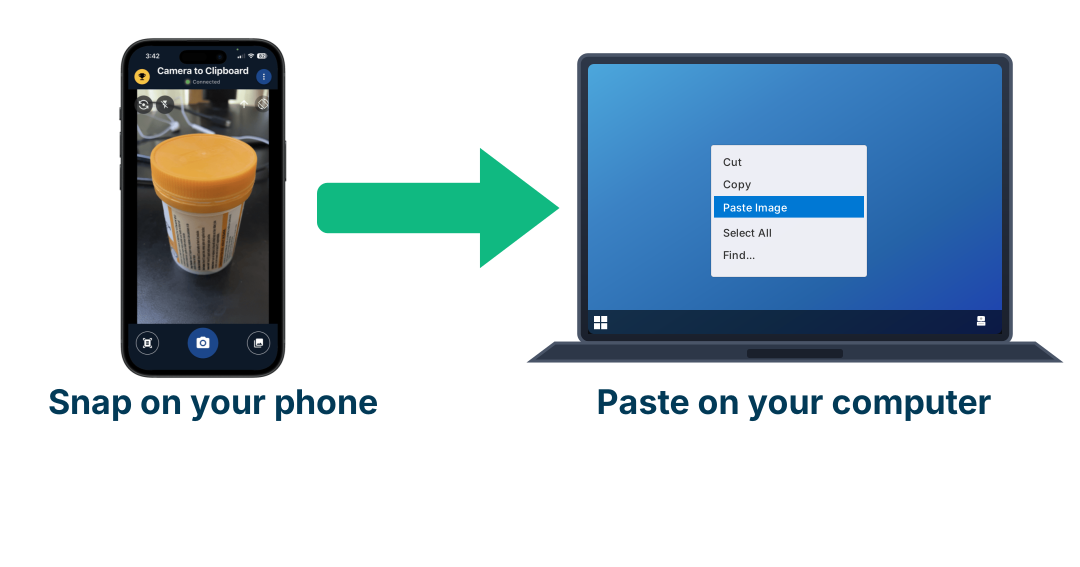
Use Camera to Clipboard to send proof photos to your appeal
Every complaint and every appeal in this article is decided on pictures: the shopfront with the sign on it, the licence on the wall, the utility bill with the address printed on it. Those pictures are taken on a phone and the form that wants them is open on a computer, and moving one to the other is the part that takes the afternoon. Camera to Clipboard, one of my own apps, removes that trip.
- A photo taken inside Camera to Clipboard is on the computer clipboard the moment you take it, ready to paste straight into the appeal form.
- The phone and the computer find each other over your own local network and send the picture directly, with no emailing it to yourself, no cable and no upload to somebody else's website in between.
- Several photos can be sent out of the phone's library at once, which is what an appeal asking for a registration, a licence and a utility bill actually needs.

A one-star rating with no words is the cheapest attack and the one Google will not remove
Google's review tools are built around policy violations, and a rating with no words contains nothing that can violate a policy.
- A review with no words cannot be shown to be fake, off topic, abusive or a conflict of interest, because it makes no claim at all.
- A one-star rating costs nothing to leave and there is no limit on how many separate Google accounts can leave one.
- A business with 20 reviews averaging 4.8 stars falls to 4.0 stars after five one-star ratings, and a business with 500 reviews at 4.8 stars falls only to 4.76.
- The number of reviews a business already has is the only thing that decides how much a rating attack hurts it.
- The only defence against a rating with no words is more real reviews, because the average is the only number that moves.

You cannot get a single star-only rating removed, so report the cluster instead of the rating
There is a defence against a rating with no words, and it starts by giving up on removing any one of them.
- A star rating with no words sits at the bottom of the listing and does not appear in the mobile review view at all, so the only thing it changes is your average.
- One rating on its own cannot be reported successfully, because a single low opinion breaks no policy, while a cluster of them landing on one day is fake engagement and does break one.
- Any rating is reported through the three-dot menu on the rating itself, and Google shows the outcome as Processing report, Content removed, Content not removed, Content restored or Report Canceled.
- Screenshot your review count and your average on the day a burst of ratings lands, because the burst is the whole evidence and it is invisible a month later.
- Open the account that left the rating and read what else it has reviewed, because a new account holding one or two reviews of scattered unrelated places is the pattern a check is looking for.
- Getting past 100 real reviews is the only permanent fix, because five one-star ratings drop a 20-review profile from 4.8 stars to 4.0 and move a 500-review profile from 4.8 to 4.76.

Google's own review policy bans attacking a competitor's listing
A rule written this specifically exists because the behaviour it names is common enough to need a rule.
- Google's Maps contributed content policy says a user must not "post content on a competitor's place or business to undermine that business' or product's reputation".
- The same policy bans content "not based on a real experience" and reviews "paid for, directly or in kind".
- It bans content from anybody with "current or former employment, a contractual or consultory relationship" with the business being reviewed.
- Quoting the exact policy line in your report is what turns a complaint into something Google can act on.
- Google's review rules apply to the business owner as well, so the public reply you write under a fake review is judged against the same policy.

Posting reviews from many Google accounts is banned whether they praise you or attack a rival
Renting a server, opening dozens of Google accounts and writing your own reviews is the attack most owners assume nobody can detect, and it is the one Google's rules describe most exactly.
- Google's Maps contributed content policy bans "content that has been posted from multiple accounts by or at the request of one person", which describes one person running a farm of Google accounts word for word.
- The same policy bans using emulators or tampering with a device to "mimic genuine engagement, manipulate sensor data or results", so the device a review is written on is part of what Google reads.
- A rented server changes the internet address a review arrives from and changes none of the other signals Google reads, which is why a fresh address on its own is not a disguise.
- Google says the punishment runs from "suspending the account privileges to account termination", so the fake accounts are the first thing destroyed rather than the business behind them.
- Google reported in June 2019 that it had disabled more than 150,000 abusive user accounts in a year, a 50% rise on the year before.
- One account farm is used both ways, to add five-star reviews to the attacker's own listing and to add one-star reviews to yours, so the same rule covers both directions.

A business caught faking reviews gets a warning label and its review button switched off
What happens to a competitor who does buy or fake reviews is written down, because a regulator made Google write it down.
- On 24 January 2025 Google agreed a set of sanctions with the UK Competition and Markets Authority after an investigation into fake reviews.
- Google agreed to put "prominent 'warning' alerts" on the Google profile of a business where suspicious review activity has been detected, so the people reading it see the warning.
- Google agreed to deactivate the review function on that profile, meaning the business cannot receive any new reviews at all.
- Google agreed that a business that repeatedly fakes reviews "will have all their reviews deleted for 6 months or more".
- Google agreed that a person who repeatedly posts fake reviews "will have their reviews deleted and will be banned from posting new reviews".
- The sanctions are fixed for 3 years, and Google reports to the regulator over that period.

Report a competitor's fake reviews on the reviews themselves, not through the spam complaint form
There is a way to tell Google, it is not the form most people reach for, and it goes further than most owners expect.
- Fake reviews on somebody else's listing are reported through the three-dot menu on each individual review, and anybody can do that on any business without owning it.
- The Business Redressal Complaint Form does not cover reviews at all, because it only accepts a business name, address, phone number, website or a business that does not exist.
- Report the pattern rather than one review, because a batch from new accounts holding one or two reviews each, all posted within the same few hours, is what a check is looking for.
- Google says it uses "a combination of people and machine-learning algorithms to detect such content", so a report joins the evidence rather than deciding the outcome by itself.
- Google says a report can end in removing the content, rejecting edits, restricting feature access or suspending accounts, so the fake accounts are destroyed before the business behind them.
- A business that repeatedly fakes reviews ends with a warning label on its profile, its review button switched off and all its reviews deleted for 6 months or more.

Reporting a listing as spam or as not existing is a form anyone can fill in
This is the route that worries small business owners most, and the honest answer is that it is open to anybody and it is not a delete button.
- The same Suggest an edit menu that changes your hours also lets any user report a listing as spam or as not existing.
- Google runs a separate form called the Business Redressal Complaint Form, its channel for reporting "misleading information or fraudulent activity on Google Maps related to the name, phone number, or URL of a business".
- That form asks the complainer to pick a type of malicious content from title, address, phone number, website or nonexistent business, and to paste the public Google Maps link.
- Both routes are open to anybody, including the business two streets away that wants your position in the map results.
- A report starts a review, and the outcome of that review is either nothing at all or a suspension.

A competitor reporting you for buying reviews does not punish you, Google's own detection does
Being accused of faking your own ratings is the fear that sends owners looking for this page, and the accusation itself is not what decides anything.
- Google agreed in January 2025 to "put in place a robust reporting function that allows consumers to easily and quickly report concerning reviews", so anybody can report a review as fake.
- A report is a request for a check, and the check is run against what Google's systems already see on your profile rather than against the wording of the complaint.
- What those systems read is the pattern of reviews arriving, meaning the accounts they come from, the devices they were written on and the order they landed in.
- Google reported in June 2019 that its internal systems removed more than 85% of the 3 million fake business profiles it took down in a year, against more than 250,000 that came from user reports.
- A profile collecting a few real reviews a month from real customers holds nothing that a check of that pattern can find.
- A sudden pile of five-star reviews is the one thing that does look bought, which is why asking customers steadily beats asking fifty of them in one week.

A hard suspension deletes your profile from Search and Maps and a soft one only unverifies it
Google has two suspensions and they are not close to each other in what they cost.
- A soft suspension leaves the profile visible on Google Search and Maps but marks it unverified, so it shows a "Claim this business" link and keeps collecting reviews.
- A soft suspension has little effect on ranking, so a business can carry one for weeks without noticing anything is wrong.
- A hard suspension removes the profile from Google Search and Maps completely.
- Google's own wording for a suspended profile is that "The public can't go to the profile" and "The owner and managers can't act on the profile".
- One plumbing business that lost its listing closed one of its locations and put ten plumbers out of work.

Getting a suspended Google Business Profile back took 5 to 6 weeks in early 2025
The suspension is not the punishment. The wait is.
- Getting the listing switched back on normally takes about a week, but the wait reached 3 to 5 weeks in late 2022 and 5 to 6 weeks in early 2025.
- The appeal is filed through Google's Business Profile appeals tool, and its status shows as Submitted, Approved, Not Approved, Can't be appealed or Eligible for appeal.
- Google requires the supporting evidence to be attached within 60 minutes of starting the appeal, or it will not attach at all.
- Google tells you not to create a new profile for the same business while the appeal is under review, because a second listing is itself a guideline violation.
- A denied appeal can be sent back for another review, but only with new evidence attached to it.
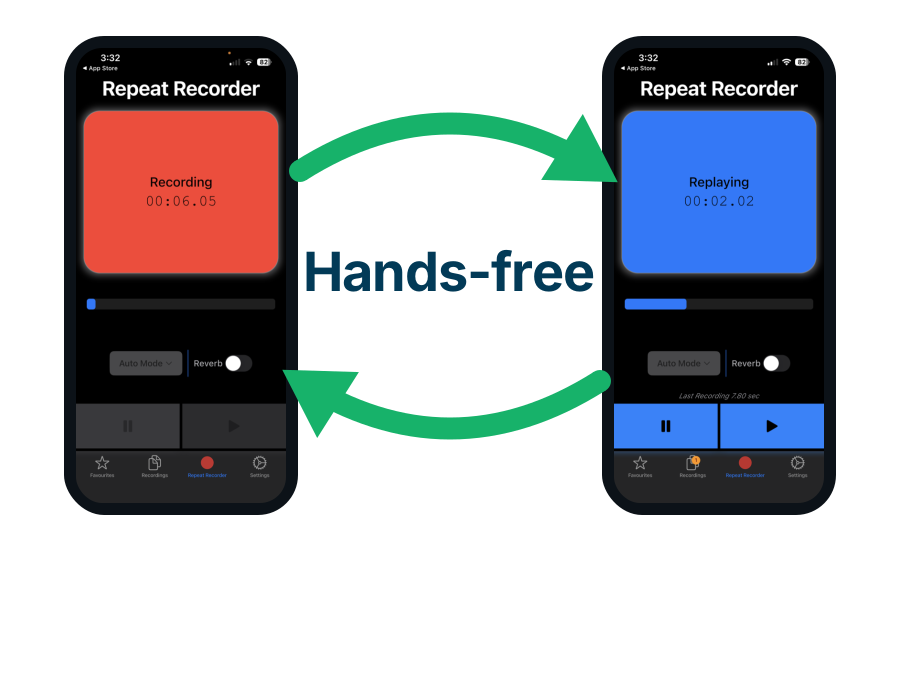
Use Repeat Recorder to rehearse your answer to a bad review
The reviews you cannot get removed are the ones customers ask you about at the counter, and the answer that sounds calm the tenth time is the one that has been said out loud nine times already. Repeat Recorder, one of my own apps, records that answer and plays it straight back without you touching the phone.
- Repeat Recorder plays each take back automatically and then starts recording again, so the same answer can be said ten times over without picking the phone up.
- It was built for speech rehearsal, language learning and vocal training, and answering a question about a bad review is the same loop with your own words in it.
- 68% of consumers will only use a local business rated at least four stars, so the answer that keeps a hesitating customer is worth the ten minutes.

Buying reviews back after an attack blocks your real customers' reviews too
The first thing an attacked business wants to do is buy five-star reviews to lift the average back, and this is what happens when it does.
- Google's answer to a business caught buying five-star reviews is to stop publishing that business's reviews altogether.
- Real reviews from real customers are blocked for the whole period as well, so the business loses the one defence it had against a rating attack.
- The quiet version of this carries no warning label at all, the review button still works, and the reviews people write simply never appear.
- Blocks on monitored cases ran 6 to 8 months, and a 30-day warning system has since appeared in the UK, the US and Canada.
- Google's systems judge the pattern of reviews arriving on a profile rather than who paid for them, which is why a sudden wave of obviously fake five-star reviews on your own listing is not good news.

A competitor stuffing keywords into their business name is the third strongest ranking signal
This one takes your position instead of damaging your listing, so nothing on your own profile ever looks wrong.
- Whitespark's 2026 study puts "keywords in the Google Business Profile business title" third out of every signal that decides the map results, on a score of 223.
- The only two signals stronger than a keyword in the business title are the primary business category on 227 and how close the business is to the person searching on 225.
- Renaming a business from "Hall Plumbing" to "Hall Emergency Plumber Perth 24 Hour" breaks Google's guidelines and works until somebody reports it.
- The Business Redressal Complaint Form is the route for reporting a keyword-stuffed business name, and it asks you to name the type of malicious content as "title".
- The Business Redressal Complaint Form can be pointed back at you, which is why your own business name has to be the name on your registration and nothing more.

A competitor pointing junk websites at yours almost never gets your website punished by Google
A link is one website pointing at another, and Google treats a link as a vote, so links normally help you rather than hurt you. The attack works the other way round. Somebody buys thousands of links from worthless websites, points every one of them at your website, and hopes Google decides you bought them yourself and pushes your website down the results as a punishment.
- The attack is called negative SEO, and the whole hope is that Google punishes the website the junk links point at instead of the person who paid for them.
- Google's own documentation says "In most cases, Google can assess which links to trust without additional guidance, so most sites will not need to use this tool", talking about the disavow tool that tells Google to ignore links.
- Google says to use the disavow tool only when a considerable number of junk links point at your site and they have already caused a manual action, which is a person at Google deciding to push your website down the results.
- A manual action always arrives as a written message in Google Search Console, so there is a specific place to look rather than a feeling to have.
- Junk links do not lift a website's ranking either, so a competitor who buys ten thousand of them and aims them at you has spent money to change nothing.
- Time spent worrying about your backlinks is time not spent watching your Google Business Profile, which is where every attack that does work in this article happens.

One report does not delete your business, but one edit can change it the same day
This is the question every owner asks first, and the three routes into a listing have three completely different answers.
- A single report does not remove a business from Google, because a report starts a review and the review is what decides.
- Google's own systems remove far more listings than user reports do, so one complaint from one competitor is a long way from a decision.
- A suggested edit is a different thing from a report, and an edit to your hours, phone number or website does not need your approval to go live.
- An ownership request is a third thing again, and it runs on a 3-day clock that starts with one email.
- The report is the slow risk and the suggested edit is the fast one, and almost every business owner is watching the report.
Use Camera to Clipboard to move screenshots of the attack to your desk
Every complaint here is judged on evidence, and the evidence lives on a phone: a screenshot of the listing before it was edited, a photograph of the shop open on the day it was marked closed, the message demanding money to take a review down. The form that wants them is open on a computer. Camera to Clipboard, another of my own apps, moves them across in one step.
- Several photos can be sent out of the phone's library at once, so a folder of dated screenshots arrives in one go instead of one email at a time.
- Anything that accepts a pasted picture accepts this one, because it arrives as an ordinary image sitting on the clipboard rather than as a file you have to go and find.
- Google gives you 60 minutes from starting a suspension appeal to attach the evidence, which is a real deadline when the pictures are still on a phone.

Claim the profile and read every Google email, the ownership clock is only 3 days
The defence starts here, and this first step costs nothing at all.
- An unclaimed Business Profile can be claimed by anybody who verifies it, so claiming and verifying your own profile is the whole first step.
- A verified profile still receives ownership requests, and the only thing standing between a request and a transfer is an email read inside 3 days.
- Make sure those emails reach a person who reads them, not a shared inbox that nobody opens on a Friday.
- Add a second manager to the profile so it does not depend on one person's inbox or one person's holiday.
- Look at the live listing yourself once a week, because reading the profile the way a customer sees it is the only check that catches all five editable fields.

Report a fake review in the tool, then appeal after 3 days even if it is still pending
Google will remove a review that breaks a written policy and will not remove one that is only unfair.
| The review | Will Google remove it | How long you wait |
|---|---|---|
| A star rating with no words | No, a rating with no words breaks no policy | Never, so the only fix is more real reviews |
| A negative opinion about a real visit | No, a genuine bad experience is allowed | Never, so reply to it in public instead |
| A review from somebody who was never a customer | Rarely, and only with evidence that it is not a real experience | Weeks, and the report is often refused |
| A review demanding money to be taken down | Yes, extortion has its own merchant form | About 3 business days with the screenshots attached |
| A review from a current or former employee | Yes, that is a conflict of interest | About 3 business days with the employment record attached |
| A wave of reviews after a viral post or news story | Yes, that is a coordinated attack | Days to weeks, depending on the evidence you show |
| A review accusing you of a crime with no proof | Yes, unsubstantiated criminal allegations are banned | About 3 business days |
| A review with hate speech, obscenity or someone's personal details | Yes, all three are prohibited content | About 3 business days |
- Reviews are reported through Google's Managing your reviews tool, and Google says most reported reviews are processed within 3 business days.
- Google's Managing your reviews tool shows a status of Report reviewed with no policy violation, Escalated, Review removed, or Decision pending.
- An appeal can be submitted after 3 days even when the decision is still pending, so a pending status is not a reason to keep waiting.
- Screenshot the social media post or the news story that started a review wave before it is deleted, because that screenshot is the whole case.
- Reply in public to every review you cannot get removed, because your reply is the only part of that listing you control.

Save the papers that prove your business is real and at its address, before you need them
Getting a suspended listing back is decided on paperwork, and a 60 minute window is not the moment to start hunting for it. Google is answering two questions with these papers: does this business legally exist, and is it really at the address on the listing.
- Google asks for the government paper that registered the business, which is the ABN or ACN certificate in Australia and the incorporation or trading name filing in the United States.
- Google asks for any licence that lets you legally trade, such as a food licence for a cafe or an electrical licence for an electrician.
- Google asks for a utility bill in the business name, because a power, water or phone bill is the thing that proves you are actually sitting at the address on the listing.
- The 60 minute window starts the moment you open the appeal, so every one of those papers has to be scanned and sitting on the computer before you begin.
- Keep dated photographs of the shopfront with the sign visible, because a listing marked permanently closed is argued about with pictures.
- Hide your street address if customers cannot visit you, because Whitespark's 2026 study names a travelling business showing a street address as the biggest suspension risk an owner creates for themselves.

Never buy reviews back, because Google puts a warning label on your profile where customers read it
Almost nobody who buys reviews is ever taken to court, and that is the wrong thing to be weighing anyway. The punishment that actually arrives comes from Google, it arrives within months, and your customers see it.
- Google puts a prominent warning alert on the profile of a business where it has detected suspicious review activity, so the person deciding whether to call you reads the warning first.
- Google switches the review function off on that profile, so the business cannot receive any new reviews at all, including the real ones it was trying to collect.
- A business that repeatedly fakes reviews has all of its reviews deleted for 6 months or more, which wipes out the genuine reviews alongside the bought ones.
- The quiet version of this carries no label at all, the review button still works, and the reviews people write simply never appear.
- Google bans the accounts that posted the fake reviews from posting reviews again, so the money buys accounts that die.
- Consumer protection law in many countries also bans buying reviews, but a regulator is slow and rare, while Google's warning label is fast and public.

Build a second way to be found, because Google fell from 83% to 71% in one year
Every attack in this article works because one company's page is the only way a stranger finds the business.
- 71% of consumers used Google to find and judge a local business in 2026, down from 83% in 2025.
- 45% of consumers used ChatGPT or another AI tool to get a recommendation in 2026, up from 6% in 2025.
- A customer list, a phone number people already have, and a listing on a second directory are the parts of the business a competitor cannot edit.
- Claiming Yelp, Bing Places and Apple Maps also puts your details where the AI assistants read them.
- The point of a second channel is not more customers, it is that a five week suspension stops being the end of the business.
Conclusion: how to protect a local business from a competitor on Google
A competitor cannot delete a business from Google with one report, and that is the only comforting sentence here. Everything else on this list is open to a stranger with a free account.
- A single report does not delete a business, because it starts a review rather than a removal.
- Anyone signed in to Google can suggest a change to your hours, phone number, website, category or map pin.
- Google decides whether that suggestion goes live, and a new listing with few reviews is far easier to change than an established one.
- An ownership request gives you 3 days to reply before somebody else may claim the profile.
- A one-star rating with no words is the attack Google will not remove.
- A hard suspension hides the business from Google entirely, and getting it back took 5 to 6 weeks in early 2025.
- Look at your own live listing once a week, because five editable fields can change without warning you.
- Report a fake review in the tool, then appeal after 3 days even if the decision is still pending.
- Keep the papers that prove your business is real and at its address ready, because an appeal allows 60 minutes.
- Posting reviews from many Google accounts is banned, and Google disables the accounts before it touches the business.
- A competitor reporting you for faking reviews starts a check of your review pattern, not a punishment.
- A business caught faking reviews gets a warning label on its profile and its review button switched off.
- Never buy reviews back, because Google puts a warning label on your profile and switches your review button off.