
Everyone treats Reddit as the forum that reaches the most people. Measured over the same period, that is wrong: WhatsApp (3 billion monthly) and Facebook Groups (1.8 billion monthly) both reach more people than Reddit's roughly 1.36 billion. Reddit still belongs first on your list, for a different reason, and knowing that reason tells you which of the fourteen alternatives below are worth your evenings.
The short version: Reddit is not the biggest forum, it is the most readable one. It is the 4th most visible US domain on Google and the most-cited domain in AI answers, so every post is a permanent, searchable asset. Every bigger platform (WhatsApp, Facebook Groups, Telegram, Discord) is invisible to search, so nobody discovers you there by accident. The underrated answer is niche independent forums: no algorithm, full pseudonymity, and threads that rank in Google for a decade.
Reddit is the third biggest forum, not the biggest
- Almost every Reddit comparison you will read is invalid, because it sets Reddit's daily user count beside Facebook's monthly one. Reddit's widely quoted 121.4 million is daily and Facebook Groups' 1.8 billion is monthly, which turns a real gap of about 1.3 times into a bogus 17 times.
- Reddit does not publish a monthly user figure at all, so every monthly number you see for Reddit is an outside estimate. It reports 121.4 million daily and 471.6 million weekly uniques, nothing else.
- Measured monthly, the order runs WhatsApp 3 billion, Facebook Groups 1.8 billion, Reddit about 1.36 billion, Telegram 1 billion, Quora 400 million and Discord 259 million.
- That 1.8 billion is Facebook Groups alone, not Facebook, which runs at about 3.04 billion monthly users. The two get conflated constantly, and the whole-site number is not a forum number.
- 56.7% of the people Reddit counts each day have no account, 70.7 million logged out against 50.7 million logged in, so Reddit's real community is a few hundred million rather than 1.36 billion.
- Reddit's logged-out audience is growing 27% a year against 10% a year for its logged-in members. That majority is search traffic, which is the whole argument of the next section.
~1.3x roughly how much bigger Facebook Groups (1.8B monthly) really is than Reddit (about 1.36B monthly), once both are measured over the same period. Compare Facebook's month against Reddit's day instead and you get a bogus 17x.
Reddit wins on discovery, because Google, the AI engines and its own front page all show your post
Audience size and discovery are different properties, and almost every "Reddit alternative" list confuses them. Reddit is strong on two kinds of discovery at once: people browsing Reddit itself, and people arriving from outside it.
- A new Reddit post is shown to everyone browsing that subreddit, so a brand new account with no followers still reaches strangers. Discord, Telegram and WhatsApp have no equivalent, which is why they can only hold an audience you already have.
- Reddit is the 4th most visible US domain on Google and holds about 10.24% of all Google top-3 positions. Its search visibility grew 1,328% between 2023 and early 2025, to roughly 842 million clicks a month from US Google alone.
- Reddit is the most-cited domain in AI answers, ranked first across all AI engines in an analysis of 30 million cited sources, ahead of YouTube, LinkedIn and Wikipedia.
- Even the most-cited domain rarely exceeds about 5% of an AI engine's total citations, so posting on Reddit raises your odds of being quoted rather than guaranteeing it.
- Discord serves a header that keeps even its invite links out of Google, and Telegram and WhatsApp channels cannot be searched at all. Facebook Groups are only partly indexed, and private ones not at all.
- A Reddit comment is an asset rather than an event, because searchers and chatbots keep finding it for years. Nothing else on this list keeps working for you that long.
The question is never "where are the most people". It is "where does one evening of writing keep working for three years".
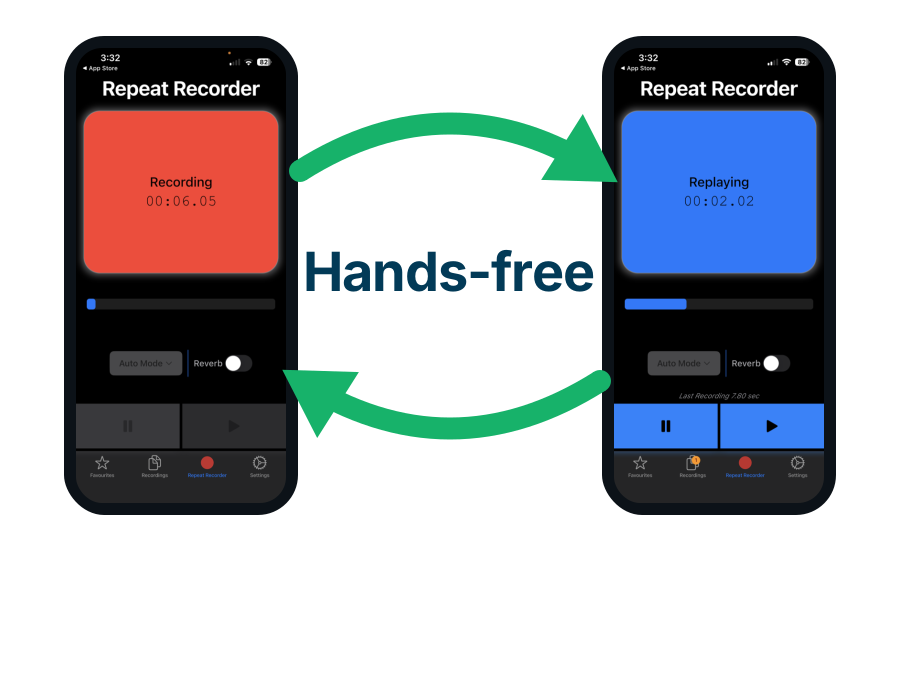
Use Repeat Recorder to rehearse the video you post to YouTube
The same test applies to video, and YouTube leads Google AI Overview citations at a 20.9% share. Video is harder than a forum post because the words have to be said out loud instead of edited quietly. Repeat Recorder, one of my own apps, records you and plays the take straight back without you touching the phone.
- Repeat Recorder plays each take back automatically and starts recording again, so you can run the same opening line twenty times without picking the phone up.
- A written forum answer can be reworded afterwards, but a spoken line is decided in the take, which is the argument for running the take more than once.
- Takes worth keeping go into favourites and into folders you name yourself, dragged into whatever order you want.
Fourteen Reddit alternatives compared on audience and reach
| Platform | Real audience (monthly) | Found via Google? | Cited by AI? | Reach with no followers | Self-promo tolerance |
|---|---|---|---|---|---|
| ~1.36B monthly (estimate), 121.4M daily, 56.7% logged out | Yes, heavily: 4th most visible US domain, ~10.24% of top-3 | Most-cited domain across AI engines | Excellent: subreddits hand you a warm topical audience | Low: 90/10 rule, karma gates, shadowbans | |
| Facebook Groups | 1.8B monthly (Meta, Oct 2024), 10M groups | Partly: public groups only, private ones never | Rarely | Excellent: Facebook actively recommends groups | Depends entirely on the admin |
| Discord | 259M monthly, 21M+ active servers | No: X-Robots-Tag blocks even invite links | No | Very poor: no discovery surface at all | Fine in your own server, policed elsewhere |
| WhatsApp Channels | 3B monthly app-wide, 500M on Channels | No | No | Very poor: you must import an audience | High: it is your own broadcast surface |
| Telegram Channels | 1B monthly, 500M daily | No | No | Poor: no algorithm means no free distribution either | High: unlimited subscribers, no gatekeeping |
| Quora | 400M+ monthly, ~292M visits/mo, 27M daily | Yes: strong evergreen answer rankings | Sometimes | Good: answer an existing question and inherit its traffic | Medium: one link in a genuinely useful answer |
| Stack Exchange | 100M+ monthly on Stack Overflow | Yes, very strong: 5B+ annual pageviews | Sometimes | Moderate, and question volume is collapsing | Very low: promotion is aggressively removed |
| Niche forums (XenForo, vBulletin, Discourse) | Small each, but e.g. Bimmerforums ~800k members | Yes: threads rank for years, tiny competition | Sometimes, and rising as generic sites get noisier | Excellent: no algorithm, everyone reads new threads | Varies: many welcome a known regular's product |
| X Communities | 126M members (not monthly actives), 840k+ communities | Partly | Sometimes | Good: community posts are visible to non-members | Medium |
| Hacker News | Small: ranked ~#4435 globally | Partly | Sometimes | All-or-nothing: front page or silence | Occasional and disclosed only |
| Bluesky | ~27.5M monthly, ~3.7M daily, 43.5M registered | Partly | Rarely | Moderate: small pond, but links are not suppressed | High: few restrictions |
| Product Hunt | ~6M monthly (150k to 250k daily) | Partly | Rarely | One big spike: 5k to 50k visits in 48h if you place | High: launching is the entire point |
| Nextdoor | ~41M monthly claimed, 21M weekly, 69M members | No | No | Good but geo-locked to your own suburb | Medium, and local businesses are expected |
| Lemmy / Mastodon | ~48,600 monthly on all of Lemmy combined | Partly | Rarely | Poor: the whole network is smaller than one subreddit | Medium, and openly hostile to marketing |
| 4chan | ~22.5M monthly uniques self-reported | No: threads are deleted, nothing persists | No | High variance: huge or nothing, and unsteerable | Actively hostile: expect to be attacked |
Anonymity comes in four tiers and they are not the same
Pick the tier you actually need before you pick a platform.
- Tier 1 lets you post under an invented handle and never learns your legal name. This covers Reddit, Hacker News, Stack Exchange, Discord, Telegram, Bluesky, Lemmy, Mastodon and virtually every independent niche forum.
- Tier 2 shows a brand publicly but verifies a real person behind it. That is a Facebook Page, a Telegram channel, a WhatsApp Channel or a branded X account.
- Tier 3 requires and displays a real identity. LinkedIn wants a real name, Nextdoor wants a real name plus a verified home address, and Quora ended anonymous answering on 22 November 2021.
- Tier 4 is genuinely anonymous, and only 4chan qualifies. It is also the one place here where a brand mention reliably attracts hostility rather than customers.
- A Facebook Page hides your admins while a Facebook Group exposes your real profile every time you post. Page Transparency shows only how many people manage a Page and which countries they live in.
- Reddit is the only platform here that gives you full pseudonymity and the best search visibility at the same time.
| Platform | Can you be pseudonymous? | What the public sees | What the platform demands | Brand-front possible? |
|---|---|---|---|---|
| Yes, fully | A handle only | Email, optional | Yes, though branded accounts get scrutiny | |
| Hacker News | Yes, fully | A handle only | Nothing but a username | Yes, but you must disclose your role |
| Niche forums | Yes, fully | A handle only | Usually just an email | Often needs the admin's blessing |
| 4chan | Yes, no account at all | Nothing | Nothing | No, and branding invites attack |
| Discord | Yes | A handle only | Phone verification on many servers | Yes, your own server is fully branded |
| Telegram | Yes | A handle, number hideable | A phone number | Yes, a channel is brand-only |
| Bluesky | Yes | A handle only | Yes | |
| Lemmy / Mastodon | Yes, fully | A handle only | Email, sometimes nothing | Yes |
| Stack Exchange | Yes | A handle only | No, corporate accounts are unwelcome | |
| X Communities | Yes | A handle only | Phone verification is common | Yes |
| Facebook Page | Publicly yes, privately no | The brand, plus admin countries | A real personal profile behind it | Yes, this is exactly what a Page is |
| Facebook Groups | Mostly no | Your real profile when you post | A real personal profile | Only by posting as a linked Page |
| Quora | No, removed in Nov 2021 | Your profile on every answer | A named profile | Partly, via a Space |
| Nextdoor | No | Real name, at minimum first name plus initial | Verified real name and home address | Only as a business page |
Use the Facebook Page as a mask and a Group as the audience
Facebook works for a semi-anonymous brand only if you split the two jobs between the two products.
- A Facebook Page is a terrible audience and an excellent disguise, because organic Page reach sits at roughly 1.4% of followers while Page Transparency reveals only your admins' countries.
- A Facebook Group is the opposite, reaching 40 to 50% of its members against a Page's 1.4%. A 10,000-member group reaches 2,000 to 4,000 people per post.
- Setting a Facebook Page as the Group's owner lets you post into the Group as the brand, which buys you Group-level reach with Page-level anonymity.
- Facebook markets your Group for you through Suggested Groups and friend social proof, which no other platform on this list gives a community owner for free.
- Group reach depends on ongoing discussion, so a group you stop tending goes quiet within weeks and stops being recommended. Budget daily community management, not weekly content production.
- Public group posts can surface in Google, and private group content is invisible to both Facebook search and Google.
We have fuller pieces on whether Facebook Groups are worth growing and whether a Facebook Page is worth growing.
Discord has 259 million users and no discovery at all
- Discord's audience is genuinely huge, at 259 million monthly active users across 32.6 million servers carrying about 850 million messages a day.
- Discord is no longer a gaming site, with over 55% of its user base expected to be non-gamers. Education groups, startups and AI communities are now a core part of it.
- Nobody browses Discord the way they browse Reddit's front page, so servers only grow when someone shares an invite link somewhere else.
- Discord serves a header that stopped even invite links appearing in Google, and message content was never indexed. Every helpful answer you write there leaves the internet's memory the moment it scrolls away.
- Use Discord as a destination and never as a source, because it holds people you won elsewhere rather than finding you new ones.
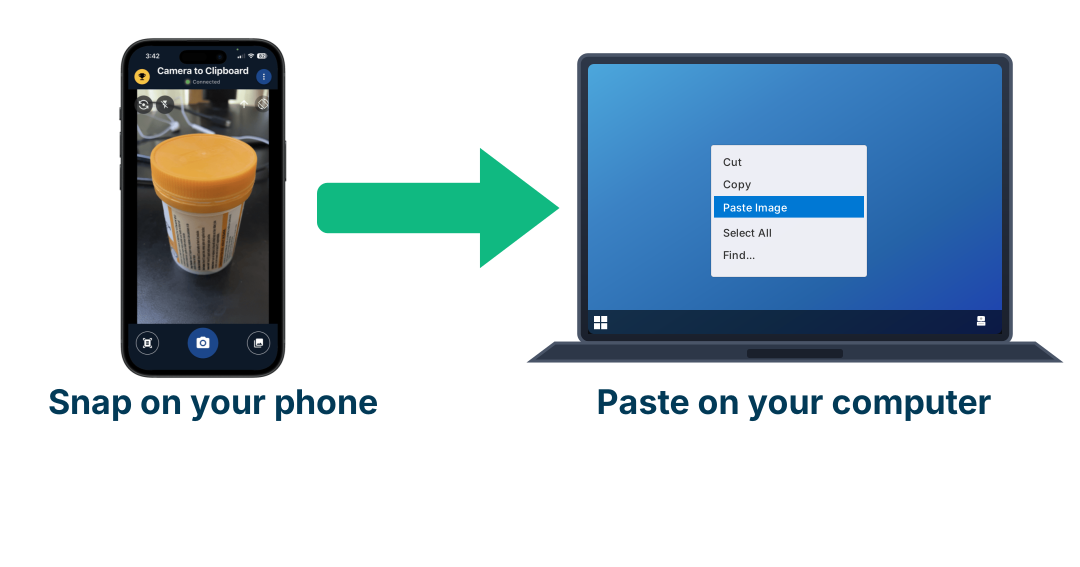
Use Camera to Clipboard to answer a forum question with a photo
The answers that keep paying you back sit on a page a crawler can read, and the best of those carry a picture: the screen, the setting, the finished thing. Camera to Clipboard, one of my own apps, gets that picture off the phone and into the post without a cable or an email to yourself.
- A photo you take inside Camera to Clipboard is on your computer's clipboard the moment you take it, ready to paste into the reply box. The phone and the computer find each other over your own local network.
- Screenshots already in your phone's library can be sent one at a time or several at once, so a forum answer needing a before and an after arrives in one go.
- The picture pastes straight into the forum reply box, because it arrives as an ordinary clipboard image.
Quora and Stack Exchange pay out for years but punish promotion
Both produce pages that rank in Google for years, and both charge a specific tax for it.
- Quora is bigger than people assume, at over 400 million monthly users and about 27 million daily visitors. The United States supplies 42.96% of its traffic and India 24.54%.
- Quora's mechanic is uniquely efficient for a small brand, because you need no audience and no following. Find a question that already ranks in Google, write the best answer on it, and you inherit traffic that was arriving anyway.
- Quora ended anonymous answering on 22 November 2021, so every answer you write there now carries your profile. If no real identity may attach to your posting, Quora is disqualified.
- Stack Exchange has enormous traffic and almost no tolerance for promotion, with Stack Overflow still drawing over 100 million monthly visitors while removing promotion aggressively.
- Stack Overflow's question volume has collapsed from over 200,000 a month at its 2014 peak to under 50,000 by late 2025. You can still win permanent search real estate there, on a narrowing base.
- Use Quora for reach if you accept being named, and Stack Exchange only where being the person who answered well is itself the marketing.
We have a dedicated piece on whether Quora answers help you show up in AI answers.
Hacker News and Indie Hackers trade audience size for conversion
These are tiny next to Reddit and still frequently outperform it, because the visitor quality is completely different.
- Hacker News ranks around #4435 globally and still produces press pickup, investor attention and technically literate signups from one front-page placement.
- Hacker News bans using the site primarily for promotion, not promotion itself, so occasional posts of your own work are allowed, Show HN needs something people can actually try, and vote manipulation is the one unforgivable sin.
- Hacker News is all-or-nothing, because the front page means thousands of visitors in hours and page two means nobody. Treat it as an occasional lottery, never a channel you build on.
- Product Hunt is a scheduled spike rather than an audience, and placing in the day's top three realistically brings 500 to 2,000 visitors. Launch guides promise 5,000 to 15,000. Full breakdown of a Product Hunt launch.
- Indie Hackers converts at a reported 23.1% per engaged post against Product Hunt's 3.1% per launch. Fewer readers, dramatically better ones, and no launch-day choreography.
- Ten thousand pre-qualified readers beat a million wrong ones, which is the best argument for niche forums.
Telegram and WhatsApp reach billions that nobody can search
- WhatsApp is the largest Reddit alternative here at 3 billion monthly users, with Channels alone reaching 500 million and over 200 million businesses on WhatsApp Business.
- Telegram has 1 billion monthly and 500 million daily users, and the average user opens it 21 times a day for about 41 minutes.
- Telegram Channels take unlimited subscribers with no algorithm in the way, so every subscriber sees every post. Nothing else here gives you 100% delivery at any size.
- WhatsApp Communities are capped at 5,000 members across up to 50 groups, so they are built for a bounded community rather than open growth.
- Neither platform has a browsable feed, search indexing or recommendations, so growth comes entirely from links you place elsewhere. They can hold your audience but never start it.
- Telegram and WhatsApp are the correct second platform and a bad first one, so pair a Telegram channel with a discovery channel like Reddit rather than opening it alone.
X Communities and Bluesky still reach strangers from a brand new account
Both are small next to the giants, and both have a mechanical advantage a zero-follower account can use.
- X Communities number over 840,000 with 126 million members in total, growing by around 70,000 new members a day.
- Posts inside an X Community are also visible to your followers and to other people on X, and anyone can reply without joining. That gives a new account a topical audience plus spillover into the general timeline.
- X Communities are a specific exception to X's general uselessness for organic growth, because a free X account otherwise gets a fraction of a paying account's reach. See is X (Twitter) worth growing.
- Bluesky has about 43.5 million registered accounts producing roughly 27.5 million monthly active users, though a January 2026 estimate put monthly active users nearer 12 to 15 million, so treat the range as uncertain.
- Bluesky does not suppress posts containing outbound links and stays chronological by default, so a link post is not quietly buried the way it is on X.
- Bluesky's entire monthly audience is smaller than one large subreddit, so size your expectations to that.
All of Lemmy has 48,600 active users, which is not an audience
Lemmy is recommended most often as the Reddit replacement and is architecturally the closest match to it.
- The whole Lemmy network runs at about 48,600 monthly active users across 455 servers, which is smaller than a mid-sized single subreddit.
- The largest Lemmy server, lemmy.world, has about 14,144 monthly active users and lemmy.ml about 1,982. You cannot reach the network from one place, so your real audience is one of those numbers.
- Lemmy has declined from about 64,900 monthly active users in July 2024, settling into a durable core rather than growing. Mastodon, the largest platform in the fediverse, has been flat since early 2026.
- Lemmy signup spikes follow every big-platform controversy and then fade, a pattern that has repeated for years.
- Lemmy's culture is explicitly anti-marketing, which is much of the point of being there, so brand posting reads as an intrusion.
- Skip Lemmy unless your product is specifically for privacy-minded or self-hosting technical users.
48,600 monthly active users across all 455 Lemmy instances combined, against Reddit's roughly 1.36 billion monthly. The architectural clone is not the practical alternative.
Niche forums have real members and threads that rank for a decade
This is the part of the landscape that "Reddit alternatives" lists almost always miss.
- One car forum, Bimmerforums, has around 800,000 members and 35 million posts. Bodybuilding.com carries over 109.7 million posts and Rennlist has over 200,000 registered Porsche owners.
- A new thread goes straight to the top of the forum and everyone browsing that section sees it, so effort converts to attention almost linearly, which is true nowhere else on this list.
- Forum threads on narrow, specific questions sit in Google results for years against very few competing pages. This is Reddit's compounding property in a pond with a thousandth of the contributors.
- A handle and an email address is the entire signup on a traditional forum. No phone number, no real name, no ID.
- Many niche forums tolerate promotion where Reddit expects nine ordinary posts for every promotional one, through a vendor section or a "show us your project" thread, and the price of admission is being a real member first.
- Finding good niche forums is manual work, and each one is small, so this is a strategy of accumulating five or ten rather than winning one. There is no directory, rules are per-site and unwritten, and moderators are often a single owner with a long memory.
The ranking changes once you weight audience by effort
Sorted by effort rather than reach, the winners are almost entirely different.
| Platform | Effort to first 1,000 readers | Gate before you can post | Time to first traction | Best case if it works |
|---|---|---|---|---|
| Niche forums | Lowest: one good thread reaches the whole section | Email signup, usually nothing else | Days | Modest per forum, compounds across many |
| Quora | Very low: inherit an existing question's traffic | A named profile, no anonymity | Weeks, as answers start ranking | High and evergreen |
| Facebook Groups | Low to post in, high to run one | Real profile; admin approval to join | Weeks to months for your own group | Very high: 40 to 50% member reach |
| X Communities | Low: posts spill out to non-members | Often phone verification | Days to weeks | Moderate |
| Medium: high reward, real ramp-up cost | Karma 50 to 500 and 7 to 30 days age on many subs | 2 to 4 weeks of participating first | Highest: search plus AI citations forever | |
| Bluesky | Medium: small pond, fair distribution | Email only | Weeks of consistent posting | Low: the whole network is small |
| Product Hunt | Medium, but front-loaded into one day | A launch-ready product | 48 hours | One spike, then nothing |
| Indie Hackers | Low: 23.1% conversion per engaged post | Email signup | Days | Low ceiling, small audience |
| Hacker News | Low to try, unrepeatable when it lands | A username | Hours, or never | Very high on the front page |
| Telegram / WhatsApp | Highest: no discovery, import everyone yourself | A phone number | Months, gated on another channel working | Very high: 100% delivery, no algorithm |
| Discord | Highest: no discovery surface at all | Phone verification on many servers | Months | Great retention, no acquisition |
| Stack Exchange | High: reputation first, promotion barely ever | Reputation thresholds gate most actions | Months | Strong search value, weak brand value |
| Nextdoor | Low locally, capped by your postcode | Verified real name and home address | Days | Very low: geo-locked to one suburb |
| Lemmy / Mastodon | Low effort, almost no payoff | Email, sometimes nothing | Days | Lowest: ~48,600 monthly across all of Lemmy |
Reddit's entry cost is the one number that reorders everything, and it is the reason "just post on Reddit" fails so often.
- Reddit has no site-wide karma minimum, but many large marketing-relevant subreddits require 50 to 500 karma and 7 to 30 days of account age before you can post.
- The working guidance is 2 to 4 weeks of genuine participation and roughly 100 comment karma before you post any external link.
- Keep self-promotion under about 10% of your Reddit posting history, and never submit the same URL to several subreddits on one day.
- Alt accounts no longer work, because large subreddits treat multiple accounts promoting one product as a single actor. The penalty is a ban on every linked account plus a blacklist of your product URL.
- A Reddit shadowban makes your posts invisible with no notification, so you can spend weeks talking to nobody without knowing.
- Niche forums beat Reddit on effort because they offer the same pseudonymity and Google indexing with no karma gate, no ratio policing and no shadowban risk.
Rerank all fourteen platforms by what you care about
Move the sliders to say how much you value each property, and say whether anonymity is a hard requirement.
A three-layer stack beats betting everything on one forum
Every platform here is strong on one axis and weak on the others, so the answer is a stack of three jobs rather than one winner.
- Layer 1 is discovery, and it is Reddit, because nothing else combines full pseudonymity with being the 4th most visible domain on Google and the most-cited domain in AI answers.
- Layer 2 is volume, and it is five to ten niche forums, which is the change most people should make. Search your subject plus "forum", sign up pseudonymously, and become a regular.
- Layer 3 is retention, and it is one owned channel, either a Telegram channel or a Facebook Group. Telegram guarantees delivery to every subscriber, a Facebook Group owned by a Facebook Page reaches 40 to 50% of its members, and you pick one rather than both.
- Add Quora only if you accept being named, since answering a question that already ranks in Google is the cheapest lasting traffic here.
- Treat Hacker News and Product Hunt as occasional events rather than channels.
- Skip Lemmy, Mastodon, 4chan and Nextdoor, and never open Discord, WhatsApp or Telegram first. The first four are too small, too hostile, too ephemeral and too geo-locked, and the last three hold an audience without ever finding you one.
Conclusion: small independent forums beat every other Reddit alternative
Reddit reaches fewer people than WhatsApp or Facebook Groups, and it should still be first, because it is the only large forum a search engine can read.
- Reddit is the only platform here that is both pseudonymous and findable in Google.
- All 455 Lemmy servers together carry about 48,600 monthly users, so the closest copy of Reddit is not its replacement.
- Five to ten small independent forums give you Reddit's permanence with none of its karma gates.
- Budget 2 to 4 weeks of genuine participation before you post a link on Reddit.
- Discord, WhatsApp and Telegram can hold an audience but cannot find you one, so none of them is a sensible first move.