
A reader favourite: can you just write your own Wikipedia page to get cited by ChatGPT? The short answer is no, and it usually backfires, yet a real page is worth more than almost anything else. Here is the honest picture.
Never write your own page, but a real one is gold for ChatGPT
A reader favourite: can you just write your own Wikipedia page? The short answer is no, and it usually backfires, yet a real one is worth more than almost anything else on this list, for ChatGPT specifically.
- Creating your own is strongly discouraged, and disclosure is mandatory. Wikipedia's conflict-of-interest guideline tells you to refrain from writing about yourself and to use its review process instead, and if you are paid, or it is your own product, you must disclose it under the Terms of Use.
- You almost certainly fail the notability bar. Wikipedia needs “significant coverage in multiple independent, reliable sources”, not your own site, not press releases, not app-store listings. Most small apps do not clear it, and failing notability is the number-one reason articles get deleted. Purely promotional writing is removed even faster.
- A deleted Wikipedia promo article leaves a permanent public deletion log. A deleted promo article leaves a public deletion log, can get the topic blocked from being recreated, and undisclosed paid editing is a rules violation. Not fatal for a tiny app, but wasted effort with a small downside.
- Yet a legitimate page is arguably the best AI asset you can own, for ChatGPT. Wikipedia is hugely over-represented in ChatGPT's sources and seeds Google's knowledge graph. The catch: it barely helps on Google's AI Overviews and is near-nothing on Perplexity, so it is mainly a ChatGPT play.
- Earn a Wikipedia page with independent press coverage rather than writing one. Get genuine independent press coverage first, and a page becomes possible, ideally created by someone unconnected to you. In the meantime, a Wikidata entry has a far lower bar and still feeds the entity graph.
Stacking your own sources will not clear the notability bar
I said you will almost certainly fail Wikipedia’s notability bar. It is worth knowing exactly what that bar is, because the obvious way to fake it, piling up citations to Trustpilot, the App Store, Quora and LinkedIn, is precisely the pattern that gets an article rejected.
What the bar actually says:
- “Significant coverage in multiple independent, reliable, secondary sources.” Every word is doing work. Significant means a source covers you directly and in depth, not a passing mention. Independent means not you, and not anyone connected to you. Reliable means a real publication with editorial oversight and a reputation for fact-checking. Secondary means someone else writing about you, not your own material. For companies and products the rule (called NCORP) is stricter still, and it explicitly throws out routine coverage: funding announcements, product launches, hiring notices and press releases.
Why your stack of sources counts for nothing:
- Trustpilot, the App Store and Google Play do not count, they are your reviews and your listing. Trustpilot is user reviews, user-generated content, which Wikipedia broadly rejects (it treats Amazon-style user reviews as literally “should not be used at all”), and an App Store or Google Play page is your own promotional material, primary and non-independent. Neither is an independent, reliable source.
- Quora and LinkedIn do not count either, they are self-published. Wikipedia’s own source guide lists both as “generally unreliable”: Quora because it is a user-generated question-and-answer forum, LinkedIn because it is a self-published platform. A LinkedIn article or a Quora answer you wrote is simply you talking about yourself.
- Your own site and your press releases are out by definition. They are not independent of the subject, which is the entire point of the rule.
- Trustpilot, app stores, Quora and press releases add up to zero notability. Stacking Trustpilot plus the App Store plus Quora plus LinkedIn plus a press release does not give you “a few sources”, it gives you zero qualifying ones, because every single item is user-generated, self-published, primary, or non-independent, all of which are explicitly excluded, and NCORP is the strictest guideline of the lot. Loading an article with them does not make it look genuine to a reviewer; it makes it look like exactly what it is.
How unpaid volunteers catch it, and why “free” is a strength, not a weakness:
- Nobody is paid to approve Wikipedia articles, so there is no reviewer to bribe. Because nobody is paid to approve articles, there is no reviewer to bribe or pressure. Instead thousands of volunteer editors patrol new pages, and any one of them can tag an article, move it to draft, or nominate it for deletion. Capturing one person achieves nothing.
- New pages are patrolled, and the sources are actually read. Reviewers (New Page Patrol, plus the Articles-for-Creation draft process that new and conflicted editors must go through) work down your citations asking whether each one is independent, reliable and in depth. A wall of Trustpilot, store and social links is recognised as zero qualifying sources on sight, it is a pattern they see every day.
- Purely promotional articles get deleted fast. Wikipedia has a speedy-deletion rule (called G11) for pages that are “exclusively promotional”, a founder-written advert is the textbook case. Paid editing must be disclosed under Wikipedia’s terms of use, hiding it is a rules violation, and coordinated fake accounts are hunted through sockpuppet investigations.
So the volunteer model looks gameable because it is open and free, but that openness is exactly what makes it hard: there is no single door to force, and the whole community can see, and undo, what you did. Your self-supplied sources do not merely fail to help, they actively signal promotion. Earn genuine independent coverage first and the page becomes possible; manufacture the sourcing and you get a deletion log instead.
The pattern is the same as everything else here: you cannot self-declare your way onto Wikipedia. You become notable, and the page follows.
Use Repeat Recorder to rehearse a pitch to a real journalist
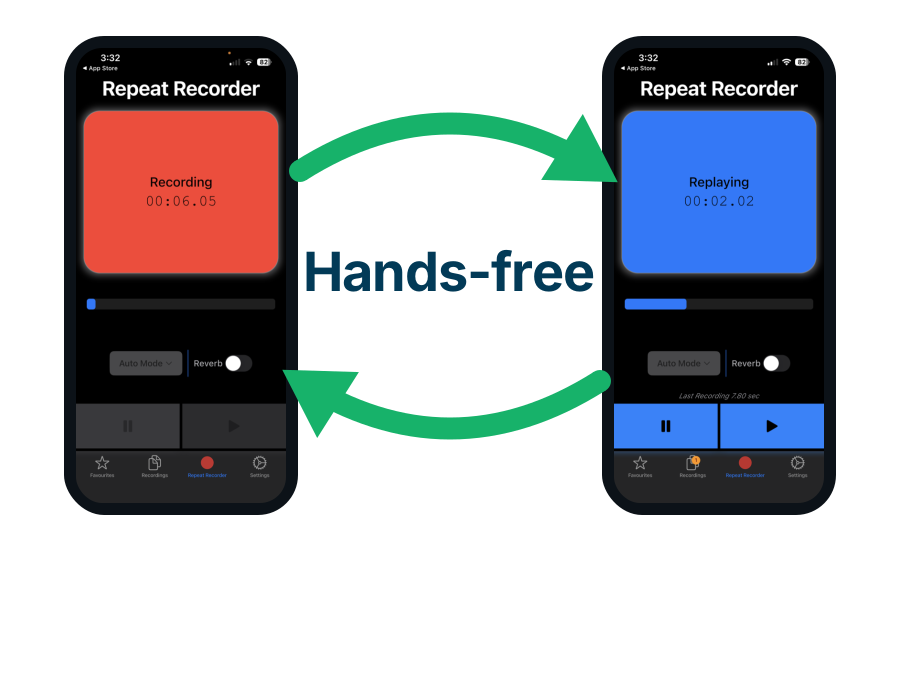
If you become notable first and the page follows, then the real task is not editing Wikipedia at all. It is persuading somebody independent to write about you, and that usually comes down to a couple of minutes of talking on a call, a voice note or a podcast. Almost nobody says their own pitch out loud before the moment it counts. Repeat Recorder, one of my own apps, records you and plays the take straight back without you touching the phone.
- Repeat Recorder replays each take automatically and then starts recording again, so you can run the same two-sentence pitch twenty times without picking the phone up. That hands-free loop is the whole app. It was built for speech rehearsal, language learning and vocal training, and a pitch is the same drill with higher stakes.
- Wikipedia wants significant coverage in multiple independent, reliable, secondary sources, so the only sentence that matters is the one you say to a stranger who has no reason to care. Every shortcut in this article fails at that same point. Nothing you write about yourself counts, so the work is entirely in making somebody else want to write it, and that starts with being able to explain the product in two sentences without stumbling.
- Takes worth keeping go into favourites and into folders you name yourself, which you can reorder by dragging. The version you use for a journalist and the version you use for a podcast host end up in separate folders, and you can play last month's attempt back before making this month's call.
Enforcement is uneven, and sources only have to exist
A fair objection: Wikipedia is full of thinly-cited articles, so how strict can it really be? The answer is that a badly-cited old article and a brand-new promotional one are treated completely differently.
- Notability is about whether sources exist, not whether they are cited. Wikipedia’s rule is explicit: a subject only needs suitable independent sources to exist in the world, not to be present in the article. So a genuinely notable subject can sit there with a terrible citation list, because the sources exist and nobody has added them yet. That is a cleanup problem, not a notability failure.
- Old articles are effectively grandfathered. “Notability is not temporary”: once a topic has had real coverage it stays notable forever, so old articles are not re-litigated when the coverage dries up. Many were created before today’s stricter standards and simply never get re-reviewed.
- Enforcement is a reactive volunteer effort, and it is swamped. There are over 7 million English articles and a tiny corps to watch them: around half a million are tagged “needs additional references”, the new-page review queue runs tens of thousands deep, and its oldest unreviewed article is eighteen years old. Low-traffic pages slip through and linger for years. That is not a low bar; it is a backlog.
- A brand-new, self-promotional article gets far more scrutiny than a grandfathered one. Your new page lands in the actively-patrolled new-pages queue, exactly where reviewers hunt for promotion and weak sourcing. The dusty old article nobody watches is not the situation you would be in.
- And “that bad article exists, so mine can too” is a known dead end. Wikipedia explicitly rejects “other stuff exists” as an argument; every article is judged on its own sources. The junk you see is not a precedent, it is a to-do list.
So the badly-cited pages are real, but they are survivors of lax historical patrolling, not proof that you can walk a new promotional article through today.
A smaller-language Wikipedia is easier and builds local authority
Now the sharp observation, and a real strategy. Some apps have no English Wikipedia article but do have one in, say, Vietnamese. That is not an accident.
- Every language Wikipedia is a separate project, with its own rules and a much smaller community. English Wikipedia is the strictest and most heavily patrolled. The Vietnamese edition has on the order of fifty times fewer active editors, and Thai around ninety times fewer, each with only a handful of admins. Thinner patrolling means an article is easier to get in, and easier to keep.
- A local-language article builds authority in that language and market, not globally. This connects to something covered elsewhere in this guide: language models store facts largely per language, AI answers localize by the user’s language and region, and Wikipedia feeds the knowledge graphs behind all of it. So a Vietnamese Wikipedia article makes you an established entity for Vietnamese queries and for Google-in-Vietnam, while doing little for English or global visibility.
- ELSA Speak is the real example, an app with a Vietnamese Wikipedia article. The AI English-pronunciation app has a Vietnamese Wikipedia article (fittingly, it even carries a “needs additional citations” banner) but no standalone English one, and its biggest markets are in Southeast Asia. Presence where its users actually search, in the language they search in.
- So it is a legitimate move if that market is yours. Rather than bounce off strict English Wikipedia, an app targeting Vietnam, Thailand or Indonesia can build a local-language entity where the bar is more attainable, and gain authority exactly where its users, and their AI assistants, are looking.
Two honest caveats: you still have to meet that edition’s own notability rules, usually with local-language sources, and it only helps that language and market, not English. The lesson is not “small Wikipedias have no standards”, they do, but they are more attainable, and a local-language entry is the right asset when your users are local. Build authority in the language your customers actually query in.
Use Camera to Clipboard to add a photo to a Wikipedia draft
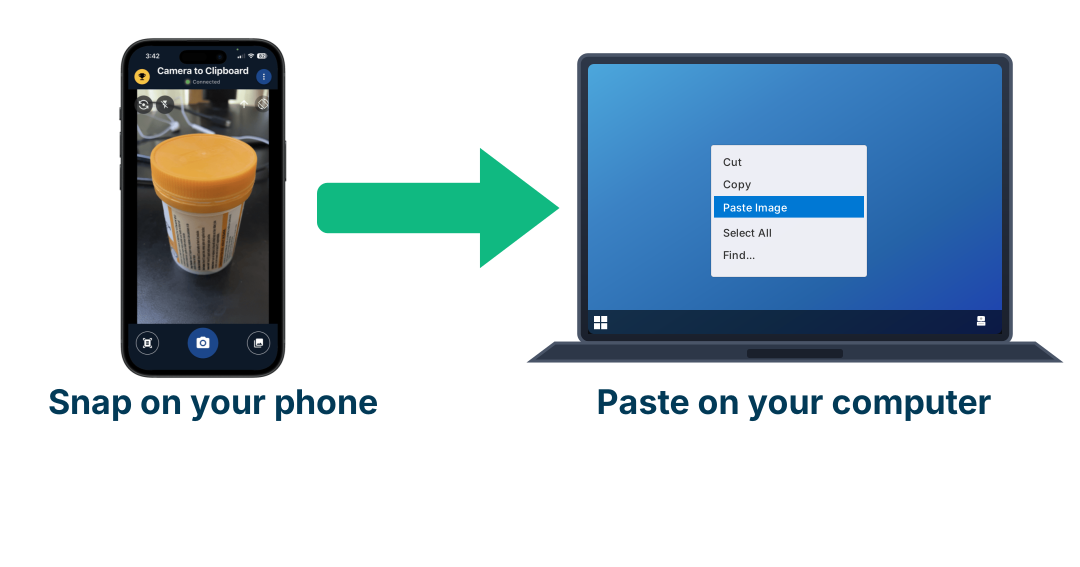
A local-language article is still an article somebody has to draft, and an entry about a product carries a picture of the product. That picture is almost always taken on a phone, and it then has to reach the computer the draft is being written on. Camera to Clipboard, another of my own apps, does that in one step.
- A photo you take inside Camera to Clipboard is ready to paste on your computer the moment you take it. There is no emailing it to yourself, no cable and no upload to somebody else's website in between. The phone and the computer find each other over your own local network and send the picture directly.
- The photo pastes into whatever you are drafting in, arriving as a new layer in Photoshop or GIMP and inline in Word or Google Docs. It arrives as an ordinary image sitting on the clipboard rather than as a file you have to go and find, so anything that accepts a pasted picture accepts this one, including the draft you are assembling before anyone else sees it.
- You can send several photos at once out of the phone's library, which is what you want when the same product has to be shot for a Vietnamese entry and for a press pitch. Wikipedia's own bar is independent coverage that already exists in the world, so the images you shoot are for the journalists and the local editions doing that covering, not for a page you write yourself.
A one-product account is a red flag, and there is no score
Two related instincts here, and both are half-right. There is no points score, but Wikipedia absolutely notices an account that exists only to write about one product, and the “build a track record then slip my article in” plan does not do what you hope.
- Wikipedia has no reputation score, but permissions unlock at fixed thresholds. Permissions are gated by simple rules, an account becomes “autoconfirmed” after 10 edits and 4 days, and “extended-confirmed” after 500 edits and 30 days, but there is no hidden points total. What actually happens is that reviewers read your contribution history: your edit count, your account age, and what else you have worked on.
- A single-purpose account is a recognised red flag. Wikipedia has a name for an account that exists to push one narrow topic, a “single-purpose account”, and it explicitly treats such accounts with less credibility, because it is fair to ask whether their edits are neutral. So yes: a brand-new account whose one and only article is its own product is exactly the pattern that trips conflict-of-interest, promotion and paid-editing scrutiny.
- But contributing a lot first does not fix the real problems. Say you spend months on genuine edits and then add your product article. You have softened the single-purpose flag, but you have not: made your product notable (that still needs independent coverage that either exists or does not); removed your conflict of interest (you are still expected to disclose it and to propose the article through the review process, not write it into place yourself); or escaped the paid-disclosure rule if money is involved. Every content rule stays in force no matter how committed you look.
- And “committed contributor sneaks in a promo article” is precisely what the scrutiny is tuned for. The article itself is still judged on its sourcing. A track record is a thin disguise over the same problem.
So the honest version is not a trick. If your product is genuinely notable, contribute honestly, disclose your connection, and propose the article through Articles for Creation so an independent editor assesses it. If it is not notable, no amount of edit history changes that. Contributing to Wikipedia is worth doing on its own merits; using it as camouflage is not.
Hired Wikipedia writers cannot fake notability
- Agencies really do sell we-will-get-you-a-Wikipedia-page services. Agencies and freelancers do sell “we will get you a Wikipedia page”. One firm, Wiki-PR, marketed to over 12,000 clients.
- It is only allowed with disclosure. Paid editing is permitted if the editor discloses their employer, client and affiliation. Undisclosed paid editing is banned outright, the Wikimedia Foundation calls it a “black hat” practice.
- No writer, however experienced, can manufacture notability. A paid editor can only help if independent, reliable coverage of you already exists. If it does not, they cannot conjure it, and the article gets deleted like any other.
- Wikipedia hunts paid sock-farms, and the 2015 Orangemoody case caught hundreds. Wikipedia actively hunts paid sock-farms. In 2015 the “Orangemoody” investigation blocked 381 accounts and deleted more than 200 articles, an operation that had posed as Wikipedia editors and extorted businesses to “publish and protect” their pages. In 2013 Wiki-PR had roughly 250 accounts blocked, the firm and its staff banned, and a legal cease-and-desist, which is what prompted the mandatory paid-disclosure rule in the first place.
- So the calculus for a small app: a disclosed, honest paid editor can save you effort if you are already notable; an undisclosed or bargain “Wikipedia service” is a fine way to pay for an article that gets deleted and your accounts blocked, exactly the money-for-a-deletion-log outcome.
The through-line, one more time: Wikipedia’s value is precisely that it is hard to place yourself into, and every workaround, single-purpose accounts, track-record camouflage, paid writers, runs into the same wall. You cannot buy or fake the independent coverage that notability requires. Earn it, and the page is straightforward. Do not, and every shortcut ends the same way.
Conclusion: a Wikipedia page must be earned, not written
- Wikipedia needs significant coverage of your product in multiple independent, reliable, secondary sources. That one requirement decides everything else on this page. Your own site, your press releases, your App Store listing, Trustpilot, Quora and LinkedIn are all either user-written, self-published or your own promotional material, so stacking five of them together gives you zero qualifying sources rather than five.
- Wikipedia’s 2015 Orangemoody investigation blocked 381 accounts and deleted more than 200 articles. Wiki-PR had roughly 250 accounts blocked in 2013, its staff banned and a legal cease-and-desist, which is what produced the rule that paid editing must be disclosed. A hired writer can only help you if independent coverage already exists, because nobody can manufacture it.
- Get genuine independent press coverage first, then let somebody unconnected to you create the Wikipedia page. A real entry is arguably the best AI asset you can own for ChatGPT, which leans heavily on Wikipedia, though it barely moves Google’s AI Overviews and does almost nothing on Perplexity. In the meantime a Wikidata entry has a far lower bar, and a smaller-language edition such as Vietnamese is genuinely more attainable when that market is where your customers already are.