
Every ad you consciously recognise as an ad is already fighting uphill, because the moment somebody files a message as advertising they start discounting it. Stealth marketing is the whole family of techniques that get the message in before that filter closes. What it hides is the advertiser, never the product. The product is on full display in all six types, because the product is the message, and the thing kept out of sight is that somebody paid for you to meet it. There are six types, and every tactic you will read about elsewhere is a variation living inside one of them. This is what each one is, how it actually works, what it costs, how fast it pays, and where the genuinely ambiguous edges are. I build small apps (Repeat Recorder, Paint Vlix, Camera to Clipboard), so I care mostly about the three types a person with no media budget can run alone, which happen to be the first three.
Not legal advice. Where a technique sits in a grey area I say so and explain what makes it grey, but how it resolves for you depends on where you are, what you say and who you say it to. Treat anything marked grey below as a prompt to get proper advice, not as a ruling.

The six types of stealth marketing
Three of the six you can run yourself with no budget. Three of them need somebody else, and cost more than money.
| Type | How it works | What it costs you | How fast it pays | Where the grey area is |
|---|---|---|---|---|
| 1. Product placement | Put the product inside a scene people were already going to watch or walk through | Placement fees or nothing at all in your own space | Months it builds over repeated exposures | Only in staged stunts when people pose as bystanders |
| 2. Watermark and logo seeding | Repeat one distinctive mark across everything you make until it feels familiar | Almost nothing design time and a bit of discipline | Very slow many months before it registers | None it never makes a claim to be false |
| 3. Content marketing | Publish something genuinely useful, written or filmed, that features the product as the answer | Your own time and nothing else | Months to rank then it earns forever | Only if you obscure whose product it is |
| 4. Astroturfing | Manufacture a crowd of accounts that appear to independently agree with you | Cheap to start and ruinous once it surfaces | Days and it unravels just as fast | Illegal when it praises. Grey if it only names. |
| 5. Fake and incentivised reviews | Buy, write or filter the ratings people check right before they decide | A few dollars each plus the platform ban risk | Immediate the listing lifts the same day | Clearly illegal |
| 6. Undisclosed sponsorship | Pay somebody the audience already trusts, and let it read as their own opinion | Creator fees the biggest cash line of the six | Days a single post can move numbers | Illegal. Grey with a soft credit like powered by or inspired by. |
Sort by how fast it pays and the trade jumps out. The three fast types are the three that stop working once anyone looks closely, and the three durable ones are all slow. There is no type that is both quick and permanent, which is the real reason small brands end up doing content.
Stealth by delivery is legal, stealth by concealment is not
The six fall into two families, and the split is the entire legal line:
- Stealth by delivery, types 1 to 3. The message does not arrive in an ad-shaped container. A film scene, a mark on a wall, a guide somebody searched for. Nothing is concealed, so these stay stealth even with the brand credited in full, and all three are legal.
- Stealth by concealment, types 4 to 6. The message arrives from a source the audience believes is independent. An invented account, a bought review, a paid post that reads as a personal opinion. These stop being stealth the moment the source is named, which is exactly why they are illegal.
The proof is where the first three go grey. Product placement drifts only when somebody in the stunt poses as an unconnected member of the public, and content marketing drifts only when you publish it from an unbranded account. Both are the moment a delivery technique borrows a concealment move, which is also why undisclosed sponsorship counts as stealth at all. The sponsor talks about the product openly. What nobody sees is the invoice.

How to tell if a campaign is clean, grey or illegal
Set the five things that determine how a campaign lands if somebody pulls on the thread.
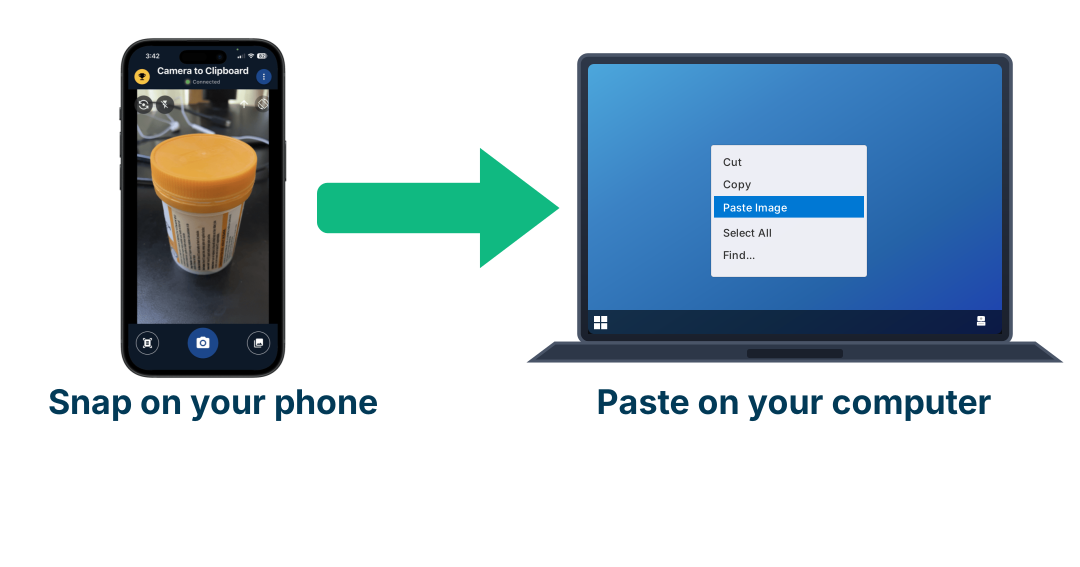
Use Camera to Clipboard to show your product doing its job
The five toggles above all resolve the same way. What puts a campaign in trouble is hiding who is speaking, never the product itself, so the safest version of every type on this page is a picture of your own product doing the thing it does, published under your own name. Making that picture means photographing something with a phone and then needing it on a computer, and Camera to Clipboard, one of my own apps, turns that into a single step.
- A photo you take inside Camera to Clipboard is on your computer's clipboard by the time you put the phone down. There is no emailing it to yourself, no cable and no upload to somebody else's website in between. The phone and the computer find each other over your own local network and send the picture directly.
- Pasting into Photoshop or GIMP drops the photo in as a new layer or a new document, and Word and Google Docs take it inline. It arrives as an ordinary image sitting on the clipboard rather than as a file you have to go and find, so anything that accepts a pasted picture accepts this one.
- Stealth marketing hides the advertiser and never the product, which makes a photograph of the product working the one asset you never have to be careful with. You can send several shots from the phone's library at once as well, so six angles of the same object arrive together and you pick the one that reads fastest.

Type 1: Product placement
Product placement means the product appears inside content or inside a space, doing its normal job, rather than being pitched. It takes three shapes:
- The classic placement is a product used in a film, show or video. A product used in a film, a show or a video. The carrier is the story, and the product borrows its ordinariness. Nobody demonstrates it, somebody just uses it.
- The ambient placement puts the product into a real space or app, not a story. A product placed in a physical or digital environment, an event, a public space, an app, so people meet it as part of the furniture rather than as content they chose to watch.
- The engineered placement is staged specifically so somebody films it. The placement staged specifically so it gets filmed and shared, with the brand’s involvement delayed until the thing is already spreading on its own.
How to run it when you are small, because the film version is not available to you:
- Every tutorial, demo or screenshot you publish is a placement opportunity. Every tutorial, demo or screenshot you publish is a placement opportunity. Show the product doing the task rather than describing itself.
- Trade placement instead of buying it. Small creators will feature a tool in the background of a workflow video for free access, which is the same mechanic at a thousandth of the price.
- A placement only works if the viewer can see what the product does. A placement only works if the viewer can tell what the thing does from watching it happen. A logo on a mug teaches nothing.
Where it goes grey: the engineered stunt. Staging a scene is fine, and delaying the reveal is fine. It stops being fine at the point where somebody involved is presented as an unconnected member of the public, because you have moved from delaying the reveal to actively faking the relationship, which is Type 6 in a wig.

Type 2: Watermark and logo seeding
Recurring branding with no call to action and no claim: a decal, a vehicle wrap, a filter, a watermark, a mark on a surface people walk past. It builds familiarity through exposure rather than argument, which is a genuinely different mechanism to everything else on this list.
- Inside content or inside a space, it works identically. Passive recurring exposure, never an active message, which is why the location does not change how you should think about it.
- A logo or watermark compounds with every impression and never expires. Every impression makes the next one land slightly harder. Nothing else here has that property, and it is why the technique survives decades of fashion changes.
- A distinctive mark gets photographed and shared before anyone knows the brand. A distinctive enough mark gets photographed and shared before anyone knows which brand is behind it, which is the same delayed reveal as an engineered placement, at no cost.
How to run it:
- Pick one logo or watermark and never change it, because a redesign resets the count. The entire mechanism is repetition, so a redesign resets the counter. Consistency beats quality here by a wide margin.
- Put it where the same people pass repeatedly. One wall that a thousand people walk past daily beats ten walls that a hundred people pass once.
- Keep the mark silent, because adding a slogan turns it back into an ad. The moment you add a slogan or an offer you have converted it into an ad and lost the thing that made it work.
Where it goes grey: nowhere, really. This is the one type with no ambiguous edge at all, because it never makes a claim that could be false and never speaks in anybody else’s voice. That is also why it is the slowest.

Type 3: Content marketing
Anything genuinely worth reading or watching that features a product as the answer. A how-to, a comparison, a teardown, a case study, a tutorial video, a walkthrough, a story about how you solved something. The format is wide open and it is not only writing, which is why this is the type most people do not realise is stealth marketing at all. The carrier is a search result, a feed or a recommendation, and the audience arrives wanting the information rather than braced for a pitch. It splits into two forms.
Your own product needs no label at all
When it is your product, published under your own name or brand, nothing has to be added:
- The connection is already apparent. The reader can see whose site they are on. Nothing is being obscured, so there is nothing to announce.
- Softening the wording of a recommendation does not make it a disclosure. Writing “I use this to solve X” instead of “I recommend this” is a style choice, not a dodge. What matters is whether the relationship is visible, not which verb you picked.
- Content marketing only works if the piece is worth reading without the product. The piece has to be worth reading or watching if the product vanished from it. That is the bar, and it is also what makes it rank.
This page is the technique. It promotes my apps, it says so openly, and it would still be worth reading if it did not.
Somebody else paying you needs one visible label
The second form is being paid, gifted or otherwise compensated by another brand to feature their product:
- One disclosure label, placed before the content, is all the law asks for. “Sponsored”, “paid partnership”, “affiliate link”. The words matter less than whether somebody skimming sees them before they read.
- Compensation includes things that are not money. A free product, a discount, a trip, an early unit, an affiliate cut, a shareholding. All of it counts as a relationship.
- The label costs you almost nothing in performance. This is the part people get wrong. Readers who were going to act still act, and the ones who would have felt tricked never find out they were.
Where it goes grey: soft credits. “Powered by [Brand]” and “Inspired by [Brand]” name the brand but read as a tool credit rather than a paid relationship, so they sit in the middle. The brand is named, the money is not. Also grey is running the same content from an unbranded personal account, which quietly removes the one thing that made the first form clean.
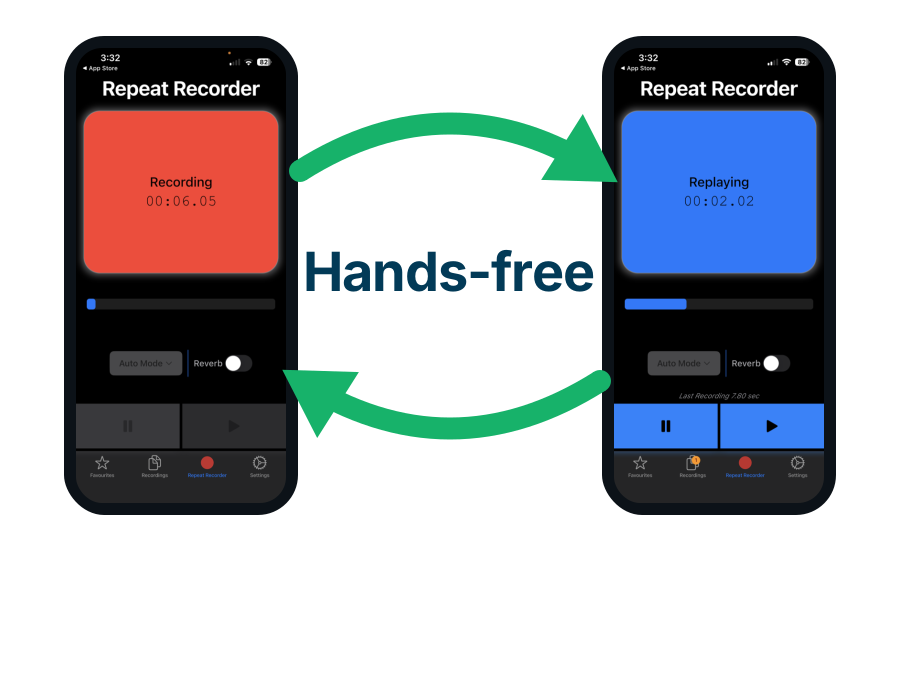
Use Repeat Recorder to rehearse the narration of a walkthrough
Content marketing is the one of the six types a person with no media budget can run alone, and the list above puts tutorial videos and walkthroughs next to written pieces rather than treating writing as the whole format. The filmed version is where most people stop, because a paragraph can be revised quietly and a spoken sentence cannot. Repeat Recorder, another of my own apps, records you and plays the take straight back without you touching the phone.
- Repeat Recorder plays each take back automatically and then starts recording again, so you can run the same sentence twenty times without picking the phone up. That hands-free loop is the entire app. It was built for speech rehearsal, language learning and vocal training, and talking your way through a product walkthrough is the same job with different words.
- Content marketing only works if the piece is still worth watching once the product is removed, and in a walkthrough that is decided by what you say over the screen. The footage is usually fine. What sinks a walkthrough is forty seconds of throat-clearing before the viewer learns what they are about to see, and hearing your own opening played back is what catches it.
- Takes worth keeping go into favourites and into folders you name yourself, dragged into whatever order you want. Two wordings of the same explanation end up side by side, and picking the better of two recordings takes about a minute.

Type 4: Astroturfing
Astroturfing borrows the most powerful carrier available, which is other people apparently agreeing with each other. The name is the joke: fake grass where a real grassroots movement should be. It shows up in three forms:
- Sock puppets are invented accounts that argue for the product and never say who runs them. Invented accounts that argue for the product, upvote it and defend it, never mentioning who runs them.
- Comment and forum seeding. Employees or paid agents posting in communities as ordinary members. The most common form, because it feels too informal to count.
- The fabricated experience is a made-up “I tried this and here is what happened” story. This is the version that escalates everything, because now there is an invented event as well as an invented person.
Why it worked, and why it mostly does not any more:
- Astroturfing scaled because one person with forty accounts could move a rating. One person with forty accounts could move a rating or a thread, which is exactly why it became popular and exactly why it became a target.
- Platforms now detect coordinated posting patterns automatically and cheaply. Platforms now run automated authenticity systems, and coordinated posting patterns are far easier to spot than individual fake posts. Getting caught is no longer a rare accident.
- One screenshot outlives the campaign. A sock puppet exposed once poisons every genuine thing the brand says afterwards, which is a cost no other type on this list carries.
- Astroturfing is now aimed at AI assistants rather than at people. The same mechanic is now aimed at the assistants rather than at people, which I cover in how people game AI answers, and the platforms are hunting it there too.
Where it stands: astroturfing is illegal, and it is at its clearest when the planted account says something good about the product or says something untrue about it. Praising your own product in a stranger’s voice is a false representation about who is speaking, and misrepresenting who is speaking is exactly what consumer law is written about. Lying about the product on top of that is a second breach stacked on the first.
Where it goes grey: naming the product without praising it. An account that answers a question with a bare product name, no claim attached and nothing overstated, is much harder to call a false representation, so it drifts toward the grey. It still leans illegal, because the account is still presenting itself as unconnected, and it is done constantly, which is the reality rather than a recommendation. The same grey covers an employee who genuinely uses the product and posts under their real name without mentioning where they work. One sentence in the bio resolves both.
A clever example of astroturfing framed softly as a rant
A post in r/VoiceActing titled The Industry is Cooked, flaired as a Saturday shitpost, at 208 upvotes. Read once it is a rant about AI voice cloning killing the trade. Read twice it is a recruitment pitch for the programme it is complaining about, aimed at the people that programme needs, because a voice marketplace has nothing to license until voice actors opt in.

Where it sits: grey, not illegal. Nothing in the post is false and it only names the product rather than praising it, which is the grey wording described just above. What keeps it out of the clear is an account that reads as unconnected. Nobody can prove who typed it either, and that is the point rather than a gap, because a placed post and a real one look identical from outside.

Type 5: Fake and incentivised reviews
Reviews are the highest-leverage carrier that exists, because people check them at the exact moment they are deciding. That is why this type is attempted more than any other and why it is policed harder than any other. It has four forms:
- Bought reviews mean paying strangers to write positive ones, or negative ones about a rival. Paying strangers to write positive ones, or a competitor’s negative ones.
- Insider reviews are written by staff, founders or friends who do not say so. Staff, founders or friends writing them without saying who they are.
- Incentivised reviews trade a discount or free product for a review, unmentioned. A discount or a free product in exchange, with the exchange left unmentioned.
- Review suppression means filtering out bad reviews or never inviting unhappy customers. Filtering out the bad ones, or quietly not inviting the unhappy customers. This is the form that has produced the largest penalties, and the one people least expect to be treated as a breach.
Where it stands: clearly illegal, in all four forms, with no interesting ambiguity anywhere in it. Buying reviews, writing them as an insider, trading them for a discount without saying so, and filtering out the bad ones are all straightforwardly prohibited, and since 2024 they have named rules of their own rather than sitting under general consumer law. Of the six types this is the only one with nothing to weigh up.
The nearby thing that is fine: asking happy customers to leave a review. Asking is ordinary and always has been. It drifts once you only ask the happy ones, and it is illegal once you filter the results. The clean version is to ask everybody at the same moment in the same way, and take what comes.

Type 6: Undisclosed sponsorship
The biggest type by spend, and the one worth reading carefully, because all six disguises are a single move. In each of them, a paid, gifted or ownership relationship is presented as if it were independent:
- The influencer post uses a product without saying it was gifted or paid for. Using or mentioning a product without saying it was gifted or paid for. The default failure mode of the entire creator economy, usually through carelessness rather than intent.
- The unboxing presents a stash of gifted product as a personal shopping trip. Stronger than a single post because the format itself implies somebody chose to buy all of it.
- The street team is paid actors posing as ordinary customers in public. Actors or reps posing as ordinary customers in bars, shops and streets, talking up a product to people who think they are meeting a stranger.
- The paid expert is a doctor, scientist or other credentialed figure endorsing a product without saying they were paid.
- The fake reviewer persona. A how-to or comparison where a hired promoter never mentions the fee, or the product’s own owner writes as an “independent reviewer”.
- The disguised advertorial. Content built to mimic a publisher’s own editorial format, same layout, same tone, same section, with no label. A fitness site runs staff-written pieces like “Best Protein Powders We Tested”; a supplement brand pays for an identical-looking article in the same section; readers assume it is the site’s independent verdict.
Where it stands: with no label at all, this is illegal. A paid or gifted relationship presented as an independent opinion is the precise thing disclosure rules exist for, and all six disguises are the same breach wearing different clothes.
Where it goes grey: the softer wordings. “Powered by X” and “Inspired by X” never say ad and never say paid, but they do put the brand in front of the reader before the content starts. That is genuinely less deceptive than saying nothing, which is why so much sponsored content now uses it, and it lands in the grey rather than clearly on either side. The brand is named, the money is not. Adding one plain word next to the credit costs nothing and takes it out of the grey completely.
The paid expert is the strongest disguise and the most fragile
Of the six disguises, the credentialed one is worth separating out:
- A paid expert persuades through the credential, not through the argument. A doctor’s recommendation works because the audience believes it comes from professional judgement, so it converts far better than an ordinary endorsement.
- A paid expert's whole effect collapses the moment the payment surfaces. The whole effect depends on the audience believing the judgement is independent. When the payment surfaces, the endorsement does not weaken, it inverts.
- Undisclosed expert endorsement clusters in health and finance, where stakes are highest. Health and finance, which is why it draws more scrutiny than any other disguise and why professional bodies get involved alongside anyone else.
A disclosed expert opinion keeps almost all of the persuasive power. “I was paid by X to look at this, and here is my honest assessment” is a sentence that costs you very little and removes the entire downside.
If you are approaching creators directly, the practical point is that the label belongs in your brief. Left to the creator it gets forgotten, and it is your campaign that wears it.

Examples of real life stealth marketing campaigns by big companies
The same six types, in the wild, across twenty-five years.
| Campaign | Which type | What happened | What it cost | Would it work today |
|---|---|---|---|---|
| Sony and David Manning, 2001 | Type 6, a fabricated reviewer | Sony invented a film critic and quoted him in its own posters for months | $1.5m settlement plus a state fine and two suspensions | No an invented byline is checked in minutes |
| Sony Ericsson fake tourists, 2002 | Type 6, a street team | 60 actors across 10 cities asked strangers to photograph them with a new phone | Nothing it predated the disclosure rules entirely | In a changed form the same stunt, openly branded |
| Whole Foods and Rahodeb, 2007 | Type 4, a sock puppet | The chief executive talked up his own company on a message board for eight years | Nothing an inquiry closed, the reputation did not | No pseudonyms get unmasked, not maintained |
| Samsung in Taiwan, 2013 | Type 4, paid commenters | Students were paid to attack a rival phone and praise Samsung in forums | About NT$10m from the local regulator | No coordinated posting is what detection targets |
| Bell Canada app reviews, 2015 | Type 5, insider reviews | Staff were encouraged to post positive app store reviews and ratings | $1.25m settlement with the competition regulator | No stores link employee devices and accounts |
| Warner Bros and Shadow of Mordor, 2016 | Type 6, paid creators | Paid YouTube coverage, including the biggest channel of the era, disclosed below the fold | Nothing an order, and a very public bad week | Yes identical campaign, label at the top |
| Lord and Taylor paisley dress, 2016 | Type 6, an influencer drop | 50 creators posted the same dress on the same day, none of them labelled | Nothing an order, and the textbook teaching case | Yes this is now a standard labelled drop |
| Meriton and TripAdvisor, 2018 | Type 5, review suppression | Unhappy guests were quietly left off the list that got review invitations | $3m penalty ordered by the Federal Court | No invitation patterns are visible to platforms |
| Sunday Riley Sephora reviews, 2019 | Type 5, insider reviews | Employees wrote reviews at the chief executive’s direction for two years | Nothing an order only, on a split vote | No insider reviews now have a named rule |
| Fashion Nova review filtering, 2022 | Type 5, review suppression | Every review below four stars was hidden from the product pages | $4.2m penalty the largest of the modern cases | No rating distributions give it away instantly |
Sort by whether it would work today and the pattern is stark. Only the two campaigns that a label would have fixed are still viable, and they are viable precisely because the underlying idea was fine and only the presentation was wrong. Everything built on an invented person or a filtered number is now simply broken as a technique, independent of anyone enforcing anything.
Use Camera to Clipboard to put a phone screenshot into a post
The campaigns in that table that would still work today are the ones where the thing being shown genuinely existed and only the credit was missing. The everyday version of showing something that genuinely exists is a screenshot: the app mid-task, the result, the invoice. Screenshots pile up on a phone while the post is being written on a computer, and Camera to Clipboard, one of my own apps, moves them across without a cable or an email to yourself.
- You can send several screenshots out of the phone's library at once rather than one at a time. That is the version you want when a post needs a before and an after, or when three screens of the same task have to arrive together and stay in order.
- Nothing leaves your own network on the way, because the phone and the computer talk to each other directly rather than through a third party service. No account, no upload, no copy of your screenshots sitting on somebody else's server waiting to be deleted.
- Only the two campaigns a disclosure label would have fixed are still viable, and both of them showed something real. A screenshot is the cheapest way to show something real, and it pastes wherever you are writing, as a new layer in Photoshop or inline in Word and Google Docs, because it arrives as an ordinary clipboard image.

A disclosure label costs almost nothing in performance
Almost every problem in this article is fixed by one sentence saying who you are, so it is worth knowing which sentences actually work. A disclosure label is judged on two things: whether it names the relationship, and whether somebody skimming still sees it before they read.
| Label | Names the relationship | Seen before the content | How readers take it | Verdict |
|---|---|---|---|---|
| Paid partnership tag | Yes and it names the brand too | Yes above the post, drawn by the platform | Understood instantly it is everywhere now | Use this the hardest to argue with |
| Ad at the start of a caption | Yes universally understood | Yes ahead of the truncation point | Understood instantly and barely noticed | Use this short and unambiguous |
| Sponsored | Yes plain English, no decoding | Yes when placed up front | Understood instantly the default term | Use this works on any format |
| Advertisement on an article | Yes the strongest word there is | Yes above the headline | Understood instantly and expected | Use this for any native placement |
| Nothing, on your own brand account | Not needed the account is the label | Yes the handle is right there | Understood instantly nobody is surprised | Fine nothing to add here |
| Gifted | Partly implies free, not paid | Yes normally up front | Mostly understood stronger in the UK | Add to it pair with a clearer word |
| Thanks to X for sending this | Partly implies a gift indirectly | Yes usually the opening line | Mostly understood friendly but vague | Add to it warm, and imprecise |
| Affiliate note in the page footer | Yes the wording is usually right | No below everything it applies to | Rarely seen the decision is already made | Move it above the first link |
| Ad buried after five hashtags | Yes the word itself is fine | No lost in the tail | Rarely seen nobody reads hashtag stacks | Move it same word, first position |
| sp or spon | No an abbreviation of a disclosure | Yes usually placed early | Not understood most readers cannot decode it | Replace it abbreviating defeats the point |
| Powered by X | No reads as a tool credit | Yes normally prominent | Not understood as a commercial relationship | Grey area replace it with a plain label |
| Inspired by X | No suggests no relationship at all | Yes normally prominent | Not understood it reads as creative credit | Grey area replace it, the weakest here |
Every failing row fails on placement or vocabulary, never on intent, and two of the three fixes are the same word moved to the top of the caption.
Conclusion: the six types of stealth marketing in one glance
- Six types cover everything called stealth marketing. Product placement, logo seeding, content marketing, astroturfing, fake reviews and undisclosed sponsorship. Everything else you will read about is a variation inside one of those six.
- Stealth by delivery is legal, stealth by concealment is not. Product placement, logo seeding and content marketing conceal nothing, stay legal fully credited, and take months to pay. Astroturfing, fake reviews and undisclosed sponsorship work only while the source stays hidden, which is what makes them both fast and illegal.
- One sentence naming your connection to the brand resolves nearly every case here. Placed before the content rather than after it, a disclosure costs you almost nothing in performance, and it is the whole difference between a campaign you can keep running and one on a timer.