
The star rating next to a business in Google Search and Google Maps is the first thing a local customer reads, and one angry review can move it by a third of a star overnight. This page works through every option a business actually has: getting the review taken down, wiping the slate clean and starting again, replying to it, and outnumbering it. Each option is measured against what Google publishes, so it is clear which ones work and which ones are wasted effort.
The short version. Google removes a review only when it breaks a written rule, and its policy says in plain words that an honest bad experience is allowed to stay. There is no reset button either, because deleting your Business Profile deletes your own photos and replies and keeps every review. What is left is replying and outnumbering, and both are measured below.
Enter your rating, every rating you hold below 5 stars, and the rating you want back. The calculator says how many perfect 5-star reviews close the gap, and next to it what the same job takes when one in every eight new reviews is a 4 instead.

Understand that your Google score is a plain average of every rating you have ever received
Google publishes how the number is worked out, and it is simpler than most owners expect.
- Google's own help page states that the review score is the average of all ratings published on Google for that place or business.
- A rating left six years ago counts exactly as much as one left this morning, because nothing in that average makes an old rating count for less.
- A star rating with no words written beside it counts exactly as much as a detailed review, because the average is taken from the stars and not from the text.
- Google shows your score rounded to one decimal place, so a true average of 4.449 appears as 4.4 and 4.451 appears as 4.5.
- A new rating can take up to two weeks to change the score shown on your profile, so today's number is not always current.
Every option later in this page is really an attempt to change one of the two numbers in that average, the total of the stars or the count of the ratings.

Work out your own damage, because one 1-star review costs 0.36 stars at 10 reviews and 0.02 at 200
The same bad review does completely different amounts of damage to two different businesses, and the difference is not fairness. It is arithmetic.
- A business holding a perfect 5.0 from 10 ratings drops to a displayed 4.6 the moment one 1-star rating lands.
- That identical 1-star rating on a business holding 5.0 from 200 ratings moves the true average to 4.98, and the profile still displays 5.0.
- Getting a displayed 5.0 back after one 1-star rating takes 69 further 5-star ratings if you only had 10 ratings to begin with.
- Five 1-star ratings in one week take a business holding 4.9 from 30 ratings down to a displayed 4.3, and undoing that takes 119 further 5-star ratings.
- The number of ratings you already hold is the only thing that decides how much a bad one hurts, because the average divides by exactly that number.

Know that one whole star of average rating is worth 5% to 9% of an independent business's revenue
The link between a star rating and money has been measured against tax records rather than guessed at from survey answers.
- A Harvard Business School study matched Yelp ratings against Washington State restaurant tax records and found that lifting a restaurant's average rating by one whole star leads to a 5 to 9 percent increase in revenue.
- That revenue effect appeared only at independent restaurants, and chain restaurants showed no revenue change at all when their average rating moved.
- The study could measure cause rather than a pattern because Yelp displays a rounded rating, so two restaurants either side of a rounding line were almost identical in quality but showed a different number of stars.
- Google rounds to one decimal place in the same way, so the single rating that pushes your true average from 4.45 down to 4.44 changes the number every customer sees.
- A 0.36 star drop in your average rating is worth between 1.8% and 3.2% of an independent business's revenue, using that study's own range.

Accept that 68% of customers will not use a business rated under four stars
BrightLocal's 2026 Local Consumer Review Survey asked 1,002 adults in the United States what they do with the star rating, and the thresholds are sharp rather than gradual.
- 97% of consumers read online reviews for local businesses.
- 68% of consumers need a business to hold at least 4 stars before they will use it, and 31% need at least 4.5 stars.
- 47% of consumers will not use a business that holds fewer than 20 reviews, whatever its star rating is.
- 74% of consumers only read reviews written in the last three months.
- 89% of consumers expect the business to reply to their review, and 19% expect that reply on the same day.
The last two of those are the reason the repair options at the end of this page work at all.

Report a review only if it breaks a written Google rule, because Google will not judge who was right
The reporting tool is not an appeal to a referee. Google states its own limits on the same help page that explains how to use it.
- Google's help page says in writing not to report a review just because you disagree with it or dislike it.
- Google states that it does not get involved in conflict between businesses and customers, so it will not decide whether the customer's account of the job is accurate.
- You are allowed to report any review, but Google only removes the ones that break its published content rules.
- A report that cannot name the rule it breaks comes back marked "Report reviewed, no policy violation" and the review stays where it is.
- Google also says its automated spam detection occasionally removes legitimate reviews by mistake, which is worth knowing when a good review disappears.

Check your bad review against the list of what Google removes and what it leaves alone
Google's prohibited and restricted content policy for Maps is the whole list, and most complaints from business owners fall in the bottom half of this table rather than the top.
| What the review contains | The Google rule that covers it | Chance Google removes it | What to do about it |
|---|---|---|---|
| Accuses you of theft, fraud or a crime with nothing to back it up | Offensive content bans unsubstantiated allegations of unethical behavior or criminal wrongdoing | High, the wording is banned by name | Report it and quote the accusing sentence |
| Written by somebody who was never a customer | Fake Engagement bans content not based on a real experience | High, if you can show they never came | Report it as fake and give the dates you have |
| Names a staff member or prints somebody's phone number | Personal information bans posting personal information without consent | High, this is a straight breach | Report it as a privacy problem |
| Swearing used to attack you rather than to describe the job | Obscenity and profanity bans profanity used to emphasise criticism | High, profanity is banned by name | Report it as profanity |
| The same wording posted again from several accounts | Repetitive content bans the same content posted multiple times from multiple accounts | High, the pattern is the evidence | Report every copy, not just one of them |
| A political speech or a general rant with no visit in it | Off-topic bans general, political or social commentary and personal rants | Medium, it turns on how it is written | Report it as off-topic |
| A rival's phone number or website pushed into your reviews | Advertising and solicitation bans promotional content and links in reviews | Medium, clear breach but often missed | Report it as advertising |
| Written by a competitor who has never bought from you | Rating Manipulation bans content based on a conflict of interest | Medium, the rule is clear and the proof is hard | Report the whole cluster, not one review |
| An angry but truthful account of a job that went wrong | No rule covers it, and Offensive content allows it in writing | None, Google allows this on purpose | Reply to it in public and fix the cause |
| A 1-star rating with no words written next to it | No rule covers a bare rating, because there is no text to break one | None, nothing in it can breach a rule | Outnumber it, and report a sudden run of them |

Accept that a truthful bad review is allowed by name in Google's own written policy
This is the sentence that decides most cases, and it sits inside the rule people usually quote when they want a review taken down.
- A customer describing a genuinely bad experience politely is doing the exact thing Google's policy protects, so no report will remove it.
- Google's own advice page tells business owners that negative reviews are not always a sign of poor service and can highlight areas for improvement.
- A mix of positive and negative reviews is described by Google as feeling more trustworthy to a customer than an unbroken run of praise.
- Strength of feeling is not a rule breach, so a furious review written about a real visit stays and a calm review inventing a crime does not.

Report a review that accuses you of a crime, because Google's rules do remove that wording
Of everything in the policy, one line is worth more to a business than the rest put together, because it catches the reviews that do the real damage.
- Google's offensive content rule bans "unsubstantiated allegations of unethical behavior or criminal wrongdoing" in exactly those words.
- Sentences such as "they stole from me", "this is a scam" and "they are ripping people off" are accusations of wrongdoing, and a reviewer almost never supplies proof of one.
- Sentences such as "the job was three weeks late" and "the final price was double the quote" describe an experience, so they stay however much they hurt.
- The dividing line is an accusation of wrongdoing without evidence, and not how angry the review sounds.
- Quote the accusing sentence in your report rather than describing the review, because the person assessing it is checking one line against one rule.

Go back through your old reviews, because Google sets no deadline for reporting one
A business that has never checked its reviews usually assumes the old ones are settled and only the recent ones are still in play. Nothing in Google's rules says that.
- Google's help pages set no time limit for reporting a review, so a review posted five years ago can be reported on the same form as one posted this morning.
- A rating from any year still counts in full towards your score, because the average has no rule that makes an older rating count for less.
- Proving that a reviewer was never a customer gets harder every year, because the invoice or booking sheet that proves it has to still exist.
- The legal route does expire, and the United Kingdom allows one year from publication to bring a defamation claim.
- Every country sets its own defamation deadline and the United States sets one state by state, so an old review can be past suing over while it is still worth reporting to Google.
- An old review costs you less with readers than a new one anyway, because 74% of consumers only read reviews written in the last three months.
Reading the whole history in one sitting is therefore worth doing once, because the only thing that has run out on an old review is the evidence you can still find for it.

Use the Reviews Management Tool, because it is the only place that shows what Google decided
You can flag a review straight from your profile, but flagging it there gives you no way to find out what was decided.
- Google's Reviews Management Tool lists every review you have reported and shows the current decision on each one.
- "Decision pending" means the review is flagged and nobody has assessed it yet.
- "Report reviewed, no policy violation" means it has been assessed and Google decided the review stays.
- "Escalated, check your email for updates" means your appeal is with a second assessor and the answer arrives by email.
- Google says assessing a report typically takes several days, so a review still showing after an hour has not been refused.

Appeal once, because Google gives you exactly one appeal for each review you report
The appeal is a second and final assessment by a different person, and there is no third one.
- Google describes the appeal as a one-time appeal, so a review refused twice is finished as far as Google is concerned.
- You can put up to 10 reviews into a single appeal, which matters when a run of fake reviews arrives together.
- Only a review already reported and refused is eligible to be appealed, so the report always comes first.
- Spend the appeal on the strongest review rather than the most upsetting one, because a refused appeal cannot be reopened.
- Reviews removed for breaking a policy are never restored, which cuts the other way when one of your good reviews is taken by mistake.
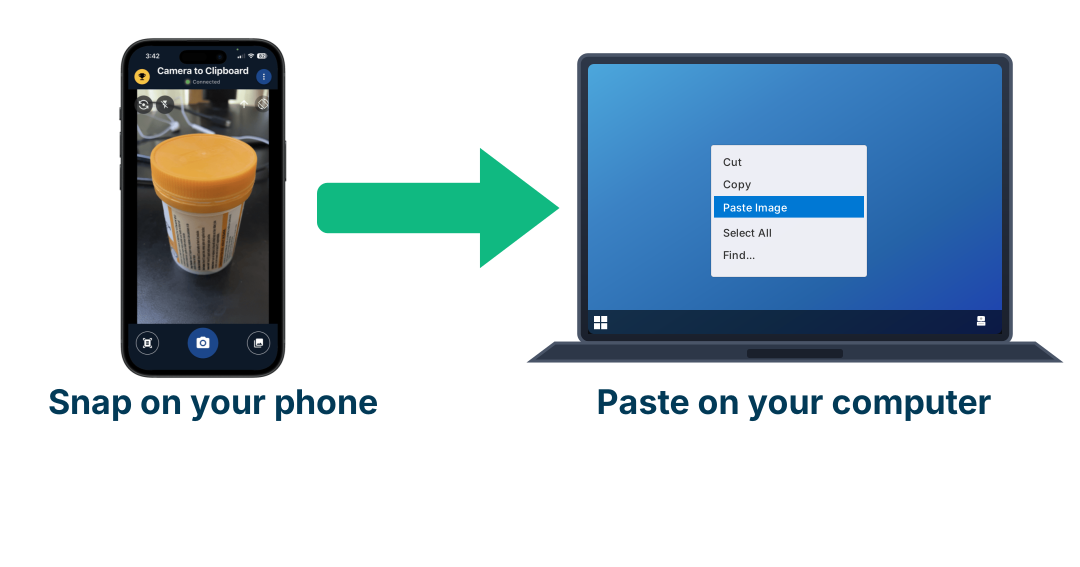
Use Camera to Clipboard to collect the screenshots your appeal needs
An appeal is assessed on what you attach to it, and the evidence is usually a job sheet on a desk, an invoice in a folder or a message on a phone. Camera to Clipboard, one of my own apps, photographs something with your phone and puts that photo straight onto your computer's clipboard, so the picture is ready to paste into the appeal form without emailing it to yourself.
- An appeal claiming the reviewer was never a customer is only as strong as the booking sheet or invoice you can show, and that paper is usually sitting on a desk rather than in a file.
- Photographing the paper and pasting it straight into the form removes the step where you email a picture to yourself and then hunt for it.
- Because you get one appeal for each review, having the evidence ready before you open the form is worth more here than anywhere else on your profile.

Use Google's extortion form when somebody demands money to remove the bad reviews they posted
This is blackmail rather than a difficult customer. A stranger posts a run of bad reviews, then contacts the business and offers to take them down for money. Google runs a separate reporting route for it, because the ordinary review report has nowhere to describe the demand.
- Google describes the pattern as a sudden increase in 1-star and 2-star reviews followed by somebody demanding money, goods or services to take them down.
- Google tells business owners not to engage with or pay the people making the demand, because paying encourages further attempts and does not guarantee the reviews come off.
- The merchant extortion report form is separate from the review report form, and using the wrong one loses the whole context of the attack.
- Screenshots must show the date, the time and the sender's contact details, which is what turns a complaint into evidence.
- Google asks for the date you first noticed the run of bad reviews and the date the demand arrived, so record both the moment it starts.
- Google states this form is only for a demand for money or favours in exchange for removing reviews, so a customer who simply wants a discount or a refund is not an extortion case.
Where the bad reviews came from a competitor rather than an extortionist, the sequence of reports is different and is set out in how to protect a local business from competitor attacks.

Accept there is no reset, because your reviews belong to the place on the map and not to you
Starting again with a clean rating is the option most owners ask about first. It fails because of how Google is built: the reviews are attached to the place itself, which exists on Google Maps whether anybody manages it or not. Your Business Profile is only the control panel bolted onto that place, so throwing away the control panel leaves the place, and its reviews, exactly where they were.
- Google's help page states that removing a Business Profile permanently deletes any posts, photos, videos and review replies left by owners and managers.
- The same page states that user-generated content and reviews remain after the removal, which is every rating you were trying to clear.
- Removing a profile does not take the business off Google, because Google says your business might still show on Search and Maps afterwards.
- Google is not matching you to an old account, because the reviews were never attached to your account in the first place, only to the address and business they were written about.
- Getting the profile back means verifying the business again from the start, and it hands you back the same place with the same reviews on it.
- Buying a business gets you its review history too, because Google transfers ownership of the existing profile to the new owner rather than issuing a fresh one.
Removing the profile therefore costs you your photos, your replies and your ability to manage the listing, and leaves the star rating exactly where it was.

Never mark a trading business as permanently closed, because you lose customers and keep the reviews
The next idea after deleting the profile is usually to mark the business closed and open a fresh listing, and it fails for the same reason.
- Google says a business marked permanently closed slowly disappears from search results before being removed, so you lose every customer searching for you in the meantime.
- The reviews sit on the place rather than on the listing, so closing the listing does not delete them.
- A second profile at the same address for the same business is a duplicate, and Google's guidelines allow one profile per address for a business customers can visit.
- Marking a trading business as permanently closed is also a false statement about the business on a public map, which is a poor position to argue from later.
- A genuine rebrand keeps its reviews too, because the profile is renamed rather than replaced when the business at that address stays the same.

Reply to every review, because hotels that started replying gained 0.12 stars and 12% more reviews
Replying is the one repair option with a measured effect size, from a study published in Marketing Science in 2017 that tracked hotels before and after they started replying.
- Proserpio and Zervas found a 0.12 star increase in ratings and a 12% increase in review volume at hotels that started replying to reviews.
- The effect was measured by comparing review platforms where management replies are shown against platforms where they are not, so the increase follows the replying rather than the other way round.
- The hotels in the study replied to positive, negative and neutral reviews at roughly the same rate, so the gain came from replying to everything rather than only to complaints.
- Hotels typically only started replying after their rating had already fallen, so the study measured businesses acting at the same moment as an owner who has just been hit.
- A 0.12 star gain in your average rating is worth between 0.6% and 1.1% of an independent business's revenue, using the Harvard study's 5% to 9% range.

Expect longer negative reviews once you reply, because that is the trade for receiving fewer of them
The same study found a cost attached to that 0.12 star gain, and it is worth knowing before you start.
- Hotels that started replying received fewer negative reviews but longer and more detailed ones.
- The authors explain this as unhappy customers becoming less willing to leave a short review they could not defend, once the business is likely to answer it in public.
- A short review saying "terrible service" is the one that disappears, because it cannot survive a polite reply asking which visit it refers to.
- The trade the study describes is fewer negative ratings in exchange for longer and more detailed negative feedback.
- Since the star average counts ratings and not words, fewer negative ratings is the half of that trade that moves your score.

Write a different reply every time, because 50% of customers are put off by a copied reply
The gain from replying does not survive being automated, and both Google and the survey data say so separately.
- 50% of consumers are put off a business by a generic or templated reply, which makes a copied reply worse than the silence it replaced.
- Google's own advice tells owners to stop sending the same thank you to everyone and to focus on reviews where they can answer a question or give an update.
- Google tells owners to address the reviewer by name, mention their specific complaint and sign off with a real name or initials.
- Google tells owners to stay conversational rather than promotional, because the reviewer is already a customer and a discount code in a reply reads as an advert.
- Google also warns against taking responsibility for things outside your control, so explain what you can and cannot do rather than apologising for everything.

Reply to get the review rewritten, because Google tells the reviewer and lets them change it
A public reply is read by future customers, but it also does something private that most owners never notice.
- Google notifies the person who wrote the review as soon as your reply is posted.
- Google states that customers can still change their review after reading your reply, and that the date on the review updates when they do.
- A changed rating is the only route that removes a bad rating from your average without Google deleting anything.
- Google's own advice says that replying constructively and following up on the concern may encourage the customer to update their review.
- Google asks the reviewer to move a complex problem to a phone call or an email rather than settling it in public, so the reply's job is to open that conversation.
- Your reply is checked against Google's content rules before it appears, usually within 10 minutes but sometimes taking up to 30 days.

Offer to put the job right, but never offer it in exchange for the review coming down
Ringing the customer, apologising and offering to redo the work is the step Google itself points owners towards. What turns that same phone call into a policy breach is attaching a condition to the offer.
- Google's policy bans a business offering incentives such as payment, discounts, free goods or services in exchange for posting any review, or for the revision or removal of a negative review.
- The dividing line is whether the offer is conditional, so redoing a bad job for free is ordinary customer service and redoing it only if the review comes down is the banned trade.
- The new review he writes in return is deleted as well, because Google treats any review written in exchange for something as fake however genuine it sounds, so you pay out the freebie and end up with nothing.
- Saying nothing at all about the review while you fix the problem is what keeps the offer clean, and a customer who ends up genuinely happy can change the rating on their own.
- In the United States that trade also breaks the Federal Trade Commission's rule, which bans compensation conditioned on a review expressing a particular opinion.
Put plainly, you may give the customer anything you like as an apology, provided the review is never mentioned as the reason for it.
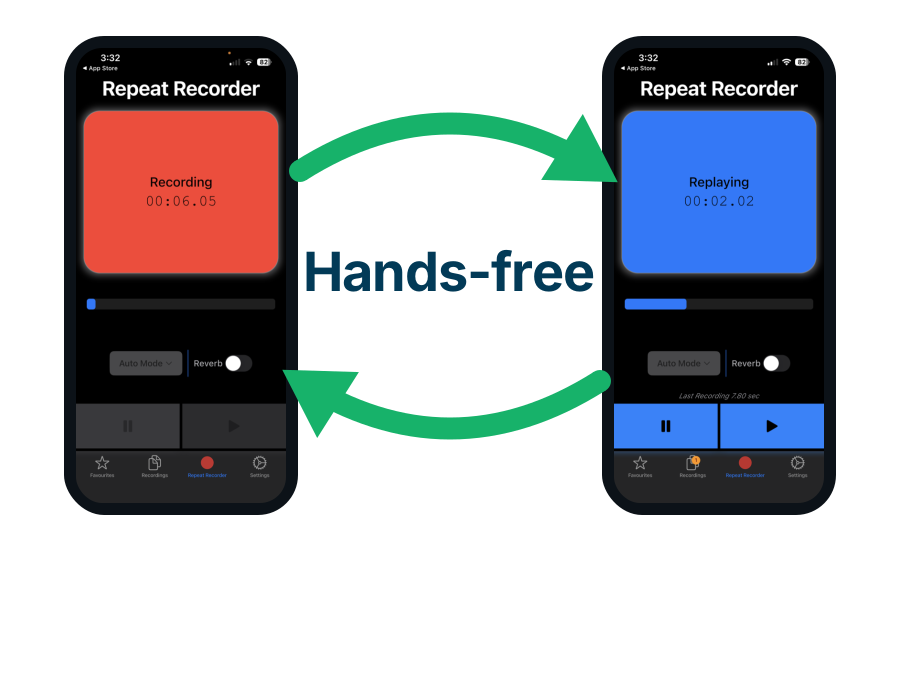
Use Repeat Recorder to practise the call that gets a bad review changed
The reply is only the invitation, and the rating changes on the phone call that follows it. Repeat Recorder, another of my own apps, records what you plan to say and plays it back on a loop, hands free, so you can hear how the apology and the offer actually sound before an upset customer hears them.
- Hearing your own apology played back is the fastest way to catch the sentence that sounds like blaming the customer, which is the sentence that stops a review being changed.
- Because Google warns against taking responsibility for things outside your control, the hard part is explaining a limit without sounding defensive, and that is worth rehearsing rather than improvising.
- The loop plays hands free, so you can practise the call while you drive to the job rather than sitting down to prepare for it.

Bury the review under new ones, because 74% of customers only read reviews from the last 3 months
Outnumbering a bad review does two separate jobs, and the second one matters more than the arithmetic.
- 74% of consumers only read reviews written in the last three months, so a bad review from last year is read by a quarter of the people who see your rating.
- New reviews push an old one down the list, and the list is what a customer reads before they ever work out the average.
- Steady new reviews shrink every future bad review as well, because each new rating makes the number the average divides by larger.
- Getting past 20 reviews matters on its own, because 47% of consumers will not use a business holding fewer than 20 whatever its rating is.
- Asking one customer a week is enough to cross 20 reviews within six months even if only half of them ever write one.

Ask every customer for a review, because asking only the happy ones is banned by name
Sorting customers before you ask, so that only the happy ones are handed the link, is ordinary advice in plenty of industries. Google's Rating Manipulation rule bans it in the same words people use to describe it.
- Google's policy says merchants must not discourage or prohibit negative reviews, or selectively solicit positive reviews from customers.
- Google's policy also bans pressuring customers to leave a review while they are still on the premises, and bans asking them to put specific content in it such as the name of the staff member who served them.
- Google's policy bans a business asking its own staff to bring in a certain number of reviews, which rules out a review target for the team.
- Google cannot hear you ask, so it polices the result instead, and its rule bans review patterns that indicate an effort to manipulate a place's rating.
- Google allows you to encourage any customer to leave a genuine review, provided you offer nothing for it and do not steer the rating or the wording.

Expect a profile holding only 5-star reviews to look filtered, because real customers leave 4s
Filtering who you ask does not leave a fingerprint on the asking. It leaves one on the shape of the reviews you end up with, and the shape is the part Google can see.
- Google's Rating Manipulation rule bans content showing unusual volumes or patterns of review contributions that indicate an effort to manipulate a place's rating, which makes it a rule about the shape of your review history rather than about any single review in it.
- Google says the system it launched in 2023 examines longer-term patterns every day, and one of the things it looks for is a sudden spike in 5-star ratings on a single business.
- A run of nothing but 5-star reviews is exactly what filtering produces, because the customers who would have left a 4 were never handed the link.
- Google tells business owners in writing that a mix of positive and negative feedback often feels more trustworthy to a customer than an unbroken run of praise.
- Letting the 4-star reviews through costs almost nothing, because a single 4-star rating moves an average of 4.6 held across 50 reviews down by 0.01.
The safest review history is therefore the one you were going to get anyway, which is why asking everybody is both the rule and the cheaper option.

Never buy reviews, because Google puts a warning on your profile where your customers read it
Buying 5-star reviews to drown out a bad one is the option that turns a rating problem into a visible public accusation.
- Google states it may stop a profile receiving any new reviews or ratings for a set period, which blocks your real customers along with the bought ones.
- Google states it may unpublish a profile's existing reviews and ratings for a set period, which hides the good reviews you earned honestly as well.
- Google states it may display a warning on the profile telling consumers that fake reviews were removed, in the place where customers read your rating.
- Under commitments Google gave the UK competition regulator in January 2025, businesses that repeatedly post fake reviews have all their reviews deleted for six months or more.
- Offering a discount or a free item in exchange for a review breaks the same rule as buying one outright, and so does offering one to have a bad review taken down.

Expect a sudden run of 1-star reviews to be caught, because Google watches for that exact shape
Google publishes what its detection system looks for, and a burst of bad ratings is named as one of the patterns.
- Google says the machine learning system it launched in 2023 looks for sudden spikes in 1-star or 5-star ratings on a single business.
- Google blocked or removed 170 million policy-violating reviews from Maps in 2023, which was 45% more than in 2022.
- Google removed or blocked 12 million fake business profiles in the same year.
- Google says it stopped 5 million fake review attempts in a single scam within weeks of finding it.
- A run of 1-star ratings is worth reporting as a group rather than one at a time, because the pattern across the whole run is evidence that no single review carries.
Use Camera to Clipboard to keep a dated record of your star rating
Proving that a run of bad ratings arrived together needs the dates, and Google's extortion form asks for the day you first noticed. Camera to Clipboard, one of my own apps, moves a photo from your phone to your computer's clipboard in one step, so a picture of your profile taken on the day is filed on the computer where the report gets written.
- Google's extortion form asks for the date and time you first noticed the increase in bad reviews, and that date is impossible to recover once the run is a month old.
- Because a new rating can take up to two weeks to change your displayed score, a picture taken on the day records what was actually showing rather than what the profile shows now.
- Keeping the record on your computer rather than in your phone's photo roll means it is already where you write the report.

Never threaten the person who wrote the review, because in the United States that is now illegal
Sending a legal letter to frighten a reviewer into deleting a review used to be a grey area. In the United States it stopped being one on 21 October 2024.
- The Federal Trade Commission's rule on consumer reviews took effect on 21 October 2024 and is written into federal regulation as 16 CFR Part 465.
- Section 465.7 makes it illegal to use an unfounded or groundless legal threat, a physical threat, intimidation or a knowingly false public accusation to get a review removed or stop it being written.
- The same rule bans creating fake reviews, paying for reviews that express a particular opinion, and reviews written by your own staff without saying who they work for.
- Civil penalties under the Federal Trade Commission Act reach $53,088 for each violation, and each fake review can count separately.
- A defamation claim against a reviewer is still possible where a review states something false as fact, but it needs a lawyer in your own country and it is the slowest and most expensive option on this page.

Compare what each of the seven options for a bad Google review is actually worth
Every route in this article, measured against how fast it works, how likely it is to work, and what it costs you if it fails.
| Your option | How fast it works | Chance it works | What it costs you | Worth doing |
|---|---|---|---|---|
| Reply to the review in public | 10 minutes to post | Measured at 0.12 stars and 12% more reviews | Nothing but your time | Always, on every review |
| Ask every customer for a review from now on | Weeks to months | Certain, the average has to move | Nothing but your time | Always, and start today |
| Report a review that breaks a written rule | Several days per report | Good where the rule is named, none otherwise | Nothing but your time | Yes, where a rule is genuinely broken |
| Appeal a refused report | Days to weeks by email | One attempt only, then it is final | Uses up your single appeal | Yes, but only on your strongest review |
| Report an extortion demand to Google | Days to weeks, an investigation | Good with dated evidence, poor without it | Nothing but your time | Yes, whenever money is demanded |
| Delete the Business Profile and start again | Immediate, and it changes nothing | None, Google keeps every review | Your photos, replies and the listing itself | Never |
| Buy 5-star reviews to outweigh it | Days to appear | Reversed by Google's own detection | A public warning label and reviews switched off | Never |

Conclusion: how to remove a bad Google review and repair your star rating
Two of the seven options work, two are wasted effort and two make things worse. These are the findings, largest effect first.
- There is no reset. Deleting your Business Profile keeps every review and permanently deletes your own photos and replies.
- Google removes a review only when it breaks a written rule. Its policy allows an honest bad experience described respectfully.
- The one wording Google does remove is an unproven accusation of a crime. Quote that sentence in your report.
- There is no deadline. Google sets no time limit on reporting, so an old review is still worth checking.
- Reply to every review. Hotels that started replying gained 0.12 stars and 12% more reviews.
- Write each reply differently. 50% of consumers are put off by a templated reply.
- Ask every customer, not only the happy ones. Selectively asking for positive reviews is banned by Google's policy.
- Never buy reviews. Google can switch off new reviews and show a warning on your profile that fake reviews were removed.
- Never threaten the reviewer. An unfounded legal threat to remove a review is illegal in the United States.
- Get past 20 reviews before you need to. One bad rating costs 0.36 stars at 10 reviews and 0.02 stars at 200.