Audiobook narration is a real, paid line of work, and it is also a field in the middle of a shake-up, because AI voices now sit on the same shelf as human ones. This guide gives the honest version: what narrators actually earn, where to apply for jobs, whether AI has taken over, and whether it is still worth starting. Then it gets practical, because the craft comes down to hearing your own reading and improving it, take after take. The same skills carry straight into podcasting and video voice-over, and that record-and-replay loop is exactly what the free Repeat Recorder app was built for.
The quick answer: audiobook narration still pays, usually per finished hour (roughly 100 to 400+ US dollars) or on a 50/50 royalty share. Most people start on ACX, with marketplaces like Voices.com and Voice123, gig sites and author communities alongside it. AI has taken over the cheapest end, but human narration still owns fiction and premium titles, and the skills transfer to podcasting and voice-over. It is worth it as a craft, not as easy money, and the part that gets you booked is being able to hear your own reading and improve it. Repeat Recorder plays each take straight back and loops the hard paragraph hands-free. 

What audiobook narration actually takes, and what to practise first
The barrier to entry is lower than people think, and the real skills are learnable ones you can start today. A trained voice helps, but it is not where the work is.
- Consistency over beauty. Listeners forgive an ordinary voice but not a wandering pace or a character who sounds different every chapter. Steady, clear delivery is the core skill.
- Reading that sounds like telling. The goal is to sound like you are talking to one person, not reading at them. That natural, engaged tone is trained by hearing yourself and adjusting.
- Endurance. Narration means hours of talking while keeping energy and pace even. You build that stamina by practising longer reads, not single sentences.
- Simple character distinction. You do not need a cast of accents, just small, consistent shifts so listeners can tell who is speaking. Recording lets you check the shifts actually read.
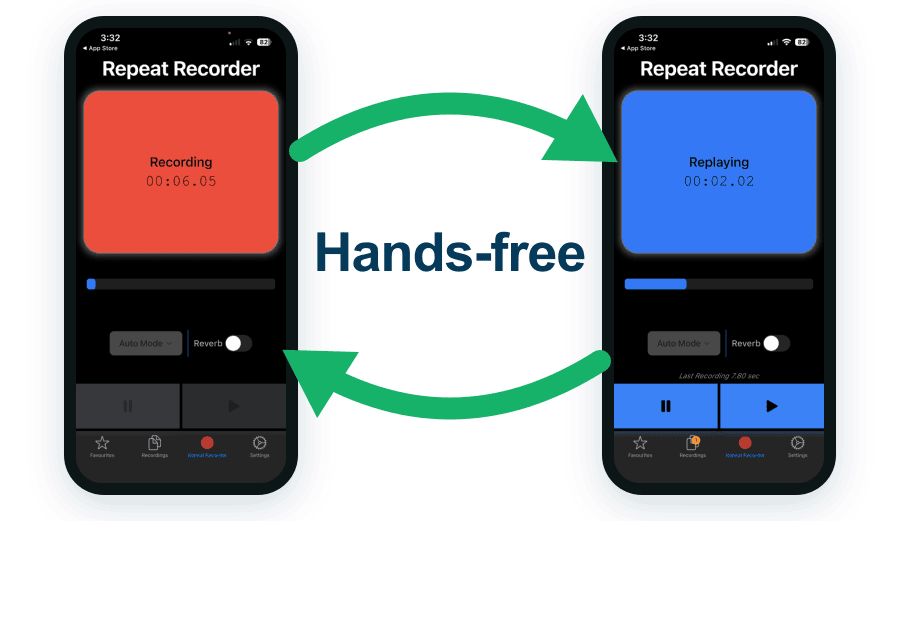
The record and replay loop in Repeat Recorder: narrate the passage, hear it back, and refine the lines that fell flat.
The state of audiobook narration in 2026: a real market now sharing the shelf with AI
Audiobooks are one of the healthiest corners of publishing, and demand for narration is genuinely there. What has changed is that the work now comes in two tiers, and knowing which one you are aiming at is the whole picture.
- The market is large and growing. Audiobook listening has climbed for years, driven by phones, subscriptions and a flood of self-published titles that all need a voice.
- Most entry-level work is indie. The bulk of openings for new narrators come from self-publishing authors on marketplaces, not from big publishers, so that is where nearly everyone starts.
- Human and AI now coexist. AI narration has arrived on the major stores, and it competes directly for the cheapest, most price-sensitive titles while human voices hold the rest.
- The bar for humans has risen. Because AI can do "clear and cheap", the human work that survives is the work that needs performance: character, emotion, and judgement AI cannot fake yet.
How much do audiobook narrators make? Per finished hour, royalty share, and the beginner reality
Narration pay is almost always quoted per finished hour (PFH), meaning one hour of completed, edited audio, not one hour of your time. That distinction matters, because a finished hour usually takes several hours of recording and editing to produce.
| Pay model | Rough range | What to know |
|---|---|---|
| Per finished hour (beginner) | ~$100–$200 PFH | Where most new narrators start once they leave royalty share. Paid upfront on delivery. |
| Per finished hour (experienced) | ~$250–$400+ PFH | Solid demo, reviews and repeat clients. Skilled full-timers live here. |
| Per finished hour (top / union) | $400+ PFH | Established names, agents, and SAG-AFTRA studio work for major publishers. |
| Royalty share (RS) | $0 upfront, 50/50 of sales | No pay until the book sells. Risky, but a common way to build a first demo reel. |
| Royalty share plus (RS+) | Small stipend + reduced royalty | A middle ground some platforms offer: a little upfront, a smaller share of sales. |
Figures are rough US-market estimates and vary by genre, length, experience and platform. Treat them as ballpark, not a quote.
- Do the real hourly maths. If a finished hour pays $200 but takes you five hours to record and edit, your effective rate is about $40 an hour before costs. It climbs as you get faster.
- Books are measured in finished hours. An average title runs six to ten finished hours, so a single PFH job might gross a few hundred to a few thousand dollars.
- Royalty share is a gamble. It pays nothing upfront and can earn almost nothing on a book that does not sell, or a modest trickle for years on one that does.
- Consistency beats one big job. A narrator's income comes from steady repeat authors and a growing back catalogue, not a single title.
Where to apply and how to find audiobook narration jobs
You do not wait to be discovered, you audition. The table below sums up who pays what, how hard each route is to break into, and how you apply, then the notes underneath add the detail.
| Where | Typical pay | Easy to get in? | How to apply | Best for |
|---|---|---|---|---|
| ACX (Audible / Amazon) | $250+ per finished hour, or a 50/50 royalty share. Human voices only. | Easy to join, hard to win paid work | Free account, upload a demo, audition on open titles, pass a QA check. US / UK / CA / IE residents only. | Beginners (via royalty share) and steady work in the Audible world |
| Voices.com | You set the quote (~$150–300 PFH typical); 20% platform fee. Premium ~$499/yr. | Easy to join, hard to earn the fee back | Build a profile and demos, pay for Premium to audition, quote per job. | Established full-timers who can absorb the fee and the cut |
| Voice123 | You set the rate; 0% commission. Paid membership (from ~$49 up to ~$495+/yr). | Easy to join, medium to earn (invites tiered by plan) | Profile and demos, pick a plan, submit custom auditions, deal direct with the client. | Narrators who want to keep 100% and negotiate directly |
| Upwork & Fiverr | Low to mid. Fiverr gigs from ~$80; Upwork ~$25–55/hr. Fees ~10–20%. | Very easy to join, but a race to the bottom on price | Post a gig or bid on jobs with a demo; build reviews cheap, then raise rates. | Building your first paid credits and reviews fast |
| Publishers & agencies | Highest, ~$200–400+ PFH. Agencies take ~10–15%. | Hard, needs a demo reel and experience | Make a genre audiobook demo reel, then pitch publishers or get signed by a voice-over agency. | Experienced narrators after steadier, higher pay |
| Author communities | Variable indie budgets, negotiable, no platform fee. | Medium, relationship-based | Join author and narrator groups, answer casting calls, pitch authors directly. | Good networkers who want direct, repeat clients |
| Findaway / INaudio | Distribution platform, not a job source now. | Not hiring narrators | Its narrator marketplace closed in 2023; use it to distribute, not to get hired. | Authors distributing audio, not narrators seeking work |
Pay figures are rough US-market estimates and vary widely by experience, genre and title. Fees and membership prices change, so check each platform before committing.
- ACX (Audiobook Creation Exchange). Audible and Amazon's marketplace and the single biggest on-ramp. Authors post titles, you record a short audition script, and you are hired per finished hour or on royalty share. Start here.
- Findaway Voices (now Voices by INaudio). Worth knowing about, but its narrator marketplace closed in 2023, so today it is a way to distribute an audiobook, not a place to get hired. Do not count on it for work.
- Voices.com and Voice123. General voice-over marketplaces that include audiobook jobs. They usually charge a membership fee, so weigh that against the work you win.
- Gig platforms. Upwork and Fiverr carry smaller narration and voice-over gigs, useful for building samples and reviews early on.
- Publishers and agencies, later. Once you have a polished demo reel, you can approach audiobook publishers and voice-over talent agencies directly. This is where the higher-paid, non-marketplace work lives.
- Author communities. Self-publishing groups and forums are full of authors looking for a narrator, often before they ever post a formal listing.
Whichever route you take, you will need two things ready: a quiet home recording space that meets the platform's audio specs (clean, low-noise, consistent), and a short audition sample that shows you can hold a performance.
Has AI taken over audiobook narration, and is it still worth starting now?
This is the question worth answering honestly, because the truth is somewhere between the hype and the panic. AI is real and it matters, but it has not ended the craft.
- AI narration is now on the major stores. Amazon and Audible offer AI "virtual voice" titles, Apple Books has its own AI narration, and tens of thousands of books now use it.
- It hits the cheap end hardest. The titles most likely to go AI are the low-budget, high-volume, price-sensitive ones, exactly the commodity work a beginner used to cut their teeth on. That entry rung is thinner than it was.
- Humans still own performance. Fiction, character-driven stories, humour, and emotionally complex nonfiction still go to human narrators, because listeners can hear the difference and many actively dislike AI voices for these.
- Some narrators are licensing their own AI voice. Platforms have begun letting consenting narrators create AI clones of their voice, turning the technology into an extra income stream rather than only a threat.
- The verdict: it is still worth it if you treat it as a skilled performance craft and aim above the commodity tier, not as easy passive income. Build a demo, get better than "clear and cheap", and lean on the fact that the same skills also serve podcasting, YouTube and video voice-over, which are growing.

Why recording and hearing yourself is the whole skill of narration
Every improvement in narration starts with noticing something in a playback. Without the recording you are performing blind.
- You cannot judge pace from the inside. A section that felt lively can drag on playback, and one that felt slow can rush. Only the recording tells you the truth.
- Mouth noises and breaths are invisible live. Clicks, lip smacks and loud breaths are inaudible to you while reading but obvious to a listener. Playback catches them so you can smooth them out.
- Flat lines hide until you hear them. A line you thought you coloured can come back monotone. Hearing it lets you read it again with the life it needed.
- Consistency is checked by comparison. Playing an earlier take against a later one is the only way to keep a character's voice and your overall pace steady across a long book.

How to practise narration at home: read a passage, listen back, refine
Use real book pages, not single sentences, so you build the pacing and stamina the job actually needs.
- Pick a page you like. A passage with some dialogue and some description gives you both narration and character work to practise.
- Read it aloud into a recording, in character. Commit to a pace and a tone rather than reading cautiously. A real take gives you real feedback.
- Play it back as a listener. Where did it drag or rush? Which lines fell flat? Any mouth noises or awkward breaths? Can you tell the characters apart?
- Reread with one fix. Lift a flat line, even out the pace, or sharpen a character, then record again and compare.
- Loop the hard paragraph. The passage that keeps defeating you gets drilled on repeat until it flows.

Preparing an audition: the practice that actually gets you booked
Most narration work is won by submitting a short sample, so the audition itself is a skill to rehearse with recordings.
- Match the book's tone. Producers want to hear you fit their title. Record your sample in the style the book calls for, and compare it against the mood of the source.
- Keep it clean and consistent. A short, polished, even sample beats an ambitious, uneven one. Loop-check that your pace and tone hold from the first line to the last.
- Nail the opening lines. The listener decides fast, so drill your first few sentences until they are effortless and inviting.
- Listen as the producer will. Play the sample back cold, once, and ask whether you would keep listening. If not, that tells you what to fix before you submit.
Why Repeat Recorder beats the voice recorder on your phone for narration practice
Your phone already has a voice recorder, and it is fine for a memo. Narration practice is a different job: many takes you want to hear back instantly, compare against each other, and loop hands-free while you hold the book.
- Instant replay the second you finish, so you review the take while it is fresh.
- Hands-free automatic mode, so your hands stay on the book and practice can happen anywhere.
- Loop a paragraph once, a set number of times, or until you stop it, so a hard passage gets drilled as long as it takes.
- A countdown before recording, so you can settle into character before the first word.
- Named folders for each book, sample or character you are practising.
- Reverb to hear how your read would sit in a room, or off for a clean, dry take.
| For narration practice | Repeat Recorder | Phone voice recorder |
|---|---|---|
| Records your read | ✔ | ✔ |
| Plays the take back automatically | ✔ | Find the file, press play |
| Hands-free while you walk or drive | ✔ | Tap to record and to play |
| Loop a phrase as often as you want | ✔ | One play at a time |
| Countdown before recording | ✔ | Starts immediately |
| Save takes into named folders | ✔ | One flat list |
| Free | ✔ | ✔ |

A simple daily narration-practice routine
- Two minutes: pick a fresh page with some dialogue and read it aloud into a recording, in character.
- Three minutes: play it back as a listener and mark the flat lines, the pacing wobbles and any mouth noises.
- Three minutes: reread with your fixes, then loop the hardest paragraph until it flows.
- Anytime: loop your audition opening hands-free until the first lines are effortless.
A little narration a day, recorded and reviewed, builds the ear and the stamina the work depends on faster than waiting for the perfect voice. The voice was never the point. Hearing your reading honestly, and improving it, is what gets you booked.