
Staring at the page and reading a scene over and over is the slowest way there is to learn lines. Memory holds on to what it hears and repeats, not what the eye skims, which is why nearly every fast-memorizing actor learns lines out loud and against cues rather than off the page. The most reliable version of that is to record the scene in your own voice and play it back on a loop until your part surfaces on its own. That record-and-replay loop is exactly what the free Repeat Recorder app was built for.
The quick answer: the best way to memorize lines is to record the scene in your own voice, then replay it on a loop, first saying your lines along with the recording, then dropping your own line and letting the recording cue you. Space the repetitions across the day, run them out loud rather than in your head, and test yourself by reciting from memory. Repeat Recorder plays each take straight back and loops it hands-free, so you can run lines while you walk, drive, or wash up instead of only at a desk. 

The best way to memorize lines: record them in your own voice and let repetition do the work
Every good line-learning method comes back to the same two ingredients, and reading silently supplies neither. What actually moves a line into memory is hearing it and repeating it, tied to the cue that comes just before it. Recording the scene gives you both on demand.
- Your own voice is the strongest cue. A line learned against the sound of the previous line, in the voice you will actually perform in, comes back the way it was stored: you hear the cue and your line is simply there, no visual page-hunting in between.
- Repetition is the whole engine. Lines are not understood into memory, they are worn into it. The question is only how many honest repetitions you can fit in, and audio you can loop hands-free gives you far more than a script you have to hold and read.
- Audio frees your eyes and hands. A recording plays while you walk, cook, or commute, so the dead minutes of a day become rehearsal minutes. That is where the rep count quietly climbs past what desk practice can match.
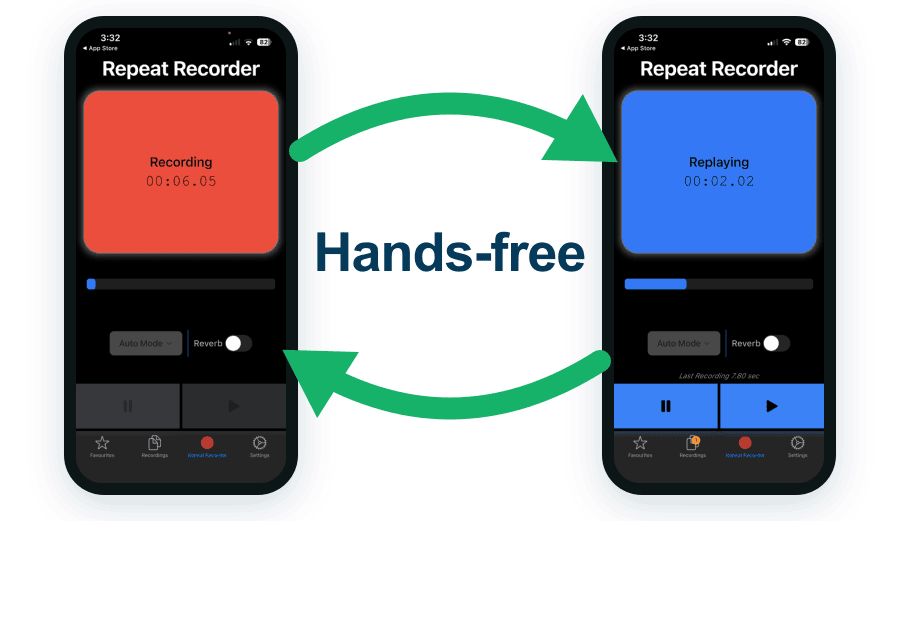
The record and replay loop in Repeat Recorder: record the scene, hear it back, then run it again hands-free until the lines are yours.

Why hearing your own voice beats reading the script over and over
Re-reading feels productive because the page gets more familiar, but familiarity is not recall. You can recognise a line on sight and still dry up the moment the book is shut. Recording and replaying attacks the real target instead.
- Recognition is not recall. Reading trains you to know the line when you see it. A performance needs you to produce it when you cannot. Playing the scene back and speaking from memory trains the thing you are actually going to do.
- The ear remembers rhythm the eye misses. Lines carry a melody, pauses, and stresses that live in sound, not in the printed words. Learning from audio bakes in the delivery at the same time as the words, so you are not memorising a flat script and acting it later.
- Your own voice removes the translation step. Hearing the cue in the exact voice you will answer in means the line comes back as a reflex, with no split-second gap while your brain converts print into sound.
- Testing yourself is what proves it. Every time you drop your own line and force yourself to say it before the recording does, you are testing recall, and retrieval practice is one of the best-evidenced ways to make a memory permanent.

How to memorize lines for a play, step by step: record the scene, loop it, then shadow it
Here is the full method actors use, turned into something you can run on a phone. Work one scene at a time and do not move on until the current one is solid.
- Record the whole scene, all parts, in your own voice. Read every character, including the other people's lines, at a natural performance pace. Leave a real beat of silence where each of your own lines will go so there is room to answer later.
- Listen right through, twice, doing nothing else. Just take in the shape of the scene: who says what, and what cues your entrances. You are learning the map before you drive it.
- Play it back and say your lines along with the recording. Speak in unison with your own recorded voice. This is the shadowing stage, and it glues your line to the cue in front of it.
- Now drop your own line and let the recording cue you. Record a second version with your lines left as silent gaps, or simply talk over your own gaps. When the cue lands, say your line into the pause before the audio moves on. This is the real rehearsal.
- Loop the hard patches. The two or three exchanges that keep slipping get their own short recording, looped over and over until they stop being the weak point.
- Run the scene with no audio at all. The recording comes off entirely and you speak the whole thing from memory. Anywhere you stall is exactly what to loop next.

Tips for remembering lines that actually stick: space the reps, drill the cues, test yourself out loud
Once the method is in place, a handful of habits decide whether the lines hold under pressure or fall apart on the night. These are the ones worth building in from the start.
- Space the repetitions, never cram. Ten minutes now, ten after lunch, and ten before bed beats a single unbroken hour. Sleep and gaps are when memory consolidates, so short sessions spread across days move lines into long-term storage that cramming never reaches.
- Learn the cue, not just the line. You will never miss an entrance because you forgot your own words in a vacuum, you will miss it because you did not recognise the cue. Drill the last few words of the line before yours as hard as you drill your own.
- Always run lines out loud. Saying them engages your breath, mouth, and ear together and rehearses the actual physical act. Reading them in your head rehearses nothing you will do on stage.
- Test, do not re-read. The instant you can, cover the script and try to produce the line from memory. Struggling to recall it and getting there is worth several passive read-throughs.
- Attach meaning and movement. Know why your character says each line and what they want from it, and tie lines to the blocking. A line hung on an intention and a step is far easier to find than a free-floating string of words.
- Sleep on the hard scene. Run the toughest scene last thing at night and again first thing in the morning. Overnight is when the day's reps settle, and the morning run tells you what truly stuck.
Run lines with Repeat Recorder: record the scene once, then loop it hands-free
Every step of the method above needs the same two things on hand: a recording of the scene in your own voice, and an easy way to hear it again. Repeat Recorder, my own app, was built for that loop and little else. It records you, plays the take straight back about a second after you stop, and then starts recording again, all without you touching the phone.
- Repeat Recorder plays a take back about a second after you stop speaking, with no file to hunt for in between. That gap between recording the scene and shadowing it is where line practice usually stalls, and closing it is the whole reason the app exists.
- Hands-free automatic mode records and replays on its own, so a walk, a drive or the washing up turns into the extra repetitions this article says decide how fast lines go in. Nothing needs tapping between takes, which is what lets the repetitions add up in the dead minutes of a day rather than only at a desk.
- Any take can loop once, a set number of times, or until you stop it, so the two or three exchanges that keep slipping get run over and over on their own. That is step five of the method above, and a countdown before each recording gives you a beat to get into character first.

How to memorize a script fast when the audition or table read is tomorrow
Sometimes there is no time for a proper spaced schedule. You can still get a short scene performance-solid by tomorrow if you use every gap in the day instead of one panicked sitting.
- Record it once, well, early. The sooner the recording exists, the more times it can loop before you sleep. Two clean minutes of recording pays back all evening.
- Loop it through the dead time. Have it playing while you cook, shower, and travel. Passive listening will not finish the job, but it makes the active tests far easier.
- Alternate listening and testing. Every few loops, mute it and try to say the scene from memory. The switch from hearing to producing is what actually loads the lines in.
- Do a run right before sleep and right after waking. The overnight gap does a surprising amount of the work for free, and the morning run shows you the two or three lines still to shore up.

Why Repeat Recorder beats the voice recorder on your phone for learning lines
Your phone already has a voice recorder, and it is fine for a memo. Learning lines is a different job, because it is not one recording, it is a scene you want to replay and loop dozens of times, hands-free, while your eyes and hands are busy.
- Instant replay the moment you finish recording, so you can go straight from capturing the scene to running it.
- Hands-free automatic mode, so lines get learned on a walk or a commute, not only at a desk.
- Loop a scene once, a set number of times, or until you stop it, so the hard exchange runs as often as it takes.
- A countdown before recording, so you can get into character before the first word.
- Named folders for each scene or each character you are learning this week.
- Reverb to hear how the lines would sit in a room with some space in it.
| For memorizing lines | Repeat Recorder | Phone voice recorder |
|---|---|---|
| Records the scene in your voice | ✔ | ✔ |
| Plays the take back automatically | ✔ | Find the file, press play |
| Hands-free while you walk or drive | ✔ | Tap to record and to play |
| Loop a scene as often as you want | ✔ | One play at a time |
| Countdown to get into character | ✔ | Starts immediately |
| Save scenes into named folders | ✔ | One flat list |
| Free | ✔ | ✔ |

A simple daily line-learning routine you can run hands-free
- Two minutes: record the scene, all parts, in your own voice at performance pace, leaving gaps where your lines go.
- Three minutes: loop it back and shadow it, speaking your lines along with the recording.
- Three minutes: loop it again, this time dropping your own line and saying it into the gap before the audio does.
- Two minutes: mute the audio and run the scene from memory, then loop whatever you stalled on.
Ten focused minutes with the recording, repeated across the day and topped up before sleep, will out-learn an hour of reading the page. The lines you want are not on the paper, they are in your voice and your ear, and looping them back is how they get there.