
A better speaking voice is not something you are born with, it is something you practise. The exercises below are simple and take a few minutes a day. The part that actually makes them work is feedback: recording a passage, hearing it back, and saying it again. That loop is what the free Repeat Recorder app was built for.
The quick answer: to improve your speaking voice, breathe from your diaphragm, keep your pitch in its natural range, slow down, and open your mouth fully so words land clearly. Then do the one thing most people skip: record yourself, listen back, and try the same lines again. You cannot fix a voice you have never heard from the outside. Repeat Recorder plays each take back a second after you speak, so the gap between saying it and hearing it disappears. 
Why you have to hear yourself to improve
When you speak, you hear your own voice partly through the bones of your skull, which adds warm low tones nobody else gets. Everyone else hears only the sound that travels through the air, and so does a recording. That is why your recorded voice sounds thinner or higher than you expected. The recording is the honest version, and it is the one worth practising with. Every exercise below improves faster the moment you can hear the difference between the take you just did and the one before it.
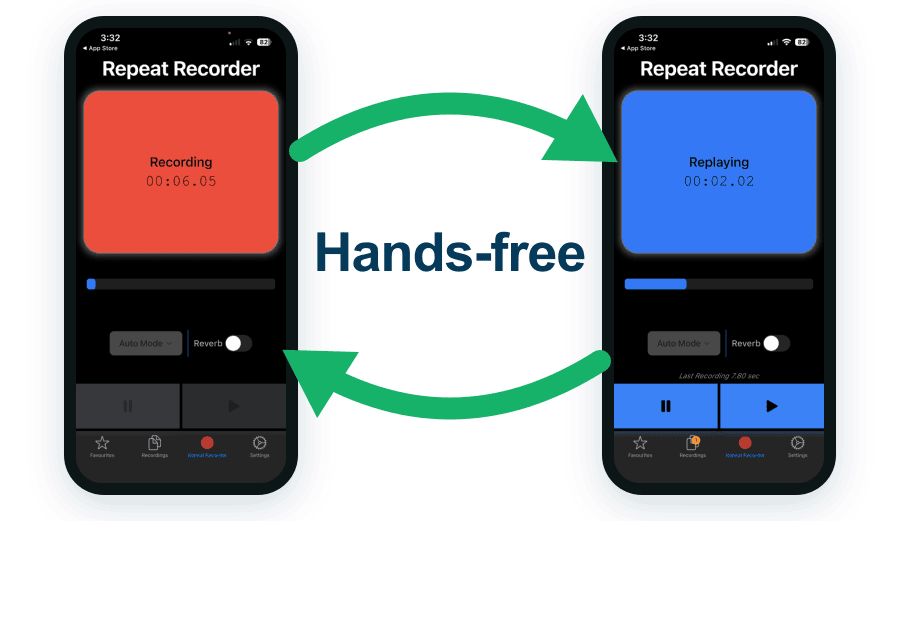
The record and replay loop in Repeat Recorder: speak a line, hear it back a second later, then go again.
Breathe from your diaphragm
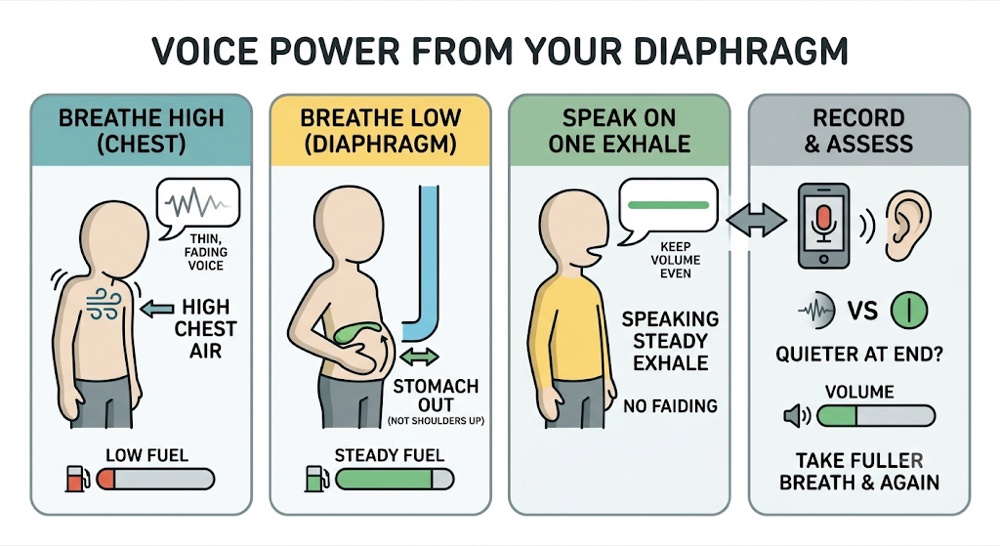
A thin, shaky, or fading voice is almost always a breathing problem. Air is the fuel, and most people run on far too little of it because they breathe high in the chest. Diaphragmatic breathing gives you a steady column of air to speak on, which steadies the tone and stops sentences trailing off at the end.
- Put a hand on your stomach and breathe in so that hand moves out, not your shoulders up.
- Read a sentence out loud on one relaxed exhale, keeping the volume even from the first word to the last.
- Record it and listen. If the last few words got quieter, you ran out of air. Take a fuller breath and go again.
Find and use your natural pitch
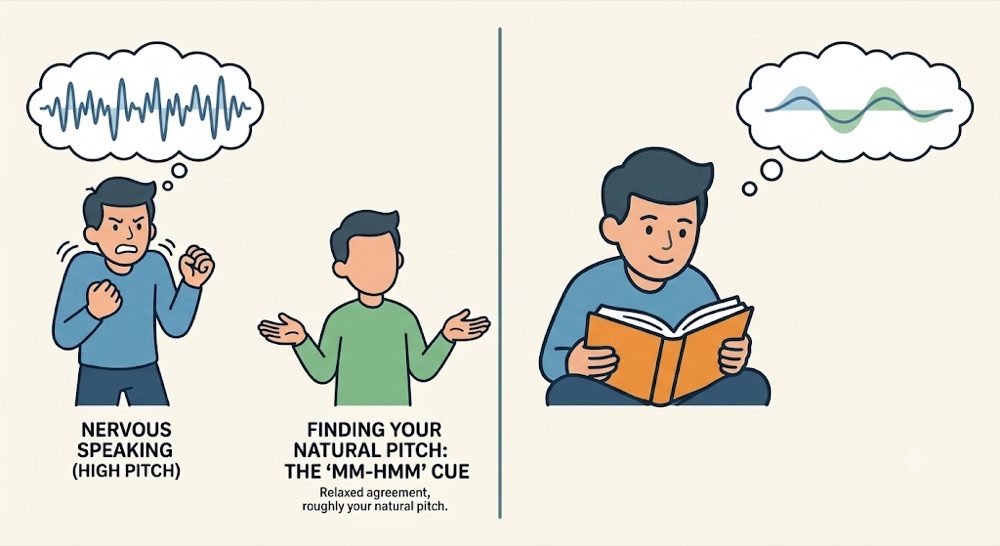
Many people speak higher than their body wants to, especially when nervous. Your natural pitch is lower, warmer, and easier to listen to. To find it, say "mm-hmm" as if you were agreeing with someone, relaxed and unforced. That is roughly your natural speaking pitch. Read a passage aiming to sit there rather than up in your throat, then check whether it landed lower by playing it back. Chasing a deeper voice by pushing down is a mistake, you are simply removing the tension that pushed it up.
Slow down and leave space
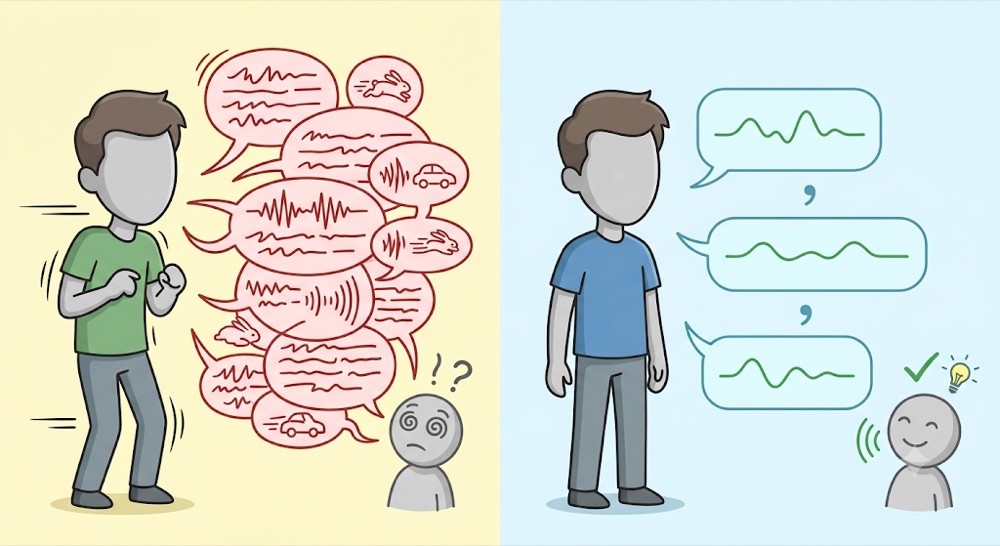
Fast talking reads as nervous and is harder to follow, and almost nobody realises they do it until they hear a recording. Aim to slow your pace and let short pauses do the work commas do on a page. If this is your main issue, there is a whole method for it in how to stop talking too fast. The quickest test: record a paragraph, time it, then read the same paragraph aiming to take a few seconds longer, and hear how much clearer the slower version is.
Open up and speak clearly
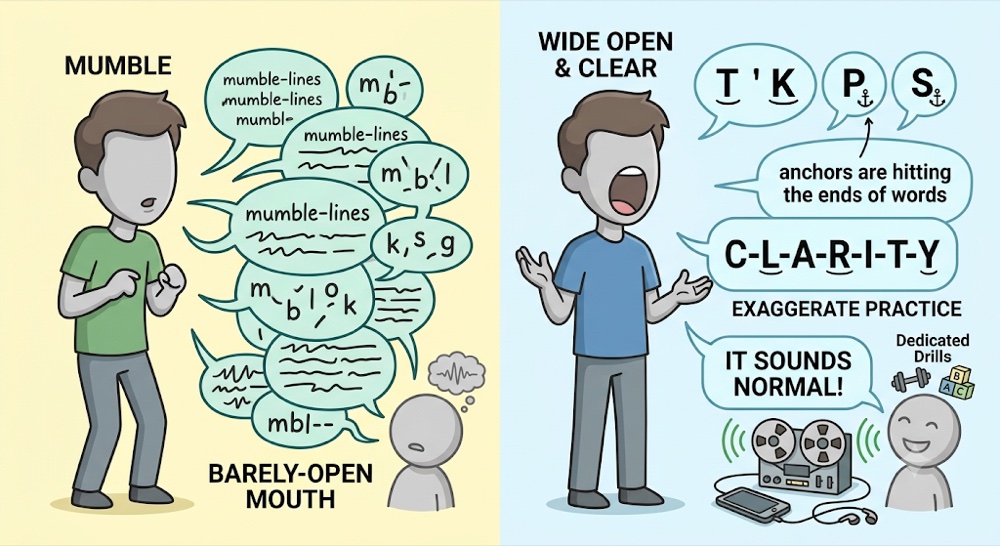
Mumbled words come from a barely-open mouth and lazy consonants. Exaggerate for practice: open wider than feels natural and hit the ends of words. It will feel over the top from the inside and sound completely normal on the recording. The dedicated drills live in diction and articulation exercises and how to speak clearly and confidently, but the core habit is the same one: say a tricky line, play it back, and listen for the consonant that collapsed.
Warm up before it matters
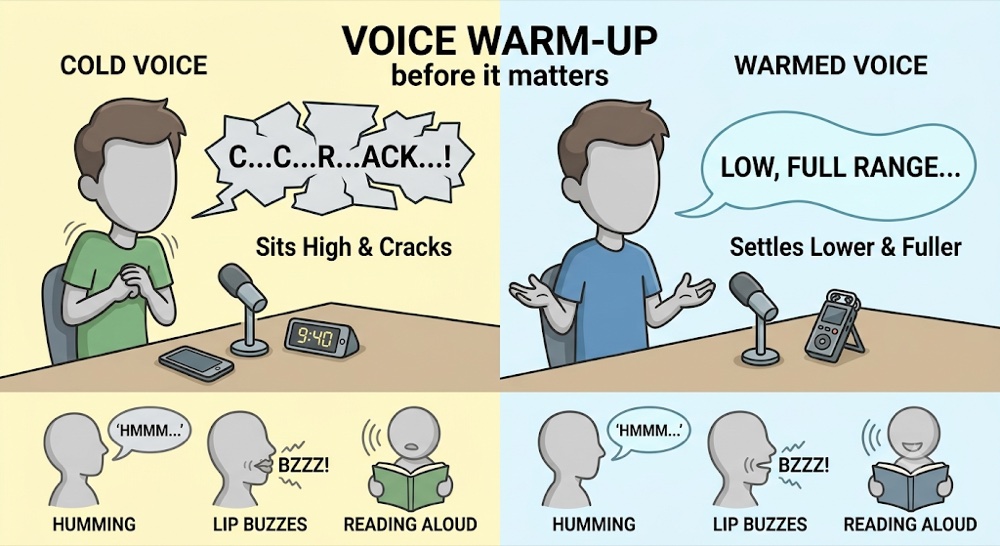
A cold voice cracks and sits high. A minute of gentle humming, some lip buzzes, and reading a few lines out loud settles it into its lower, fuller range before a call, a class, or a presentation. The full routine is in voice training for beginners. Warming up with the recorder running gives you a baseline take, so you can compare where your voice starts and where it settles.
The habit that ties it all together
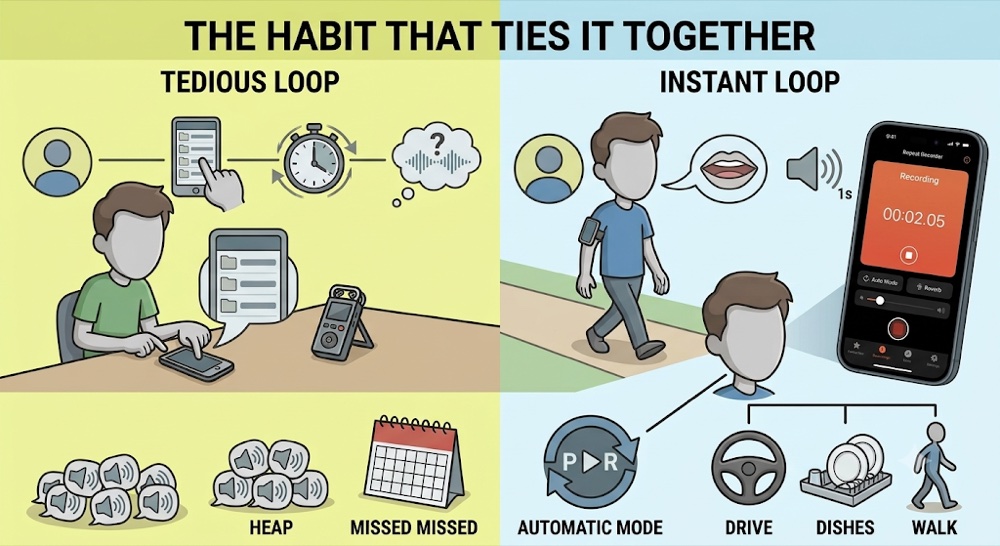
Every exercise above shares one requirement: you have to hear yourself, immediately, and try again. That is the loop, and it is exactly what an ordinary voice recorder makes tedious. You stop, hunt for the file, press play, and by the time it starts you have forgotten what you were trying to fix.
Repeat Recorder removes that dead time. You speak, and a second later your take plays back on its own. In automatic mode you never touch the screen, so you can run these exercises while driving, walking, or doing the dishes, not only at a desk.
Why Repeat Recorder beats the voice recorder on your phone
Your phone already has a voice recorder, and it is fine for capturing a memo. For practice it fights you, because practice is not one recording, it is dozens of short takes you want to hear back the instant you finish.
- Instant replay, a second after you stop, with no file to find.
- Hands-free automatic mode, so you can practise on a commute or a walk.
- Loop a take once, a set number of times, or until you stop it.
- A countdown before recording, so you get a breath to prepare.
- Named folders for the phrases you are drilling this week.
- Reverb to hear how a line would sit in a room with some space in it.

| For voice practice | Repeat Recorder | Phone voice recorder |
|---|---|---|
| Records your voice | ✔ | ✔ |
| Plays each take back automatically | ✔ | Find the file, press play |
| Hands-free, no tapping | ✔ | Tap to record and to play |
| Loop a phrase as often as you want | ✔ | One play at a time |
| Countdown before recording | ✔ | Starts immediately |
| Save takes into named folders | ✔ | One flat list |
| Reverb to simulate a room | ✔ | Dry recording only |
| Free | ✔ | ✔ |
A simple daily routine
- One minute: hum and read a few lines to warm up, recorder running.
- Two minutes: read a paragraph on full diaphragm breaths, listen, fix the fade, repeat.
- Two minutes: read it again slower and more clearly, then compare the two takes.
Five minutes a day, with feedback, beats an hour of talking into the void. The voice you want is a few weeks of short, honest repetitions away.