
Reading silently and reading out loud feel like the same skill, but they train completely different things. Silent reading is about taking words in. Reading aloud is a performance: your breath, your mouth, your pace and your ear all working at once. It is one of the oldest and most reliable ways to sharpen diction, steady your pace and build the confidence to speak in front of others, and the fastest way to improve at it is to hear yourself. Recording a passage and playing it back shows you the mumbles and the rushed lines you never notice while speaking, and that record-and-replay loop is exactly what the free Repeat Recorder app was built for.
The quick answer: to get better at reading out loud, read a short passage while recording, then play it back and listen for the words you slurred, the places you sped up, and the sentences that lost their shape. Re-read those until they flow. Do it daily and your diction, pace and confidence all improve together. Repeat Recorder plays each take straight back and loops it hands-free, so you can practise while you walk or commute, not only at a desk. 

Why reading out loud does what silent reading never can
The moment you say the words instead of scanning them, a different set of muscles and skills switches on. That is the whole value, and it is why reading aloud has survived as a practice for centuries.
- It forces full articulation. Silently, your eye can skim a long word. Out loud you have to actually form every syllable, which is what trains crisp diction.
- It exposes your real pace. A sentence that felt fine in your head turns out to be rushed or breathless when spoken. Only reading aloud reveals it.
- It rehearses breathing and phrasing. You learn where to breathe and where to pause, the same skills a good speaker uses, because the punctuation finally means something physical.
- It builds the confidence to be heard. Hearing your own voice fill a room, again and again, makes speaking up feel normal instead of frightening.
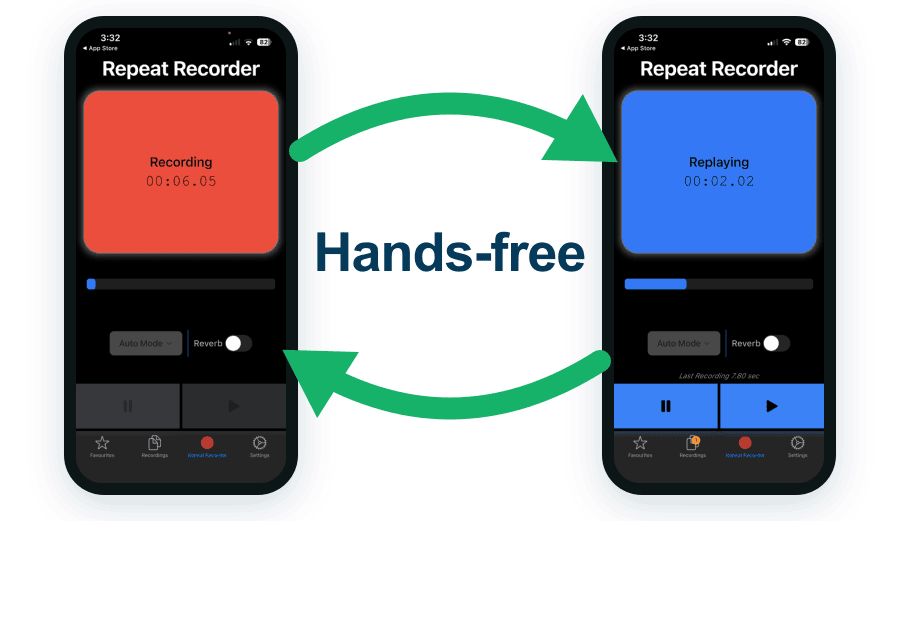
The record and replay loop in Repeat Recorder: read the passage, hear it back, and reread the lines that slipped.

What reading aloud actually improves: diction, pace and confidence
Three specific things get better, and a recording lets you track each one instead of just hoping.
- Diction gets crisper. Played back, you can hear exactly which endings you drop and which clusters you slur, and drill just those until every word lands clearly.
- Pace gets steadier. The recording shows you where you sprint and where you stall, so you can even it out and stop the nervous rush that swallows words.
- Expression gets richer. When you can hear a flat, monotone take, you can read it again with the stress and rise and fall that hold a listener.
- Confidence follows the evidence. Hearing a passage improve from a shaky first take to a clean one is proof you can point to, and that proof is what steadies your nerves.

How to practise reading out loud, step by step: record, listen back, reread
The method is short and repeatable. Work with passages you find a little challenging, not ones you can already breeze through.
- Choose a short passage. A few paragraphs of an article, a story, or a speech. Long enough to have rhythm, short enough to reread several times.
- Read it aloud at a natural pace, recording. Do not perform yet, just read it the way you normally would. This first take is your honest baseline.
- Play it back and listen as an outsider. Mark the mumbled words, the rushed sentences, and any place the meaning got lost.
- Reread with one thing to fix. Slow the rushed part, or over-articulate the slurred word, then record again and check it improved.
- Loop the hard sentence. The one line that keeps tripping you gets its own short recording, looped until it stops being the weak point.

Common reading-aloud mistakes a recording catches that your ear misses live
These are the habits almost everyone has and almost no one notices in the moment. The recording makes them obvious.
- Speeding up out of nerves. The commonest fault by far. On playback you will hear the pace climb, especially as sentences end.
- Dropping the ends of words. Final consonants and syllables get swallowed. Heard back, the slur is unmistakable, and easy to fix once you know it is there.
- Ignoring the punctuation. Running commas and full stops together makes you sound breathless. The recording shows you where a pause was needed.
- A flat, single-note delivery. It feels expressive from the inside and sounds monotone from the outside. Only a recording tells you the truth.
Why Repeat Recorder beats the voice recorder on your phone for reading practice
Your phone already has a voice recorder, and it is fine for a memo. Reading practice is a different job: many short takes you want to hear back instantly and reread hands-free while your eyes stay on the page.
- Instant replay the second you finish, so you catch the slur while it is fresh.
- Hands-free automatic mode, so your hands stay on the book and your practice can happen on a walk.
- Loop a sentence once, a set number of times, or until you stop it, so a hard line gets drilled as long as it takes.
- A countdown before recording, so you get a breath before the first word.
- Named folders for the passages you are working through this week.
- Reverb to hear how your reading would carry in a bigger room.
| For reading out loud | Repeat Recorder | Phone voice recorder |
|---|---|---|
| Records your reading | ✔ | ✔ |
| Plays the take back automatically | ✔ | Find the file, press play |
| Hands-free while you walk or drive | ✔ | Tap to record and to play |
| Loop a phrase as often as you want | ✔ | One play at a time |
| Countdown before recording | ✔ | Starts immediately |
| Save takes into named folders | ✔ | One flat list |
| Free | ✔ | ✔ |

A simple daily reading-aloud routine
- One minute: pick a short passage a little above your comfort level.
- Two minutes: read it aloud at a natural pace, recording, then listen back and mark the worst two spots.
- Three minutes: reread just those spots, slower and clearer, until they flow, then read the whole passage once more.
- Anytime: loop yesterday's hard sentence on your commute and say it under your breath.
A few minutes a day, out loud and recorded, sharpens your speech faster than hours of silent reading. The page gives you the words; your recording gives you the honest feedback; rereading turns it into clear, confident delivery.