
You do not need a classroom or a coach to change the way you sound. An accent is a set of physical habits, the exact vowels you land on, where you put the stress, the melody of a sentence, and habits are changed by hearing a model, copying it, and checking yourself against it. The one thing you cannot skip is that check, because while you are speaking you are far too busy to hear your own slips. Recording yourself and comparing your take to a native model is what turns vague effort into steady progress, and that record-and-replay loop is exactly what the free Repeat Recorder app was built for.
The quick answer: to practise an accent at home, pick a short clip of a native speaker in the accent you want, loop it, and shadow it aloud, copying the sounds, stress and rhythm. Then record your own version and play it back next to the model. The gap you hear is your next target. Drill one sentence at a time, hands-free, until the new sound comes out without thinking. Repeat Recorder plays each take straight back and loops it while you walk or commute, so the reps add up. 

Why you can train an accent at home without classes or a coach
A coach mostly does three things: gives you a model to copy, tells you where you are off, and makes you repeat it. A recording lets you supply all three yourself, on your own schedule.
- Native audio is a perfect model on demand. A short clip of the accent you want, looped, is an ideal you can copy as many times as you like without anyone getting tired of repeating it.
- Your recording is the honest feedback. Played back, it shows you the exact vowel or stress that is off, and you can replay that one word until you hear precisely what to fix.
- Repetition is the whole method. New mouth positions are physical habits, and habits form through reps. The more you can fit in, the faster the accent settles.
- No audience, no self-consciousness. Alone you can sound as exaggerated or as wrong as you need to while the new sounds bed in, which is exactly the freedom a class does not give you.
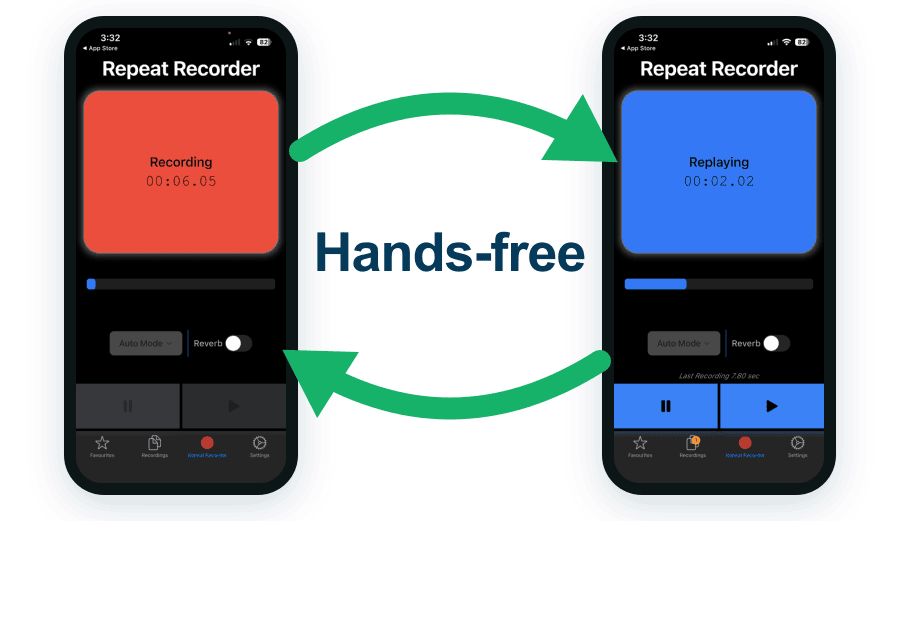
The record and replay loop in Repeat Recorder: say the line, hear it back, compare it to the model, and go again.

Record and compare: the one method that fixes an accent faster than anything else
Everything else is detail. This four-step loop is the core, and it works because it turns your own ear into the coach that catches what you cannot hear mid-sentence.
- Pick one short native sentence. From a film, a podcast, or a pronunciation video. Keep it to a single sentence so you can hold its whole rhythm in your head.
- Loop it and shadow it aloud. Play it on repeat and speak along, copying not just the words but the vowels, the stressed syllables and the melody. This is shadowing, and it trains your mouth to move like the model's.
- Record your own version. Say the sentence yourself, without the model playing, and record it.
- Play both back and hear the gap. A flattened vowel, a stress in the wrong place, a rushed ending: whatever you hear is your exact next target. Record again and close it.

How to practise an American accent at home: the sounds and rhythm to target
A General American accent has a few features that carry most of the effect. Drill these with the record-and-compare loop.
- The rhotic R. Americans pronounce the R at the end of words like car and water. If your accent drops it, this single change moves you a long way. Record word pairs and check the R is really there.
- The T that softens to a D. In the middle of words like water and better, American speech taps the T so it sounds close to a D. Loop a native clip and copy the softening.
- Relaxed, even rhythm. American speech tends to be steady and slightly slower, with strong stress on the key word. Listen back for places you rushed or clipped.
- The broad A vowel. Words like cat and bath use a flatter, wider vowel than in many other accents. Record and compare the vowel until it matches.

How to practise a British accent at home: what actually changes
A standard British (RP-style) accent moves in almost the opposite direction on several of the same features. Target these.
- The dropped R. The R at the end of car or far largely disappears, and the vowel lengthens instead. Record and check you are not sounding the R.
- The crisp T. The T stays a clear, sharp T in the middle of words, the opposite of the American tap. Loop a model and copy the crispness.
- The long broad A. Words like bath, grass and dance take a long open ah. This vowel does a lot of the work, so drill it on its own.
- A more varied melody. British intonation tends to rise and fall more across a sentence. Record a full sentence and compare the tune, not just the sounds.

Why looping and shadowing a phrase hands-free is what makes a new accent automatic
Knowing how a sound is made is not the same as making it without thinking. The bridge is repetition, and the more of it you can do, the sooner the new accent stops being an effort.
- Muscle memory needs volume. Your tongue, lips and jaw are learning new default positions, and that is physical training built from many reps.
- Hands-free multiplies the reps. If a target phrase loops in your ears on a walk and you shadow it under your breath, the day fills with practice you would otherwise never do.
- Looping isolates the hard sound. Put the one word that keeps defeating you on repeat and drill only that, instead of running whole passages and hoping.
- Automatic is the finish line. You have the accent when it comes out right while you think about the meaning, not the mouth. Reps get you there.
Why Repeat Recorder beats the voice recorder on your phone for accent practice
Your phone already has a voice recorder, and it is fine for a memo. Accent practice is a different job: many short takes you want to hear back instantly, compare against a model, and loop hands-free while your eyes and hands are busy.
- Instant replay the second you finish, so you catch the vowel while it is fresh.
- Hands-free automatic mode, so you practise on a walk or a commute.
- Loop a phrase once, a set number of times, or until you stop it, so a hard sound gets drilled as long as it takes.
- A countdown before recording, so you have a beat to set your mouth and start cleanly.
- Named folders for the sounds or the accent you are drilling this week.
- Reverb to hear how your speech would carry in a real room.
| For accent practice | Repeat Recorder | Phone voice recorder |
|---|---|---|
| Records your voice | ✔ | ✔ |
| Plays the take back automatically | ✔ | Find the file, press play |
| Hands-free while you walk or drive | ✔ | Tap to record and to play |
| Loop a phrase as often as you want | ✔ | One play at a time |
| Countdown before recording | ✔ | Starts immediately |
| Save takes into named folders | ✔ | One flat list |
| Free | ✔ | ✔ |

A simple daily accent-practice routine you can do alone
- Five minutes: pick one native model sentence, loop it, and shadow it aloud until your mouth matches the rhythm.
- Five minutes: record your own version, compare it to the model, and re-record until the gap closes.
- Five minutes: read a fresh paragraph in the target accent, listen back, and mark the one sound to fix tomorrow.
- Anytime: loop today's phrase hands-free on your commute and shadow it under your breath.
Fifteen minutes a day, out loud and recorded, will move your accent faster than any amount of silent listening. The model shows you the target; your own recording shows you the gap; repetition closes it.