Crisp speech is not about a bigger voice, it is about fully forming your consonants and not letting your word endings drop. The drills below are simple and take a few minutes a day. The part that actually makes them work is feedback: recording a rep, hearing exactly what blurred, and saying that line again. That loop is what the free Repeat Recorder app was built for.
The quick answer: to sharpen your diction, over-articulate a line by exaggerating your mouth movement then relax back to normal, run classic tongue twisters slowly before speeding up, and hit the final consonants (t, d, k, p) instead of swallowing them. Then do the one thing most people skip: record each rep and play it back, because a collapsed consonant is invisible from the inside. Repeat Recorder plays each take back a second after you speak, so you hear the sound that slipped while it is still fresh. 
Why you have to hear yourself to fix your diction
A collapsed consonant or a dropped word ending is almost impossible to catch from the inside, because your brain hears what you intended to say, not what actually left your mouth. You think you said "facts" but the recording says "fax". That is why articulation improves fastest the moment you can hear the difference between the rep you just did and the one before it. Every drill below works better with playback, so record each one, listen for the exact sound that blurred, then redo just that line.
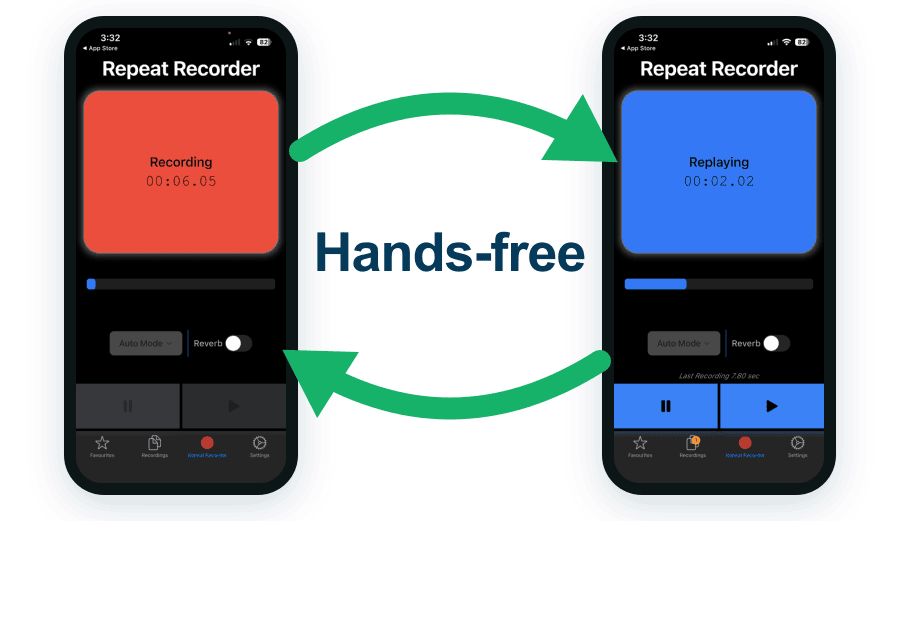
The record and replay loop in Repeat Recorder: speak a line, hear it back a second later, then go again.
Articulation exercises
Articulation is the physical work your tongue, lips and jaw do to shape each sound. Most unclear speech is simply lazy movement: the mouth barely opens and the tongue never fully reaches its target. The fix is to train the movement bigger than you need, then dial it back to normal.
Exercise 1: Over-articulate, then relax
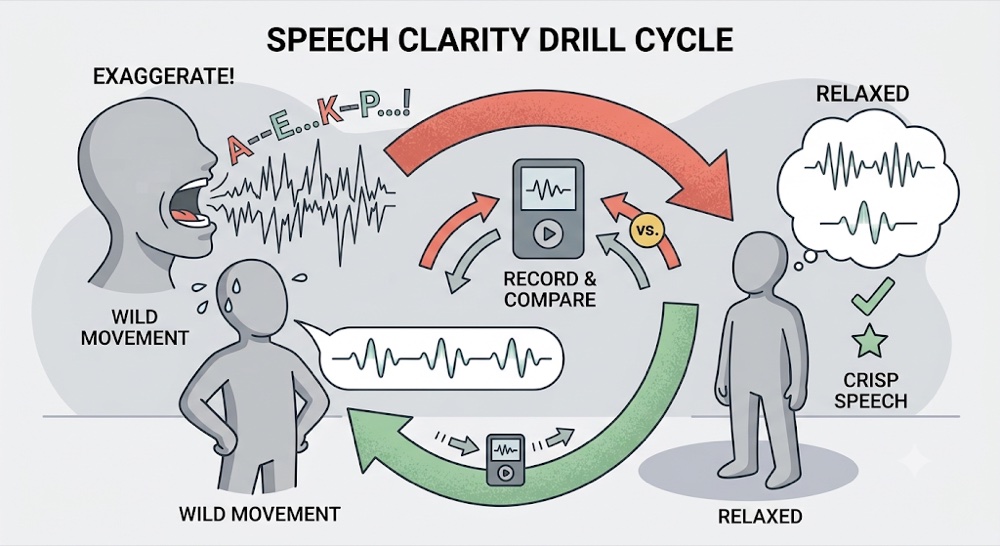
Read a sentence while wildly exaggerating your mouth movement, stretching every vowel and slamming every consonant. It will feel absurd from the inside. Then read the same sentence at a normal, relaxed effort. Record both. The relaxed version will now sound noticeably crisper than your usual speech.
Exercise 2: The pen (or cork) drill
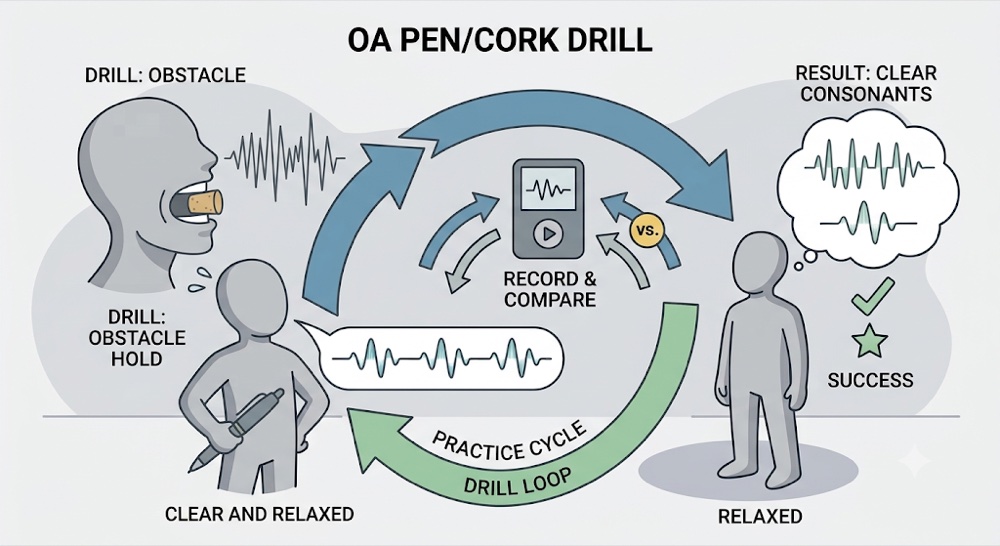
Hold a pen or a wine cork gently between your front teeth and read a line out loud. Your tongue and lips have to work much harder to be understood around the obstacle. Take it out and read the same line again. Everything suddenly feels easy, and the recording proves your consonants landed.
Exercise 3: Hit the final consonant
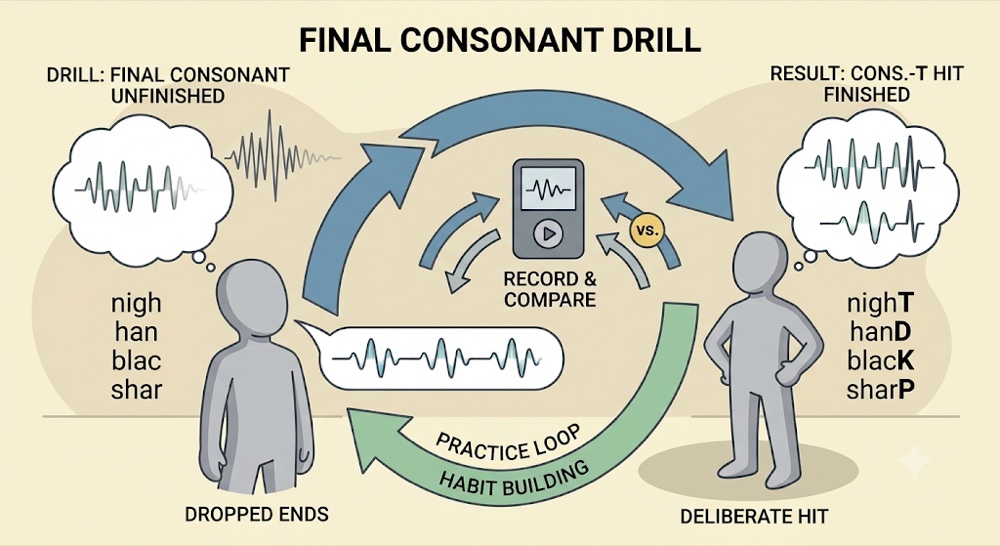
Read a list of words that end in a hard stop (t, d, k, p) and deliberately land that last sound: "night", "hand", "black", "sharp". Dropped endings are the single most common diction problem, and they vanish once you make a habit of finishing the word.
Enunciation exercises
Enunciation is articulation applied to whole phrases: keeping every syllable distinct instead of letting words run into each other. "Did you eat?" collapses into "Djeet?" the moment you stop paying attention. These drills keep the seams between words intact.
- Separate the words. Take a fast, mumble-prone phrase ("What are you doing?") and read it with a tiny, deliberate gap between each word. Record it, then close the gaps back to a normal rhythm while keeping each word whole.
- Syllable by syllable. Pick a long word you tend to slur ("particularly", "comfortable", "specifically") and say it one clean syllable at a time, then at speed. Play it back and check that no middle syllable disappeared.
- Read on a steady breath. Read a paragraph out loud without letting the volume fade at the end of sentences, because endings are where enunciation slips first. If the last few words got mushy on the recording, you ran low on air, so take a fuller breath and go again.
Tongue twisters that actually help
A tongue twister forces your articulators through awkward consonant sequences, so it is genuine precision training, but only if you do it right. The trap is racing through it and mumbling, which just rehearses the mistake. Say it slowly and completely cleanly first, then build speed only while it still sounds clean.
- Red leather, yellow leather. A workout for your lips and tongue tip. Say it three times slowly and perfectly, then a little faster.
- Unique New York. Brutal on the jump between "k" and "N". Slow, clean, then speed up.
- The sixth sick sheikh's sixth sheep. Notorious for the "s" and "sh" switching, so it trains the difference between the two.
Record three passes of each: slow, medium, fast. Play them back and you will hear the exact point where a sound started to smear. Loop that one line and clean it up before you push the pace again.
How to enunciate clearly
Put the pieces together into a short, honest routine. Slow down slightly, open your mouth more than feels natural, land every final consonant, and keep the words separate. None of that is hard to do for one sentence. The difficulty is noticing when you have stopped doing it, and that is exactly what recording solves. You cannot correct diction you have never heard from the outside, so make playback part of every rep rather than something you do at the end.
Repeat Recorder plays each take back a second after you speak, so the gap between saying a line and hearing it disappears. In automatic mode you never touch the screen, so you can run these drills while driving, walking, or doing the dishes, and loop a tricky line as many times as you need until the sound lands.
Why Repeat Recorder beats the voice recorder on your phone
Your phone already has a voice recorder, and it is fine for capturing a memo. For diction practice it fights you, because practice is not one recording, it is dozens of short reps you want to hear back the instant you finish so you can catch the sound that slipped.
- Instant replay, a second after you stop, with no file to find.
- Hands-free automatic mode, so you can drill on a commute or a walk.
- Loop a line once, a set number of times, or until you stop it.
- A countdown before recording, so you get a breath to prepare.
- Named folders for the phrases and twisters you are drilling this week.
- Reverb to hear how a line would sit in a room with some space in it.

| For diction practice | Repeat Recorder | Phone voice recorder |
|---|---|---|
| Records your voice | ✔ | ✔ |
| Plays each take back automatically | ✔ | Find the file, press play |
| Hands-free, no tapping | ✔ | Tap to record and to play |
| Loop a line as often as you want | ✔ | One play at a time |
| Countdown before recording | ✔ | Starts immediately |
| Save takes into named folders | ✔ | One flat list |
| Reverb to simulate a room | ✔ | Dry recording only |
| Free | ✔ | ✔ |
A simple daily routine
- One minute: the pen drill on a couple of lines, recorder running, then read them again without it.
- Two minutes: one tongue twister slow, medium, fast, looping the line that smeared until it is clean.
- Two minutes: read a paragraph landing every final consonant, listen back, and fix the words that dropped.
Five minutes a day, with feedback, beats an hour of talking into the void. The clearer diction you want is a few weeks of short, honest repetitions away.