The most common reason learners stay stuck is not grammar or vocabulary, it is that they almost never speak. Reading, listening, and app drills are easy to do alone, so speaking gets skipped for want of a partner. But speaking is the one skill you can only build by doing, and you do not actually need another person to do it. You need a way to say things out loud, hear yourself honestly, and compare that to how it should sound. Recording yourself gives you all three, and the record-and-replay loop is exactly what the free Repeat Recorder app was built for.
The quick answer: to practice speaking English alone, record yourself. Pick a short phrase or answer a question out loud while recording, play it back and compare it to how a native speaker says the same thing, then record it again and close the gap. Loop a native model, shadow it aloud, and check your own take against it. Do fifteen focused minutes a day and speaking becomes automatic. Repeat Recorder plays each take straight back and loops it hands-free, so you can practise while you walk, commute, or cook. 

Why you do not need a conversation partner to improve your spoken English
A partner is useful, but most of what a good partner gives you, you can supply yourself with a recording. The belief that you are blocked without one keeps people from ever starting, and starting is the whole game.
- The bottleneck is speaking time, not company. Fluency comes from hours of your own mouth forming English. A recording lets you rack up those hours any time, with no scheduling and no one to feel shy in front of.
- You can be your own feedback. A partner points out what sounded off. A recording lets you hear it yourself, which is more precise, because you can replay the exact word as many times as you need.
- A native model is a perfect partner on demand. A clip of a native speaker, looped and shadowed, gives you an ideal to copy that never gets tired and never rushes you.
- Alone means no embarrassment. The fear of sounding wrong in front of someone is exactly what stops many learners from speaking. On your own you can be as clumsy as you need to be while you improve.
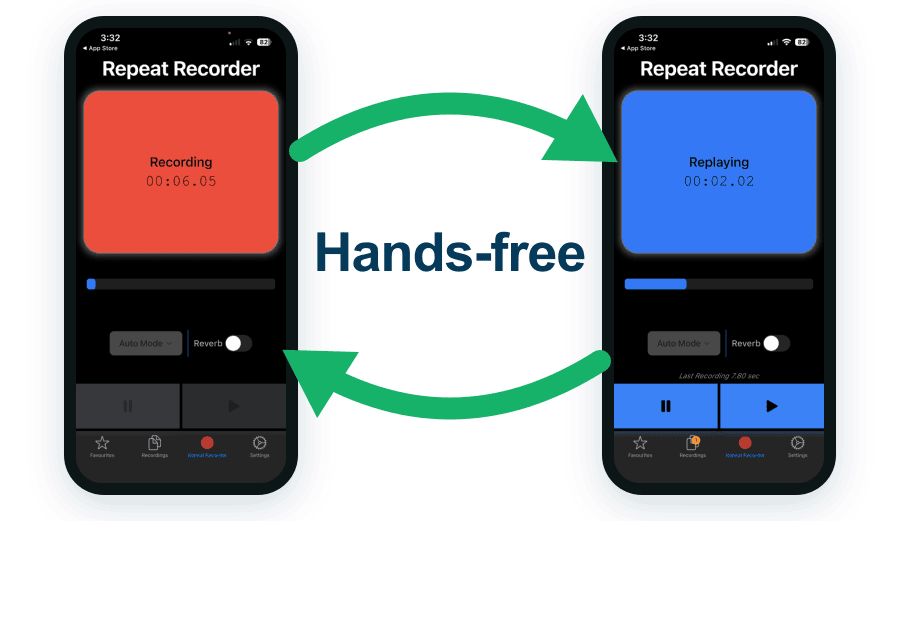
The record and replay loop in Repeat Recorder: say the phrase, hear it back, compare it to the model, and go again.

Record and compare: the fastest way to fix pronunciation you cannot hear while you speak
The core method is a loop of four steps, and it works because it turns your own ear into the coach. You cannot correct a sound you never notice, and while you are speaking you are too busy to notice.
- Find a short native model. A sentence from a video, a podcast, or a phrase you want to master. Keep it short, one sentence, so you can hold the whole rhythm in your head.
- Loop it and shadow it aloud. Play the model on repeat and speak along with it, copying the sounds, the stress, and the melody, not just the words. This is shadowing, and it trains your mouth to move like a native speaker's.
- Record your own version. Now say the sentence yourself, without the model playing, and record it.
- Play both back and hear the gap. Compare your take to the model. The difference you hear, a flattened vowel, a missing stress, a rushed ending, is your exact next target. Record again and close it.

What to practise when you are on your own: read-alouds, self-talk, and answering questions out loud
You never run out of material to speak, even with no one to speak to. Rotate through these so practice stays varied and useful.
- Read passages aloud. Read a paragraph from an article or book into a recording, then listen for the words that tripped you and the sentences that lost their rhythm. Re-read those until they flow.
- Describe your day out loud. Narrate what you did, what you are about to do, or what is around you. This builds the everyday fluency conversation actually needs, and it is free and endless.
- Answer common questions. Record yourself answering "what do you do", "tell me about your weekend", "what did you study". These are the exchanges you will really have, so rehearse them.
- Retell what you just watched. After a video or a scene, summarise it out loud from memory and record it. You practise real, connected speech instead of isolated phrases.
- Repeat useful chunks. Collect the set phrases you keep needing ("could you say that again", "what I mean is", "it depends on") and loop them until they come out without thinking.

Why looping and shadowing a phrase hands-free is what makes new sounds automatic
Understanding how a sound is made is not the same as being able to make it without thinking. The bridge between the two is repetition, and the more of it you can do, the faster the sound becomes yours.
- Repetition builds the muscle memory. Your tongue, lips, and jaw have to learn new positions. That is physical training, and physical training is just reps done often.
- Hands-free multiplies the reps. If practice only happens at a desk, you get a little. If a phrase loops in your ears while you walk or wash dishes and you shadow it aloud, the day fills with reps you would otherwise never do.
- Looping fixes one thing at a time. Put the single sentence that keeps defeating you on repeat and drill only that until it clicks, instead of running the whole passage and hoping.
- Automatic is the goal. You are done with a phrase not when you can say it carefully, but when it comes out right while you are thinking about something else. Reps are what get you there.
Why Repeat Recorder beats the voice recorder on your phone for speaking practice
Your phone already has a voice recorder, and it is fine for a memo. Speaking practice is a different job, because it is many short takes you want to hear back instantly, compare, and loop hands-free while your eyes and hands are busy.
- Instant replay the second you finish, so you catch the slip while it is fresh.
- Hands-free automatic mode, so you practise on a walk or a commute.
- Loop a phrase once, a set number of times, or until you stop it, so a hard sound gets drilled as long as it takes.
- A countdown before recording, so you have a beat to breathe and start cleanly.
- Named folders for today's phrases, this week's sounds, or a set of answers.
- Reverb to hear how your speech would carry in a real room.
| For speaking practice | Repeat Recorder | Phone voice recorder |
|---|---|---|
| Records your voice | ✔ | ✔ |
| Plays the take back automatically | ✔ | Find the file, press play |
| Hands-free while you walk or drive | ✔ | Tap to record and to play |
| Loop a phrase as often as you want | ✔ | One play at a time |
| Countdown before recording | ✔ | Starts immediately |
| Save takes into named folders | ✔ | One flat list |
| Free | ✔ | ✔ |

A simple daily English speaking routine you can do alone
- Five minutes: pick one native model sentence, loop it, and shadow it aloud until your mouth matches the rhythm.
- Five minutes: record your own version, compare it to the model, and re-record until the gap closes.
- Five minutes: speak freely, describe your day or answer a common question, and record it, then listen back for one thing to improve.
- Anytime: loop today's phrase hands-free on your commute and shadow it under your breath.
Fifteen minutes a day, out loud and recorded, will move your speaking faster than hours of silent study. You already have everything you need to practise: your voice, your ears, and a way to loop them together. The partner was never the missing piece.