The reason a good answer collapses in the room is almost never that you did not know it. It is that you only ever ran it in your head, where it was a vague idea rather than a finished sentence. Interviewers do not hear your idea, they hear the words that come out, complete with the rambling, the filler, and the lost thread you never noticed silently. The fix is to rehearse the thing you will actually do: say your answers out loud, record them, and listen back. That record-and-replay loop is exactly what the free Repeat Recorder app was built for.
The quick answer: to practice for an interview, write out the questions you are most likely to get, then say a full answer to each one out loud while recording. Play it back and listen for rambling, filler words, and pace, then re-record until the answer is tight and sounds natural. Hearing the take is the only way to catch how you actually come across, which is nothing like how you sound from the inside. Repeat Recorder plays every take straight back and loops it hands-free, so you can drill answers on a walk or a commute, not only at a desk. 

Why rehearsing answers in your head is the reason they fall apart in the room
Silent rehearsal feels like preparation, but it trains none of the skills the interview actually tests. Speaking a clear answer under mild pressure is a physical performance, and you cannot practise a performance by thinking about it.
- In your head, an answer is never finished. You think in gist, not sentences, so the gaps stay invisible until the moment you have to fill them out loud and find you cannot.
- You never hear your own filler. The um, like, and you know that pepper a spoken answer are inaudible to you in the moment. On a recording they are obvious, and once you hear them you stop making them.
- Pace and rambling only show up out loud. A point that felt crisp in thought turns into a ninety-second tangent when spoken. You cannot judge the length or shape of an answer until you have said the whole thing and heard it back.
- The room adds nerves you have not rehearsed against. If the first time you ever say the answer aloud is to the interviewer, you are performing it live for the first time under the most pressure. Recorded practice moves that first time somewhere safe.
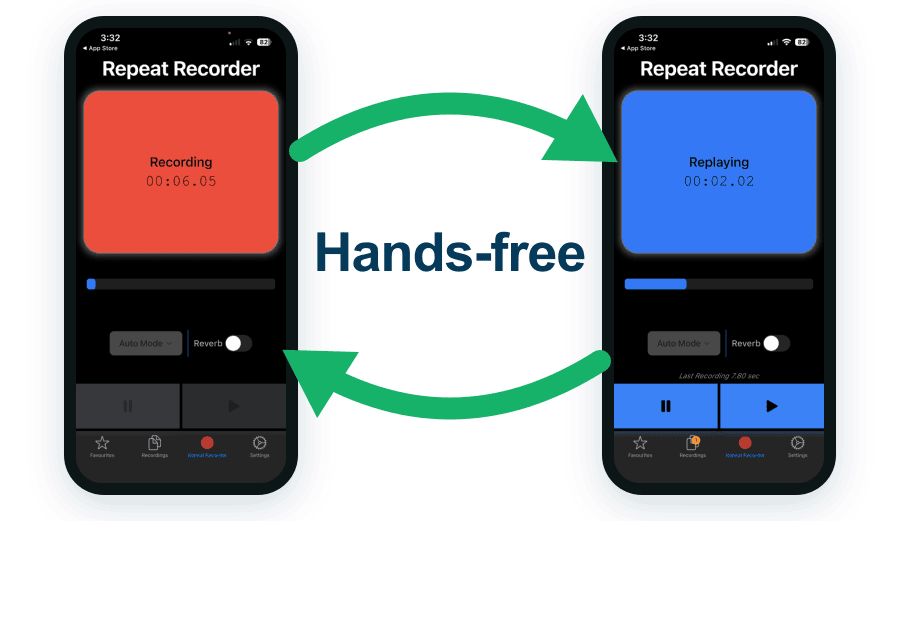
The record and replay loop in Repeat Recorder: say the answer, hear it back a second later, then tighten it and go again.

How to practice interview answers step by step: record, listen back, and tighten each answer
This is the whole method, and it works for any format, from a phone screen to a panel. Do it one question at a time and keep the takes short.
- List your likely questions. Start with the universals ("tell me about yourself", "why this role", "a time you handled a conflict") and add the ones specific to the job and your field. Ten to fifteen is plenty.
- Answer each one out loud, recording as you go. No script. Say the answer the way you would in the room, start to finish, even the messy first attempt. The mess is the point: it shows you what to fix.
- Play it straight back and listen as the interviewer would. Is it too long? Where does it wander? How many fillers? Did you actually answer the question asked, or drift?
- Re-record with one fix in mind. Change a single thing per take: cut the ramble, lead with the point, land the result. Small targeted takes beat one big vague retry.
- Stop when it sounds natural, not memorised. You are learning the shape of the answer, not the exact words. Once it comes out smoothly in a minute or two, that question is done.
- Loop the ones you fear. The two or three questions that make you tense get looped hands-free through the week so the answer is a reflex by the day.

Use the STAR method for behavioural questions and record until the story lands in under two minutes
Behavioural questions ("tell me about a time...") are where people ramble most, and a simple structure fixes it. Record your stories against the STAR shape and play them back to check each part is actually there.
- Situation and Task, fast. Set the scene in a sentence or two. On playback, if the setup runs longer than the point, cut it.
- Action, in the first person. What you did, not what the team did. Listening back, count how many times you say "we" where you should say "I".
- Result, with a number if you have one. The answer has to end somewhere concrete. If your recording trails off with no outcome, that is the fix for the next take.
- Under two minutes, checked by the clock. A recording gives you the real runtime. Most strong behavioural answers land between sixty and ninety seconds, and the playback tells you the truth.
Drill your answers with Repeat Recorder: say it, hear it back, then say it again
Every method on this page is the same short loop repeated: answer out loud, listen to the take, change one thing, answer again. Repeat Recorder, my own app, was built for that loop and little else. It records you, plays the take straight back about a second after you stop, and then starts recording again, all without you touching the phone.
- Repeat Recorder plays an answer back about a second after you stop, so you hear the filler and the rambling while you still remember what you meant to say. Judging a take is much easier when nothing sits between finishing the answer and hearing it, and there is no file to find first.
- A countdown runs before recording starts, which rehearses the beat between a question landing and your first word. The nerves this article warns about arrive in exactly that beat, so practising it is what stops the interview being the first time you have ever started an answer under pressure.
- Hands-free automatic mode records and replays on its own, so the two or three questions you dread get drilled on a walk or a commute rather than only at a desk. Any take can loop once, a set number of times, or until you stop it, which is how a scary question becomes a reflex by the day.

How to run a solo mock interview when you have no one to practise with
You do not need a partner or a coach to run a realistic mock. A recording plus a little discipline gives you most of the benefit of a live rehearsal.
- Record the questions first, in a random order. Read your question list into the app with a pause after each, then play it back cold so you answer without knowing what is next, the way a real interview feels.
- Answer on the spot, no restarts. Let the awkward pauses and recoveries happen. Practising the recovery is as valuable as practising the answer.
- Add a countdown for pressure. A few seconds before recording mimics the beat between the question and your reply, so you rehearse starting under mild stress.
- Review the whole set at the end. Listen back to the run as one piece and you will hear your patterns: the crutch word, the rushed opening, the answer that always overruns.

Why Repeat Recorder beats the voice recorder on your phone for interview prep
Your phone already has a voice recorder, and it is fine for a memo. Interview prep is a different job, because it is many short takes you want to hear back instantly and loop hands-free while you are doing something else.
- Instant replay the second you finish, so you go straight from answering to fixing.
- Hands-free automatic mode, so you drill answers on a walk or a commute.
- Loop an answer once, a set number of times, or until you stop it, so the scary question runs as often as it takes.
- A countdown before recording, so you rehearse starting under pressure.
- Named folders for each role or each round you are preparing for.
- Reverb to hear how you would carry in a bigger room.
| For interview practice | Repeat Recorder | Phone voice recorder |
|---|---|---|
| Records your answer | ✔ | ✔ |
| Plays the take back automatically | ✔ | Find the file, press play |
| Hands-free while you walk or drive | ✔ | Tap to record and to play |
| Loop an answer as often as you want | ✔ | One play at a time |
| Countdown to rehearse under pressure | ✔ | Starts immediately |
| Save answers into named folders | ✔ | One flat list |
| Free | ✔ | ✔ |

A simple interview-prep routine for the week before
- Day one: record a rough answer to every question on your list, then listen back and note the worst three.
- Days two to four: re-record the weak answers, one fix per take, until each one lands naturally in under two minutes.
- Daily: loop your two scariest questions hands-free on your commute so the answers become automatic.
- The night before: run the full set once as a cold mock, then leave it. You want it fresh, not over-drilled.
A few short recorded sessions will do more for you than hours of silent worrying. The answer you want already exists in your head. Recording it, hearing it, and tightening it is how you make sure the same answer comes out of your mouth when it counts.