
Read Aloud is the task most people rush past on their way to the harder-looking parts of PTE Speaking, and that is a mistake. It feeds a large share of your speaking and reading score at once, it is completely predictable, and it rewards exactly the kind of practice you can do alone: read a sentence on screen aloud, clearly and fluently, into the microphone. Because it is scored on fluency and pronunciation, the fastest way to improve is to hear yourself, catch the hesitations and mispronounced words, and repeat. That record-and-replay loop is exactly what the free Repeat Recorder app was built for.
The quick answer: to practise PTE Read Aloud, take a short paragraph, use the preparation time to scan it, then read it aloud into a recording at a steady pace with clear pronunciation. Play it back and listen for hesitations, mispronounced words, and flat delivery, then read it again and fix them. Fluency and pronunciation are what the task scores, so smooth and clear beats fast. Repeat Recorder plays each take straight back and loops the hard sentence hands-free. 
What PTE Academic is, what it costs, and who needs it
Before the Read Aloud detail, here is the test it sits inside, because the way PTE is built explains why Read Aloud matters and how it is judged.
- What it is. PTE Academic is a computer-based English test from Pearson, scored entirely by AI with no human examiner. Results usually land in one to two days and are valid for two years.
- Who needs it. Thousands of universities accept it for admission (across Australia, New Zealand, the UK, Canada and the US), and it is approved for visas and migration by Australia's Department of Home Affairs, Immigration New Zealand and UK visas. For Australian skilled migration, only PTE Academic counts, not PTE Core or General.
- The score scale. Every skill is scored from 10 to 90 on Pearson's Global Scale of English. Universities often want somewhere around 50 to 65, while migration points step up at higher bands, with a "superior English" 79 in each skill as the top rung. Always check the exact number your university or visa needs.
The fee varies by country and changes over time. As a rough guide:
| Where | Approximate fee |
|---|---|
| Australia | ~AUD 490 (about USD 315) |
| United States | ~USD 200–260 |
| India | ~₹18,900 |
| Typical worldwide | ~USD 180–320 |
Fees are indicative 2025–2026 figures and are adjusted periodically. Confirm the exact price for your centre and date when you book.
How the PTE test is structured, and where Read Aloud sits
PTE Academic is a single, uninterrupted session of about two hours, split into three parts. It is integrated-skills scored, so one task can feed more than one skill, and a weak skill can quietly drag down others.
| Part | Approx. time | What is in it |
|---|---|---|
| 1. Speaking & Writing | ~54–84 min | Read Aloud (the first scored task), Repeat Sentence, Describe Image, Re-tell Lecture, short answers, and written summaries and an essay. |
| 2. Reading | ~22–30 min | Fill-in-the-blanks, multiple choice, and re-order paragraphs. |
| 3. Listening | ~30–43 min | Summarize spoken text, write from dictation, multiple choice, and more. |
Read Aloud is the first scored task of Part 1, right after an unscored personal introduction, which is why getting it right sets the tone (literally) for your whole speaking score, and why it is worth drilling first.
Is PTE the hardest English test? How it compares to IELTS and TOEFL
Worth answering head-on, because the reputation and the reality differ.
- Usually not the hardest. Most test-takers find it easier to reach a high score on PTE than on IELTS, because the AI scoring is consistent and the task types are predictable and drillable.
- No human interview. There is no face-to-face speaking examiner; you speak to a microphone, which suits people who freeze in an interview.
- But the time pressure is real. Tasks are tightly timed and back-to-back, and the integrated scoring means a weak skill (often listening) quietly pulls down others.
- Versus IELTS and TOEFL. IELTS is the most language-intensive and uses a human speaking examiner who can be more forgiving; TOEFL is American-English oriented and computer-based like PTE. Which is "hardest" is individual.
- Bottom line. PTE is often the easiest of the three to score high on if you drill the formats and are comfortable with speed and machine grading. It is not objectively the hardest test.
How smart is the PTE scoring, and does the AI judge your accent fairly?
The scoring is smarter, and blunter, than people expect. Knowing how it thinks is half the battle.
- It is machine-scored, trained on human ratings. Pearson's engine (its Versant speech technology) was trained on responses graded by human experts, then replicates those standards. For Read Aloud, pronunciation and fluency are judged by the machine alone; a human only steps in for anomalies such as unclear audio.
- It matches your speech to the exact text. The system compares what you say against a model of the words on screen, so it checks both that you read the right words and that each one was recognisable English.
- You do not need a native accent. The pronunciation score rewards intelligibility and correct stress, not a British or American accent, so a clear Indian, Chinese or Nigerian accent can score highly.
- But clarity is everything. The top band leans native-like, so heavy features that blur sounds, drop consonants or misplace stress cap your score in the middle. It judges pronunciation (clarity and stress), not accent, but "clear and steady" is rewarded more than "expressive".
- A known quirk. Because it favours smooth, evenly paced, clearly articulated reading, some fluent native speakers actually score lower than well-drilled non-natives, because they pause naturally or vary their pace. Steady beats natural.
Can you pause during Read Aloud? The three-second silence rule
This is the rule that catches people out, and it is worth knowing before test day.
- You get preparation time first. After the text appears, a countdown (around 30 to 40 seconds) runs before the microphone opens. Use it to scan, spot hard words and plan your breaths; recording then starts automatically.
- Silence ends your recording. Once you start, if the microphone hears roughly three seconds of continuous silence, it assumes you have finished and stops, and you cannot restart. A long pause to think can literally cut you off mid-answer.
- Even short pauses cost you. Fluency is scored on smooth, continuous delivery, so hesitations, false starts and long gaps pull the score down even when they do not trigger the cutoff.
- So never stop to think. If you stumble on a word, keep going. A mispronounced word costs far less than a three-second silence that ends the recording.
The preparation window (~30–40s) and the silence cutoff (~3s) are widely reported by PTE tutors rather than published as exact official figures, so treat them as approximate.

Why the PTE Read Aloud task is worth more practice than people give it
Read Aloud looks simple, so it gets skipped. But its scoring weight and its predictability make it one of the best returns on practice in the whole test.
- It scores two skills at once. Because PTE marks are integrated, a good Read Aloud contributes to both your speaking and your reading scores, so improving it lifts more than one number.
- It is completely predictable. The task is always the same shape: a short text, a preparation window, then you read. Nothing is unseen, so practice transfers directly.
- It rewards solo practice perfectly. Fluency and pronunciation are trained by reading aloud and hearing yourself, which needs no partner and no examiner.
- Small fixes move the score. Cutting the hesitations and getting a few tricky words right is quick to do and directly raises what the task measures.
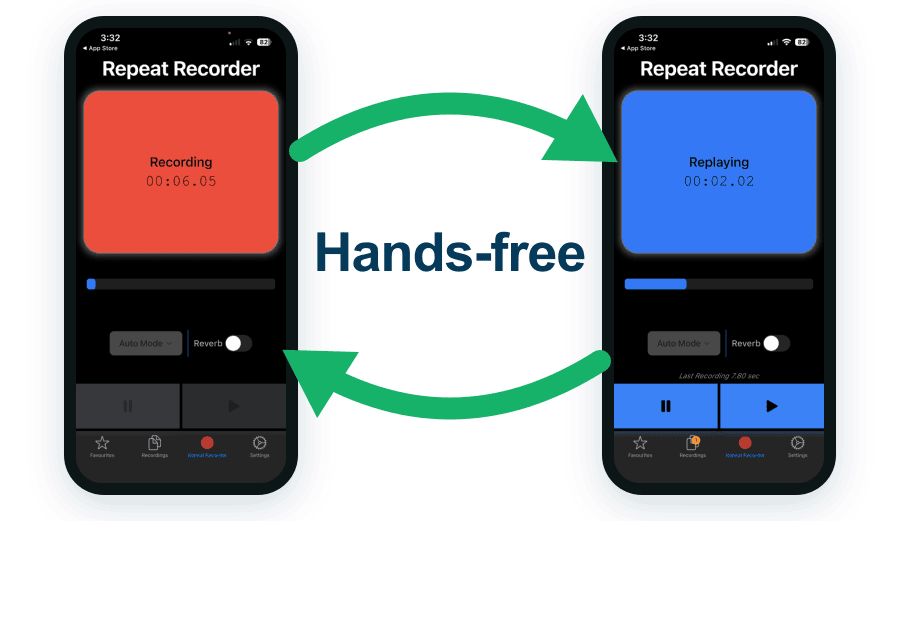
The record and replay loop in Repeat Recorder: read the paragraph, hear it back, and reread the words that tripped you.

What PTE Read Aloud actually scores: fluency, pronunciation and content
Knowing what the machine is listening for tells you exactly what to practise. Three things carry the mark.
- Fluency. A smooth, even pace with no long pauses, false starts, or repeated words. This is usually the biggest and most fixable win, and a recording shows every stumble.
- Pronunciation. Clear, recognisable sounds and correct word stress. You do not need a native accent, but the words must be understandable, so you compare your take against how a word should sound.
- Content. You have to read every word correctly, without adding, skipping, or swapping any. On playback you can check you matched the text exactly.
- The trade-off to know. Fluency and pronunciation pull against each other. Going fast for fluency causes slips, and going carefully for pronunciation causes pauses. Recording yourself is how you find the steady middle.

How to practise PTE Read Aloud at home: prepare, record, compare, repeat
Mirror the real task each time so your practice transfers straight to test day.
- Take a short paragraph. Two or three sentences of formal, academic-style text, the kind PTE uses. Practice texts are easy to find online.
- Use the preparation time to scan. Give yourself the same brief window the test does. Spot the long words and mark where you will breathe.
- Read it aloud into a recording, once. Steady pace, clear sounds, straight through, the way you would in the exam.
- Play it back and diagnose. Mark every hesitation, every mispronounced word, every place you sped up or paused too long.
- Loop and fix the hard words, then reread the whole thing. Drill the two or three words that tripped you, then read the full paragraph again and confirm it is smoother.

Common Read Aloud mistakes a recording catches that you miss live
These are the habits that quietly cost marks and that you cannot hear while you are concentrating on reading.
- Speeding up to sound fluent. Rushing causes slurred words and swallowed endings, which hurts pronunciation more than it helps fluency. The recording shows the rush.
- Long thinking pauses. A gap before a hard word reads as a fluency drop. Spotting it on playback tells you which word to pre-drill.
- Mispronouncing one key term. A single mangled academic word stands out to the scorer. Comparing against how it should sound fixes it fast.
- Flat, robotic delivery. Ignoring the natural stress of the sentence lowers your pronunciation score. Heard back, the monotone is obvious.
How to score full marks (near 90) on PTE Read Aloud
Putting it together, here is what a near-perfect Read Aloud actually looks like, and every one of these is something you can hear in a recording of yourself.
- Work during the preparation time. Scan the sentence, mark the punctuation, spot the long words, and group the words into chunks before the beep. Top scorers do their thinking before they speak.
- Start promptly and read every word. Begin right after the beep with no long opening silence, and read the words exactly as written, because content is scored word by word.
- Hold a steady, slightly brisk pace. A touch faster than casual conversation, but a speed you can sustain without stumbling. Consistency matters more than raw speed.
- Never pause, stop or restart. Read short sentences in one breath and take a single quick breath partway through long ones, never a deliberate pause at commas. If you slip, carry on.
- Keep every word clear. Clean vowels and consonants, and correct word and sentence stress. Aim for intelligible, not native.
- When in doubt, keep flowing. Fluency and pronunciation are scored separately, and the engine rewards smooth continuity heavily, so a flowing read with a couple of minor slips usually beats a "perfect" one broken by pauses.
Why Repeat Recorder beats the voice recorder on your phone for exam speaking practice
Your phone already has a voice recorder, and it is fine for a memo. Exam speaking practice is a different job: many short reads you want to hear back instantly, with the hard words looped hands-free until they are clean.
- Instant replay the second you finish, so you diagnose the read while it is fresh.
- Hands-free automatic mode, so you can drill on a walk or a commute.
- Loop a sentence once, a set number of times, or until you stop it, so a hard word gets drilled as long as it takes.
- A countdown before recording, to mimic the test's preparation beat.
- Named folders for your practice paragraphs and your best reads.
- Reverb off for a clean, dry read that matches the exam.
| For exam speaking practice | Repeat Recorder | Phone voice recorder |
|---|---|---|
| Records your read | ✔ | ✔ |
| Plays the take back automatically | ✔ | Find the file, press play |
| Hands-free while you walk or drive | ✔ | Tap to record and to play |
| Loop a phrase as often as you want | ✔ | One play at a time |
| Countdown before recording | ✔ | Starts immediately |
| Save takes into named folders | ✔ | One flat list |
| Free | ✔ | ✔ |

A simple daily Read Aloud routine before your test
- Two minutes: take a fresh paragraph, scan it, and read it aloud once into a recording.
- Three minutes: play it back, mark the hesitations and hard words, and loop-drill those words.
- Two minutes: reread the whole paragraph and confirm it is smoother and clearer.
- Anytime: loop a tricky academic word hands-free on your commute until it is automatic.
A few short Read Aloud reps a day, recorded and reviewed, lift the score more reliably than hours spent only on the flashier tasks. The text is always there and always the same shape. Reading it, hearing it, and fixing the stumbles is the whole game.