
YouTube publishes what it sells and what it does not. It says it takes no payment for placement in search results, and it says a paid promotion does not change how a video performs organically. This article pairs those published statements with a peer reviewed study of 270,133 videos and the current price of a bought view.
The short version. You cannot buy your way into YouTube's recommendations, and YouTube says so on its own help pages.
- YouTube Premium is bought by viewers, and it does nothing for the channels they watch.
- Joining the YouTube Partner Program is free, and staying in it is free.
- YouTube says it does not accept payment for better placement in organic search results.
- A paid Promote campaign buys views, and YouTube says it does not change organic performance.
- Watch hours from ad campaigns do not count toward the 4,000 hour threshold.
- Never buy views from a reseller, because YouTube removes them and can end the channel.
- Half of all channels get a click from 2% to 10% of the people shown the thumbnail.

Do not buy YouTube Premium to grow your channel, it is built for viewers not creators
The belief is that YouTube pushes videos harder for creators who pay for Premium. YouTube Premium is a subscription a viewer buys to remove ads from the app, and YouTube does not sell it to creators as a growth product at all.
- YouTube Premium removes ads for the person watching, and changes nothing about the channels that person watches.
- No YouTube help page lists a paid subscription as a ranking signal. The pages on search, recommendations and discovery name relevance, engagement, quality and the viewer's own history, and none of them mentions money.
- Buying YouTube Premium on your own account only changes your own app.
- YouTube Premium does pay creators more per view, which is where the belief starts. YouTube splits part of each Premium fee among the creators that subscriber watched that month.
- Being paid more for a view is not the same as being shown to more people.
- A channel membership is a third thing again, where a viewer pays you monthly, and it also has no effect on reach.

Stop looking for a paid lane in search, YouTube says it does not sell placement
YouTube's help page on how its search works states the rule in a single sentence. It is the plainest thing the company has published on the subject, and it settles the question without any interpretation.
- YouTube's exact words are "YouTube doesn't accept payment for better placement within organic search results".
- The same sentence adds that Google-owned content gets no favour over any other creator.
- YouTube search ranks a video on three things, relevance, engagement and quality.
- Relevance is measured on how well your title, tags, description and video content match what the viewer typed.
- Engagement here means watch time for that particular search phrase, not the video's total views.
- Quality means signals that show which channels have expertise, authority and trustworthiness on the topic.

Apply to the YouTube Partner Program, because joining it and staying in cost nothing
The YouTube Partner Program is the scheme that lets a channel earn money from ads, paid channel memberships, and Super Chat, which is the highlighted comment a viewer pays for during a live stream. It is the closest thing YouTube has to a paid tier, and it is free in both directions.
- There is no fee to apply to the YouTube Partner Program.
- There is no fee to stay in the YouTube Partner Program once you are accepted.
- You need a free Google AdSense account, which is how YouTube pays you.
- You need two-step verification turned on for your Google account.
- You need no active Community Guidelines strikes on the channel.
- Anyone selling you a faster paid route into the YouTube Partner Program is selling you nothing.

Pick one of the two doors into the Partner Program before you spend a cent
YouTube offers two separate routes to the same place, and they suit completely different channels. Knowing which one you are walking toward decides what you should film next.
- Door one is 1,000 subscribers plus 4,000 qualified public watch hours in the last 12 months.
- Door two is 1,000 subscribers plus 10 million qualified Shorts views in the last 90 days.
- A qualified watch hour must come from a public video longer than 60 seconds, a live stream, or a premiere.
- Shorts views watched in the Shorts feed do not count toward the 4,000 watch hour door.
- The 4,000 watch hour door has a 12 month window, so a slow steady channel can still reach it.
- The 10 million Shorts views door has a 90 day window, so it needs a run of hits rather than patience.

Let Premium viewers watch you normally, their subscription pays you with no ad at all
A YouTube Premium member never sees an ad, so the usual ad payment cannot happen on that view. YouTube pays you from a different pot instead, and you do nothing to trigger it.
- YouTube's own words are "we share your monthly membership fee with creators".
- Your share of the Premium pot is sized by how much Premium watch time your videos pulled that month.
- A Premium member's watch time is ordinary organic watch time, so it counts toward the 4,000 hour threshold.
- A Premium view earns roughly $0.50 to $2 per 1,000 Premium views on top of your ad income, on the published estimates.
- You cannot buy more Premium watch time, because only the viewer's own choice creates it.

Press Promote only when you want views today, because it does not move the algorithm
Promote is the button in YouTube Studio that turns one of your videos into an advert. It is the only official way to pay YouTube to show your video to strangers, and YouTube is blunt about what it does not do.
- Promote is a simplified advertising tool inside YouTube Studio, and YouTube says it is powered by Google Ads.
- You reach Promote from the three dot menu on one of your videos, or from the Promotions tab under Content in YouTube Studio.
- You choose a goal, an audience, a budget and a length, and YouTube builds the campaign for you.
- YouTube's own answer is "No, promotions don't impact your channel's or a specific video's organic performance". Organic here means the views YouTube sends you for free, through search, suggested videos and the home page.
- YouTube also states that the views and subscribers a Promote campaign brings are legitimate, so they are real people rather than bots.
- A video running as an advert carries a Promote label, so a viewer can tell it was paid for.

Do not count ad views toward the Partner Program, YouTube excludes ad campaigns by name
This is the part that catches out creators who try to buy their way to the point where YouTube starts paying them. YouTube publishes a list of watch time that does not qualify, and paid campaigns are on it.
- YouTube's own words are "Watch hours & subscribers gained through ad campaigns do not count towards YPP eligibility thresholds". "YPP" is YouTube's own short name for the YouTube Partner Program.
- YouTube lists "ad campaigns" next to private, unlisted and deleted videos as watch time that does not qualify.
- Subscribers gained from an ad campaign are excluded from the 1,000 subscriber threshold too.
- A creator who buys 4,000 hours of ad watch time still has zero qualified watch hours.
- TeamYouTube, the official support account, repeated this in a public post in October 2025, so it is current policy and not a rumour.
| Where the watch time came from | Counts toward 1,000 subscribers | Counts toward 4,000 watch hours | What YouTube says about it |
|---|---|---|---|
| Public video over 60 seconds | Yes | Yes | The main route in |
| Live stream converted to a video | Yes | Yes | Counts like a normal video |
| Premiere | Yes | Yes | Counts like a normal video |
| Shorts watched in the Shorts feed | Yes | No | Has its own separate 10 million view door |
| Follow-on views after an advert | Yes | Yes | Only on Audience Growth campaigns |
| Paid ad campaign views | No | No | Excluded by name |
| Private or unlisted video | No | No | Zero hours whatever the watch time |
| Deleted video | No | No | No credit once it is gone |
| Bought views from a reseller | No | No | Removed, and can end the channel |

Watch your follow-on views instead, the organic views after an advert do count
There is one number in a paid campaign that moves you toward the point where YouTube starts paying you, and most creators running Promote never look at it. YouTube gives it a name and reports it separately.
- YouTube defines a follow-on view as an organic view you get when somebody watches your videos after seeing your promoted content.
- Each further video that person watches counts as its own follow-on view.
- Follow-on views do count toward YouTube Partner Program eligibility, unlike the paid views that produced them.
- Follow-on views are reported only on Audience Growth promotions, not on every campaign type.
- Judge a Promote campaign on its follow-on views, because the paid views themselves buy you nothing that lasts.

Set a daily budget of 5 to 10 dollars to test Promote, a view costs 2 to 30 cents
Google Ads sets no hard minimum for a video campaign, so the floor is whatever you are willing to lose. The published benchmarks give you a rough idea of what a day of spending returns.
- A view on a skippable YouTube advert costs roughly 2 to 30 cents, depending on the country and the subject.
- Cheap subjects like retail and online courses sit at the 2 to 12 cent end of that range.
- Expensive subjects like finance and legal services sit at the 8 to 30 cent end.
- A budget of $10 a day therefore buys somewhere between 33 and 500 views a day.
- None of those paid views counts toward your 4,000 qualified watch hours, so price the test as advertising and not as growth.
- Run any test for 7 to 14 days before you judge it, because a campaign needs that long to settle.

Never buy views from a reseller, because YouTube removes them and can end your channel
Buying views is a different thing from paying YouTube to run an advert. An advert is a product YouTube sells you. A bought view is a rule YouTube enforces against you.
- YouTube's fake engagement policy bans "anything that artificially increases the number of views, likes, comments, or other metrics".
- The ban covers automatic systems and serving your video to people who did not ask for it.
- It also bans promoting a third-party service that inflates metrics, so even reviewing one on camera is a violation.
- A first violation is usually a warning with no penalty to the channel.
- Three strikes within 90 days can end the channel permanently.
- A channel caught faking engagement can also be removed from the YouTube Partner Program, which takes away ad income, memberships and Super Chat at once.

Expect the removal in a daily batch, one study found most corrections land around 5 pm
Researchers at Grenoble and the CNRS tracked the hourly view counts of 270,133 videos from 1,064 French news and politics channels for 17 months, starting in January 2021. It is the largest published measurement of how YouTube strips fake views, and the pattern is a daily sweep rather than a live filter.
- The study found view count corrections on 90% of the channels it tracked and on 61% of the videos.
- The corrections totalled 22.5 million views across the sample.
- Corrections averaged 0.5% of total views, but were spread very unevenly.
- More than 80% of all corrections fell on just 20% of the videos.
- The most corrected channels lost 40% of their reported views.
- The median number of views removed jumped from a few dozen in most hours to more than 10,000 at 5 pm, which points to one sweep a day.

Assume the correction arrives too late to help, 54% landed after a video stopped growing
The same study measured when the removals happened relative to a video's own life, and that timing is the reason buying views is a bad trade rather than a neutral one. The money is spent, the number goes up, and then the number comes back down after nobody is watching any more.
- Only about 10% of corrections happened before a video had collected 80% of its real views.
- 54% of corrections happened after a video had stopped collecting real views altogether.
- Most real views arrive in the first hours after publishing, while corrections are spread across the whole life of the video.
- The authors could not prove that fake views caused real ones, because YouTube publishes no timing data on when fake views arrive.
- The one thing the fake views study does prove is that an inflated view count stays public for days before it is corrected.
- The data was collected from January 2021 onward and covers French news and politics channels only, so treat the exact percentages as one sample rather than a law.

Compare the five ways to spend money on a video before you pick one
Every paid option on YouTube falls into one of five buckets, and only two of them buy anything real. The column that matters most is the one that is red all the way down.
| Way to spend money | What it buys | Counts toward the Partner Program | Changes the free views YouTube sends | Risk to your channel |
|---|---|---|---|---|
| YouTube Premium bought by you | Nothing for the channel, it is a viewer product | No | No | None |
| Promote in YouTube Studio | Real views at 2 to 30 cents each | Follow-on views yes, ad watch hours no | No, YouTube says so | None |
| Google Ads video campaign | Real views, the same auction as Promote | Follow-on views yes, ad watch hours no | No, the same rule applies | None |
| Paid hype with Jewels | One extra entry on the Hype leaderboard | No | No | None |
| Bought views from a reseller | Views that get removed in a later sweep | No | No | Strikes, then permanent termination |

Earn the click first, half of all channels get a click from 2% to 10% of people shown
Every free lever on YouTube runs through the same two numbers, and the first one is whether people click. YouTube publishes the range that most of the platform lives in, which is rare and useful.
- YouTube's own words are "Half of all channels and videos on YouTube have an impressions CTR that can range between 2% and 10%".
- An impressions click-through rate is the share of the people shown your thumbnail who then pressed play.
- A brand new video, a channel under a week old, or a video under 100 views can sit far outside that range in either direction.
- YouTube says a video that gets a lot of impressions, such as one on the home page, will naturally have a lower click-through rate.
- Do not read a falling click-through rate as failure when your reach is growing, because a wider audience is a colder one.
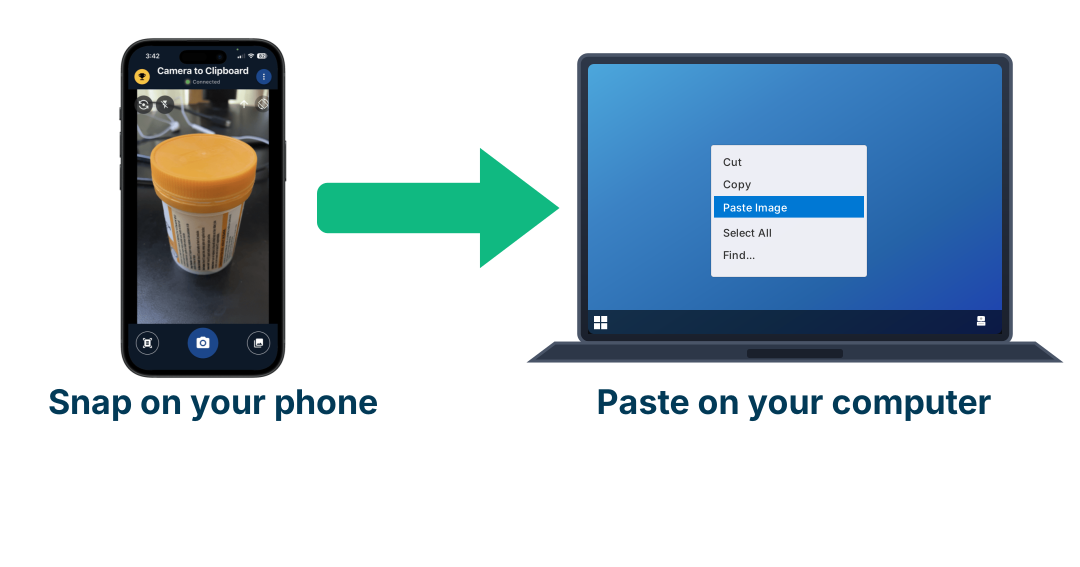
Use Camera to Clipboard to build the thumbnail that earns the click
No amount of advertising budget fixes a thumbnail nobody wants to press, and half of all YouTube channels get a click from only 2% to 10% of the people shown their thumbnail. The slow part of making a better one is never taking the photograph. It is getting the photograph off the phone and into the thing you design in. Camera to Clipboard, one of my own apps, turns that into a single step.
- A photo you take inside Camera to Clipboard is ready to paste on your computer the moment you take it.
- A real photograph of a real subject costs nothing, unlike the 2 to 30 cents a paid view costs.
- A whiteboard, a notebook page or a printed sheet of rough layouts all photograph the same way.

Hold the first 30 seconds, because a fast exit undoes a high click rate
The second number is whether people stay once they have clicked. YouTube says its systems look at whether viewers stick around, and it names average view duration and average percentage viewed as the signals it reads.
- YouTube's recommendation system looks at whether a viewer chooses to watch a recommended video, ignores it, or marks it "not interested".
- It then looks at whether the people who did click stayed, using average view duration and average percentage viewed.
- A thumbnail that wins the click and loses the viewer in 15 seconds teaches YouTube to stop recommending the video.
- Relative watch time matters more on a short video, and absolute watch time matters more on a long one.
- The first 30 seconds is the only stretch of a video no advertising budget can help you with.
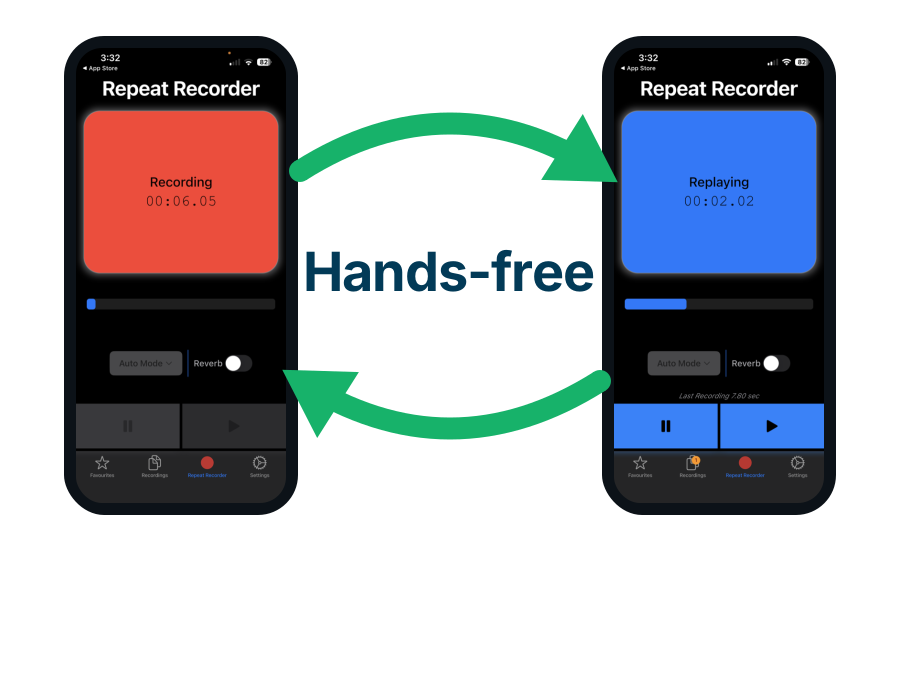
Use Repeat Recorder to fix the first thirty seconds of your video
An opening line is the cheapest thing on YouTube to improve and the hardest to judge while you are saying it. Repeat Recorder, another of my own apps, plays each take straight back without you touching the phone.
- Repeat Recorder replays each take and starts recording again on its own, so you can run one opening line twenty times.
- Hearing your own opening back is what catches the 40 second wind-up that loses the viewer YouTube just sent you.
- Takes worth keeping go into folders you name yourself.

Treat every upload as its own test, YouTube judges videos one at a time not channels
Todd Beaupré, who leads growth and discovery at YouTube, was interviewed by YouTube's own creator liaison in March 2024 and corrected three beliefs creators hold. The first one changes how much a bad video costs you.
- Beaupré's words are that "the algorithm for Discovery is focused more on individual videos" than on averaging a channel's performance.
- A video that does badly does not drag down the video you publish next week.
- That is what makes trying a new format cheap, because the downside is one video and not the channel.
- It also means a single hit does not carry the next upload, so each video has to earn its own click.
- Judge a format change on three or four videos rather than one, because one result is noise.

Stop picturing YouTube pushing your video out, it pulls videos toward one viewer
The second correction from the same interview is about direction, and it explains why buying reach does not work the way people expect. YouTube does not hold a dial marked "distribution" that money can turn.
- Beaupré's words are that "a lot of creators think of YouTube as pushing videos out to a bunch of people, but it's actually more the reverse".
- YouTube builds a page for one viewer at a time out of that viewer's own history.
- Your video is a candidate on somebody else's home page, never a broadcast you can pay to widen.
- That is why the honest question is which existing viewer would want this video, not how many people can I reach.
- A video with no obvious existing audience has nobody to be pulled toward, whatever you spend on it.

Take a break without fear, YouTube says quiet channels are not put in a penalty box
The third correction is the one that costs creators the most money, because the fear of a penalty is what makes them start buying adverts. A channel whose views have fallen often starts buying promotion to climb back out of a hole that does not exist.
- YouTube's growth team says the recommendation system does not penalise a channel for taking a break or for a drop in views.
- The system matches videos to interested viewers without leaning heavily on a channel's past record.
- YouTube runs no penalty box for quiet channels, so there is nothing to buy your way out of.
- A fall in views after a break is the old videos ageing, not a punishment applied to the channel.
- Spend the recovery budget on the next video's opening instead, because that is what the system actually reads.

Ask your viewers to hype the video, it is free and worth more the smaller your channel
Hype is the one place on YouTube where a viewer can deliberately boost a creator, and it was built to favour small channels on purpose. YouTube took it to 39 countries on 26 August 2025, including the United States, the United Kingdom, Japan, Korea, Indonesia and India.
- A viewer can hype up to three videos a week for free.
- Only creators in the YouTube Partner Program with 500 to 500,000 subscribers can be hyped.
- The video has to have been uploaded in the last 7 days.
- YouTube's own words are that "the fewer subscribers a creator has, the more bonus points are applied each time viewers hype".
- Creator guides report a hype on a 500 subscriber channel being worth 7,500 points against 50 points on a 500,000 subscriber channel, but YouTube has not published those figures.
- Viewers in Brazil, Japan, Korea and Taiwan can buy extra hypes with Jewels, which is the only place money touches this feature at all.

Know what a hype buys, a spot on a leaderboard and not a place in recommendations
Hype is easy to oversell, and the point a hype earns does not go where most creators assume it goes. The Hype leaderboard is a separate discovery page, sitting beside the recommendation system rather than inside it.
- The Hype leaderboard shows up to 50 top hyped videos, filtered by topics such as gaming and music.
- Every video on that leaderboard was uploaded in the last 7 days, so a place on it expires quickly.
- Reaching the leaderboard puts your video in front of people browsing the leaderboard, which is a much smaller room than the home page.
- Paid hypes with Jewels raise your leaderboard chances, not your ranking in search or suggested videos.
- Treat hype as a way to be found by people hunting for new channels, not as a boost you can buy.

Write a title people actually type, because YouTube search ranks on its own rules
YouTube search is a separate lane from recommendations, with its own published ranking rules, and it is the one lane where your words decide the outcome. It is also free.
- YouTube search ranks on relevance, engagement and quality, and relevance is read from your title, tags, description and the video content itself.
- Engagement in search means watch time for that particular search phrase, so a video that answers the question keeps ranking for it.
- Write the title as the phrase a person would type, not as the phrase you would use with a colleague.
- A video that keeps earning search traffic keeps earning qualified watch hours, which is the opposite of a paid campaign.
- Search results differ between viewers, because YouTube may use each viewer's own search and watch history.

Bring traffic from outside YouTube, because those views are organic and do count
A view that arrives from a forum post, a newsletter or your own site is an ordinary organic view. It costs nothing, it counts toward the 4,000 hour threshold, and YouTube treats it the same as a view from its own home page.
- External views count toward the 4,000 qualified watch hour threshold, unlike views from an ad campaign.
- A person who arrives from a link they chose to click was not interrupted by an advert, so they arrive already wanting the video.
- Longer watching is exactly the signal YouTube says it reads, so outside traffic can feed back into recommendations.
- YouTube Analytics reports "External" as its own traffic source, so you can see exactly how many views each outside post sent you.
- Post where your subject already has readers, rather than where the most people are.
Use Camera to Clipboard to post your video outside YouTube
Outside traffic is the free version of a Promote campaign, and almost every place you can post it wants a picture as well as a link. Camera to Clipboard, one of my own apps, photographs whatever is in front of you and puts it straight onto your computer.
- A photo you take inside Camera to Clipboard is ready to paste into a forum post or a newsletter the moment you take it.
- You can send several photos at once out of your phone's own gallery, which suits a post that needs a small set.
- Every view those posts send you is an organic view, so it counts toward the 4,000 hour threshold that paid views never reach.

Check the source and the date behind every number on this page
YouTube changes its rules often, so the date a number was measured matters as much as the number. The weakest rows are marked red on purpose.
| Claim | Where it comes from | Size of the evidence | When it was measured | How solid it is |
|---|---|---|---|---|
| YouTube does not sell placement in search | YouTube's own help page on how search works | A direct statement by the platform | Live page, September 2026 | The strongest kind of source there is |
| Promotions do not change organic performance | YouTube's own Promote help page | A direct statement by the platform | Live page, September 2026 | The strongest kind of source there is |
| Ad campaign watch hours do not count | Partner Program help page plus a TeamYouTube FAQ post | A direct statement plus a public clarification | Page live now, clarification October 2025 | Stated twice in two places |
| Half of channels sit between 2% and 10% click-through | YouTube's own impressions and click-through help page | All of YouTube | Live page, September 2026 | Platform-wide and published |
| Buying views breaks the fake engagement policy | YouTube's own fake engagement policy page | A direct statement by the platform | Live page, September 2026 | The strongest kind of source there is |
| 61% of videos had their view counts corrected | Peer reviewed study, Scientific Reports | 270,133 videos on 1,064 channels | Collected from January 2021, over 17 months | Good method, old data, French channels only |
| 54% of corrections landed after the video stopped growing | The same peer reviewed study | The same 270,133 videos | Collected from January 2021, over 17 months | Good method, old data, French channels only |
| A promoted view costs 2 to 30 cents | Published advertising benchmark reports | Many agency datasets, no shared method | 2026 figures | No sample size or method published |
| Hype gives smaller channels a bigger bonus | YouTube's Hype announcement and help page | A direct statement by the platform | Announced 26 August 2025 | Direction stated, no numbers published |
| A hype on a 500 subscriber channel is worth 7,500 points | Third-party creator guides | No stated source | Reported during 2026 | YouTube has never published these numbers |
| A Premium view adds $0.50 to $2 per 1,000 views | Published creator earnings reports | Aggregated channel reports, no shared method | 2026 figures | No sample size or method published |
| YouTube judges videos individually, not channels | YouTube's growth and discovery lead, on YouTube's own channel | A direct statement by the person who runs it | Interview from March 2024 | Authoritative but two years old |

Conclusion: how to promote a YouTube video without paying YouTube, in one glance
YouTube publishes what money buys and what it does not, and the answer is short. These are ordered by how much each one changes what you should do tomorrow.
- Do not buy YouTube Premium to grow a channel, because it is built for viewers and not for creators.
- Stop looking for a paid lane in search, because YouTube says it does not accept payment for better placement.
- Press Promote only when you want views today, because YouTube says it does not change organic performance.
- Do not count ad views toward the Partner Program, because YouTube excludes ad campaigns by name.
- Never buy views from a reseller, because YouTube removes them and three strikes in 90 days can end the channel.
- Apply to the YouTube Partner Program, because joining it and staying in cost nothing.
- Earn the click first, because half of all channels get a click from 2% to 10% of the people shown.
- Hold the first 30 seconds, because a fast exit undoes a high click rate.
- Watch your follow-on views on any paid campaign, because they are the only views in it that count.
- Treat every upload as its own test, because YouTube judges videos one at a time and not channels.
- Write a title people actually type, because YouTube search ranks on relevance, engagement and quality.
- Bring traffic from outside YouTube, because those views are organic and do count.
- Ask your viewers to hype the video, because it is free and worth more the smaller your channel is.
- Take a break without fear, because YouTube says quiet channels are not put in a penalty box.