
Researchers building a video streaming system needed to know when people swipe. They recorded 15,344 swipes from 133 paid participants and 3,069 more from 25 students, on a real short-video feed.
The swipes did not spread out. 29% landed in the first fifth of a video. 42% landed in the last fifth. Between 60% and 80% of the way through, only 6% of swipes happened at all.
That is what a hook is for, and it is the whole reason the first seconds get treated as a separate job from the rest of the video.

Show one specific moment in the first 3 seconds and leave one question open
The whole answer, before the evidence behind it.
- Show a specific moment that is already happening, rather than announcing what the video will be about.
- Get the point of the video on screen inside 3 seconds, because that is what the highest click-through videos do.
- Leave exactly one question unanswered, so the viewer has a reason to still be there in second four.
- Say the hook out loud and write it on screen at the same time, because the two are counted separately in TikTok's own data.
- Be specific when the videos around you are vague, and vague when the videos around you are specific.
Here is every common opening, and how much evidence sits behind each one.
| The opening | What the viewer sees in the first 3 seconds | How well it is evidenced | What it costs you |
|---|---|---|---|
| The finished result first | The decorated cake, before any of the baking | Strong, TikTok reports 63% of its highest click-through videos show the point inside 3 seconds | Nothing, the rest of the video still has to happen |
| Words on screen with no voice yet | Four large words over a moving shot | Strong, TikTok reports 40% of the ads people watched furthest through use text overlays | Nothing, it also works with the sound off |
| A specific number said out loud | "This flight cost me $38" | Strong, 8,977 randomised headline tests measured how much detail wins | Works only while the videos around you are vaguer than yours |
| Somebody looking down the lens | A person addressing the viewer directly | Medium, TikTok reports 33% of the ads people watched furthest through do it, with no control group | Nothing, it costs one framing decision |
| A named wrong belief | "You are salting the pasta water too early" | Medium, tested on how much people learn rather than on how many people watch | Fails completely when the viewer does not hold that belief |
| A question asked to camera | "Why does this chair cost $9,000?" | Medium, opening a gap is well evidenced but the question form itself is not | A viewer who guesses the answer has no reason left to stay |
| A slow build to the point | Background and context, with the point still coming | None, nothing measured supports it | 29% of all swipes land in the first fifth of a video |
| "Wait for it" over a still frame | A promise, with nothing yet moving | None, no test of this opening exists | Opens a gap with nothing behind it, which is the one thing curiosity research says fails |
| Asking for a follow before the content | A request, and no video yet | None, no test of this opening exists | Spends the 1.7 seconds of attention a mobile feed gives you |

Fix the first fifth of your video, because 29% of every swipe away happens there
The best measurement of when people leave a short video came from engineers who were not studying hooks at all.
They were building a streaming system and needed to know which parts of a video to download. So they recorded real swipe behaviour on a real feed.
- 133 paid participants produced 15,344 swipes, and 25 student volunteers produced another 3,069.
- 29% of swipes landed inside the first 20% of the video's length.
- 42% of swipes landed inside the last 20%, which is mostly the video simply ending.
- Only 6% of the students' swipes fell between 60% and 80% of the way through a video.
- One video in the sample took 60% of its swipes inside the first 20%, which is what a failing hook looks like in data.
- Two other videos in the same sample took 60% and 80% of their swipes in the final few seconds, which is what a working hook looks like.
The same video, watched by different groups of people, produced almost the same swipe shape both times. So the shape belongs to the video, not to the crowd.

Put your key message in the first 3 seconds, because 63% of the best videos do
TikTok publishes its own creative guidance, drawn from the highest-performing ads on the platform.
- Over 63% of the videos with the highest click-through rate show their key message or product inside the first 3 seconds. Click-through rate here means the share of the times a video was shown where somebody tapped the link.
- TikTok's own instruction is to get straight to the point and keep it short and direct.
- 61% of the best-performing ads on TikTok use half or more of the nine creative tips TikTok publishes.
- The 63% figure is a count of what winning videos happen to do, with no losing group to compare against. A pattern, not proof.
The 3 second figure keeps appearing because it is roughly how long a person gives a video before the decision is made.

Build the hook for 1.7 seconds of attention, because that is what a mobile feed gives
The 3 second rule is generous compared to what the attention research says.
- Meta reports the average person spends 1.7 seconds with a piece of content in a mobile feed.
- Attention on a desktop screen averages 2.5 seconds, so a phone gets about two thirds of what a computer gets.
- Nielsen found that people who saw a video ad for under 2 seconds still produced 38% of all the brand recall those ads generated.
- Meta has not published the method behind the 1.7 second figure, so treat it as a budget rather than as a measurement.
Read your hook out loud with a timer. If the point has not arrived by the time you hit two seconds, the point is too late.

Open a gap the viewer wants closed, because curiosity is felt as a missing piece
The reason a hook works at all was described in 1994 by the economist George Loewenstein, and it is not the reason most people assume.
Curiosity is not a pleasure you offer somebody. It is a discomfort you create.
- Curiosity starts when a person notices a gap, not when they are offered something interesting.
- The gap has to be small enough that the viewer can feel the shape of the missing answer. A completely unknown subject creates no gap at all.
- A viewer who can guess the answer has no gap left, so the hook stops working the moment it is predictable.
- A hook that promises a gap without showing anything gives the viewer nothing to feel deprived of.
- Showing the end result first opens the largest gap available, because the viewer can see the answer but not how it happened.
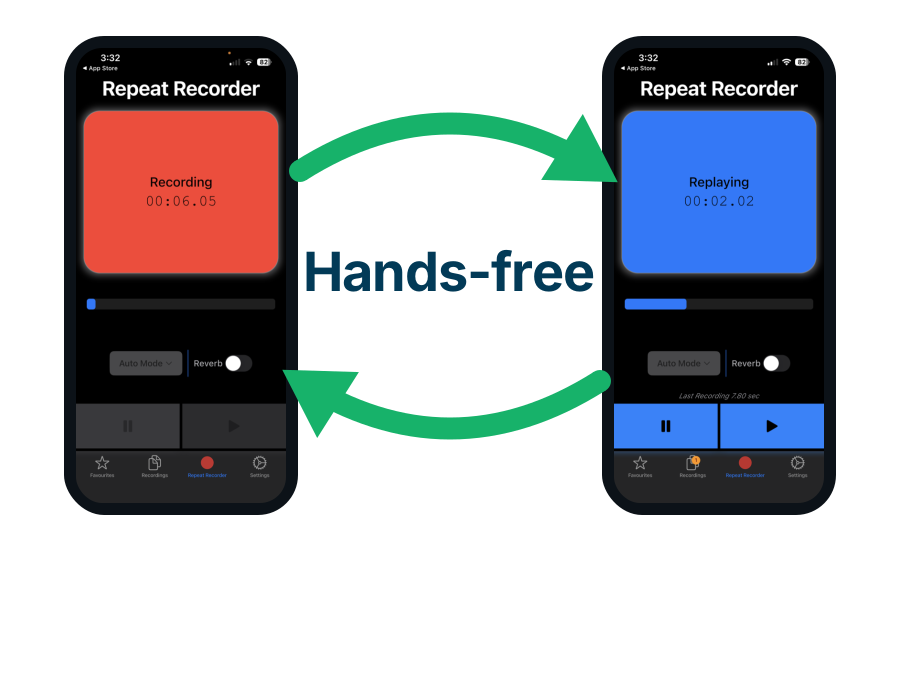
Use Repeat Recorder to hear your first line back a second after you say it
A hook has to land in about two seconds of speech, and the only way to know whether yours does is to hear it. Repeat Recorder, one of my own apps, records your voice and plays it straight back to you without you touching anything, so you can fix a line while you still remember what you were trying to fix.
- The gap between saying your hook and hearing it back is about one second, which is short enough that you can still hear what you meant to say.
- Automatic mode starts recording when you speak and replays when you stop, so you can run twenty attempts at one line without ever looking at the screen.
- The countdown before recording gives you a breath to get ready, which matters when the thing you are practising is a two second line.

Expect an open loop to be finished, not remembered, because the recall effect did not replicate
The open loop idea comes from Bluma Zeigarnik, who reported in 1927 that people remembered interrupted tasks better than finished ones.
Half of that famous result has now failed.
- A 2025 meta-analysis of the Zeigarnik and Ovsiankina effects found no memory advantage for unfinished tasks at all.
- The 2025 meta-analysis did find a real tendency for people to go back and finish something they had started.
- An earlier replication by Van Bergen in 1968 also found no difference in recall between finished and interrupted tasks.
- The surviving half of the Zeigarnik effect is the useful half for a video hook, because you are trying to stop somebody leaving rather than trying to be remembered.
- The pull to finish is strongest when the person cares about the task, so an open loop about something the viewer does not care about closes by itself.

Be concrete when rival videos are vague, and vague when they are concrete
How much to give away in a hook has been measured properly, on headlines rather than on videos.
The publisher Upworthy ran real randomised tests on its own readers, and the whole archive was later released to researchers.
- 8,977 randomised headline experiments were analysed, covering 70,546 headlines at an average click-through rate of 1.33% of the times a headline was shown.
- Where the competing headlines were vague, being more concrete raised the click-through rate by a predicted 5.5%.
- Where the competing headlines were already concrete, being more concrete lowered the click-through rate by a predicted 9.9%.
- Half of all 8,977 tests were run in fields where the headlines were already concrete, so being more specific was the losing move more often than the winning one.
- The winning amount of detail depends entirely on the videos beside yours, which means there is no fixed rule to copy.
- Nobody has run the equivalent experiment on video hooks, so this is the closest available evidence rather than direct evidence.
The practical version is to open the feed you are posting into and read the first line of the videos already there.

Rewrite a topic hook into a moment already happening, because a topic invites judgement
A hook that names a topic asks the viewer to decide whether they are interested in that topic.
Deciding is how you get skipped. A moment already in progress gives them nothing to decide about yet.
| What the video is about | The hook that loses | The hook that wins | Why the swap works |
|---|---|---|---|
| Budget travel | "Today I want to talk about travelling cheaply" | "This flight cost me $38" | A number in the first second, and the video has to show the booking |
| Cooking | "Hi guys, welcome back to my channel" | "I burnt it. This is attempt two" | A state the viewer can see, with the outcome still missing |
| Push up form | "Let's talk about push up form" | "Your elbows are doing this" while showing it | The error is on screen before the sentence finishes |
| Index funds | "A beginner's guide to index funds" | "I put in $500 and forgot about it for 9 years" | A number and a closed period, so the result is guaranteed to arrive |
| Skincare | "Skincare tips for beginners" | "30 days, left side of my face only" | A comparison the viewer can already picture, with the result withheld |
| Phone review | "In this video I review the new phone" | "One thing on this phone is broken" | Negative wording raised clicks in headline tests, never measured on video |
| Any subject | "Wait for it" over a still frame | "Wait for it" over something already moving | Opening a gap works, but an empty gap gives the viewer nothing to want |
| Any subject | "Follow me for part two before we start" | Cut it entirely and start the video | A request spends the whole attention budget and returns nothing |
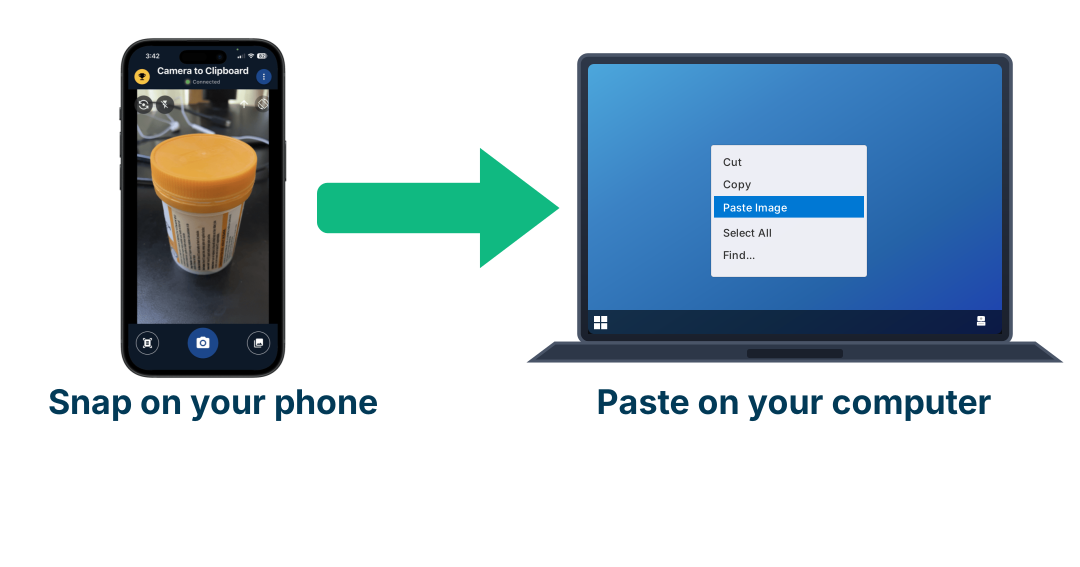
Use Camera to Clipboard to compare your first frames on a big screen
Choosing between opening frames is much easier when you can see them next to each other at a decent size instead of on the phone that shot them. Camera to Clipboard, another of my own apps, puts a photo from your phone straight onto your computer's clipboard, so a frame you just shot is one paste away from a document you can lay them all out in.
- The photo arrives on your computer's clipboard as soon as you take it, so there is no cable, no email to yourself and no cloud folder to wait on.
- Laying several opening frames side by side is the only way to answer whether yours is more specific or vaguer than the videos it will sit beside.
- Pairing is a one-time QR code scan between the phone app and the desktop app, and it works on Windows and macOS.

Look straight down the lens, because 33% of the best performing TikTok ads do
TikTok calls this breaking the fourth wall, which just means addressing the viewer directly instead of performing beside them.
- 33% of the TikTok ads that people watched furthest through have somebody looking straight into the camera and speaking to the audience.
- TikTok's own advice is to turn looking down the lens into a real exchange by asking the viewer questions and provoking a reaction.
- The 33% figure is a count of what winning ads happen to do, with no losing group to compare against. A pattern, not proof.
- Looking down the lens costs one framing decision and no money, which is why it is worth doing on weak evidence.

Put words on screen in the first second, because 40% of the best TikTok ads do
The written hook and the spoken hook are separate jobs, and they are counted separately in TikTok's own data.
- 40% of the TikTok ads that people watched furthest through use text overlays, effects or stickers.
- A written hook is the only part of your hook that survives when the phone is on silent.
- Meta found that adding subtitles raised the time people spent watching a video ad by an average of 12%.
- The words on screen and the words you speak should not be identical, because reading and hearing the same sentence wastes one of the two channels.
- Keep the on-screen line short enough to read in one look, because a viewer who is still reading at second three has not started watching yet.

Turn the sound on, because 88% of TikTok users say sound is essential to the app
TikTok is one of the few feeds where the sound plays by default, and the platform has surveyed what that is worth.
- 88% of TikTok users told Kantar that sound is essential to the TikTok experience.
- 73% of the same people said they would stop and look at an advert that had audio.
- TikTok reports that music tracks above 120 beats per minute tend to keep people watching further through than slower ones.
- The three sound figures above are answers people gave in a survey rather than behaviour anybody recorded, so read them as a direction rather than a size.
- The sound survey was run for TikTok by Kantar, so it was commissioned by the company the result flatters.
Write the hook so it still works with the sound off, then add sound that makes it better.

Shoot vertical and fill the screen, because 25% more people then reach the 6 second mark
The cheapest number on this page belongs to a decision you make before filming anything.
- TikTok reports that videos shot vertically at 9 by 16 keep 25% more people watching to the 6 second mark than videos that do not fill the screen.
- A horizontal video pasted into a vertical feed leaves black bars, which reads as an advert before a single word is spoken.
- TikTok also advises balancing an authentic look against a polished advertising look, because content that looks like the feed around it gets treated like the feed around it.
- The 25% vertical video figure is TikTok's own, with no published method, so treat it as a strong reason to do something free rather than as a measured effect.

Open on a face or a curved shape, because curves reach awareness before hard edges do
Faces are the standard advice for a first frame, and the research behind that advice says something slightly different.
- In experiments where images were hidden from conscious awareness, faces broke through into awareness faster than objects did.
- The researchers concluded the advantage probably came from curvature rather than from the images being faces. Curved shapes, not faces specifically.
- A curvature explanation makes a rounded shape, a soft silhouette or a face all equally good candidates for the first frame.
- The face and curvature study measured how fast an image reached awareness in a lab, not how many people watched a video.
- A face is still the easiest curved thing to put in a first frame, which is probably why the advice took the shape it did.
Use Repeat Recorder to drill your hook hands free while you walk
Writing ten versions of a hook takes an afternoon, and picking the one that sounds right takes saying all ten out loud many times over. Repeat Recorder, one of my own apps, runs that loop without a screen, so the practice can happen while you are walking or driving instead of sitting at a desk.
- You never touch the screen in automatic mode, so a hook can be drilled while your hands are busy with something else.
- Saving the best take to a named folder means the version you liked on Tuesday is still one tap away on Friday.
- Playing a take back on a loop that runs until you stop it is how a two second line stops sounding like a line you are reading.

Track viewed versus swiped away, because that number is the closest thing to a hook score
YouTube added a Shorts metric that measures exactly the decision a hook is responsible for.
- Viewed versus swiped away shows the share of times your Short appeared in the Shorts feed where somebody watched rather than swiping past.
- Almost nothing except your opening has happened when a viewer chooses to watch or swipe, which is what makes it a hook score rather than a video score.
- You find it in YouTube Studio under Analytics, in the numbers for an individual Short.
- YouTube has published no target for it, so every benchmark you see quoted is a creator rule of thumb rather than an official number.
- Comparing your own Shorts against each other is the only honest use of the metric, because the number moves with who the video was shown to.
- TikTok has no equivalent published metric, so the nearest substitute there is the graph in your analytics showing how many people are still watching at each second.

Change only the first 3 seconds when you test, because everything else moves the result too
Most of the numbers on this page are counts of what winning videos happen to do. Only one came from a randomised experiment, and only one more came from recorded behaviour.
Here is what each source can and cannot tell you.
| The number | Where it comes from | How strong the evidence is | What you can conclude from it |
|---|---|---|---|
| 9.9% fewer clicks for a concrete headline in a concrete field | 8,977 randomised Upworthy experiments, 70,546 headlines | Randomised, so one thing was changed at a time | Cause and effect, on headlines rather than on videos |
| 29% of swipes land in the first fifth of a video | A streaming study that recorded 15,344 real swipes | Recorded behaviour, not a survey and not a self-report | Where in a video attention is actually lost |
| 47% lift in ad recall from under 3 seconds of watching | Nielsen, across 173 brand-effect studies for Facebook | Real measurement, but of recall rather than of views | That a partly watched video is not a wasted one |
| 63% of the highest click-through videos show the point in 3 seconds | TikTok for Business creative guidance | A count of winners, with no losing group to compare | A pattern worth copying, not a proven cause |
| 40% of the furthest watched ads use text overlays | TikTok for Business creative guidance | A count of winners, with no losing group to compare | A pattern worth copying, not a proven cause |
| 25% more people reach 6 seconds on a vertical video | TikTok for Business creative guidance | Platform reported, with no method published | Enough reason to do something that costs nothing |
| 88% of users say sound is essential to TikTok | A Kantar survey commissioned by TikTok | What people said, not what anybody recorded them doing | A direction, with no reliable size attached |
| 1.7 seconds of attention per piece of mobile content | Meta, quoted without a published method | A reported figure with no method to check | A rough budget to write against, nothing more |
- Post the same video twice with only the first 3 seconds different, because any other change makes the comparison meaningless.
- Judge the test on viewed versus swiped away rather than on views, because views depend on how far the platform pushed the video.
- One pair of videos proves nothing, so run the same swap across several videos before believing the result.

Count the people who swiped, because under 3 seconds still lifted ad recall by 47%
A swipe reads as a total loss, and the brand research says it is not.
- Nielsen analysed 173 brand-effect studies of video ads on Facebook for the platform itself.
- People who watched for less than three seconds still showed a 47% lift in ad recall.
- The same group showed a 32% lift in brand awareness and a 44% lift in purchase intent.
- The lift began before one second of watching, so it was produced by the first frame rather than by the video.
- The Nielsen numbers are brand measures rather than views, so a strong first frame builds recognition even where it does not win the watch.
- The 173 Nielsen studies were run for Facebook, which is the company the result flatters, so weigh them accordingly.
The first frame is doing work on everybody who scrolls past, not only on the people who stay.
Conclusion: what makes a good hook for TikTok and YouTube Shorts, in one list
Every rule on this page, in the order they appear.
- Show one specific moment inside the first 3 seconds and leave one question open.
- Fix the first fifth of the video. 29% of all swipes away happen there.
- Get the point of the video on screen inside 3 seconds. 63% of the highest click-through videos do.
- Write the hook to land in 1.7 seconds. That is the average attention a mobile feed gives.
- Open a gap the viewer wants closed, because curiosity is felt as a missing piece.
- Expect an open loop to be finished, not remembered. The memory half of that idea failed.
- Be concrete when rival videos are vague, and vague when they are concrete.
- Rewrite a topic hook into a moment already happening. A topic invites a decision, and deciding is how you get skipped.
- Look straight down the lens. 33% of the best performing TikTok ads do.
- Put words on screen in the first second. 40% of the best performing TikTok ads do.
- Make the hook work with the sound off, then add sound. 88% of TikTok users say sound is essential.
- Shoot vertical and fill the screen. 25% more people then reach the 6 second mark, and it costs nothing.
- Open on a face or another curved shape. Curves reach awareness before hard edges do.
- Track viewed versus swiped away in YouTube Studio. It is the closest thing to a score for your hook.
- Change only the first 3 seconds when you test. Anything else makes the comparison meaningless.
- Do not open with a follow request or a slow build. Neither has ever been measured to work.