

Notion passed 100 million users in 2024. It reports about 4 million paying customers.
Ask ten of those users what Notion is and you get ten answers. That is not confusion on their part. It is the product working as designed.
The short answer for anyone selling to Notion users.
- Notion's user base is young and international, and its paying accounts are American and small.
- The largest group you can actually reach is template buyers, at 11 million people in a year.
- The group with the most money per head, large firms on the $20 plan, has no channel you can walk through.

Notion is a blank page plus database blocks you assemble yourself
Every description of Notion as an all-in-one workspace is true and useless. Here is what it literally hands you.
- A Notion page starts almost empty, and the user builds the tool they want by stacking blocks. A block is a paragraph, a heading, a to-do line, an image, a table or an embedded database.
- The database block is the part that separates Notion from a notes app. One set of rows can be shown as a table, a board, a calendar or a gallery, and each view filters and sorts independently.
- Notion replaces four separate products for most people: notes, a team wiki, a task list and a light spreadsheet. That bundle is the entire pitch.
- Notion ships with no opinion about what you are doing, which is why two users describe two different products. One runs a reading list, one runs a company handbook, and neither is wrong.
- Notion added agents in September 2025 and scheduled custom agents in February 2026. By April 2026 those agents cost 35% to 50% less to run and gained Salesforce and Box connectors.

Notion has over 100 million users and about 4 million paying customers
The gap between those two numbers is the single most important fact about selling to Notion users.
- Notion crossed 100 million users in 2024, announced by chief executive Ivan Zhao in September that year.
- Notion reports about 4 million paying customers, so the large majority of people on Notion pay nothing.
- More than half of the Fortune 500 have teams using Notion, which usually means one department rather than the whole company.
- Notion gives away more than 2 million free student licences, so a slice of the user base is structurally unable to pay.
- The mix of individual customers to company customers moved from 90 to 10 in the early years to about 50 to 50 by 2023. Notion started as a personal tool and grew into a work tool.

Two thirds of Notion users are under 35 years old
Notion's audience is unusually young for a work tool, and that shapes what they will pay for.
- The 25 to 34 age group is 37.14% of Notion users, the single largest band.
- The 18 to 24 age group is another 26.61%, so roughly two thirds of Notion users are under 35.
- Notion is free for students, and students are a deliberate part of that young base rather than an accident. Today's free student becomes tomorrow's paying employee, which is the whole reason for the giveaway.
- A young base explains why Notion templates sell at $10 to $97 rather than at software prices. Most of the audience is buying with their own money, not a company card.

More than 80% of Notion users live outside the United States
Most write-ups treat Notion as a San Francisco startup tool. The user numbers say otherwise.
- The United States is about 16.2% of Notion users, so more than 80% of the user base is somewhere else.
- South Korea is 11.98% of Notion users and Japan is 10.86%, together larger than the United States.
- Brazil is 6.83% and France is 4.28%, which puts four of the top five markets outside North America.
- Notion opened data storage inside Japan and South Korea in May 2026 for Enterprise customers, which is a company spending money to follow its users.
- Paying business accounts skew the opposite way, with 6sense recording the United States at 45.27% of tracked companies, France at 11.35% and the United Kingdom at 8.69%.
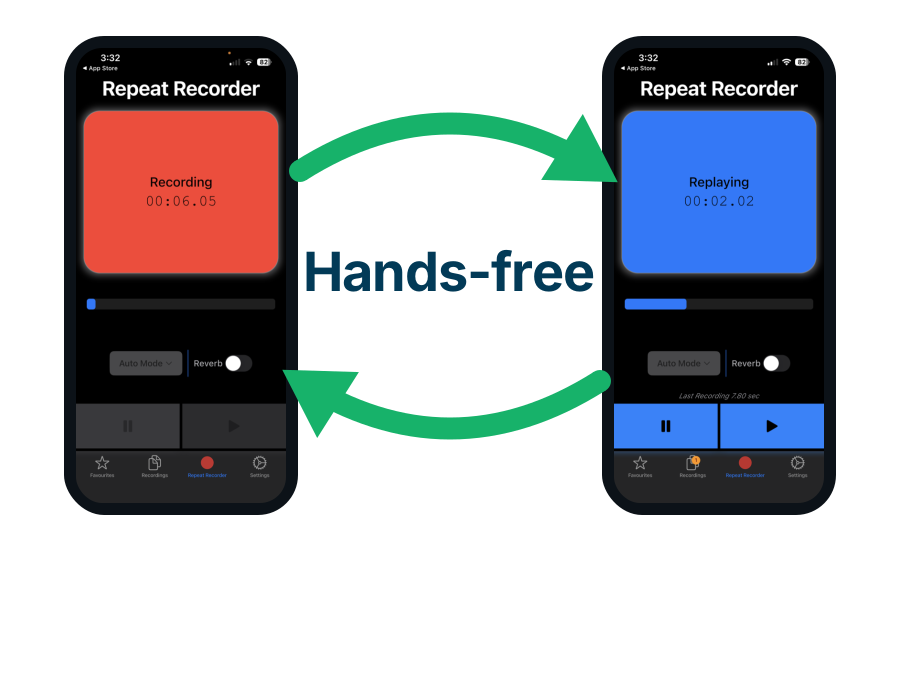
Use Repeat Recorder to practise speaking English out loud
If more than 80% of Notion users are outside the United States, then a large share of the people you would sell to, hire, or pitch in this market are working in a second language. Repeat Recorder, one of my own apps, is built for exactly that job: you speak, and your own voice plays back about a second later, so you hear the problem while it is still fresh.
- Automatic mode records when you start speaking and replays when you stop, so you never touch the screen. That makes practice possible while driving or walking.
- You can replay a take once, a set number of times, or on a loop that runs until you stop it. A difficult phrase rarely sticks on the first listen.
- Takes worth keeping go into favourites and into folders you name yourself, so this week's phrase is one tap away.

Most companies running Notion have fewer than 10 staff
Notion's marketing shows enterprise logos. Its business accounts tell a different story.
- Of the 32,555 companies 6sense tracks on Notion, 15,492 have between 0 and 9 employees, nearly half the total.
- The next largest band is companies with 20 to 49 employees, at 8,613, and then 100 to 249 employees at 3,493.
- Notion holds 52.12% of the collaborative workspace category in that tracking, which is first place by a wide margin.
- Marketing teams are the most common function on Notion at 306 tracked customers, ahead of technology at 255 and software companies at 251.
- The typical Notion buyer is a small marketing or software team, not an enterprise procurement department.
Software and internet firms are 24% of the companies paying for Notion
Nobody publishes a survey of Notion users by job title, so the closest real answer is the industry each paying company sits in. Enlyft tracks 962 of them.
- Computer software is the single largest industry at 14% of paying companies, and internet firms are another 10%. Together those two are just under a quarter of the whole list.
- Marketing and advertising is third at 7%, tied with information technology services. So yes, agencies are a real part of the base, but they are half the size of software.
- The remaining 62% is spread thinly across every other industry, so no single trade owns Notion.
- Bloomberry, tracking 4,008 companies on the paid Business and Enterprise plans, puts software development highest at 22%. A stricter sample makes the software lean stronger, not weaker.
- 58% of Notion's paying companies have fewer than 50 staff and 74% earn under $50 million a year. Only 9% have more than 1,000 staff.
- Job titles cannot be read off this chart, because the data counts companies and not the people inside them. The honest reading is the industry, not the role.

Notion costs $10 to $20 per person a month and locks its AI to the $20 plan
The AI meeting recorder in the picture above is a Business plan feature, and the price ladder decides which group can afford what.
- Notion Free costs $0 and caps page history at 7 days, file uploads at 5MB and outside guests at 10.
- Notion Plus costs $10 per member a month billed annually, or $12 billed monthly, and lifts the upload and history limits.
- Notion Business costs $20 per member a month billed annually, or $24 billed monthly.
- Notion retired the standalone $10 AI add-on in May 2025, so full Notion AI now requires the Business plan or higher. That single change doubled the price of AI for anyone who was on Plus.
- Notion Enterprise is quoted per deal and is the only tier that gets in-region data storage.
| Notion plan | Price per person a month | Notion AI included | Who is actually on it |
|---|---|---|---|
| Free | $0, with 7 day history and 5MB uploads | No, only limited AI trials | Most of the 100 million users, plus 2 million students |
| Plus | $10 annually, or $12 month to month | No, removed from this tier in May 2025 | Individuals and small teams paying their own money |
| Business | $20 annually, or $24 month to month | Yes, including agents and AI meeting notes | Companies under 250 staff, the bulk of paying accounts |
| Enterprise | Quoted per deal, higher than Business | Yes, plus admin controls and audit logs | Over half the Fortune 500, usually one department |
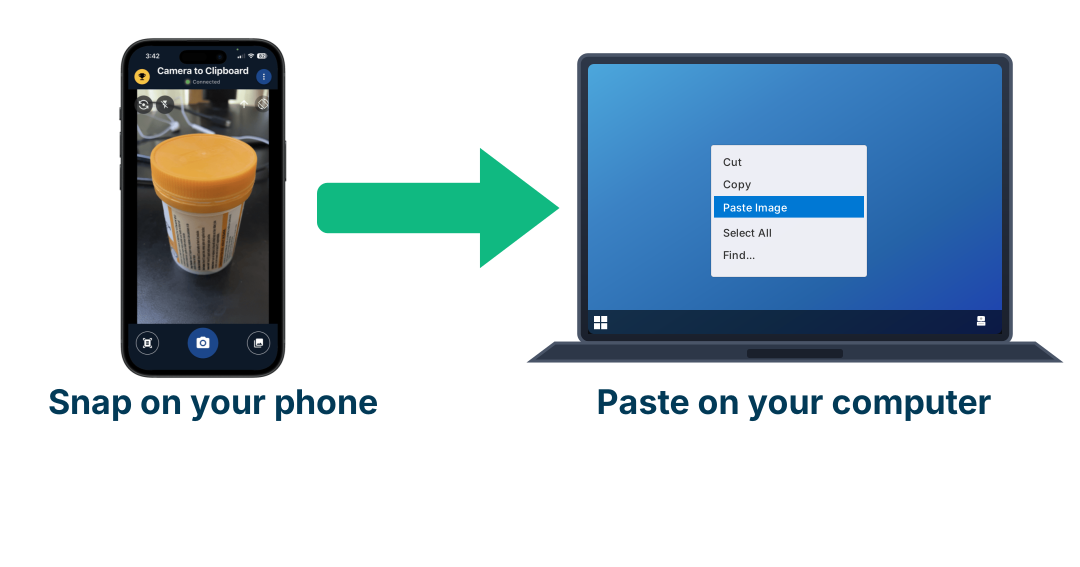
Use Camera to Clipboard to get phone photos into a Notion page
Notion pages live on a computer, and the pictures people want inside them live on a phone: a whiteboard, a receipt, a page of a book, a printed form. Camera to Clipboard, another of my own apps, closes that gap by putting the photo straight onto your computer's clipboard, so pasting it into a Notion block is one keystroke.
- You snap a photo on your phone and it lands on your computer's clipboard, with no email to yourself and no cable.
- The phone and the computer pair once, so every photo after that is a single tap.
- Marketing teams are the most common function on Notion, and marketing work is full of paper and screens that start as phone photos.

11 million people copied a Notion template 51 million times in one year
This is the largest group of Notion users that a stranger can actually reach, and it is the one most people miss.
- About 11 million people duplicated Notion templates 51 million times in a single year.
- Notion's template marketplace takes over 1 million visitors a month, and search inside it still works. Notion widened it from 21 categories to more than 250 and added a proper search bar.
- Notion charges template creators 8% plus 40 cents per sale, lower than Apple's 15% to 30% and lower than Shopify's 15%. Creators outside the United States pay another 1% to convert their payout.
- Most creators reach about $1,000 a month only after publishing 8 to 12 templates, and beginners typically make $100 to $500 in their first month.
- The million-dollar template creators had large audiences before they had templates, so their numbers measure the audience rather than the marketplace.
- Notion's Integration Gallery stopped being invite-only and now accepts self-serve submissions, which is a far emptier shelf than templates. Notion also shipped a hosted runtime in May 2026, so an integration needs no server of your own.
Half of all Notion templates are built for personal life, not for work
Notion's own gallery sorts every template into a named category, and the counts are public. Adding all 24 of them up gives the clearest picture anyone has of what people actually do in Notion.
- Life templates are 50.4% of the gallery at 42,628 listings, against 27.9% for work and 21.7% for school.
- Personal Productivity is 24,032 templates on its own, nearly three times the largest work category.
- Operations is the biggest work category at 8,161, ahead of Marketing at 4,688 and Design at 2,685.
- Engineering is the smallest work category at 1,005 templates, even though software is the top industry paying for Notion. Developers buy Notion and then do not shop for templates.
- School templates total 18,346, which is 78% of the 23,630 templates built for work. Notion's free student licences show up directly in what gets built.
- The top four categories are Personal Productivity, Operations, Student Life and Study Planner, and only one of those is a work category.
- Anyone selling to Notion users through templates is selling to a personal-productivity buyer first and a work buyer second.
- Anyone selling an integration is selling to the opposite group, because integrations are bought by companies and companies are mostly software firms.
Use Repeat Recorder to rehearse your Notion demo voiceover
Selling a template or an integration means recording a walkthrough, and the narration is what makes a two minute video watchable or unwatchable. Repeat Recorder, one of my own apps, is a record and replay loop for practising a spoken line until you are happy with it.
- Manual mode plays each take straight back, which is the mode for working through a script line by line.
- A countdown before recording and a pause before playback let you take a breath instead of racing the app.
- You choose which microphone records, so a Bluetooth headset does not quietly replace the better microphone in your phone.

Notion users say the setup work never finishes
Every complaint that pushes people off Notion is a gap somebody could sell into.
- Users report spending more time arranging their Notion workspace than doing the work it was meant to hold. Because everything is configurable, nothing ever feels finished.
- Large Notion workspaces slow down, with users reporting the drop-off starting somewhere past 20 to 30 members.
- Notion was cloud-only until August 2025, when offline access finally arrived, which had pushed away anyone who wanted notes stored locally.
- Notion stores your data on its own servers with no option to host it yourself, which rules it out for some privacy-sensitive users entirely.
- The block interface has a real learning curve, and it is the reason people search for Notion alternatives rather than more Notion features.

Notion earns about $600 million a year and is valued at $11 billion
Whether Notion survives decides whether anything you build on top of it survives, so the money matters.
- Notion took about $600 million a year in subscription payments in 2025, double the roughly $300 million it took in 2024.
- Notion's management is reported to be targeting $900 million to $1 billion by the end of 2026.
- Notion completed a $270 million share sale in January 2026 at an $11 billion valuation, up from $10 billion in 2021. Five years for a 10% rise in value is slow, and it says the 2021 price was ahead of the business.
- Notion is not a marketplace and takes no cut of what its users sell, apart from 8% on templates. Its revenue is per-seat subscriptions, which is a far steadier base than a transaction fee.
- Notion has no meaningful discovery problem of its own, because it grew through personal recommendation and free student accounts rather than paid search.

The five kinds of Notion user, ranked by how easy each is to sell to
Size and money pull in opposite directions here. The biggest groups have the least money, and the richest group has no door.
| Kind of Notion user | Size of the pool | What they already spend | How you reach them | What sells to them |
|---|---|---|---|---|
| Free personal users | Most of the 100 million users pay Notion nothing | $0 a month on the product itself | No channel at all, no list and no marketplace | A free app they find and adopt on their own |
| Template buyers | 11 million people copied a template in one year | $10 to $97 once, with no repeat billing | Notion's own marketplace, over 1 million visits a month | Templates, template bundles and setup guides |
| Paying individuals on Plus | Part of 4 million paying customers | $10 per person a month already committed | No channel, only your own content and audience | A paid template or a tool built for one person |
| Small teams under 10 staff | 15,492 of 32,555 tracked companies | $10 to $20 per seat a month | The Integration Gallery, self-serve since 2026 | An integration that does one job properly |
| Large firms on Business or Enterprise | Over half the Fortune 500, usually one department | $20 or more per seat a month with AI included | Sales calls only, months per deal | Admin, security and data residency tools |
- Template buyers are the only large group with both a marketplace and money, which is why templates are the crowded lane.
- Small teams under 10 staff are the best paying group you can reach without a sales team, through the Integration Gallery.
- The free personal user is the largest pool and the worst target, because there is no place to stand in front of them.
- An integration earns money every month while a template earns money once, on the same amount of build work.
Conclusion: who to sell to on Notion, in one glance
Notion is a blank page with database blocks, used mostly by people under 35 outside the United States, and paid for mostly by small American teams. If you are selling to Notion users, these are the numbers that decide where to point.
- Most of Notion's 100 million users pay nothing, so user count is not a market size.
- 11 million people copied a template last year, the largest group you can reach.
- Half of all Notion templates are built for personal life, not for work.
- Computer software and internet firms are 24% of the companies paying for Notion.
- Notion's marketplace takes 8% plus 40 cents, the cheapest cut of any major store.
- Templates sell for $10 to $97 once, so the money stops when the sale ends.
- The Integration Gallery went self-serve in 2026 and is far emptier than templates.
- Small teams under 10 staff pay $10 to $20 a seat and can be reached without a sales team.
- Build an integration if you want monthly money, and a template if you want it this month.