
Veritasium makes videos about bearing friction, general relativity and the mathematics of voting, and has passed 20 million subscribers and 4 billion views doing it. Derek Muller, who runs it, has described his own method as a formula: V = (M + (Q→E)) × (A + B). M is the wrong answer your viewer already believes. Q→E is asking the question before you give the explanation. A and B are two stories running at the same time. He did not invent those three ideas, and that is the useful part, because each one was tested separately in peer-reviewed work before he put them together. The planner below turns your own topic into a timed beat sheet built on that order.
Interactive video script planner that turns a topic into a timed beat sheet with word budgets
0 out of 4
| Time | Beat | Words |
|---|
Copied
How this is calculated
The score is the formula itself, worked out on what you have typed. M scores 1 when you have named a wrong belief, Q→E scores 1 when you have written a question, A scores 1 when you have named a topic, and B scores 1 when you have picked a second story. The two brackets are then multiplied, exactly as written, so the highest score is 4 and any empty bracket takes the whole thing to 0. That is the point of the multiplication sign and it is why the number falls off a cliff rather than sliding.
Word budgets use 150 words per minute, which is the usual pace for narrated explainer video. Cut the numbers if your video carries long silent demonstrations. Raise them if you talk fast over static shots.
Videos of two minutes or more get eleven beats, because a second story needs room to open, run into trouble and pay off. Anything shorter gets five, because under two minutes a second story cannot do those three things and trying costs you the explanation. Picking "No second story" removes the B beats and spreads their time across the rest.
The beat weights are a working template rather than a measurement. No published study has tested this running order against another one, so treat the order of the beats as the researched part and the exact seconds as a starting point to edit.
Everything runs in your browser. Nothing you type is sent anywhere.

Open with the wrong answer your viewer believes, because a clear explanation changes nothing
Before Veritasium existed, Derek Muller spent a PhD at the University of Sydney testing whether teaching videos teach. The answer he got is the reason his videos are built the way they are, and it is not a comfortable one for anyone who has ever tried to explain something well.
- Muller randomly split 364 first-year physics students across four versions of the same lesson on Newton's first and second laws.
- The two versions that stated the common wrong beliefs out loud and then pulled them apart moved a typical student from the middle of the class into the top third.
- Students called those two winning versions confusing and said they had to work harder to follow them.
- A clear video can leave a viewer worse off than no video, because it raises their confidence without correcting their belief.
| Version of the lesson⇅ | What students said about it⇅ | What happened to their scores⇅ | Worth writing this way⇅ |
|---|---|---|---|
| Plain lecture | Concise, clear, easy to understand, low effort | No change from before they watched | No, and it raised false confidence |
| Lecture plus extra material | Interesting, still easy to follow | No meaningful gain over the plain lecture | No, longer changed nothing |
| Wrong beliefs stated and refuted | Confusing, hard work | Middle of the class up to the top third | Yes, one of the two that worked |
| Student and tutor arguing it out | Confusing, hard work | Middle of the class up to the top third, the largest gain measured | Yes, the strongest of the four |
So the first line of your script is not your topic. It is the sentence your viewer would say if you stopped them in the street and asked.

Ask your question before you explain, because a wrong guess lifts test scores from 56% to 75%
The second letter of the formula is an arrow: question, then explanation, never the other way round. This one is not Muller's finding at all. It comes from five separate memory experiments run at UCLA and published in 2009, and it is one of the cleanest results in the whole of learning research.
- All five experiments gave people the same essay about human vision and changed only whether they saw the questions before reading it or not.
- Merely showing people the questions beat extra study time at 78% of the final test correct against 63%, and making them attempt an answer beat everything at 90%.
- Derek Muller's own way of putting the same rule is that a demonstration with no prediction teaches about as much as no demonstration at all.
| Experiment⇅ | Asked the questions first⇅ | Given extra time to study instead⇅ | What asking first was worth⇅ |
|---|---|---|---|
| 1, plain essay | 75% of the final test correct | 56% correct | Up 19 points |
| 2, key lines italicised | 71% correct | 54% correct | Up 17 points |
| 3, key lines in bold | 82% correct | 64% correct | Up 18 points |
| 4, harder rewritten questions | 55% correct | 45% correct | Up 10 points |
| 5, answering versus only reading the question | 90% correct | 63% correct | Up 27 points |
The practical rule is small and strict. Every time your script is about to explain something, put a question in front of it and leave a gap where the viewer can be wrong.
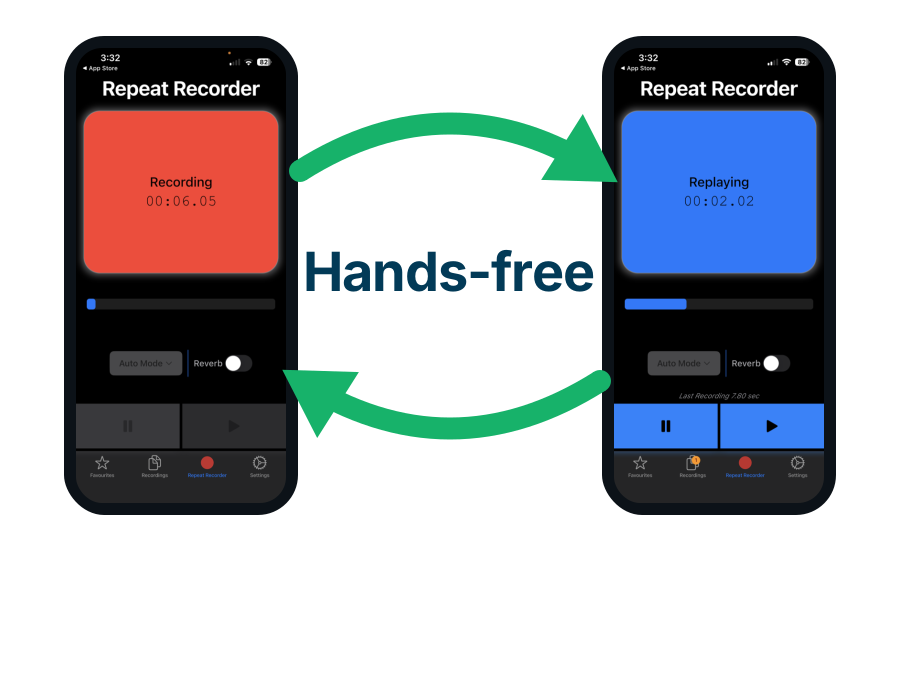
Use Repeat Recorder to hear your script back before you film it
The two rules above are both easy to break by accident, and you only catch it out loud. A wrong belief that sounds like a script stops being a belief, and a question you already know the answer to comes out flat. Repeat Recorder, one of my own apps, replays each take a second after you stop talking, so you hear the problem while you still remember what you were trying to do.
- Manual mode plays each take straight back, which is the fastest way to hear whether your opening line sounds like something a person would actually say.
- Automatic mode starts when you speak and replays when you stop, so you can drill your first 15 seconds while walking or driving without touching the screen.

Run a second story beside the explanation, because stories are remembered about twice as well
The last bracket of the formula is A plus B, and both letters are plots. Screenwriting has used the pair for decades: the A story is what the film is about, the B story runs beside it and usually carries the meaning the A story cannot state out loud. Muller runs the same pair in a science video, and the reason it works has been measured. Two plots also mean two chances a viewer keeps hold of one of them.
- Story writing is read about twice as fast as explanatory writing and remembered about twice as well, whether or not the reader knew or cared about the subject beforehand.
- A 2021 review pooling more than 75 samples and over 33,000 people found stories were better understood and better remembered than essays, and the result did not rest on any one study.
- The second story in a Veritasium video is usually a trip to see the thing, a rig being built on camera, an expert who disagrees, or a bet with a deadline.
- Under about two minutes there is no room for a second story to open, run into trouble and pay off, so a short drops it and leans harder on the wrong answer instead.

Multiply the teaching by the story, never add them, because either one alone scores zero
The sign in the middle of the formula is the part people skip, and it is doing the most work of any character in it.
- A perfect explanation with no story is a lecture, and Muller's own study measured what a lecture does to test scores, which was nothing.
- A gripping story that teaches nothing scores zero on the teaching side, which is what most branded video already is.
- Adding instead of multiplying is the mistake that produces a good video nobody watches, and it is the commoner failure among people who know their subject well.
The story half is what gets the video watched. The teaching half is what makes having watched it worth anything.

Write your opening 15 seconds last, because you only find the sharpest wrong answer at the end
The opening is the one part of a script that cannot be written in order. You are trying to state a belief in the exact words that make the rest of the video inevitable, and you do not know what those words are until the rest of the video exists.
- The sharpest way to state the wrong answer only becomes obvious once the explanation is finished, so writing the opening first means writing it blind.
- Figures published by creator analytics tools cluster around a third of viewers leaving inside the first 30 seconds, and they come from marketing companies rather than peer-reviewed work, so trust the direction and not the decimal.
- A greeting spends the only stretch of the video where every single viewer is still present.
| What the video covers⇅ | The opening that loses⇅ | The opening that wins⇅ | What the swap adds⇅ |
|---|---|---|---|
| How a plane flies | "Today I am going to explain how a wing generates lift." | "Air moves faster over the top of a wing, so the wing lifts. That is what nearly everyone is taught. So how does a plane fly upside down?" | Both, it names the wrong answer and asks |
| Compound interest | "In this video we will look at how compound interest works." | "Would you take a million pounds today, or one penny that doubles every day for a month?" | The question only |
| Why the sky is blue | "The sky is blue because of Rayleigh scattering." | "The sky is blue because air scatters blue light. If that is the whole story, why is the sunset red?" | Both, it names the wrong answer and asks |
| A software demo | "Our app has three key features I want to show you." | "Almost everyone backs up their photos and never opens them again. Here is what that habit actually costs." | The wrong answer only |
| A tutorial | "Hi everyone, welcome back to the channel." | "You are about to make the mistake I made for two years. Can you spot it before I say it?" | Both, it names the wrong answer and asks |
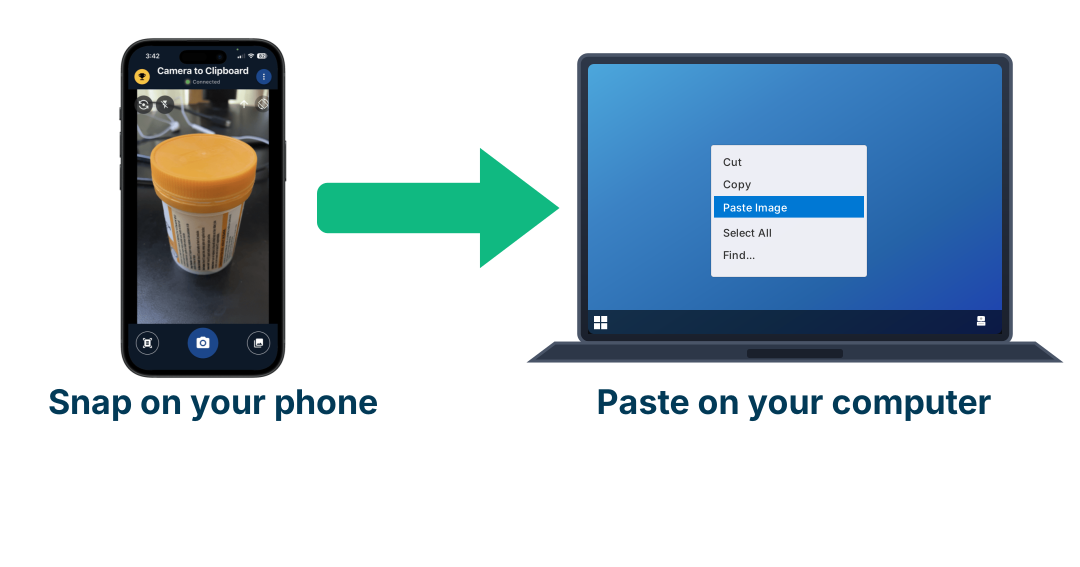
Use Camera to Clipboard to get a whiteboard script plan onto your computer
Beat sheets get drawn on paper and whiteboards, because eleven beats are easier to shuffle by hand than in a document. Retyping that plan afterwards is where a good half of it quietly goes missing. Camera to Clipboard, another of my own apps, photographs the board on your phone and puts the picture straight onto your computer's clipboard.
- The photo arrives on the computer's clipboard, so it pastes into the document you are already writing the script in.
- Pairing your phone to your computer is a one-time QR scan, and after that the picture crosses your own network instead of a chat you send to yourself.

Put the wrong belief in your title, because the gap between wrong and right earns the click
The formula stops at the script, but the script never gets a chance unless the title does its own version of the same job. The mechanism has a name and a literature, and it explains why a title about your subject does nothing while a title about a belief does a great deal.
- George Loewenstein's 1994 account of curiosity describes it as a feeling of deprivation caused by a gap between what you know and what you want to know.
- The gap only opens if the viewer already knows enough to notice something is missing, so a title about a subject they have never thought about opens nothing at all.
- A gap that is too wide produces less curiosity rather than more, which is why a title promising the secrets of the universe reads as noise.
- A 2014 brain-imaging study found people in a curious state remembered the answer better, and found reward circuits active while they were still waiting for it.
The rest of that argument, tested on real A/B data rather than on brain scans, is in How to Write a Headline That Gets Clicked.

Never invent a wrong belief your viewer does not hold, because an unasked question opens no gap
This is the part that gets copied badly. Once you know the opening should name a wrong belief, it is tempting to write one, and a manufactured wrong belief is exactly what people mean when they say clickbait.
- The wrong beliefs in Muller's study were documented ones that physics students genuinely hold, not ones written to sound surprising.
- A wrong answer nobody holds leaves nothing to correct, so your opening becomes a claim the viewer can settle without watching the rest.
- The cheapest place to find the real wrong belief is the questions you already get asked, the replies under other people's videos, and search autocomplete.
- When a subject genuinely has no common wrong belief, the first bracket of the formula runs on the question alone and still scores half.
Use Repeat Recorder to check your script fits the time you planned
A beat sheet gives every section a word budget, and word budgets lie. Repeat Recorder, one of my own apps, gives you the real number by playing each beat straight back at you.
- Reading one beat aloud and hearing it back gives you that beat's true running time, which is the only number worth checking against the plan.
- Looping a take until you stop it is how a line that keeps coming out clumsy gets fixed.

Check what this formula cannot do, because the studies measured learning and not views
Everything above is worth using, and none of it is worth overclaiming. The evidence under the three ingredients is strong. The evidence that the assembled formula produces views is a single very successful channel, which is not the same thing.
- Muller has described the formula as his own working method, and no published study has tested this running order against a different one.
- The wrong answer and the question were tested on test scores among first-year physics undergraduates, never on views, watch time or clicks.
- Veritasium is one channel, and the channels that copied the same structure and went nowhere never get written about.
- What survives every one of those limits is narrow and still worth having, which is that naming the wrong belief and asking before explaining both make an explanation land.
Conclusion: how to write a video script that gets views, in one glance
The list runs from the change that alters the script most to the change that alters it least. The first four are the formula itself and the rest are how to run it.
- Open with the wrong answer your viewer already believes, not with your topic.
- Ask your question before you explain, and leave a gap where the viewer can be wrong.
- Run a second story beside the explanation, and let it open, fail and pay off.
- Multiply the teaching by the story, because either one on its own is worth nothing.
- Write your opening 15 seconds last, and never spend them on a greeting.
- Put the wrong belief in your title, not the subject of the video.
- Never invent a wrong belief nobody holds, because there is then nothing to correct.
- Budget about 150 words for every minute of finished video.