
Spark Ads are the format everybody recommends and almost nobody examines. The pitch is irresistible: take a video that already worked on TikTok, pay to show it to more people, and keep every like and comment it earns on the original post. TikTok publishes numbers to match, and they are enormous. What I wanted to know was whether those numbers survive contact with a sceptical reading, what the format actually costs once you include the minimum spend TikTok quietly requires, whether you can genuinely send someone to a product page from inside one, and how any of it compares to buying the same attention on Meta or Google. The short answer is that Spark Ads are a genuinely good format sold with a genuinely misleading statistic. I build small apps and run small budgets, so I use my own as the running examples: Repeat Recorder, Paint Vlix and Camera to Clipboard. There is a companion piece to this one on whether a viral Spark Ad ends up selling the trend instead of your product, which is the failure mode this article deliberately does not cover.
The short version: A Spark Ad is a paid boost of a real organic post, and it is the only paid format where the money you spend permanently grows an organic asset rather than evaporating. You can link out to your product with a call-to-action button, but that link is one of several exits, and the others lead to a profile or a sound page. TikTok's headline claims of 134% higher completion and 157% higher view-through are real measurements of a rigged comparison, because Spark creative is pre-filtered for videos that already won. On the one independent dataset that measures both platforms identically, TikTok beat Meta on cost per thousand ($13.26 vs $14.19), cost per customer ($32.74 vs $38.19) and return (2.21 vs 1.86), while losing on click-through. Against Google the comparison is not about price at all: Google sells intent, TikTok sells attention. The real floor on spend is about $50 a day, and the things that quietly kill campaigns are an authorisation code that expires, a caption you can never edit, and music rights that do not transfer from organic to paid.

A Spark Ad is the only ad format that grows something you own
Almost every explanation of Spark Ads starts with the marketing description. The mechanical description is more useful, because the mechanics are where the advantages and the traps both live.
- It is an existing organic post, promoted. Not a video uploaded into the ads system, but a post that already lives on a TikTok profile, either yours or a creator's. The ad is a pointer to that post, not a copy of it.
- A Spark Ad runs under the original creator's handle, photo and comments. The username, the profile photo, the caption and the comment section all come from the source post. Viewers see an account, not an advertiser.
- The engagement flows back to the original post, permanently. This is the part that genuinely has no equivalent elsewhere. TikTok's own documentation states that all views, comments, shares, likes and follows gained while the video is being boosted are attributed to the organic post. When the campaign ends, that engagement stays.
- A standard In-Feed ad is the opposite: a dark post. It exists only inside the ads account, has no home on any profile, and everything it earns disappears with the campaign. You rent the attention and hand it back.
- You are borrowing the post, not receiving a copy of the file. Which is why you cannot edit anything inside it, and why advertising somebody else's post needs their explicit permission. That permission is the authorisation code, explained just below.
- Which gives the format its real economic argument. Every other paid format converts money into temporary reach. This one converts money into temporary reach plus a permanent increase in the follower count, view count and comment volume of a post that keeps working after you stop paying. That residual is never in the cost per acquisition figure, and it is the strongest honest case for the format.
Every other ad format rents attention. A Spark Ad rents attention and keeps the receipts on an asset you own.
You only need an authorisation code for somebody else’s post
This term gets used constantly in TikTok advertising advice and almost never explained, so here it is plainly. An authorisation code, also called a spark code, is permission to advertise a video you do not own.
- For your own posts there is no code at all. If your TikTok account is linked to your ads account, you simply pick the video from a list of your own posts. Nothing is generated, nothing expires, and none of the warnings later in this article apply. This is worth knowing because most guides describe the code as if it were a universal step, which puts people off a format they could use in two clicks.
- For a creator's post, the code is the entire handover. It is a string of characters the creator produces and sends you. Pasting it into your ads account unlocks that one specific video for you to advertise, and nothing else on their account.
- The creator generates it in four steps, inside their own TikTok app. Open the video, tap the three dots, tap Ad Settings, accept the advertising terms and switch on Ad authorization. They then choose a duration and tap Copy Code.
- Their account has to be a Professional account. On a personal account the Ad Settings option is not there at all, which is the usual reason a willing creator tells you they cannot find the button.
- The creator picks the authorisation window, 7, 30, 60 or 365 days, not you. 7, 30, 60 or 365 days. The creator picks it, not you, which is why it has to be part of the conversation rather than an afterthought.
- You paste it into Ads Manager under the TikTok posts tab, where TikTok also lets you authorise up to twenty video codes in one go if you are running several creators at once.
- And the clock starts when the code is generated, not when your campaign launches. That single detail is the source of the problem covered later: a 7 day code handed over during negotiation can be half expired before you have finished building the ad.
The practical rule, in one line: always ask for 365 days. It costs the creator nothing, it is the same four taps as choosing 7, and it removes the single most common way a Spark campaign dies unexpectedly. If a creator is nervous about a long window, the reassurance is that authorisation is per video and revocable, not access to their account.

Your link is only one of several exits from a Spark Ad
This is the question I see asked most often and answered least precisely. The answer is yes, with a structural caveat that matters more than the yes does.
- The call-to-action button goes to your landing page. You attach a CTA and a destination URL when you build the ad, exactly as with any other TikTok ad format. Website traffic, app installs, lead generation and conversions are all available objectives.
- The caption link goes there too. If the ad carries a caption with a link, it points at the same destination.
- But the profile photo, the username and a left swipe do not. Per TikTok's help documentation, all three take the viewer to the profile page of whoever posted the video. If you sparked a creator's post, that is the creator's profile, not yours.
- The music or artist name goes to the sound page. Tapping it drops the viewer into a feed of every other video using that sound. That is a fully functional exit door out of your ad and into somebody else's content.
- The follow button follows the posting account. Again, the posting account, which on a creator spark is the creator.
- So the practical rule is that a Spark Ad has one door to your product and four doors elsewhere. This is not a defect, it is what makes the ad feel native instead of feeling like an ad, and the native feel is the entire point. But it means the video itself has to do the persuading, because a meaningful share of the people who engage will engage by going somewhere other than your landing page.
The one case where the extra exits are the goal. If you spark your own post and the objective is follower growth or community building rather than a sale today, then the profile exit is not leakage, it is the conversion. That is a legitimate use of the format and it is measured completely differently. Decide which of the two campaigns you are running before you look at the cost per click, or you will judge a following-building campaign by a sales metric and conclude the format is broken.
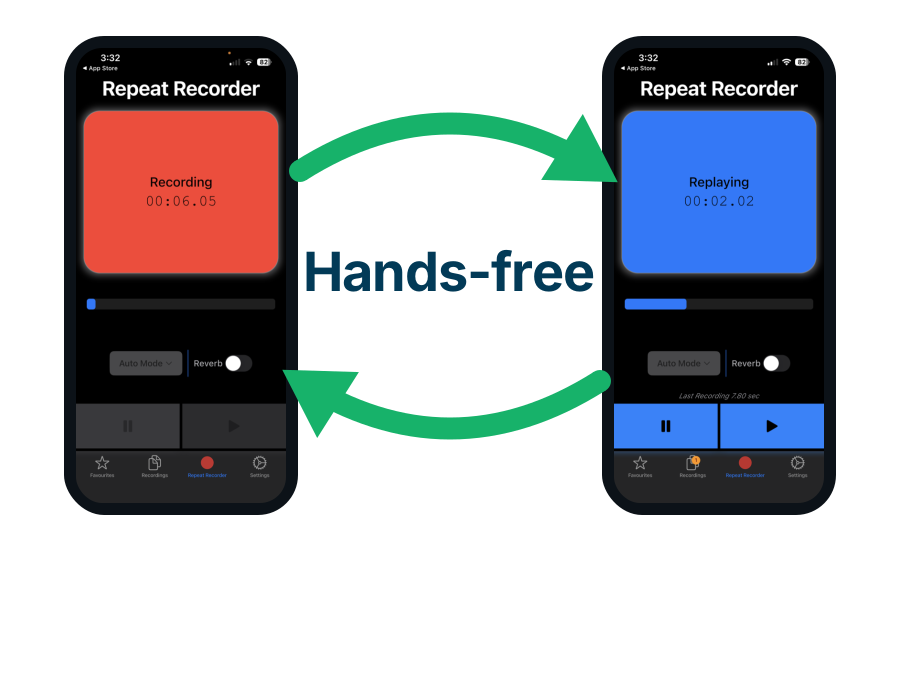
Use Repeat Recorder to rehearse what you say in a TikTok video
Four of the five exits from a Spark Ad lead somewhere other than your landing page, which leaves the video itself doing all of the persuading. What that really means is that the words spoken over the first few seconds are the ad, and they are the one part almost nobody practises before the camera is rolling. Repeat Recorder, another of my own apps, records you and plays each take straight back without you touching the phone.
- Repeat Recorder plays each take back automatically and then starts recording again, so you can run the same opening line twenty times without picking the phone up. That is the entire app. It was built for people drilling a phrase in a new language or warming a voice up, and reading a script to camera is the same job with different words.
- The profile photo, the username, the sound name and a left swipe all lead away from your product, so the spoken line is what has to work before any of them are tapped. Hearing your own delivery played straight back is the cheapest way to find out that it takes eleven seconds to reach the point, which on TikTok is far too late.
- Takes worth keeping go into favourites and into folders you name yourself, so two versions of the same first line sit side by side. The whole strategy in this article is to generate candidates cheaply and promote only the ones that already won, and that logic applies to the sentence just as much as to the video.

TikTok ads cost more to start and rise about 16% a year
There is no separate price list for Spark Ads. They compete in the same auction as every other TikTok ad, so the cost question is really a TikTok cost question with one format-specific wrinkle at the end.
- The minimum daily campaign budget is above $50. TikTok's budget documentation is explicit: campaign budget must exceed $50, ad group budget must exceed $20. Since a campaign needs at least one ad group, roughly $50 a day is the practical floor.
- Lifetime budgets are worse than they look. The minimum lifetime ad group budget is the number of days multiplied by the daily minimum. TikTok's own worked example: a 31 day campaign needs at least $620 at the ad group level.
- Median CPM was $13.26 across 2025. That is from Triple Whale's full-year benchmark set, drawn from connected ecommerce accounts rather than from TikTok. It was up about 16% year over year from $11.43.
- Median cost per acquisition was $32.74, up about 8.6%, with conversion at 2.01% (down 6.2%) and return on ad spend at 2.21 (down 5.7%). Click-through rate went the other way, up about 13.7% to 1.77%.
- TikTok cost per acquisition runs from about $13.46 in pets to far higher elsewhere. In the same dataset, cost per acquisition ran from about $13.46 in pets and animals to about $31.25 in electronics, with most categories clustering between roughly $17 and $25.
- The direction of travel is the real headline. Costs up, conversion down, return down, clicks up. That is the signature of a maturing auction: more advertisers bidding for the same attention, and the attention getting slightly less valuable per unit as the novelty wears off. TikTok is no longer the arbitrage it was in 2021.
- The Spark-specific wrinkle is modest. TikTok has reported roughly a 4% lower CPM for Spark Ads than non-Spark In-Feed placements. Four percent is a discount, not a strategy.
Treat every benchmark number in this article as an order of magnitude, not a target. Published TikTok CPM figures range from under $5 to over $13 depending on who is counting, what accounts they can see, and which objectives are included. The Triple Whale set is used here because it is a large connected-account dataset that measures TikTok and Meta the same way in the same period, which makes the comparison trustworthy even where the absolute level is arguable. Your own account is the only benchmark that actually applies to you.

The 134% claim measures a comparison TikTok could not lose
Every Spark Ads guide on the internet repeats the same four statistics. They come from TikTok's own blog, and they are impressive.
- 134% higher completion rate than standard In-Feed ads.
- 157% higher 6-second view-through rate than standard In-Feed ads.
- 69% higher conversion rate and 37% lower cost per action with the profile landing page interface.
- A Spark Ad is made from a post that already performed well, which biases every figure. A Spark Ad is, by definition, made from a post that already existed and already performed well enough that somebody chose to promote it. The pool of Spark creative is pre-filtered for videos that human beings voluntarily watched. The pool of standard In-Feed creative contains every ad anybody made, including the ones that were bad from the first frame.
- Survivorship bias alone could explain the whole Spark Ad performance gap. If you compared "songs that already charted" against "all songs recorded", the charting group would show a spectacular listening advantage, and none of it would tell you that charting causes people to listen. The comparison cannot lose.
- Spark Ads do add something real, because prior engagement is a genuine ranking signal. Prior engagement is a genuine ranking signal, social proof on a visible like count is a genuine persuasion mechanism, and content shot by a creator for their own feed genuinely looks less like an ad than content shot for a brand. There are good mechanistic reasons to expect a positive format effect.
- But nobody has published the test that would size it. The question that matters is not whether Spark Ads beat In-Feed ads in aggregate. It is whether sparking this specific video beats running that same video as a standard In-Feed ad, same audience, same budget, same week. That is a trivially easy split test to run inside one account, and the absence of any published clean result is itself informative.
The statistic is not false. It just answers a question nobody asked: are videos that already worked better than videos that never did?
You can test this in one afternoon for about a hundred dollars
- Run the test TikTok did not. Take one video. Build it two ways, as a Spark Ad from the organic post and as a standard In-Feed ad from the same file. Same targeting, same objective, same budget, same period.
- Judge on cost per outcome, not on completion rate. Completion rate is the metric most flattered by the format and least connected to money.
- Expect the gap to be smaller than 134% and larger than zero. If it is not, you have learned something specific to your account that no benchmark could have told you, which is the entire value of the exercise.

Against Meta, TikTok is cheaper to convert but worse at clicks
Cross-platform comparisons are usually worthless because each number comes from a different source with a different definition. The exception is a dataset that reads both platforms from the same connected accounts in the same period. Triple Whale's 2025 set covers close to 35,000 brands and does exactly that.
- Reaching a thousand people cost less on TikTok: $13.26 against Meta's $14.19.
- Acquiring a customer cost less on TikTok: $32.74 against Meta's $38.19.
- Return on ad spend was better on TikTok: 2.21 against 1.86.
- Conversion rate was better on TikTok: 2.01% against 1.60%.
- Meta beat TikTok on click-through, 2.19% against 1.77%. 2.19% click-through against TikTok's 1.77%.
- Meta is closing the gap from the wrong direction. Meta's CPM rose about 20% year over year while TikTok's rose about 16%, so both are getting more expensive and Meta faster. But Meta's conversion rate improved while TikTok's fell, which is the trend to watch.
- The honest reading is "comparable, with TikTok slightly ahead on cost". Not the tenfold difference the TikTok advocacy suggests, and not the disaster the sceptics suggest. Two large auctions selling similar attention at similar prices, one of them a little cheaper and a little less proven.
One caveat that cuts against TikTok in this dataset. These are ecommerce brands with connected stores, which is TikTok's strongest use case and not necessarily yours. If you are selling an app, a service or a B2B product, the conversion path is longer, the in-app browser is a friction point, and the TikTok advantage shown here should be discounted accordingly.

Price cannot compare TikTok and Google because one sells intent
Comparing a TikTok CPM to a Google Search CPC is a category error, and it is the error behind most "TikTok is cheaper than Google" claims. The two platforms are not selling the same thing.
- Google Search sells intent. Somebody typed the words. The click costs about $2.69 on average across industries and converts at about 2.81% for ecommerce, giving roughly $45 per conversion. Expensive traffic, cheap customers.
- Google Display sells attention, badly. Clicks around $0.63, ecommerce conversion around 0.59%, cost per conversion around $66. I went through why that inversion happens in the Google Display piece.
- TikTok sells attention, well. Nobody on TikTok asked for your product, but they are watching full screen with sound on, which is a fundamentally better attention product than a banner in a sidebar. TikTok's $32.74 median cost per acquisition beats both Google Display and Google Search on that dataset, which is genuinely notable.
- The catch is that attention platforms create demand and search platforms capture it. A TikTok campaign that works often shows up as a rise in branded search, direct traffic and app store searches, and only partly as clicks on the ad. If you are running both, some of what your Google Search line is being credited with was actually caused by TikTok.
- TikTok now sells a bit of intent too. TikTok Search Ads let you target keywords on the search results page, with TikTok recommending roughly 10 to 50 thematically grouped keywords per ad group. Volume is small compared to Google, and it costs more per click than In-Feed, but it is the intent half of the platform and it is new enough that competition is thin.
- So the real comparison is not TikTok versus Google. It is whether you have a demand problem or a capture problem. If nobody knows your product exists, Search has nothing to capture and TikTok is the better buy. If people are already searching for what you sell and you are not there, no amount of TikTok will fix that.
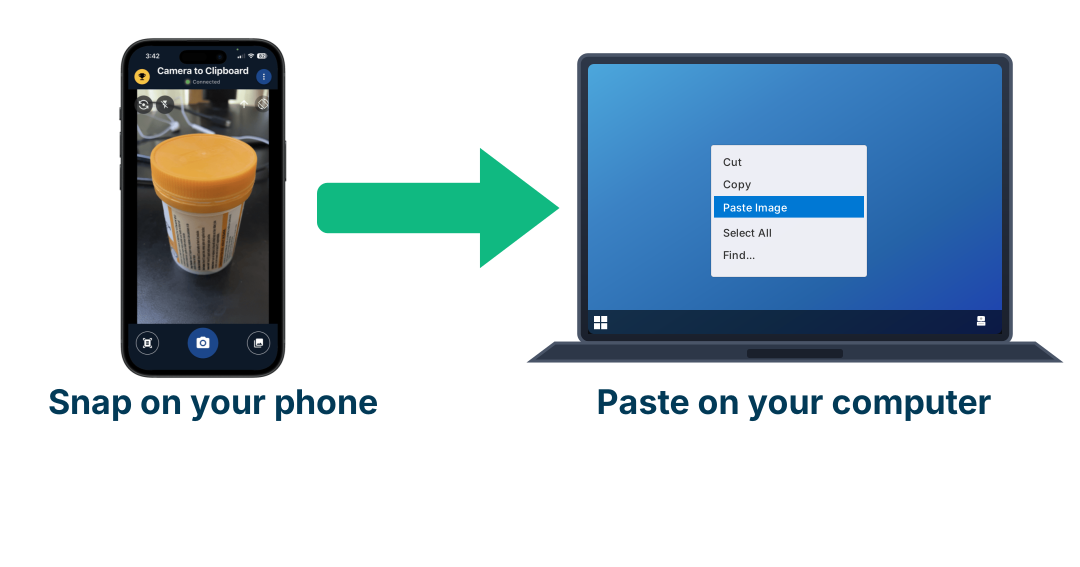
Use Camera to Clipboard to photograph the product a TikTok ad sells
Nobody on TikTok typed your product into a search box, so every ad has to start by showing somebody a thing they were not looking for. That makes photographs of the actual product the raw material of the whole campaign, and they are taken on a phone while the ad is put together on a computer. Camera to Clipboard, one of my own apps, is a phone camera that pastes.
- A photo you take inside Camera to Clipboard is ready to paste on your computer the moment you take it. There is no emailing it to yourself, no cable and no upload to somebody else’s website in between. The phone and the computer find each other over your own local network and send the picture directly.
- TikTok creates demand rather than capturing it, so the picture has to explain a product to somebody who has never heard of it. That is a job for a photograph of the real thing in a real hand, and the reason people fall back on a rendered product shot is almost always that moving their own photo across took too many steps.
- Several photos can be sent at once out of the phone’s library, so a whole shoot lands in one go. Pasting into Photoshop or GIMP drops each one in as a new layer, and Word or Google Docs takes it inline, because it arrives as an ordinary picture on the clipboard rather than a file you have to go and find.

Last-click undercounts TikTok and its own dashboard overcounts it
Both of these are true at the same time, which is why arguments about whether TikTok "works" go in circles. The two errors point in opposite directions and neither side is lying.
- Last-click undercounts, because TikTok is upstream. Somebody sees your video, does nothing, searches your name four days later and buys. Google Analytics credits organic search. TikTok caused it and gets nothing.
- TikTok's own reporting overcounts, because of the view-through window. The default attribution setting is 7-day click and 1-day view, and the view-through half means a conversion can be credited to your ad because the video appeared on the screen, with no interaction at all. On a platform where people scroll past dozens of videos a minute, that is a very large net.
- TikTok's dashboard and your own analytics measure different things and will never match. They are measuring different things. Expect TikTok's number to be several times your analytics number and treat neither as the truth.
- Only a holdout experiment settles whether TikTok ads caused the sales. TikTok's Conversion Lift Study is a proper holdout experiment: some of your audience is prevented from seeing the ads, and the difference is the causal effect. TikTok says it has run these with over 1,400 advertisers.
- TikTok's own lift case studies are worth reading sceptically. TikTok's case studies show large gaps between last-click and measured lift, and a striking finding that a majority of incremental revenue in one study arrived in the weeks after the campaign ended. That is plausible for a demand-creation channel. It is also a marketing asset published by the platform whose product is being validated.
- The cheap version of a holdout test is to run TikTok in some regions and not others. Run TikTok in some regions and not in others for a month, and compare total revenue, not attributed revenue. It is crude, it needs enough volume to see through the noise, and it is still more honest than any dashboard.
- Set the view-through window to off while you are learning. You will see a much smaller and much more real number, and you can turn it back on later once you know what your true baseline looks like.

Expiring codes, locked captions and music rights kill campaigns
These are not edge cases. Each one has a specific mechanism and each one is invisible until it costs you something.
- The authorisation code expires on a timer, and your ads stop dead. This one applies to creator posts only, since your own posts need no code. Codes are issued for 7, 30, 60 or 365 days, counted from the moment the creator generated it rather than from your launch date. When the window closes the code goes inactive, any live ads using it stop running, and it cannot be reactivated. You need a brand new code from the creator and a rebuilt ad. Nobody warns you in advance, so the first symptom is usually a campaign that flatlined overnight.
- Set the longest duration you can get, every time. There is no cost to a 365 day code and no benefit to a short one, other than the creator's comfort. Ask for the long one up front, because renegotiating after a campaign stops is worse.
- You cannot edit the caption after the ad is created. Finalise the copy first. Anything wrong in it is permanent for that ad's life.
- You cannot edit the video at all. No trimming, no reframing, no adding a CTA card. What the creator posted is what you are buying, which is the price of authenticity.
- The comment section comes along, and it is live. You are paying to distribute other people's replies as well as your video. On a good post that is the strongest social proof money can buy. On a post with a sceptical top comment, you are paying to amplify an objection to your own product to a much larger audience than ever saw it organically.
- Read the top comments before you spend, and re-read them daily after. This is the single highest-value five minutes in running a Spark Ad, and almost nobody does it.
- Music rights do not transfer from organic to paid. A trending consumer sound is licensed for personal posts, not necessarily for advertising. Boosting the post does not launder the licence. TikTok maintains a separate Commercial Music Library of pre-cleared tracks precisely because of this, and it is why some perfectly good organic posts simply cannot be sparked.
- You cannot delete the organic post while it is authorised. The source has to stay up. Un-authorise first, then delete.
- Videos have a ten minute ceiling. Rarely a constraint, occasionally fatal for long-form content.

Spark Ads, whitelisting, dark posts and Promote are four things
Most of the confusion in TikTok advertising advice comes from these four being used interchangeably. They are not interchangeable, and the differences decide who controls what.
| How you are buying | Whose handle it runs under | Targeting control | Where engagement lands | Setup friction |
|---|---|---|---|---|
| Spark Ads | Real account yours or the creator's | Full normal ads manager | Kept banks on the source post | Moderate needs an auth code |
| Standard In-Feed (dark post) | Ad account no profile behind it | Full normal ads manager | Lost dies with the campaign | Lowest just upload a file |
| Creator whitelisting | Creator's full account access | Full you run everything | Creator's grows their account | Highest access and contracts |
| Promote (in-app boost) | Yours your own post only | Minimal a few presets | Kept banks on your post | Lowest two taps in the app |
- Promote is the trap for small budgets. It looks like the cheap easy version of a Spark Ad and it is really a stripped-down toy: almost no targeting, no proper objectives, no useful reporting. If you are spending enough to care about the result, use Ads Manager.
- Whitelisting is Spark Ads with the training wheels off. You get the creator's account access and can build entirely new ads under their handle, including videos they never posted. More power, more paperwork, more trust required, and the follower growth is theirs.
- Dark posts still have a job. If you want to run fifteen creative variants without publishing fifteen posts to a profile, that is exactly what standard In-Feed is for.

Five ways to buy this attention, compared past headline price
Buyer intent and cost per customer together show the trade the entire industry runs on.
| How you are buying | Cost to reach | Cost per customer | Buyer intent | Beats ad blindness | Creative work needed | Do you keep the engagement | Can you trust the numbers |
|---|---|---|---|---|---|---|---|
| TikTok Spark Ads | Cheapest $13.26 per thousand | Cheapest around $33 | Lowest nobody searched | Best it is a real post | Moderate needs a post that worked | Yes banks on the source post | Worst view-through on by default |
| TikTok In-Feed (dark post) | Cheap same auction, about 4% dearer | Cheap same auction | Lowest nobody searched | Mixed looks produced | Highest built from nothing | No dies with the campaign | Worst same windows |
| TikTok Search Ads | Dearer intent carries a premium | Middling thin volume | Higher they typed something | Good it answers a query | Moderate keyword sets too | No search placement | Better query-level signal |
| Meta feed and Reels | Dearer $14.19 per thousand | Dearer around $38 | Low nobody searched | Mixed trained eyes skip it | Moderate every ratio | No dark posts are the norm | Mixed heavy modelling |
| Google Search | Dearest about $2.69 a click | Middling around $45 | Highest they asked for it | Mixed many scroll to organic | Lowest text only | No nothing to keep | Best intent is explicit |
No row wins outright, which is the point of laying them side by side. TikTok buys the cheapest customers and the least intent. Google Search buys the dearest clicks and the only certainty about what the person wanted. Spark Ads are the only row where the money leaves something behind, and the only row where the reporting is least trustworthy by default.

Automation is eating the controls and US TikTok changed owners
Two structural changes matter more to a 2026 media plan than any creative tactic, and both are recent enough that most guides have not caught up.
- GMV Max replaced the shopping ad formats outright. From July 2025, TikTok consolidated Product, LIVE and Video Shopping Ads into a single automated campaign type optimising for gross merchandise value. For TikTok Shop destinations the legacy formats can no longer be created.
- And it took the audience controls with it. For shop sales objectives you can no longer choose age, gender or interests. The system decides who sees the ad. Whether you like it or not, that reallocates your job from targeting to creative.
- Smart+ automates buying across traffic, leads, app installs and web conversions. A single automated buying flow across traffic, leads, app installs and web conversions, with the amount of automation dialable rather than mandatory.
- Which makes Spark Ads more important, not less. When targeting levers disappear, the creative asset becomes the only lever left, and a Spark Ad is the highest-quality creative asset most small advertisers can obtain, because it was validated by an audience before you paid for it.
- TikTok's US business became a separate joint venture on 22 January 2026. The deal closed on 22 January 2026. TikTok USDS Joint Venture LLC is roughly 80% owned by US investors, with Oracle, Silver Lake and MGX each holding about 15% and ByteDance retaining 19.9%. Oracle is the security partner and the US recommendation algorithm is operated independently and retrained on US data.
- The practical effect for advertisers is stability plus uncertainty. The existential ban risk that made planners avoid TikTok for two years is largely resolved. In exchange, the algorithm serving US users is being retrained, so historical performance is a weaker guide to future performance than it usually would be. Re-test rather than assume.
Use Repeat Recorder to try ten opening lines before you film one
With age, gender and interest targeting removed from shop campaigns, the video is the only lever an advertiser still has, and the fastest part of a video to change is the sentence at the front of it. Filming ten versions to find out which one lands takes an afternoon. Saying ten versions out loud takes about four minutes. Repeat Recorder, another of my own apps, records you and plays each take straight back without you touching the phone.
- Repeat Recorder plays each take back automatically and then starts recording again, so ten different openings can be recorded and heard back without touching the phone between them. That is the entire app. It was built for people drilling a phrase in a new language or warming a voice up, and trying ten versions of a sentence is the same job with different words.
- Automated buying has moved the job from choosing who sees the ad to choosing what the ad says, which makes a spoken sentence the cheapest thing left to test. A two day, $100 experiment on TikTok tells you almost nothing, and this article says so plainly. Ten spoken openings cost nothing at all and can be judged the same afternoon.
- Folders you name yourself, and reorder by dragging, keep one video’s candidate openings together. Favourites mark the two or three worth filming, which is the same generate-then-promote method this article recommends for the videos themselves, run one step earlier and for free.

Spark Ads are cost efficient, but the format is not why
Here is the whole thing as a working method rather than a verdict.
- Spark Ads are cost efficient because of what they are made of, not because of what they are. The format adds a modest CPM discount and a genuine social proof effect. The large advantage comes from the creative selection: you are promoting something an audience already voted for. Any process that reliably picks good creative would capture most of the same gain.
- Which gives you the actual strategy: post organically to generate candidates, then spark the winners. Treat organic posting as a cheap testing lab for paid creative. This is the single highest-return workflow on the platform and it costs nothing but time.
- Budget realistically or not at all. About $50 a day is the floor, and you need enough days for the system to exit its learning phase. A two day, $100 experiment tells you nothing except that you spent $100.
- Expect roughly $30 to $35 per customer on ecommerce, and treat that as a starting hypothesis. Category matters more than platform: the same campaign structure that lands at $13 in pets can land at $31 in electronics.
- Ask for the long authorisation code, finalise the caption before you launch, and read the top comments daily. Three habits that prevent most of the ways Spark campaigns die.
- Turn the view-through window off while you are learning what is real. Then run a holdout, geographic or otherwise, before you make any decision bigger than the budget you have already spent.
- Compare against Meta on your own account, not on benchmarks. The independent data says TikTok is slightly cheaper on both cost per thousand and cost per customer. Slightly is not enough to be true for everyone.
- Do not use it to capture demand that already exists. If people are typing your category into a search box, that budget belongs on Google Search. TikTok is for the demand that has not been created yet.
- And read the failure mode before you write the creative. The hook that makes a Spark Ad cheap is the same hook that can make people remember the joke and forget the product, which is the vampire effect, and it has a TikTok-specific version.
A Spark Ad is not a clever ad format. It is a distribution deal with a video that already earned its audience, and the reason it works is that somebody else already did the hard part.
Conclusion: are TikTok Spark Ads worth it, in one glance
- A Spark Ad promotes a real organic post under its own handle, and the likes, comments, shares and follows it earns stay on that post after the campaign ends. No other paid TikTok format leaves anything behind when you stop paying. The trade is that the profile photo, the username, a left swipe and the sound name are four exits out of an ad you paid for, against one call-to-action button pointing at your product.
- TikTok's median cost across 2025 was $13.26 per thousand impressions and $32.74 per paying customer, only just under Meta. Meta cost $14.19 per thousand and $38.19 per customer in the same dataset, so the gap is a few percent rather than a bargain, and TikTok's cost per thousand rose 16% in a year while conversion fell 6.2% and revenue per dollar spent fell 5.7%.
- Run the sparked versus standard test TikTok never published, for about a hundred dollars, before you believe its 134% claim. Same video, once as a Spark Ad and once as a standard In-Feed ad, same audience and same budget, judged on cost per outcome. TikTok's 134% and 157% figures compared Spark videos that had already proved themselves organically against In-Feed videos that had not, so the advantage of the format is probably real and certainly smaller than advertised.