
TikTok runs on virality, and virality runs on borrowed interest: a sound everybody already knows, a format everybody already recognises, a joke that was funny before you arrived. So there is an obvious worry about boosting one of those videos as a Spark Ad. If the hook is doing all the work, do people walk away having enjoyed a great piece of content and absorbed nothing at all about the product? Advertising research has a name for exactly that failure, the vampire effect, and it has been measured properly. What I found when I went looking is that the worry is not just valid, it is more valid on TikTok than anywhere else, and that a Spark Ad has four separate vampires rather than one. Three of them are structural, which means no amount of clever creative removes them. The good news is that the same research is unusually specific about the cure. I build small apps and run small budgets, so I use my own as the running examples: Repeat Recorder, Paint Vlix and Camera to Clipboard. If you want the money side first, that is what Spark Ads cost and whether they are worth it.
The short version: The vampire effect is a measured drop in brand recall when something inside the ad is more interesting than the brand, established across 4,970 respondents in a 2015 study and confirmed by eye tracking across more than a hundred brands. TikTok is the highest-risk environment for the vampire effect ever built, because its basic creative unit is borrowed interest. A Spark Ad has four vampires: the hook, the sound, the creator and the format itself. Only the first is a creative problem. The sound is the one TikTok made clickable, since tapping the music takes viewers to a feed of everyone else using it. The creator vampire is guaranteed by design, because the handle, the follows and the banked engagement are theirs. And the native format suppresses ad recognition so hard that in the landmark study only 7% of people realised they were looking at an ad. Late branding does not save you, because attention decays in about a second and a half. Being a famous brand does not save you either, which the research tested directly. What does work is congruence: the hook and the product have to be the same object, not two things sharing a screen.

A measured loss of brand recall, across 4,970 people
The term gets used loosely to mean "the ad was too clever". The research definition is much narrower and much more useful, because it isolates exactly one variable.
- The formal definition compares two versions of the same ad. In the 2015 paper by Erfgen, Zenker and Sattler in the International Journal of Research in Marketing, the vampire effect is "a decrease in brand recall for an advertising stimulus that features a celebrity endorser versus the same stimulus with an unknown but equally attractive endorser".
- The experiment held the ad identical and changed only the fame of the face. Same ad, same layout, same attractiveness of the person in it. The only difference is fame. So any drop in recall cannot be blamed on the ad being worse. It is caused purely by one element being more interesting than the rest.
- The vampire effect was tested across 4,970 respondents. A series of experiments with a total of 4,970 respondents, which is why this is the citation that settled a long-running argument between brand managers who loved celebrities and brand managers who feared them.
- Eye tracking later showed the mechanism directly. A 2023 study in the Journal of Current Issues and Research in Advertising, covering more than a hundred brands across eight product categories, found viewers fixated on the celebrity's face for significantly longer than on any other element of the ad. The attention is not shared. It is taken.
- The vampire effect is named literally, the device feeds on the brand. The device feeds on the brand it was supposed to be selling. The ad is remembered, enjoyed, shared and quoted, and the advertiser is a blank.
- And crucially, none of this requires a celebrity. A celebrity is simply the cleanest experimental version of "one element far more interesting than the brand". A trending sound, a shocking hook, a perfect joke or a beautiful stranger all occupy the same position in the design.
The vampire effect is not a punishment for making a bad ad. It is what happens when you make a very good ad about something other than what you sell.

TikTok is the worst environment for this ever built
Most media punish borrowed interest mildly. TikTok is constructed almost entirely out of it, which changes the base rate rather than the mechanism.
- A trend is borrowed interest by definition. Its whole value is that the audience already knows it and already likes it. That is precisely the condition the vampire effect research isolates: an element with pre-existing pull sitting next to a brand with none.
- The platform actively rewards using them. TikTok's own creative research reports that 77% of users like it when brands use trends, memes or challenges. The advice is sound for reach. It is silent on attribution.
- The feed is competitive in a way a TV break is not. A television ad has your attention by default for thirty seconds. A TikTok has to earn every second against an infinite alternative one thumb-flick away, which pushes creative toward the most arresting possible opening, which is exactly the creative that overshadows.
- Sound carries most of the borrowed interest, and sound is on. TikTok reports that 88% of users say sound is vital to the experience. On a muted feed a trending audio track is inert. On TikTok it is the single most recognisable element in the video.
- And Spark Ads deliberately remove the ad framing. The whole point of the format is that it does not look like an ad. Every design decision that helps it blend in also removes a cue that would have told the viewer "this is a message from a company, note who it is from".
- A viral hook run as a Spark Ad genuinely can end up unattributed. Running a viral hook as a Spark Ad genuinely can produce an ad that is watched, liked, shared and completely unattributed. The rest of this piece is about the four separate ways that happens and which ones you can actually do something about.
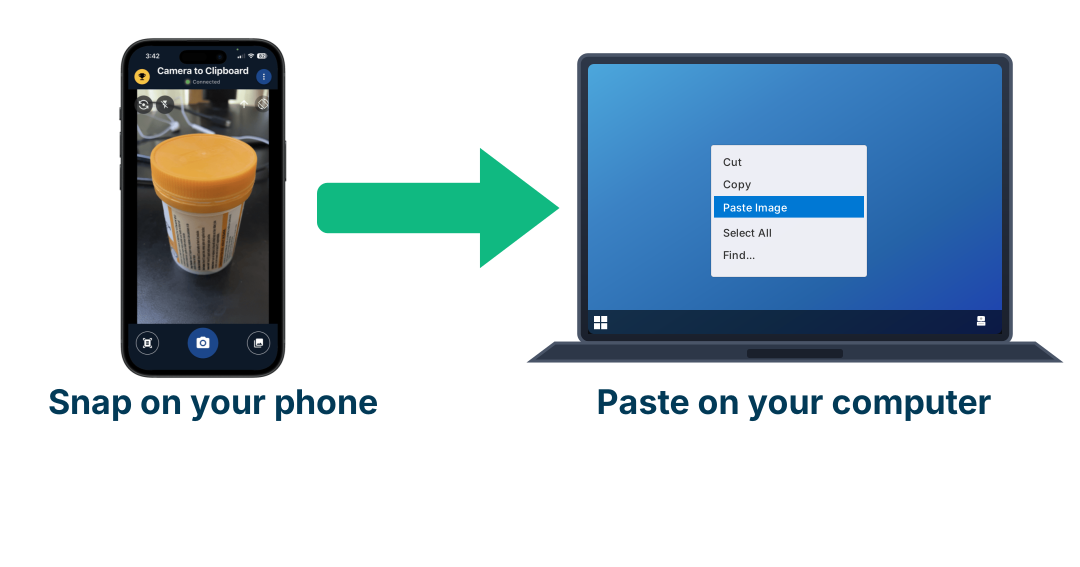
Use Camera to Clipboard to check your product stayed in frame
Every design decision that makes a Spark Ad blend into the feed also removes a cue that would have told the viewer who the video was from, which leaves you with one question worth answering before you spend anything, and that is whether your product is actually visible while the trend is doing the work. The honest way to answer it is to pull frames out of your own cut and look at them large on a computer rather than on the phone you shot on. Camera to Clipboard, one of my own apps, moves those frames across in one step.
- A picture sent from Camera to Clipboard is on your computer's clipboard ready to paste, with no email to yourself, no cable and no upload to a third party. The phone and the computer find each other over your own local network and send it directly, which is the difference between checking six frames in five minutes and deciding it can wait.
- Several pictures can go out of the phone's library at once, so a whole run of frames lands on the computer together. Pasting into Photoshop or GIMP opens each one as a new layer and Word or Google Docs takes them inline, because they arrive as ordinary clipboard images rather than files you have to go and find.
- Checking the frames is worth the trouble because TikTok's own research found 77% of users like brands using trends, and a trend is borrowed interest by definition. The platform is telling you to lean on an element that already has the audience's attention, which is exactly the arrangement the recall experiments were built to isolate, so the only thing standing between you and an unattributed hit is whether the product is on screen while it happens.

A Spark Ad has four vampires, not one
This is the part that is genuinely specific to Spark Ads rather than to advertising in general. Four different things are competing with your brand for the same memory slot, and they have completely different remedies.
- The hook vampire is the joke, the shock, the stunt or the beautiful person. The joke, the shock, the stunt, the beautiful person. The classic effect from the literature. This one is a creative problem and creative can fix it.
- The sound vampire is the trending audio, which on TikTok is a tappable link away. The trending audio, which arrives pre-loaded with associations to thousands of other videos and, uniquely on TikTok, is a tappable link out of your ad.
- The creator vampire is the handle, the follow button and every like, all theirs. On a creator spark, the handle, the profile, the follow button and every banked like belong to them. Guaranteed, structural, in the product design.
- The format vampire is the native styling, which hides that this is an ad at all. The native styling itself, which suppresses the viewer's recognition that this is advertising at all.
- Three of the four TikTok vampires cannot be fixed by rewriting the ad. You can rewrite a hook. You cannot rewrite the fact that the follow button follows the creator, or that the music name is a link, or that a native ad reads as content. Those are handled by choosing the deal and the setup differently, not by choosing better words.
| Which vampire | What it drinks | How likely on a Spark Ad | Can better creative fix it | What actually fixes it |
|---|---|---|---|---|
| The hook | Attention pulls focus off the product | Common whenever the device is strong | Yes this is a writing problem | Congruence make hook and product one thing |
| The sound | Attention and traffic it is a tappable exit | Common on any trend-led video | Partly only if the audio is yours | Own the audio or say the brand out loud |
| The creator | Identity and followers the handle is theirs | Guaranteed it is the product design | No nothing in the video changes it | Deal terms brief, mention, or spark your own |
| The format | Recognition it never reads as an ad | Guaranteed it is the whole point | No blending in is the objective | Loud branding blend with layout, not identity |
One of the four can be fixed by rewriting the hook. The other three have to be designed around.

The hook takes attention rather than sharing it
The classic case, and the best evidenced. Two findings from the eye-tracking work are worth carrying into a TikTok brief.
- Viewers looked at the celebrity's face far longer than at anything else in the ad. In the 2023 eye-tracking study across more than a hundred brands, viewers spent significantly longer looking at the celebrity's face than at any other ad element. A dominant device does not take a proportionate share of attention, it takes a disproportionate one.
- A face in frame competes with your product for exactly the same attention. Which is worth knowing before you brief a talking-head hook, because a face in frame is competing with your product for exactly the same fixations.
- A small screen weakens the vampire effect, because the eye covers everything at once. The same study found the vampire effect was attenuated on a small screen versus a large one, because everything sits closer together and the eye covers the brand and the device in the same visual neighbourhood. That is the one thing TikTok has going for it structurally: it is a phone-first, full-screen, physically small canvas.
- Put the brand inside the same part of the frame as the interesting thing. Visual proximity is protective. Put the brand and the product inside the same part of the frame as the interesting thing, not in a corner watermark and not on an end card. Distance on screen is distance in memory.
- If the hook could be swapped out without changing the message, it is a vampire. The more the attention-grabbing element could be swapped out without changing the message, the more likely it is a vampire. If the ad works equally well with a different sound, a different joke or a different person, that element is decorative, and decorative elements are the ones that drink.

The sound is also a working link out of your ad
This is where the user-level worry about virality becomes something you can point at in the interface rather than a vague fear.
- The music name on a Spark Ad is a link. Per TikTok's own documentation, tapping the music or artist name takes the viewer to that sound's page. That page is a feed of every other video using the same audio.
- A trending sound offers the viewer a one-tap route to a hundred rival videos. You paid for an impression, the audio hooked the viewer, and the interface offers them a one-tap route to a hundred other videos using the same hook, none of which are yours. The vampire is not a metaphor here, it is a button.
- A borrowed sound also arrives with somebody else's associations. A trend that has been used ten thousand times already occupies a well-worn memory path. Your brand is a new, weak association trying to attach itself to an old, strong one. That competition is the whole mechanism of the vampire effect, transposed to audio.
- Say the brand name out loud, because the audience has sound on. With 88% of users saying sound matters, an audio brand mention is the cheapest branding device available on the platform, and it is the one most often skipped in favour of an on-screen logo that gets 0.4 seconds of peripheral vision.
- Owning the audio is the strongest version of the fix. A sound you created cannot lead anywhere except to videos about you. If it catches on, the sound page becomes an asset instead of an exit.
- Music cleared for organic posting is not cleared for a paid Spark Ad. Music cleared for organic posting is not automatically cleared for paid promotion. Boosting a post does not launder the licence, which is why TikTok maintains a separate Commercial Music Library for advertising. Some perfectly good viral posts simply cannot be sparked.
- Which produces a slightly uncomfortable conclusion. The most viral sounds are frequently the ones you are least able to use in a paid ad, so trend-chasing at the creative stage often collides with the legal stage. Plan the audio before you plan the boost.

On a creator Spark Ad every follow and like is theirs
This one is not a risk, it is a certainty, and it is worth being clear-eyed about because it is written into the format.
- The ad runs under their name. The username and profile photo on screen are the creator's, so the account the viewer registers as the source is theirs.
- Three of the interaction paths lead to their profile. Tapping the profile photo, tapping the username and swiping left all go to the creator's page, per TikTok's documentation. The follow button follows them.
- And the earned engagement banks on their post permanently. TikTok states that all views, comments, shares, likes and follows gained during the boost are attributed to the organic post, which on a creator spark is the creator's post. Your budget durably grows their account.
- Paying a creator partly in your own audience growth is fair if you chose it. You are renting credibility that cannot be manufactured, and paying for it partly in cash and partly in audience growth. Plenty of campaigns are worth that.
- The follower graph that moved was the creator's, not yours, and nobody checked. Small advertisers frequently spark a creator video, watch the metrics look wonderful, and only later notice that the follower graph that moved was not theirs.
- The fixes for the creator vampire go in the contract, not in the edit. Brief the creator to say your brand name aloud and hold the product in frame. Ask for a version that tags or duets your account. Negotiate the right to also run the video as a standard In-Feed ad from your own account. Or spark your own posts and use creators for reach rather than for the boosted asset.
- Sparking your own post inverts the whole thing. Then every one of those exits leads to you, the follows are yours, and the engagement compounds on an asset you own. This is the single strongest structural argument for building even a small organic account of your own before spending on creator sparks.
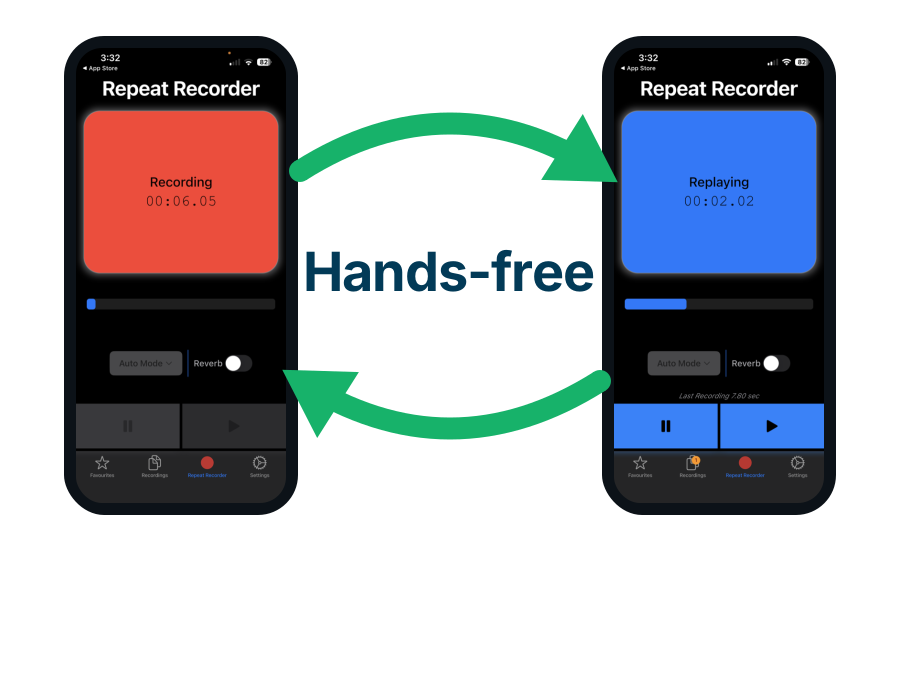
Use Repeat Recorder to rehearse saying your brand name aloud
The first item on the list of fixes just given is to have your brand name said out loud in the video, and it is the cheapest of them by a distance, but a name that is rushed, swallowed or mangled on the take is a name nobody heard. Whoever says it, a hired creator or you on a post of your own, has usually said it once, on camera, cold. Repeat Recorder, another of my own apps, records you and plays the take straight back without you touching the phone.
- Repeat Recorder replays each take automatically and then starts recording again, so the same sentence can be run twenty times without picking the phone up. That hands-free loop is the entire app, and it was built for speech rehearsal and language learning, which is the same job as getting a product name to sit naturally in the middle of a spoken line.
- The spoken name is often the only thing a creator Spark Ad leaves you with, because TikTok banks every view, like, comment, share and follow on the creator's post. The tap targets go to their profile and the follow button follows them, so the sentence with your name in it is carrying almost the whole attribution job on its own.
- Two attempts at the same line can be kept as favourites and filed into folders you name yourself, so the versions sit side by side. Folders reorder by dragging, which is how a set of six candidate lines stays in the order you want to hear them rather than the order they happened to be recorded.

Only 7% of people recognised a native ad as an ad
The most counter-intuitive of the four, because it is caused by the feature everybody buys the format for.
- Native styling suppresses recognition dramatically. In Wojdynski and Evans' Journal of Advertising research on sponsored news articles, only 17 of 242 viewers in the first study identified the content as advertising, about 7%. In a second, eye-tracking study the figure was about 17%.
- Those were articles with a disclosure label on them. The label was there, the readers looked at the page, and the overwhelming majority still did not register what they were reading. TikTok's small grey "Sponsored" tag under a handle is not doing better than that.
- Recognising something as an ad is what tells your brain to note the sender. Recognising something as advertising is what tells your brain to note the sender. Content gets filed under what it was about. Advertising gets filed under who it was from. An unrecognised ad is filed under the first heading and the advertiser is simply not part of the record.
- Which is the exact experience the question describes. "They will just look at the ad as a cool thing but not even know what the product is about." That is not a hypothetical, it is the documented default outcome of a well-executed native ad.
- So the format buys you attention at the cost of attribution, and the trade is only worth it if you deliberately put the attribution back. Blending in is a distribution strategy, not an identity strategy.
- The rule that falls out of this is the same one that governs all native advertising. Blend in with the layout, never with the identity. Match the feed's grammar, the vertical framing, the unpolished look, the pacing. Do not match its anonymity. I go through the general version of this in Do Meme Ads Actually Work and the Google version in the Display ad piece.

A brand at the end is a brand that did not appear
Most vampire problems are actually timing problems wearing a costume. The device arrives first and the brand arrives late, by which point there is nobody left to receive it.
- Attention on a social video decays steepest in the very first seconds. Karen Nelson-Field's attention research describes a steep decay across the opening seconds of a social video, with the largest losses in the first second or two. Whatever is on screen at second one is seen by a completely different sized audience than whatever is on screen at second eight.
- But encoding is fast, which is the hopeful half. Her work also reports that roughly 1.5 seconds of genuine attention is enough to encode a memory. You do not need a long watch. You need a branded first moment.
- TikTok's own numbers agree. TikTok's creative research states that around 90% of ad recall impact is captured in the first six seconds, and its MediaScience lab study of 343 US respondents aged 18 to 45, using eye tracking, heart rate and galvanic skin response, found an ad on screen for six seconds or less still delivered 38% of the recall of ads watched for twenty seconds or more.
- Read that 38% carefully, because it cuts both ways. It is genuinely good news that a brief exposure still lands more than a third of the recall. It is also a reminder that the majority of your audience is in that brief-exposure group, and they will only ever see the opening.
- So the end card is not branding, it is a bonus for the minority. A logo at second twelve reaches the small remainder who were already interested. The people who needed convincing left at second three having seen an unbranded joke.
- The practical instruction is uncomfortable but simple. Whatever you were saving for the reveal has to be visible while the hook is still happening. Not after it. During it.
Branding late is not branding weakly. It is branding to the people who were already yours.

Weak branding hands the memory to the market leader
There is a failure mode worse than a wasted impression, and it is common enough that it should change how you think about the risk.
- Unbranded memories get filed under the most available brand. Nelson-Field's attention work has found that weakly branded ads are misattributed to competitors, with big, familiar brands absorbing the credit.
- Which means the ad can work and still lose. The viewer forms a genuine intention to buy the category, and their brain supplies the name it already knows. In the worst case your budget produced demand and handed it to the incumbent.
- Small brands are structurally more exposed. If you are the least famous name in your category, you are exactly the brand whose weakly branded ad gets misfiled upward, because the misattribution flows toward whatever is most mentally available.
- Attention that does not carry your name can subsidise a competitor. Attention that does not carry your identity does not merely fail to help. It can subsidise a competitor.
- And it explains why the fix is repetition of identity, not repetition of impressions. Buying the same person three more unbranded views does not fix a misattribution problem. Making the identity unavoidable in the first two seconds does.

Congruence protects you, and being famous does not
The 2015 study did more than establish the effect. It tested what removes it, and one of the answers is genuinely surprising.
- High endorser-brand congruence protects you. When the attention-grabbing element genuinely fits the product, recall does not suffer. Fit is not decoration, it is the mechanism.
- A strong cognitive link between the device and the brand protects you. The two have to be connected in the viewer's mind, not merely adjacent on screen. Congruence is about whether it makes sense; cognitive link is about whether the memory of one retrieves the other.
- Brand familiarity does not protect you, and the researchers flagged this as surprising. Being a well-known brand did not significantly moderate the effect. Fame is not armour. Large advertisers get vampired too, they just have the budget to survive it.
- Which kills the most common reassurance in the room. "It is fine, people know us." The evidence says that is not the protection you think it is, and if you are a small app or a new product you were never eligible for it anyway.
- Ask whether the hook can be retold without mentioning what you sell. Ask whether the hook can be retold without mentioning what you sell. "There was this guy doing the thing with the chair" is a vampire. "There was this guy who recorded himself saying a phrase and played it back until he got the accent right" has the product inside the anecdote and cannot be separated from it.
- The retelling test asks whether the ad is about the product, not whether it is branded. Not whether the ad is branded. Whether the ad is about the product. Branding is a label you attach; congruence is a structure you build.
One caveat on transplanting this research. The 4,970-respondent study and the eye-tracking work were both conducted on static or traditional advertising with celebrity endorsers, not on vertical video with trending audio. The mechanism transfers cleanly, because the mechanism is competition for a limited memory slot, and TikTok has every one of the conditions that produce it. But nobody has run the definitive TikTok replication, so treat the direction as well established and the magnitude as unmeasured on this platform.

How to hook hard and still get remembered
None of this argues for a boring ad. A weak hook on TikTok is not a safe ad, it is an unwatched one. The goal is a hook that cannot be separated from the product.
- Put the product physically on screen inside the first second or two. Not a logo, the thing itself, in use. TikTok's own creative research associates keeping the product on screen with a 65% increase in brand affinity and a 25% uplift in recall.
- Say the brand name out loud, early. Sound is on for most of the audience and an audio mention survives a viewer who is looking away from the screen. It is the most underused branding device on the platform.
- Make the product the reason the hook works. The strongest structure is one where removing the product breaks the joke. Then the hook cannot be retold without you.
- A hook that shows what the product does is the only device immune to this. A surprising thing the product does is a hook and a proof at the same time, which is the only creative device that is structurally immune to this failure.
- Keep the brand visually close to the interesting element. The eye-tracking finding on visual proximity is directly actionable: corners and end cards are far away in memory as well as in space.
- A closing call-to-action card lifts recall 45% and likeability 19%. TikTok associates them with a 45% lift in recall and a 19% increase in likeability. It is a cheap addition, as long as it is not doing the branding on its own.
- An original sound leads viewers back to you, and dodges the licensing trap. An original sound cannot lead the viewer anywhere except back to videos about you, and it dodges the commercial licensing trap at the same time.
- Brief creators explicitly on the mention and the frame. This is the only lever you have over the creator vampire, and it has to happen before the video is shot, because a Spark Ad cannot be edited afterwards.
- Spark your own posts when the objective is brand building. Reserve creator sparks for reach and credibility, where handing over the follower growth is a price you consciously chose to pay.
Three tests that tell you whether it already happened to you
- Run the retelling test on someone unconnected to the project, for free. Show the ad to someone unconnected to the project, wait ten minutes, and ask them to describe it. If they can retell the whole thing without naming or describing what is being sold, you have your answer before you spend anything.
- The branded search test, which uses data you already have. A working ad raises searches for your name. Watch branded search volume, direct traffic and app store searches during and after the flight. Enjoyment that produces no lift in people looking you up is the signature of a vampire.
- The engagement-to-outcome gap. Very high completion and share rates sitting next to flat outcomes is the classic pattern. The video is working. The advertisement is not. That gap is the effect, expressed in your own dashboard.

Which creative devices drink attention and which pay it back
Not all hooks carry the same risk, and the differences are predictable.
| Creative device | Stopping power | Brand recall risk | Congruence with product | Survives retelling test | Leads viewers away | Effort to produce |
|---|---|---|---|---|---|---|
| Product demo with a surprise | Good curiosity does the work | Lowest the product is the hook | Total inseparable by design | Yes cannot retell without it | No nothing to click away to | Moderate needs a real feature |
| Creator telling their own story | Good credibility holds attention | Medium depends on the brief | Variable only if scripted for it | Sometimes if the product is central | Yes handle and follows are theirs | Low they make it |
| Trending sound or challenge | Highest pre-loved by the audience | Highest the trend owns the memory | Usually none borrowed wholesale | No the trend is the story | Yes the sound name is a link | Lowest the format exists already |
| Pure comedy sketch | High jokes stop the thumb | High the joke gets remembered | Variable rarely built in | No punchline travels alone | No self-contained | High writing and performance |
| Before and after transformation | High the payoff is promised | Low product causes the change | Total the change is the proof | Yes the result names the cause | No self-contained | Moderate needs a real result |
| Celebrity or big-name face | Highest fame is instant attention | Highest the documented case | Usually low unless genuinely linked | No people recall the person | Sometimes to their profile | Highest fees and negotiation |
The pattern is consistent enough to be a rule. Every device in the low-risk group has the product embedded in the mechanism of the hook, so the hook cannot function without it. Every device in the high-risk group works perfectly with the product removed, which is exactly why the product gets removed in the viewer's memory.
Use Camera to Clipboard to build a hook out of the product itself
The table above splits every creative device by one test, which is whether the hook still works with the product taken out of it. Camera to Clipboard, my own app, is worth naming here because it only exists on the safe side of that test. What it does is the thing worth watching, so a video of it working cannot be told without it.
- You take a photo on the phone and it is on the computer's clipboard, ready to paste, which is a hook that stops working the moment the product is removed from it. That is the property this whole section says the low-risk devices share, and the reason the high-risk ones fail is that the same clip would be just as good with any other logo on it.
- There is no emailing it to yourself, no cable and no upload to somebody else's website in between, because the phone and the computer talk over your own local network. Existing pictures go the same way and several can be sent at once out of the phone's library.
- Pasting into Photoshop or GIMP opens the picture as a new layer, and Word or Google Docs takes it inline. It arrives as an ordinary image sitting on the clipboard, so anything that accepts a pasted picture accepts this one, with nothing to save, rename or go looking for first.

Virality only eats your ad if the hook and product differ
Pulling the whole thing together into a position rather than a warning.
- The vampire effect is real, and TikTok has every condition that produces it. The vampire effect is real, established across 4,970 respondents, confirmed by eye tracking, and TikTok has every condition that produces it in unusually concentrated form.
- But virality is not the enemy, borrowed interest is. A viral video whose virality comes from the product is the best ad you will ever run. A viral video whose virality comes from a sound you rented is a gift to the sound.
- Three of the four vampires are structural, so handle them structurally. Own the audio, choose whose account the ad runs under deliberately, and put your identity back into a format designed to hide it. None of those are creative decisions.
- Moving the brand to second one beats doubling the ad budget. Given how fast attention decays, moving the brand from second eight to second one is worth more than doubling the budget.
- Being a well-known brand does not protect you, and the research tested that. The research tested that directly and found it does not help. If you are a small app, you were never getting that protection anyway.
- Use the retelling test before you spend, and the branded search test after. Ten minutes and a colleague will catch most of this before it costs money.
- And accept the honest trade behind the format. A Spark Ad buys attention by not looking like an ad. Attribution is the thing you give up in that trade, and you have to buy it back deliberately, in the first two seconds, every single time.
- If the money side is what you are weighing up, the costs, the benchmarks and the comparison with Meta and Google are in the companion piece on whether Spark Ads are worth it.
A hook that can be retold without your product is not an advertisement. It is a donation to the trend.
Conclusion: will a viral Spark Ad sell your product, in one glance
- The vampire effect is a measured loss of brand recall, and a TikTok Spark Ad has four separate sources of that loss. The 2015 Erfgen, Zenker and Sattler paper measured the drop across 4,970 people by holding an ad identical and changing only whether the face in it was famous. On a Spark Ad the hook, the sound, the creator and the format each take attention that never reaches what you sell, and only the hook is a writing problem.
- Branding late in a Spark Ad counts as not branding at all, and an unbranded ad gets credited to the market leader instead of to you. TikTok reports around 90% of ad recall impact is captured in the first six seconds, and roughly 1.5 seconds of real attention is enough to fix a memory, so a logo at the end reaches only the few people still watching. Everyone else saw an unbranded joke and files it under whichever name in your category they already know, which usually means your budget produced demand and handed it to the biggest brand you compete with.
- Rewrite any hook that can be retold without naming the product you sell. Show the video to somebody unconnected to the project, wait ten minutes, and ask them to describe it. A hook built out of the product itself cannot be described without naming it, while a hook borrowed from a trend can, which means you paid for attention the trend keeps.