
You looked at a pair of shoes once and now those shoes follow you across the internet for a fortnight. That is retargeting, and almost everybody has experienced it from the receiving end without ever being told how it works. From the advertiser's side it is sold as the cheapest thing in marketing: 10 times the click rate, half the cost per customer, free to set up. All three of those claims are true and all three are misleading. This is what is actually happening, how to do it, and why the arithmetic comes out against it.
The short version:
- The verdict: it does not work, because it costs more than it brings in. Meta says a customer costs $22. But only about a quarter of those buyers needed the ad, the rest were buying anyway, so the real price is nearly four times higher: $80. That same platform sells you a total stranger for $42 to $48. You lose money on every customer you buy this way.
- Install the tag anyway, and not for retargeting. The same tag also goes on your order-confirmation page, where it tells Meta and Google that a sale happened. That is the only way they ever find out. Without it they cannot tell you which ad worked, cannot aim a campaign at people who buy rather than people who click, and cannot find you strangers who resemble your existing customers. All of that is ordinary advertising, and the tag is free.
- Retargeting is not a new audience. It is a second conversation with traffic you already have. That single fact explains every one of its strengths and every one of its limits.
- If that traffic was free, half of this argument goes away. An organic audience costs nothing and takes nothing from your other advertising, so it is worth a test that a paid one is not. It still does not make an $80 customer cheaper than a $45 stranger, so your price decides it.
- A tag on your page tells Meta or Google that a logged-in account visited. a tag on your page tells Meta or Google "this logged-in account was here". Inside a walled garden there is no guessing, because one company owns both your tag and their feed.
- A retargeting audience is free to set up, about an afternoon of work. Both Google and Meta now run audiences from 100 people, though delivery is erratic below 1,000.
- The numbers Meta and Google report to you are real: around 10x the click rate of cold display, roughly 3.8% vs 2.2% conversion, up to 50% lower reported cost.
- Privacy defaults delete most of your audience. 29.5% run ad blockers, consent runs 42% to 47%, Safari caps cookies at 7 days (24 hours from an ad click). A 10,000-visitor site can reach about 2,600.
- On iOS apps it is largely broken without ATT consent, which only 15% to 30% grant.
Retargeting buys a second conversation with traffic you own
Ordinary advertising buys strangers. The industry word for that is prospecting, and it means exactly what it sounds like: paying to put your ad in front of people who have never heard of you. Retargeting buys a specific list of people who already did something: visited a page, watched a video, added to a cart, installed an app. Everything good and everything limiting about it follows from that one distinction.
- The audience is defined backwards. Normal targeting says "women aged 25 to 40 interested in fitness". Retargeting says "the 812 people who opened my pricing page in the last 30 days". It is a list, not a description.
- You are advertising to your own past traffic. Which means the list can only ever be as big as the traffic you already have. This is the fact that ends up mattering most, and it is the one that gets left out of every guide.
- "Retargeting" and "remarketing" are the same thing. Google historically said remarketing, everyone else says retargeting. Some people use remarketing to mean email specifically. There is no meaningful technical difference.
It comes in seven flavours, and they are not equally available to a small product.
| Type of retargeting | What puts someone on the list | Where the ad then appears | How well it works next to other retargeting | Is it even available to a small product |
|---|---|---|---|---|
| Site retargeting | Loading any page carrying your tag | Any platform whose pixel you installed: Facebook, Instagram, YouTube, Bing, TikTok, Pinterest, Snapchat, LinkedIn, Reddit, X, plus the open display network | Most volume and the steadiest delivery of the seven | Yes, this is the default one |
| Cart or checkout abandonment | Reaching a specific deep page and not converting | Same places, but with a much sharper message | The best-converting slice of retargeting, and still a reported number | Only if you have a multi-step checkout |
| Customer list (CRM) retargeting | You upload hashed emails or phone numbers | Anywhere the platform can match the account | Depends on match rate, typically 60% to 80% | Yes, and it survives cookie loss |
| Engagement retargeting | Watching your video or opening your lead form | Inside that platform only | Weaker intent than a site visit, but far more volume | Yes, and it needs no website at all |
| Dynamic product retargeting | Viewing a specific product, which is then shown back to you | Display and social, as an auto-generated product ad | Worse than generic ads on average, per published research | No, needs a product catalogue feed |
| App retargeting | Installing or opening your app | Other apps, via the mobile advertising ID | Largely broken on iOS without tracking consent | Rarely, and almost never on iOS |
| Search retargeting (RLSA) | Visiting your site, then later searching on Google | Google search results, at an adjusted bid | High intent: they are searching and they know you | Yes, but only if you already run search ads |
The one row worth arguing with
Dynamic retargeting, the shoes-following-you-around kind, is the most famous form and on average the worst performing. Lambrecht and Tucker's field experiment in the Journal of Marketing Research found that showing people the exact product they had browsed was less effective than a generic brand ad. The exception was people whose preferences had clearly moved on, for example by visiting a review site in the meantime. Those people responded well to the specific product.
The reading: showing someone the thing they already decided against is not a reminder, it is an argument they have already had. Specificity only helps once they know what they want.
A tag on your page hands your visitor identity to Meta
This is the part that feels like magic and is not. The short answer is that you tell them, and the company you tell is one that already has your visitor logged in somewhere else.
The sequence, for a Meta pixel, in the order it happens:
1. You paste a few lines of JavaScript into your site's
<head>. It is called a pixel or tag, and it is free.Setup2. A visitor loads your page. Their browser runs that code, which quietly calls Meta's servers.Page load
3. That call carries the browser's existing Meta cookie, the one set when they logged into Facebook or Instagram. Meta already knows who that is.Identify
4. Meta records "account #4471 visited azrin.example, page /pricing, at 14:02" against your ad account's audience.Store
5. Next time account #4471 opens Instagram, you are eligible to bid for that impression. No matching, no inference, no guesswork.Serve
The same tag does a second job, and it is the one that matters even if you never retarget.
- It reports whichever page it is sitting on. On a product page it says "someone looked at this". On the page a customer lands on after paying, the one that says thank you for your order, it says "someone paid, $34.99". Same few lines of code, different page.
- The amount comes from one extra line you add on that page. The tag does not work out that a sale happened. You tell it. The confirmation page carries the same snippet plus a line naming the event and the value, and your shop software fills the number in. That is the entire difference between reporting a visit and reporting a sale.
- That is the only way Meta or Google ever learns you made a sale. The payment happens on your site, or inside Stripe, where they cannot see any of it. If you do not tell them, they never find out.
- Which is why they can tell you an ad worked. Meta sees the click on your ad, then the purchase from that same browser twenty minutes later, and joins the two together.
- And why they can go and find you more buyers. Once Meta knows which of your visitors actually paid, it can point your next campaign at strangers who resemble the payers instead of at people who merely like clicking ads. That is a tool for finding new people, and it has nothing to do with retargeting.
- A website tag cannot see inside an app. It is JavaScript running in a browser, so it cannot see one single thing that happens in an installed app, including the install itself.
- Apps use a kit instead, and you should install it for the same reasons. You add a small library to the app itself, Meta's SDK or Google's Firebase SDK, and it reports the same kinds of events from inside the app: the app was opened for the first time, someone reached the paywall, someone paid $34.99. Without it Meta and Google have no idea your app was ever installed, cannot tell you which ad caused it, and cannot aim your next campaign at people who install and pay rather than people who tap.
- On Android that works properly. On iPhones it is crippled. Android reports back within minutes. On iOS, unless the person taps Allow on the tracking prompt, and only 15% to 30% do, everything comes back through Apple's privacy system instead: a day or more late, in 64 coarse buckets, and sometimes not at all if too few people converted to clear Apple's threshold. That is why app advertising is measured so much worse than web advertising.
Which explains the two things people find most surprising about it.
- It is not listening to your microphone. It does not have to. You handed over the visit yourself, in exchange for a free analytics and ads product.
- Retargeting follows an account, not a browser, so it works across devices. Because the identifier is an account, not a browser. Visit on your laptop at work, see the ad on your phone that night. That only works inside a walled garden where people log in.
Outside the walled gardens it is much shakier, and the difference matters when you choose where to run.
| How you get recognised | What the match is actually based on | How reliable it is | What breaks it | Works across devices |
|---|---|---|---|---|
| Meta pixel, logged-in account | Their Facebook or Instagram login, read as a first-party cookie on Meta's own domain | Deterministic: it is the same company at both ends | Ad blockers and consent refusals stop the tag firing | Yes, the ID is the person |
| Google tag, Google account | Their signed-in Google identity, plus the click ID on ad traffic | Deterministic where signed in, weaker where not | Signed-out browsing, consent mode, ad blockers | Yes, where signed in |
| Hashed email upload (Customer Match) | You upload emails, the platform hashes and matches them to accounts | 60% to 80% match rate, but immune to cookie loss | People using a different email with the platform | Yes, and it survives everything else |
| Server-side events (Conversions API) | Your own server posts the event to the platform, not the browser | Recovers 20% to 40% of otherwise lost signal, not all of it | Needs real engineering to implement properly | Only where you can identify the user yourself |
| Third-party cookie and cookie syncing | Ad tech firms swap ID tables so two cookies can be agreed to be one browser | Leaky: every hop in the chain loses matches | Safari and Firefox block it outright, Chrome is degrading | No, it identifies a browser, not a person |
| Mobile advertising ID (IDFA, GAID) | A device-level identifier passed between apps | Collapsed on iOS since App Tracking Transparency | 15% to 30% opt-in on iOS kills the pool | No, it is one device |
The practical takeaway: retargeting inside Meta, Google or TikTok is a solved problem, and retargeting across the open display web is held together with tape.
Nobody is spying on you in the cinematic sense. The site you visited voluntarily told a company you were already logged into that you had been there.
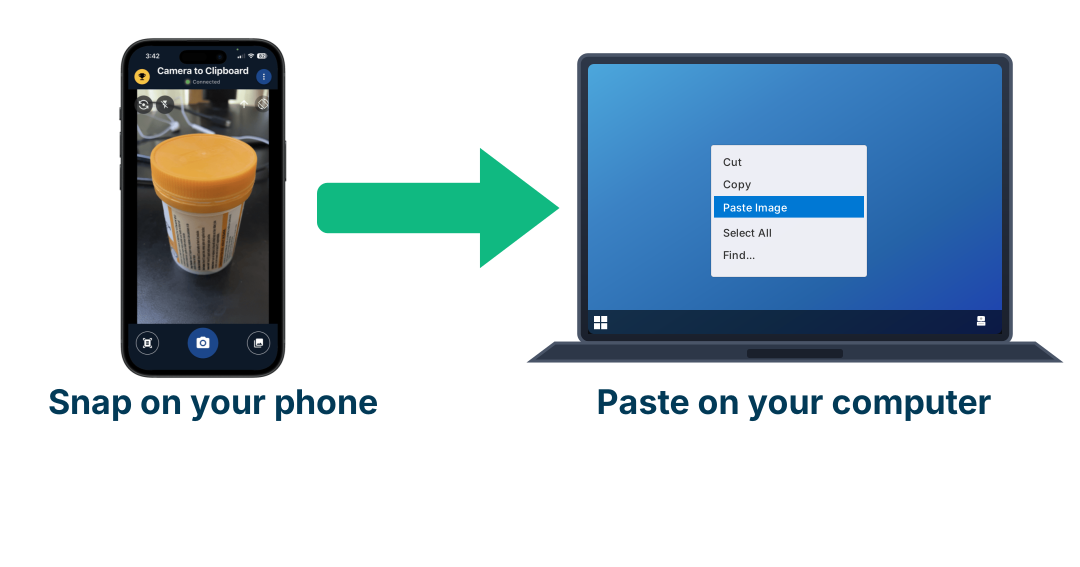
Use Camera to Clipboard to move a photo off a phone with no upload
Once you have seen how ordinary the tracking is, the same question turns around on your own habits. The usual way to get a photo from a phone onto a computer is to email it to yourself or park it in a cloud album, which means handing it to a company for no reason other than that the phone and the computer would not talk to each other. Camera to Clipboard, one of my own apps, removes the middleman entirely.
- The phone and the computer send the picture to each other over your own local network, so it never reaches anybody else’s servers. The whole mechanism this article describes runs on data voluntarily handed to a third party, and a photo emailed to yourself is exactly that pattern applied to your own files.
- A photo taken inside Camera to Clipboard is on your computer’s clipboard the moment you take it, with no cable and no file to go and find. Paste it wherever you were already working, because it arrives as an ordinary picture on the clipboard rather than as an attachment sitting in a mailbox.
- Pictures already in the phone’s library can be sent the same way, several at once. That covers the receipt photographed last week as well as the one taken thirty seconds ago, and it means clearing a backlog does not turn into a cloud sync you did not want.
Set the tag up anyway, because it makes all your ads work
There is no product to buy and no minimum spend. The steps are the same everywhere:
- 1. Create an ad account. Free. You are not committing to spend anything.
- 2. Copy the tag into every page. One block of JavaScript in the
<head>. On a static site that means pasting it into each file; on anything templated it is one edit. - 3. Mark the pages that mean something. Pricing, checkout, signup, thank-you. These become the segments worth separating later.
- Step four is to save an audience, which is just a filter like visited in 30 days. An audience is just a saved filter: "visited any page, last 30 days". It starts empty and fills as people arrive.
- Step five is waiting, because an audience fills at the speed of your traffic. This is the actual constraint. An audience is a rolling window, so it takes as long as the window to reach full size.
Step 5 is why the timing advice is so lopsided in one direction.
Why install the tag if you have just been told not to retarget
Because almost everything the tag does has nothing to do with retargeting. The same few lines of code also sit on your order-confirmation page, and there they report "someone paid $34.99" rather than "someone visited". That is the only way Meta or Google ever learns a sale happened, because the payment goes through your site or Stripe, where they cannot see it. Without that, they cannot tell you which ad produced a sale, so every campaign you run is guesswork. They cannot aim a campaign at people who will buy rather than people who will click, which is the difference between cheap clicks and actual customers. They cannot build you an audience of strangers who resemble your existing buyers, which is one of the better ways to find new people. And they cannot stop you paying to advertise to customers who already bought. All of that is ordinary advertising, not retargeting, and none of it works without the tag.
The retargeting audience is just a free by-product. It costs nothing, it accumulates in the background, and it is the only part you cannot buy your way out of later. Decide in November to run ads for a December launch and you start with an audience of zero, because the audience is built from traffic that has already happened.
The same logic applies to the retention window. Set audiences to the maximum duration from day one, because you can always narrow a long window later, but you can never recover visits that were never recorded.
Retargeting is not a Google and Meta feature, it is a pixel feature, and nearly every ad platform ships a pixel. What actually differs between them is the smallest list each one will serve an ad to and how long it remembers a visit, and both of those thresholds changed recently while most guides still quote the old ones. The last column rates installing the free tag, which is worth doing. It is not a rating of spending money on retargeting ads, which this article argues against.
| Platform | Smallest audience it will run | How long someone stays on the list | What you install | Worth installing the tag |
|---|---|---|---|---|
| Meta (Facebook, Instagram) | 100 people technically, 1,000+ before delivery is stable | Up to 180 days for website visitors | Meta pixel, plus Conversions API if you can | Yes. Its tag is what measures and aims your ordinary campaigns, whether or not you ever retarget |
| Google Ads | 100 active users across Search, Display and YouTube (was 1,000 on Search) | Up to 540 days on Display, 180 on Search | Google tag, or GA4 audiences linked to Ads | Yes. Same reason, and it feeds GA4 as well |
| Microsoft Ads (Bing) | 300 people before it will serve the list at all | 180 days, and that is a hard cap you cannot raise | The UET tag | Only if you already run Bing search ads |
| TikTok | 1,000 people for a custom audience | Up to 180 days | TikTok pixel or Events API | Only if you already advertise on TikTok |
| 100 matches on an uploaded customer list; Pinterest publishes no floor for site visitors | Up to 540 days, tied with Google for the longest memory here | The Pinterest tag | No unless you already advertise there | |
| Snapchat | 1,000 people, the highest floor of any self-serve platform here | Up to 395 days | The Snap Pixel | No unless you already advertise there |
| 300 people and a high floor price per impression | Up to 365 days | LinkedIn Insight Tag | Only if you sell B2B and already advertise there | |
| Reddit and X | Around 100 to 300, varies by objective | Typically 180 days | Their own pixel | No. Small audiences and thin ad supply |
| Third-party networks (AdRoll, Criteo) | Effectively thousands of visitors to be worth their fee | Varies by contract | Their tag, plus a monthly platform fee | Never. A monthly fee for reach that barely works any more |
Two settings matter more than any bid you will place
- An audience of pricing-page visitors beats an audience of anyone who visited. "Anyone who visited" is the weakest possible list. Someone who reached your pricing page is worth several times someone who bounced off a blog post, and they should get different money and a different message.
- A 7-day retargeting audience outperforms a 180-day one on almost everything. A 7-day audience will outperform a 180-day one on almost every metric. Long windows are for building volume, not for performance.
- Always exclude existing customers from a retargeting audience. This is the single most common unforced error. Without an exclusion audience you spend real money advertising a product to the people who already bought it, and they are the most likely to click, which makes your metrics look better while wasting the budget.
- Segment by what they did, not by who they are. The whole advantage here is that you know the action. Throwing that away by lumping everyone into one list gives up the only thing retargeting is good at.
It clicks 10 times more and converts twice as well, both real
The statistics quoted in every retargeting pitch are, unusually for marketing, mostly accurate. It is what they are taken to mean that goes wrong.
| The claim you will be shown | The number | Is it actually true | What it really proves |
|---|---|---|---|
| "Retargeting clicks 10x better than display" | 0.7% against 0.07% for standard display | Yes, and newer sets put retargeting at 0.9% to 1.2% | That display's baseline is catastrophically low, not that retargeting is strong |
| "It converts far better than cold" | 3.8% against 2.2% non-retargeted | Yes, and the gap widens to 3x to 5x against pure strangers | That people who already visited you are closer to buying, which you knew |
| "It halves your cost per customer" | Up to 50% lower reported CPA | True as reported, and reported is doing heavy lifting | Nothing yet, until it survives a holdout test |
| "Retargeting CPMs are cheaper" | $5 to $15 against $12 to $20 broad cold | Contested: other sets show warm audiences at the highest CPMs | Both happen: relevance pushes price down, a tiny audience pushes it back up |
| "Retargeting lifts return visits" | 14.6% more users returned within four weeks | Yes, and this one is causal: a randomised field experiment | The genuine article. This is what a measured effect looks like |
Notice which row is different. Four of those are observational: they compare people who saw retargeting to people who did not, and those two groups were never comparable to begin with. Only the last is an experiment, and it is the only one that can tell you the ads caused anything.
The ads reach people who were going to buy anyway
The mechanism is simple enough to state in one line, and it invalidates most published retargeting results.
- The audience is selected on intent. The people on your retargeting list are, by construction, the people who already came to your site. They were always the most likely to buy.
- The platform then claims the sale. If someone was going to buy on Thursday and they see your ad on Wednesday, the ad gets the credit. Nothing about that is fraudulent. It is just the wrong question being answered.
- It gets worse: they count people who never clicked. Many platforms count a conversion if the ad was merely displayed, without a click, within a day. On a small audience with a high frequency, almost every buyer will have technically seen something.
- Only a holdout test measures whether retargeting caused the sale. Randomly withhold ads from a slice of the audience, then compare the two groups. Everything else is a guess dressed up as a measurement.
What a holdout typically finds, using the standard worked example:
Sales Meta says the campaign produced8,000
Purchases made by the exposed 80% of the audience12,200
Purchases made by the held-out 20%, scaled to the same size10,000
Purchases the advertising actually caused, which is 27.5% of the reported figure2,200
27.5% of the sales Meta and Google credit to retargeting typically survive a randomised holdout test. The other three quarters were people who had already decided. So every reported retargeting cost per customer has to be divided by about four before you compare it to anything else, and once you do, the cheap price is gone.
The error runs both ways, so neither dashboard is right
Meta and Google taking too much credit is the famous story, and it is only half of it. Google Analytics makes the opposite mistake, and it can be just as large.
- Meta and Google claim too much. They count people who only saw the ad and never clicked it, and they assume everyone who bought was persuaded, so the number comes out too high.
- Google Analytics claims too little. In one controlled group experiment, Google Analytics credited remarketing with 1.7% of conversions while the measured lift against the control group was 18.5%, an 11x understatement.
- Both can be true on the same campaign. They are different errors: one counts influence that did not exist, the other refuses to count influence that did.
- The real effect of retargeting varies so widely that only your own test answers it and nobody can hand you the answer for your own account. You have to run the test.
How each measurement method fails, so you know what you are looking at.
| How you are measuring | What it actually counts | Which way it gets it wrong | How hard it is to run | Should you believe it |
|---|---|---|---|---|
| Platform-reported conversions | Anyone who converted after clicking, or often just after seeing, your ad | Claims far too much: Meta and Google mark their own homework | Zero effort, it is the default screen | Only as a trend line, never as a level |
| Last-click analytics (GA4) | Only conversions where the ad click was the final touch | Claims far too little: measured at 11x too low in one experiment | Zero effort, already installed | No, especially where most people see the ad without clicking it |
| Platform conversion lift study | A randomised no-ads control group run by the platform itself | Roughly right, though the platform designs the test | Moderate: needs minimum spend to qualify | Yes, the best effort-to-truth ratio |
| Your own audience holdout | The difference between a random exposed group and a random excluded one | The actual answer for your account | Moderate: a week of setup, weeks of patience | Yes, this is the gold standard |
| Geo holdout | Turning the channel off entirely in matched regions | Clean and causal, but blunt | Hard: needs scale and matched markets | Yes, if you are big enough to run it |
| Eyeballing it after switching it on | Whatever else changed that month | Unbounded in both directions | None | No |
Your audience cannot exceed your traffic, minus three quarters
Everything above is about how well retargeting converts. This section is about the ceiling on how many people it can convert at all, and for a small product the ceiling binds long before the conversion rate does.
Start with 10,000 monthly website visitors, which is more traffic than most independent products have, and watch what is left.
Monthly website visitors10,000
Minus the 29.5% who run an ad blocker, which stops your tag firing at all7,050
Minus consent refusals, at the 42% to 47% average acceptance in consent-required regions3,170
Minus Safari decay: 24% browser share, capped at a 7-day cookie inside your 30-day window2,590
Share of your visitors you can actually put an ad in front of~26%
Each of those haircuts is separately documented, and they multiply rather than add.
| What eats your audience | What it does | How much it costs you | Can you do anything about it |
|---|---|---|---|
| The traffic ceiling itself | You cannot retarget people who never came | Absolute: it caps the entire channel | No: the only fix is more traffic, which costs what traffic costs |
| Ad blockers | Block the pixel from loading, so the visit is never recorded | 29.5% of users globally, 32.5% in the US, 38% to 40% in the UK | Partly: server-side events recover some of it |
| Cookie consent | No consent, no tracking, in the EU, UK and increasingly elsewhere | 42% to 47% average acceptance, under 25% in some countries | Somewhat: banner design moves this a lot |
| Safari ITP | Caps JavaScript cookies at 7 days, and at 24 hours from an ad click | Guts long windows for the 24% of users on Safari | Partly: server-side tagging restores longer lifetimes |
| Apple's App Tracking Transparency | Removes the device ID that app-to-app retargeting depends on | Only 15% to 30% opt in, so the iOS pool collapsed | Barely: web-to-app journeys are the workaround |
| Third-party cookie decline | Open-web display retargeting depends on cookies Safari and Firefox already block | Chrome kept them after reversing course, but reliability keeps sliding | Yes: stay inside the walled gardens |
| The platform minimum | An audience under the floor simply will not deliver | 100 people to run at all, ~1,000 to run reliably | Yes: widen the window, or combine audiences |
- A US-heavy audience fares much better, because consent banners are mostly not required. The same 10,000 visitors leave roughly 5,000 addressable rather than 2,600.
- Hashed email lists are the one thing that survives all of it. If you have signups, uploading them is worth more than any pixel tuning, because a matched account does not care about cookies, browsers or ad blockers.
- Working backwards from the 1,000-person threshold: you need roughly 4,000 monthly visitors for retargeting to deliver reliably in a consent-heavy market. Below that it will technically run and will not do much.
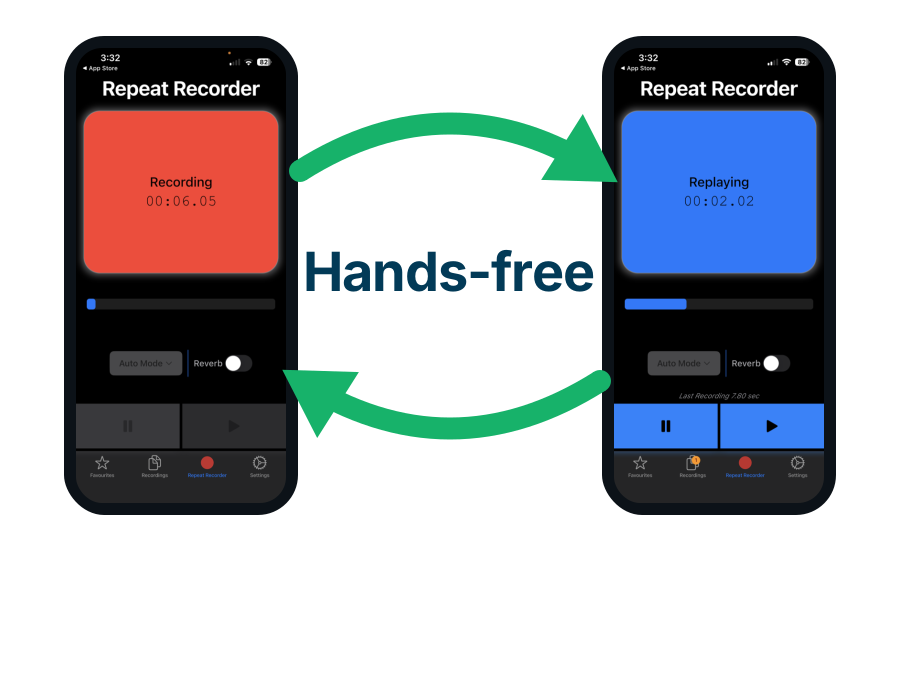
Use Repeat Recorder to rehearse a demo video instead of buying ads
Under roughly 4,000 monthly visitors there is nobody in the audience to advertise to, so the only lever left is whatever makes strangers turn up in the first place. For most small products that lever is a two minute video of the thing working, and the part of it most likely to be bad is the talking over the top. Repeat Recorder, another of my own apps, records you and plays each take straight back without you touching the phone.
- Repeat Recorder plays each take back automatically and then starts recording again, so you can run the same opening line twenty times without picking the phone up. That is the entire app. It was built for people drilling a phrase in a new language or warming a voice up, and reading a script for a video is the same job with different words.
- Meta and Google will sell you a stranger for $42 to $48, so an afternoon spent making the video better is the only version of that spend you keep. The advertising stops the day the budget does, and a clearer explanation of what your product does carries on working on every visitor who arrives afterwards.
- Takes worth keeping go into favourites and into folders you name yourself, so two readings of the same sentence sit side by side. Recording a line twice and picking the better one takes about a minute, which is faster than any advertising test in this article and costs nothing to run.
A small audience forces you past the creepiness cliff
This is the failure mode that produces the shoes-following-you-for-a-fortnight experience, and it is almost always an arithmetic accident rather than a decision.
- A third of retargeting's first-week effect is gone within days. In the Sahni, Narayanan and Kalyanam field experiment, 33% of the first week's entire effect happened on day one, and the impact of retargeting fell the longer it had been since the person's original visit.
- Most of the value lands in the first two impressions. Roughly 80% of an ad's weekly impact occurs in the first two views. Conversions generally peak at three to five exposures.
- Past about 5 to 7 views, warm audiences start to sour. At 10 or more exposures, measured negative sentiment rises by about 16%. You are now paying to annoy people who liked you.
- Across 2.8 billion impressions, some campaigns wore out in days and others never did. Across 2.8 billion impressions in 30 natural experiments, four campaigns wore out after one or two exposures while ten showed almost none after fifty. Your creative and category decide which you are.
Now put the small audience and the ordinary budget together, and see why over-exposure is the default outcome rather than a mistake:
Your reachable retargeting audience, from the chain above2,590
A modest monthly retargeting budget$200
At a $10 CPM, that budget buys impressions20,000
Times each person sees your ad this month, which is straight into the fatigue zone7.7
The counter-intuitive fix
If your frequency is too high, the answer is usually to spend less, not to change the creative. A tiny audience with an uncapped budget has nowhere to put the money except into repetition, so the platform obediently shows the same person the same ad eight, twelve, twenty times. The budget is not buying reach any more. It is buying resentment.
Set a frequency cap of around 3 to 5 per week, cap the budget at whatever that many views actually costs for an audience your size, and put the remainder into finding new people, which is what actually makes the retargeting audience bigger next month.
Its cheap cost per customer is partly an accounting illusion
On paper retargeting wins every cost comparison. Here is the whole comparison, including the rows the pitch decks leave out.
| What you are comparing | Advertising to strangers | Retargeting | Why the gap exists |
|---|---|---|---|
| Cost per 1,000 impressions | $12 to $20 broad cold targeting | $5 to $15, but warm pools can run higher | Relevance earns a discount; a tiny contested audience takes it back |
| Cost per click | Around $0.30 to $1.00 on Meta | $0.50 to $1.20, dearer per click but far more clicks per impression | A higher click rate offsets the dearer click, so the two end up close |
| Conversion rate of that traffic | 0.7% to 1.5% typical cold | 3.8%, up to 3x to 5x cold | Selection: these people already chose to visit you |
| Cost per customer Meta and Google report | $42 to $48 on Meta, $49 on Google Search | Up to 50% lower, about $22 on Meta | They are counting sales they did not cause |
| Cost per customer after a holdout | Roughly what it said. Cold traffic is not picked out of people already trying to buy | About $80, which is more than the cold row beside it | Divide the reported figure by the share the ads really caused |
| Can you scale it by spending more | Yes, until you exhaust the market | No: extra budget buys repetition, not reach | The audience is fixed by last month's traffic, not by your budget |
| What happens if you cut it | Your retargeting list shrinks next month | Nothing else is affected | Retargeting is built out of the traffic strangers-advertising buys, never a substitute for it |
Throw away the buyers who were going to buy anyway and the cheap price disappears:
Monthly retargeting spend$2,200
Customers Meta reports, at the benchmark $22 each100
How many of those 100 the ads actually caused, at the 27.5% a holdout typically finds27.5
What one real customer actually cost you, which is $2,200 divided by 27.5$80.00
$80 is what a "$22 per customer" retargeting campaign really costs, because most of those buyers never needed the ad. That is more than the same platform charges you for a total stranger, which is $42 to $48 on Meta and $49 on Google Search. Retargeting is not a cheap way to buy customers. It is an expensive one wearing a cheap price tag.
The most expensive misunderstanding in this article
A cheap reported cost per customer is not a discount you can scale into. The tempting move, once retargeting reports $22 a customer next to $42 to $48 for a stranger, is to shift the budget across. It fails twice over: the $22 was never real, and the retargeting list only exists because the money spent on strangers created it. Move the money and next month there is nobody left to retarget.
Retargeting is a small nudge to traffic you already have, not a cheaper source of customers. The industry answer is to budget it as 20% to 30% of your ad spend. On the numbers in this article the better answer is zero, and if you run it at all, run it as a test with a holdout rather than as a line in the budget.
Work out what retargeting would cost you specifically
Three questions decide this, and all three are arithmetic rather than opinion: how many people can you reach, how often will they see you, and what does one real customer cost. Set your own numbers, or use the presets.
A free audience is additive but still not cheaper
Everything above quietly assumes you paid for the visit. Plenty of people did not: they rank in search, they got a good thread on a forum, someone told a friend. That is a materially different case and it deserves a straight answer.
- The scaling objection disappears completely, and it was one of the two that mattered. The warning that moving money into retargeting shrinks the very list you are retargeting depends entirely on the list being built by paid traffic. Search results, word of mouth and forum posts keep arriving whether or not you advertise, so spending here takes nothing away from anything.
- The cost objection does not budge. The 27.5% is low because the audience is selected on intent: everyone on it already came to your site, so they were always the most likely to buy. Arriving by a search result rather than an ad click does not make them less likely to have bought anyway. $22 divided by 0.275 is still $80, and the same platform still sells you a total stranger for $42 to $48.
- A free input does not make an expensive output cheap. The audience costs nothing to have. The impressions you serve to it cost exactly what impressions cost.
- What decides it is your price, not where the traffic came from. At a real $80 a customer, the usual rule that a customer should return three times what they cost means that customer has to be worth about $240. The median subscription app earns $21.37 per payer in a year. For a normal consumer app that is a no by a factor of ten. For a $200-a-year business tool it is fine.
- You do get one thing the paid case never has: a free holdout. Nothing about the audience is at risk, so withhold ads from a random 10% to 20% and find out your own number rather than borrowing this article's. That is the only figure that counts and it costs you nothing but a month.
A subject page converts worse but proves more
Take an accent training app running an article on how accents actually form. The readers are exactly the right kind of person and none of them came to buy anything. Retargeting them is a different proposition again, and it moves in two directions at once.
- Your share of genuinely caused sales should beat 27.5%, and that is the good news. That figure is low precisely because retargeting audiences are people already partway through buying, so the ad collects credit for sales that were coming anyway. Someone reading an explainer is in no purchase process at all and may not know your product exists. There is far less for the ad to take undeserved credit for, so more of what it produces is real.
- Your conversion rate will be far worse, and that is the bad news. The 3.8% retargeting conversion rate above was measured on people who looked at products. An article reader is several steps further back, so the cost per customer starts much higher than $22 before any correction is applied to it.
- Better attribution and a worse conversion rate cancel out, and nobody has measured the net. Better causation multiplied by a worse conversion rate. Which one wins depends on your subject and your product, which is exactly why the holdout is the entire answer here rather than a formality.
- Do not show them the product they never looked at. Lambrecht and Tucker found specific product ads only beat generic brand ads for people whose preferences had already formed. Article readers are the opposite case by definition. Generic creative is the choice the research actually supports.
- Calling this retargeting flatters it. Someone who read an explainer and never saw your product is much closer to a warm stranger than to a cart abandoner. Judge it against what a stranger costs, not against the $22 benchmark, which was measured on people who were shopping.
- The audience floor bites hardest here. An article pulling 2,000 readers a month leaves roughly 520 you can reach after the privacy haircuts, well under the 1,000 needed for steady delivery. Google will happily run a list of 100. It will not do much with 520.
Chrome is not what tracks them, and Display is the worst of the three places to try this
Your tag does the tracking, not the browser. Google Display retargeting works because you put the Google tag on your pages, or link a GA4 audience to Google Ads. Chrome does not report anyone's browsing to your ad account, and no browser setting switches retargeting on. If the tag is not on the page, the visit never happened as far as Google is concerned.
Chrome does matter, for a different reason. Serving those ads back out across the Display Network leans on third-party cookies. Safari and Firefox block them outright and Chrome kept them after reversing course, so open-web display retargeting still works on Chrome and largely does not elsewhere. That is a limit on who you can reach, not the thing doing the recognising.
And Display is the dearest of the three anyway. Corrected for the sales the ads really caused, a customer costs about $138 on Google Display against $95 on Google Search and $80 on Meta, set out next to every other channel here. If you are going to test this at all, do not start with the most expensive version of it.
The three cases side by side, because they are usually discussed as if they were one thing:
| How the visitor got to you | What the audience costs you | Does spending here shrink your other advertising | How many of the sales the ads really cause | Should you spend money on it |
|---|---|---|---|---|
| They clicked one of your ads | The price of the click, which is most of your ad budget | Yes. Move money here and next month's list is smaller | About 27.5%. They were already shopping | No. $80 a customer against $42 to $48 for a stranger |
| They found you in search and looked at your product | Nothing, and it keeps arriving | No. The traffic comes whether or not you advertise | Still about 27.5%. Arriving free does not make them less likely to buy anyway | Worth testing, because finding out costs nothing |
| They read your article on the subject and never saw your product | Nothing | No | Better than 27.5%. They were not shopping, so less of it was going to happen without you | No. They convert far worse, and they are worth more as a seed |
Which points at the two things a free audience is actually good for, neither of which is retargeting:
- Use them as a seed to go and find strangers who resemble them. Hand Meta or Google your readers, and especially the handful who paid, and let it build an audience of people who look like them. That pool is the whole internet rather than the 520 people you already have, and it is the part of advertising that can actually grow.
- Take their email while they are on the page. Then reaching them costs nothing, forever, instead of $80 a customer. On an audience you did not pay for in the first place, paying Meta to talk to them is the strangest possible choice.
Seven of the ten reasons to retarget are a straight no
These are the ten situations the industry names when it tells you to run retargeting.
| Your situation | Should you spend money on it | Why | What to do instead |
|---|---|---|---|
| Pre-launch, no traffic yet | No. There is nobody to retarget | The list is built from past visits and you have none | Install the tag anyway, for conversion tracking rather than for retargeting |
| Under 1,000 visitors a month | No. Not even close | Roughly 260 reachable people cannot sustain delivery | Spend the same money and effort on getting more traffic |
| 5,000 to 50,000 visitors, considered purchase | Only as a test, with a holdout running from day one | Big enough to deliver, but a real customer still costs more than a stranger does | Cap the spend at what you can afford to write off, and measure it properly |
| Ecommerce with cart abandonment | The strongest case here, worth testing | Reported $13 a customer. Even divided by the 27.5% a holdout typically finds, that is about $47, the only case in this article that lands anywhere near the $42 to $48 a stranger costs | A 7-day cart audience only, and hold out a random slice to see what it really did |
| Free iOS app with in-app purchases | No. | App-to-app retargeting needs tracking consent that 70% to 85% of people refuse | Nothing. Put the money into finding new people |
| B2B SaaS with a long sales cycle | No, and LinkedIn charges a premium on top | Long decisions do favour reminders, but a LinkedIn impression is the dearest in the table | Email the list yourself. It costs nothing and reaches them properly |
| Cheap impulse product, instant decision | No. | If they did not buy in the first session they mostly never will | Fix the first session instead |
| You have an email list of past signups | Email them instead. It is free | Uploading the list to Meta means paying to reach people you can already reach for nothing | Use the list directly. Only upload it if email has already failed |
| Organic visitors who looked at your product | Worth testing, because the test itself is free | The audience costs nothing and takes nothing from your other advertising, but a caused customer still costs more than a stranger does | Hold out a random slice from day one, and seed a lookalike audience from them either way |
| Organic readers of your content, who never saw your product | No. Use them as a seed instead | They were never shopping, so they convert far below the $22 benchmark, which was measured on people who were | Take their email on the page, and hand them to Meta or Google to find similar strangers |
The setup that wastes the least money if you run it
- 1. Install the tag today, even at zero traffic. Free, and it is what lets Meta and Google measure and aim every other campaign you ever run.
- 2. Set every window to the maximum. 180 days on Meta, 540 on Google Display. Narrow later; you cannot widen backwards.
- 3. Email your list yourself before you upload it anywhere. Reaching your own signups costs nothing. Only pay Meta to reach them if emailing them has already failed.
- 4. Build exactly three audiences. Deep visitors at 30 days, all visitors at 180 days, and converters as an exclusion. More segments than that on a small audience just starves each one.
- 5. Cap frequency at 3 to 5 a week, and set the budget to whatever that many views costs for an audience your size, rather than to what you wish you were spending.
- 6. Keep at least 80% of the budget on finding new people. That is the part that actually grows you, and it is what creates next month's retargeting list in the first place.
- 7. Do not use dynamic product ads by default. The research says generic creative usually beats showing people the thing they already passed on.
- 8. Run a holdout before you believe any of it. Exclude a random 10% to 20% for a month. Whatever the gap turns out to be, that is your real number, and it will be well under what Meta and Google tell you. If it comes out worse than your ordinary advertising, switch it off.
- 9. Divide the reported cost per customer by the share your own test says the ads caused before you compare retargeting to any other channel. Otherwise you are comparing a measured number to a flattered one.
The honest bottom line: retargeting does not work, because it costs more than it brings in. The ads do move some people, and that part is properly measured: roughly a 15% lift in return visits in the best controlled study available. But Meta and Google report an effect about four times larger than the one they caused, because the ads are shown to people who had already decided. Strip those people out and the famous $22 customer really cost $80, where the same platform sells you a total stranger for $42 to $48. There is no version of that arithmetic where you come out ahead, and you cannot spend your way past it either, because the list only exists at all thanks to the money you spent on strangers. Install the tag on day one anyway. It is free, and it is what lets Meta and Google tell you which ad produced a sale, aim a campaign at people who buy rather than people who click, and find you strangers who resemble your existing customers. Then put the budget into finding those new people, and treat every retargeting figure Meta and Google show you as an upper bound rather than a result.
Use Camera to Clipboard to photograph the product your ads show
If most of the money is going on finding new people, then the picture in the ad is doing the persuading, and the research in this article says a plain image of the product usually beats an automated feed showing somebody the thing they already walked away from. Somebody has to take that photograph, and it will be taken on a phone and used on a computer. Camera to Clipboard, one of my own apps, is a phone camera that pastes.
- Generic images beat dynamic product ads in the research above, which puts the whole result on one photograph you took yourself. A photo taken inside Camera to Clipboard is on your computer’s clipboard the moment you take it, so the gap between having an idea for an ad and looking at it is about ten seconds.
- Pasting into Photoshop or GIMP drops the photo in as a new layer, which is where an ad image gets built. Word and Google Docs take it inline instead. Anything that accepts a pasted picture accepts this one, because it arrives as an ordinary image on the clipboard rather than as a file you have to go and find.
- Several shots can be sent at once out of the phone’s library, so six versions of the same product photo arrive together. Running two images against each other is the one test in this article that costs nothing and needs no holdout group, and the slow part of it has always been moving the pictures.
Conclusion: retargeting costs more than it brings in
- Retargeting is not a new audience, it is a second conversation with traffic you already have. Every strength and every limit follows from that one fact. The list can never be bigger than the traffic you already own, and privacy defaults delete most of what is left, so 10,000 monthly visitors leave about 2,600 people you can actually reach.
- A retargeted customer really costs about $80 on Meta, and the same platform sells you a total stranger for $42 to $48. Meta reports $22, but only about a quarter of those buyers needed the ad and the rest were buying anyway, so $22 divided by that quarter is the honest price. There is no version of that arithmetic where you come out ahead.
- Install the free tag today, then spend the money on finding new people rather than on retargeting ads. The same few lines of code sitting on your order-confirmation page are the only way Meta and Google ever learn a sale happened, and that is what lets every other campaign you run be measured and aimed. If you do buy retargeting ads, withhold them from a random 10% to 20% of the audience for a month first, and switch them off if your own numbers come out worse than your ordinary advertising.