
If you have never trained your voice before, the good news is that the starter routine is short and simple. A few gentle exercises, five minutes a day, and a little consistency will take you a long way. The part beginners most often miss is a way to measure progress, and that is exactly the gap the free Repeat Recorder app fills: record a passage, hear it back, and try it again.
The quick answer: voice training for beginners is a small daily routine. Warm up with humming, lip buzzes and gentle sirens, breathe from your diaphragm, settle into your natural pitch, and open your mouth so words come out clearly. Start with five minutes a day and stay consistent. Then do the thing that turns practice into progress: record a short passage, keep it as a baseline, and compare it a few weeks later. Your voice improves fastest when you can actually hear the change. Repeat Recorder plays each take back a second after you speak. 
Voice exercises for beginners
You do not need a studio or a coach to begin. The whole of beginner voice training comes down to four things done in order: warm the voice up, put breath behind it, find the pitch that suits you, and speak clearly. None of them are hard, and they build on each other. The one rule that beats every clever technique is to start small and come back tomorrow. Five honest minutes a day, repeated, will outrun a single long session you never do again.
The exercises below improve much faster the moment you can hear yourself from the outside. When you speak, you hear your own voice partly through the bones of your skull, which adds warm low tones nobody else gets. A recording is the honest version, and it is the one worth practising with.
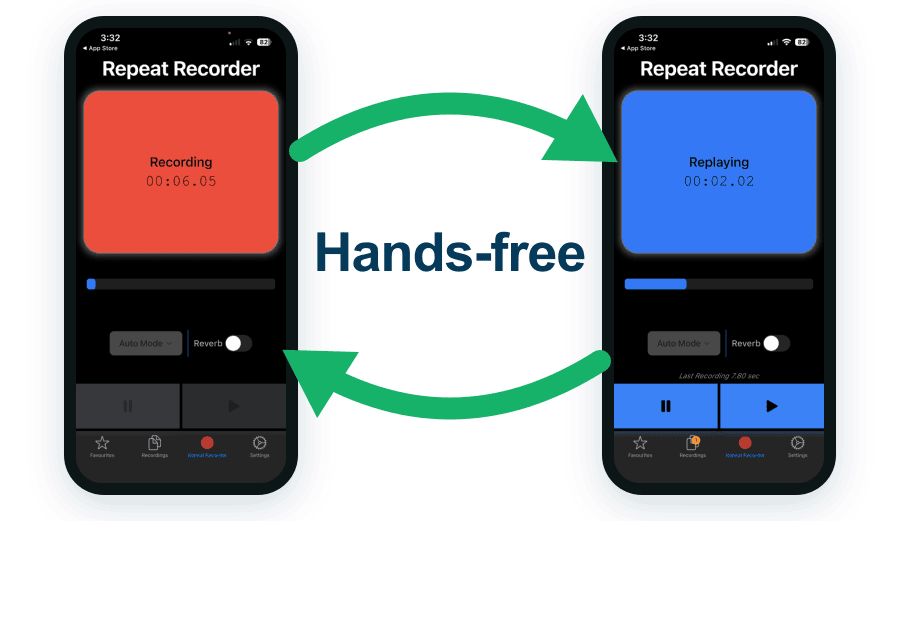
The record and replay loop in Repeat Recorder: speak a line, hear it back a second later, then go again.
A voice warm up for speaking
A cold voice sits high and cracks. A short vocal warm up settles it into its lower, fuller range before you have to use it. This is the gentlest part of the routine, and the best place for a beginner to begin.
- Humming. Hum a comfortable note for a few seconds, feeling the buzz on your lips and the front of your face. Slide gently up and down.
- Lip buzzes. Let your lips flap loosely on an outward breath, like a small motor. This loosens the mouth and relaxes tension.
- Gentle sirens. On an "oo" or "ng" sound, glide smoothly from a low note up to a high one and back down, like a slow siren. Keep it soft, never strained.
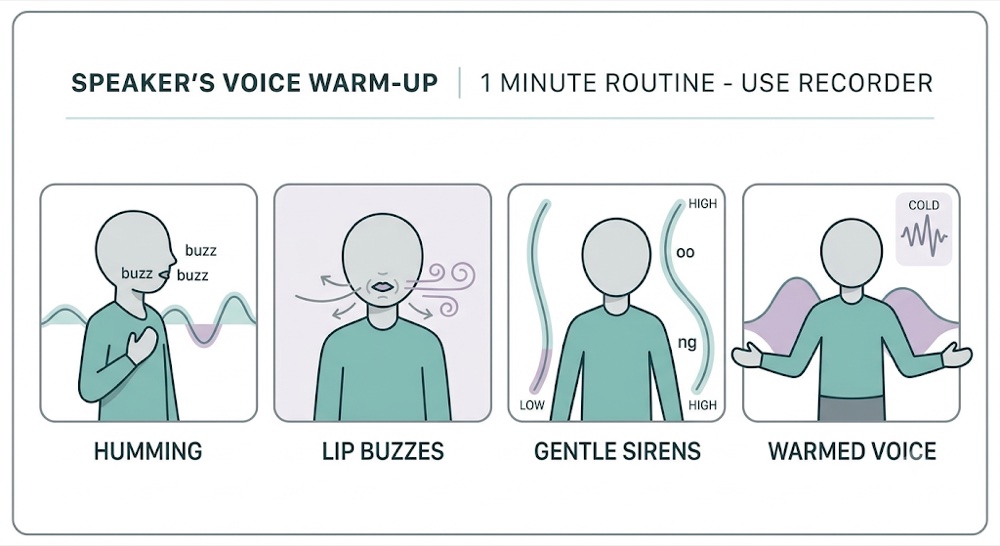
A minute of this is plenty. Do it with the recorder running and you get a baseline take, so you can hear where your voice starts and where it settles.
Exercises to strengthen your voice
A thin or fading voice is almost always a breathing problem, not a strength problem. Air is the fuel, and most beginners run on far too little of it because they breathe high in the chest. Diaphragmatic breathing gives you a steady column of air to speak on, which steadies the tone and stops sentences trailing off at the end.
- Put a hand on your stomach and breathe in so that hand moves out, not your shoulders up.
- Read a sentence out loud on one relaxed exhale, keeping the volume even from the first word to the last.
- Record it and listen. If the last few words got quieter, you ran out of air. Take a fuller breath and go again.
The same fuller breath is what lets you find and use your natural pitch. Many beginners speak higher than their body wants to, especially when nervous. To find your natural pitch, say "mm-hmm" as if you were agreeing with someone, relaxed and unforced. That is roughly where your voice wants to sit. Read a passage aiming to land there rather than up in your throat, then play it back to check it actually did.
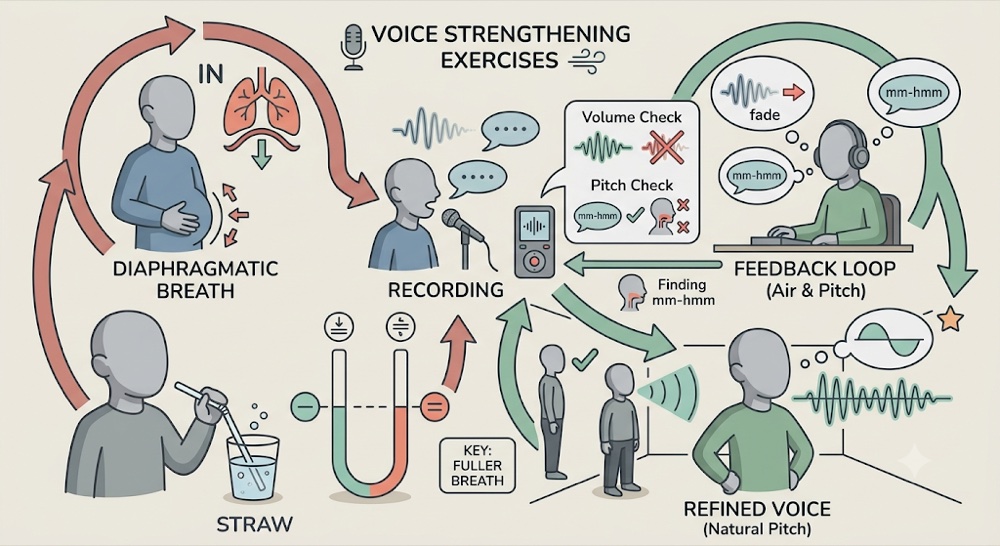
Simple voice training exercises
The last piece is clarity. Mumbled words come from a barely-open mouth and lazy consonants. For practice, exaggerate: open wider than feels natural and hit the ends of words. It will feel over the top from the inside and sound completely normal on the recording. Read a short passage, play it back, and listen for the consonant that collapsed.
Here is the honest part, and the reason a beginner needs more than a set of exercises. All of this only turns into progress if you can measure it, and you cannot measure a voice you have never heard from the outside. So give yourself a baseline. In your first week, record a short passage and keep it. Practise a little each day. In week four, record the same passage again and play the two takes back to back. The difference is something you can actually hear, rather than something you have to take on faith.
Repeat Recorder was built for exactly this loop. You speak, and a second later your take plays back on its own, so the gap between saying it and hearing it disappears. Its list of recordings lets you revisit that first-week take whenever you want. And because automatic mode is hands-free, daily practice becomes realistic: you can run these exercises in the car or on a walk, not only sitting at a desk.
Why Repeat Recorder beats the voice recorder on your phone
Your phone already has a voice recorder, and it is fine for capturing a memo. For practice it fights you, because practice is not one recording, it is dozens of short takes you want to hear back the instant you finish.
- Instant replay, a second after you stop, with no file to find.
- Hands-free automatic mode, so a beginner can practise on a commute or a walk.
- Loop a take once, a set number of times, or until you stop it.
- A countdown before recording, so you get a breath to prepare.
- Named folders for the passages you are drilling this week.
- A saved baseline, so you can compare week one to week four and hear the progress.

| For voice practice | Repeat Recorder | Phone voice recorder |
|---|---|---|
| Records your voice | ✔ | ✔ |
| Plays each take back automatically | ✔ | Find the file, press play |
| Hands-free, no tapping | ✔ | Tap to record and to play |
| Loop a phrase as often as you want | ✔ | One play at a time |
| Countdown before recording | ✔ | Starts immediately |
| Save takes into named folders | ✔ | One flat list |
| Reverb to simulate a room | ✔ | Dry recording only |
| Free | ✔ | ✔ |
A simple daily routine for beginners
- One minute: hum, buzz your lips and do a few gentle sirens to warm up, recorder running.
- Two minutes: read a paragraph on full diaphragm breaths, listen, fix the fade, repeat.
- Two minutes: read it again in your natural pitch, clearly, then compare the two takes.
Five minutes a day, with feedback, is all a beginner needs to start. Keep your first-week recording, stay consistent, and in a few weeks the progress will be something you can play back and hear.