
Most people already have a deeper voice than the one they use. Your true lower range shows up when you are relaxed, and the goal is not to force the voice down but to consistently use the bottom of the range you already have. The exercises below help you get there, and the part that actually makes them work is feedback: recording a line, hearing whether it really landed lower, and trying again. That loop is what the free Repeat Recorder app was built for.
The quick answer: to make your voice deeper, relax. Stand tall with an open chest, breathe low into your belly, release the tension in your throat and larynx, and speak on a steady exhale. Your deeper voice is a register you drop into when you are calm, not one you push down into. Then do the thing most people skip: record yourself and play it back, because you cannot tell from the inside whether a take actually landed lower. Repeat Recorder plays each take back a second after you speak, so the gap between saying it and hearing it disappears. 
How to get a deeper voice
The single biggest reason people sound higher than they need to is tension. When you are nervous, rushed, or trying too hard, your throat tightens and your pitch climbs. The path to a deeper voice runs through relaxation, not effort. Everything below is really one idea in different forms: take the strain off, let the voice settle, and it drops into its natural low range on its own.
There is an honest limit worth saying up front. You cannot permanently rebuild your anatomy, so your vocal folds set a floor you will not go below. What you can change, and change for good, is your habitual pitch: the pitch you default to without thinking. For most people that habit sits higher than their true bottom, and moving it down is a real, lasting improvement.
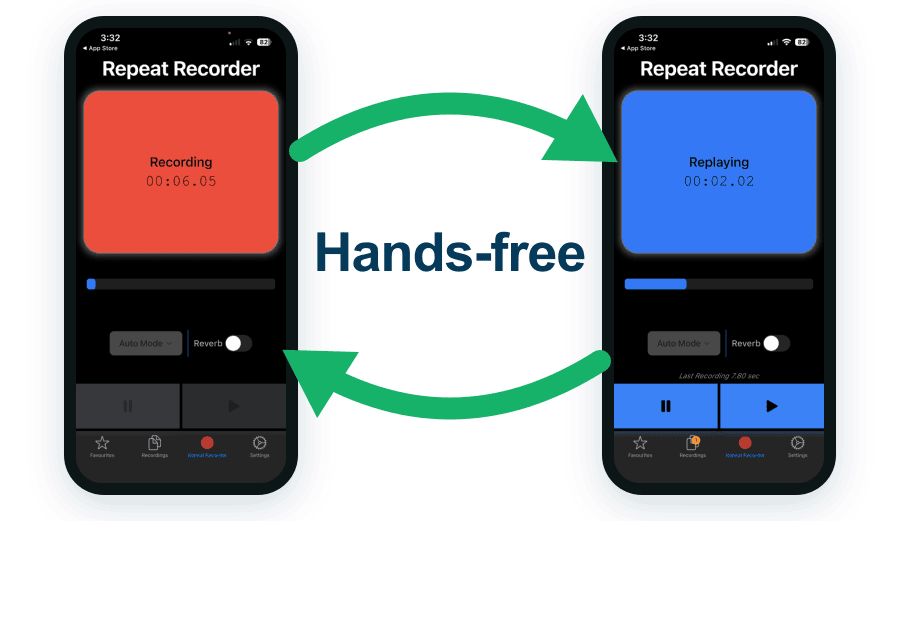
The record and replay loop in Repeat Recorder: speak a line, hear it back a second later, then go again.
How to deepen your voice naturally
Natural is the key word. A voice that is forced down sounds strained and is tiring to keep up, while a voice that has simply relaxed into its low range sounds easy and carries. Work through these one at a time.
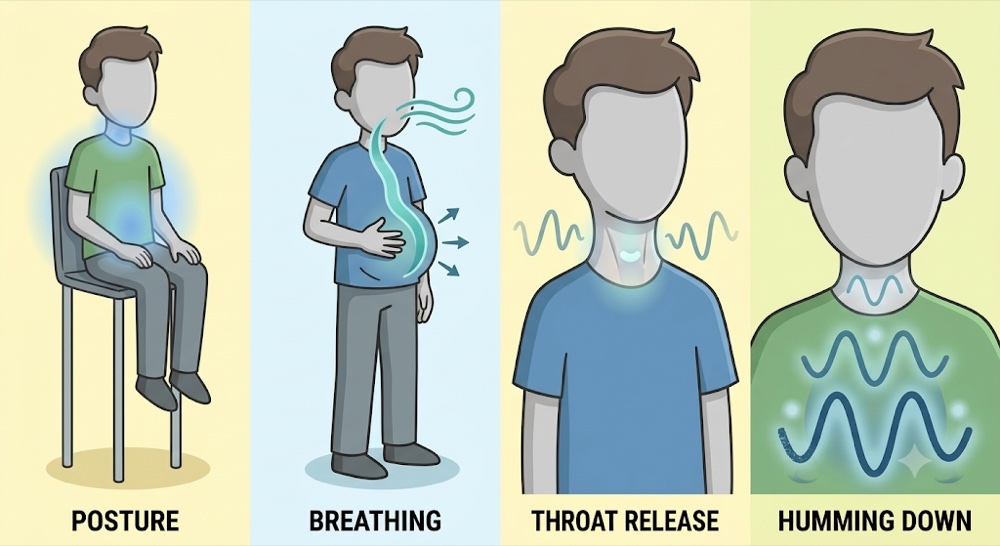
- Open the chest and sit tall. Slumping compresses everything and pushes the pitch up. Roll your shoulders back, lift through the top of your head, and let your chest open. A relaxed, upright frame gives the voice room to resonate low.
- Breathe low and steady. Put a hand on your belly and breathe so that hand moves out, not your shoulders up. That low breath from the diaphragm gives you an even column of air, and a voice riding on steady air sits lower and stops climbing at the ends of sentences.
- Release the throat. Let your jaw hang loose, unclench your tongue, and drop your larynx to a neutral resting position by yawning gently and noticing where it settles. A relaxed throat is a lower throat.
- Hum down through your range. Start on a comfortable note and hum slowly downward, sliding to the lowest note that still feels easy and buzzy. Stop where it stays relaxed. That bottom is your natural floor, and humming teaches your body the feel of getting there without pushing.
How to make your voice deeper permanently
"Permanently" needs the honest version. There is no exercise that lengthens your vocal folds, so the lowest note you can produce is fixed. But that is not what most people actually want. What they want is to stop defaulting to a tight, high, nervous pitch, and that default is learned, which means it can be relearned.
The change becomes permanent the same way any habit does: through repetition. Each time you speak from your relaxed lower register instead of your tense higher one, you make that the more familiar setting. After a few weeks of short daily practice, dropping into the lower range stops being something you do on purpose and becomes where your voice starts. That settled, habitual pitch is a genuine and lasting change, and it is very different from forcing a fake-deep voice, which never becomes comfortable because it was never natural.
How to speak in a deeper voice
Reaching a low note in an exercise is one thing. Actually speaking there, in a sentence, is where it counts. Two habits carry the low range from a hum into real speech.
First, speak on the exhale. Take your low belly breath, then begin talking as you let the air out, never holding your breath and squeezing words past a tight throat. Speaking on a relaxed outward breath keeps the voice low and even. Second, find your natural pitch and aim to sit there. Say "mm-hmm" as if you were agreeing with someone, easy and unforced. That relaxed hum is roughly the bottom of your comfortable range. Read a passage aiming to land your voice around that pitch rather than up in your throat, and remember you are removing the tension that pushed it up, not shoving it down.
Deep voice training exercises
Two short exercises do most of the work. Run them with a recorder going so you can hear the result, not just feel it.
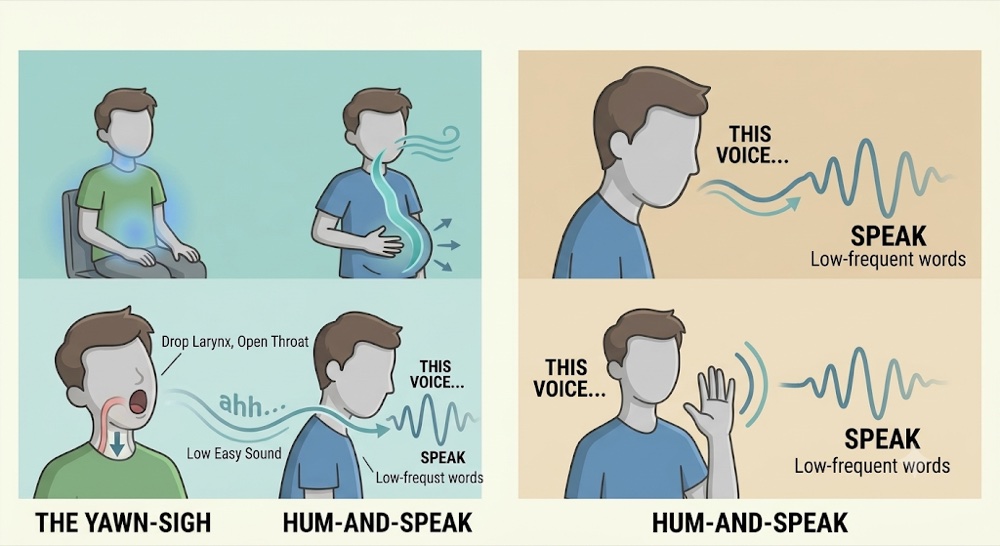
- The yawn-sigh. Start a gentle yawn to open the throat and drop the larynx, then let it turn into a relaxed, voiced sigh on an "ahh" as you breathe out. Notice how low and easy the sound is at the bottom of that sigh. That is the sensation you are chasing when you speak.
- Hum-and-speak. Hum down to your comfortable low note, hold it for a second, then, without changing the feeling in your throat, open straight into a spoken sentence. The hum sets the pitch and the relaxation, and the sentence inherits both.
Here is the catch that makes a recorder essential. You cannot trust your own ears for this, because when you speak you hear your voice partly through the bones of your skull, which adds low tones nobody else gets. From the inside a take can feel deep when it was not, or feel unchanged when it actually dropped. The only way to know is to hear the air-conducted version: the recording.
That is exactly what an ordinary voice recorder makes tedious. You stop, hunt for the file, press play, and by the time it starts you have forgotten how the take felt. Repeat Recorder removes that dead time: you speak, and a second later your take plays back on its own. In automatic mode you never touch the screen, so you can practise your low register while driving or walking, not only at a desk.
Why Repeat Recorder beats the voice recorder on your phone
Your phone already has a voice recorder, and it is fine for capturing a memo. For deepening your voice it fights you, because this is not one recording, it is dozens of short takes you want to hear back the instant you finish, so you can tell a genuinely lower take from one that only felt lower.
- Instant replay, a second after you stop, so you catch whether the take really landed lower.
- Hands-free automatic mode, so you can practise on a commute or a walk.
- Loop a take once, a set number of times, or until you stop it, to compare a relaxed take with a tense one.
- A countdown before recording, so you get a breath to relax and drop in.
- Named folders for the lines you are drilling this week.
- Reverb to hear how your lower voice would sit in a room with some space in it.

| For deepening your voice | Repeat Recorder | Phone voice recorder |
|---|---|---|
| Records your voice | ✔ | ✔ |
| Plays each take back automatically | ✔ | Find the file, press play |
| Hands-free, no tapping | ✔ | Tap to record and to play |
| Loop a phrase as often as you want | ✔ | One play at a time |
| Countdown before recording | ✔ | Starts immediately |
| Save takes into named folders | ✔ | One flat list |
| Reverb to simulate a room | ✔ | Dry recording only |
| Free | ✔ | ✔ |
A simple daily routine
- One minute: yawn-sigh and hum down through your range to warm up and relax, recorder running.
- Two minutes: read a paragraph on low belly breaths, aiming to sit at your relaxed low pitch, then listen back and check whether it really landed lower.
- Two minutes: read it again, once tense and high on purpose and once relaxed and low, then compare the two takes so your ear learns the difference.
Five minutes a day, with feedback, beats hours of pushing your voice down into a strain. The deeper voice you want is not a new voice, it is your own relaxed low range, and a few weeks of short, honest repetitions are what turn it into your default.