
The idea is a good one and it is not new. Instead of paying to advertise your product, you pay to advertise the payout: "earn $100 a week sharing our app". Cheap banner inventory, an offer that sells itself, and at the end of it an army of people out there selling for you on commission. It is one of the most attractive-looking growth ideas there is, which is why so many companies have tried it. This is what happens to the arithmetic when you do, the three situations where it genuinely works, and the earnings-claim rules that usually stop the ad running at all.
The short version:
- Buying ads to recruit referrers loses badly for a consumer product. On Google Display's $0.63 average click and a 2% signup rate, one recruited referrer costs about $31, which is already most of what a finished paying customer costs on Meta. Roughly 90% of people who join a referral or affiliate program never refer anybody, so one referrer who actually refers costs about $315.
- Paying the reward on signup can lose money at any volume. A $25 bounty on a signup that converts to paying at 30% has already committed $83 per paying customer before a cent of ad spend, against $42 to $48 for a stranger on Meta. No amount of extra referrals fixes that, because it is a per-unit cost, not a fixed one. Pay on the first purchase instead.
- The break-even is about the referrer's audience, not your ad. Even with every assumption set generously, each recruited-and-active referrer has to produce about five or six referred signups, and on ordinary numbers it is closer to 60. A consumer produces one or two. Somebody with an audience produces dozens. That single line divides every version of this idea that works from every version that does not.
- The ad and the mechanism fight each other. A referral beats an ad only because it does not look paid. Field experiments in the Journal of Marketing Research found rewards aimed at the friend beat rewards aimed at the sender, because senders hold back when they think they will look self-interested. "Earn $1,000" is the most self-interested framing there is, so the ad recruits hardest for the people whose recommendations will persuade least.
- The ad you want to run is against policy on both cheap networks. Google classifies specific income promises as unreliable claims, Meta rejects a named dollar figure with near certainty, and in the United States "earn up to $10,000" is a regulated earnings claim that has to be typical, not achievable. The FTC sued Arise Virtual Solutions over an advertised "up to $18 an hour" that fewer than 1% of workers earned.
- Uber ran the largest referral-incentive programme ever, then shut it down. Driver referral incentives cost $199M in 2017, $136M in 2018 and $103M in 2019, and both referral programs were shut in 2020. It lasted as long as it did because the person referred was the supply Uber was short of.
- The link is the right mechanism, as you would expect, and it has one real cost. A shareable link needs nothing typed and tracks itself. It also travels, so codes end up on coupon aggregator sites collecting bounties on people who were already coming to you.
- Advertise the referral programme to the customers you already have, not to strangers. advertise the program to the users you already have, where the audience is free and already likes you, and recruit the people with audiences by hand rather than by auction.
An ad-funded referral program advertises at a salesperson
Every other campaign on this site is a transaction between you and the person who will pay you. This one inserts a stranger in the middle, and everything that follows comes from that:
- You are buying a distributor, not a customer. The click you pay for produces somebody who might later produce a customer. The ad has stopped being the last step before revenue and become the first step of four.
- A cash referral offer converts across every audience, which is why it looks promising. That is exactly why it looks so promising: cash converts across every audience, every country and every ad format, with no explaining to do. It is the easiest ad you will ever write.
- It is a single-tier affiliate program with a paid front door. Nothing about the mechanism is unusual. The novelty is only in where the participants come from: bought at auction instead of grown out of your user base.
- The reward is a real cost of goods, not a marketing expense. Every customer who arrives this way carries a permanent payout attached, so the reward sits underneath your unit economics forever, unlike an ad you can switch off.
- You inherit the behaviour of everyone you recruit. What they write in a text message, whether they disclose that they are paid, and where they post your code all become your legal exposure. An ad buys attention. This buys agents.
An ordinary campaign fails by wasting money. This one fails by acquiring people whose incentives are not aligned with yours, and then paying them.
Referrals are the cheapest customer you cannot buy more of
This is not a straw man. The premise behind the idea is correct, and it is supported by the numbers already published on this site and in the academic literature:
- A referral program produces the cheapest customers measured anywhere in this series. The customer acquisition cost breakdown puts a referral program at $25 to $65 per paying customer with the reward included, against $42 to $48 on Meta, $49 on Google Search and $76 on Google Display.
- Referred customers are also worth more once they arrive. Schmitt, Skiera and Van den Bulte tracked about 10,000 customers of a German bank for nearly three years and found referred customers were worth at least 16% more than comparable non-referred ones, with a higher contribution margin that faded and a higher retention rate that did not.
- The channel has one hard limit, and it is the one you are trying to break. The same table lists what caps a referral program: "the size of your user base". You cannot get more referrals than your users are willing to make, and only 5% to 15% of customers ever share a link at all.
- So the logic of buying referrers is sound as far as it goes. If the constraint on your cheapest channel is a shortage of participants, and participants can be bought at auction like anything else, then buying them converts a capped channel into an uncapped one. That is a real idea, not a naive one.
- Each recruited referrer could in theory keep referring for years. Each recruit is theoretically permanent and could keep referring for years, which is the argument that makes a high upfront cost look acceptable.
The rest of this article is about what happens to that logic when you put the actual conversion rates into it.
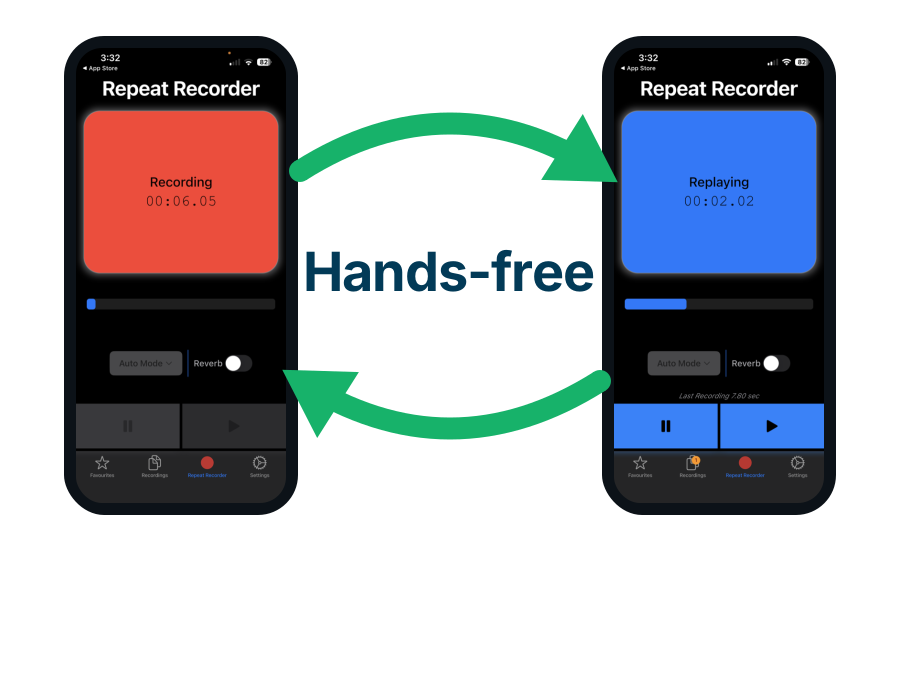
Use Repeat Recorder to hear how you describe your product
The ceiling on your cheapest channel is the number of your own customers willing to say something about you, and only 5% to 15% of them ever share a link at all. What those people say is a one-sentence description of your product, in their words rather than yours, and most founders have never heard themselves attempt that sentence. Repeat Recorder, one of my own apps, records you and plays the take straight back, so you hear your own description the way somebody else hears it.
- Repeat Recorder plays each take back automatically and then starts recording again, so you can try the same sentence twenty times without picking the phone up. It was built for speech rehearsal, language learning and vocal training, and getting one sentence about your product down to something you can say without stumbling is the same drill.
- A referral program produces paying customers at $25 to $65 each against $42 to $48 on Meta, and the entire discount comes from one person saying something in their own words. That sentence is the product being sold, so it is worth more preparation than the ad creative it replaces, and it costs nothing to practise.
- Takes worth keeping go into favourites and into folders you name yourself, dragged into whatever order you want. The wording you settled on is still there next week when you have to say it again on a call.
Five multiplications turn a $31 referrer into a $315 one
An ordinary ad has two multiplications between the money and the customer: click, then buy. This one has five, and they multiply rather than add. Here is $1,000 of Google Display traffic pushed through all of them at ordinary published rates:
$1,000 at Google Display's average $0.63 cost per click1,587 clicks
× 2% of them fill in the "start earning" signup form32 referrers
× 10% of program members ever refer anybody at all3.2 active
× 2 referred signups each, which is a normal consumer figure6.4 signups
− 15% of those are self-referrals and fake accounts5.4 real
× 30% of real referred signups become paying customers1.6 customers
Ad cost per paying customer, before you pay a single reward$617
The two figures worth memorising sit in the middle of that chain:
- One recruited referrer costs about $31. That is already two thirds of what a finished, paying customer costs on Meta at $42 to $48, and you have bought somebody who has not yet done anything.
- One referrer who actually refers costs about $315. The 90/10 split is the best-documented number in affiliate marketing: around 90% of affiliates send zero traffic, and 5% to 10% of them produce 90% of the revenue. An active rate above 10% is considered a healthy program, not a poor one.
- A 2% signup rate from cold display traffic is a generous assumption, not a harsh one. A 2% signup rate from cold display traffic is generous, given that Display converts at roughly 0.59% for an ordinary offer. The 90/10 rule is an industry benchmark from vendors who sell affiliate software and have every reason to quote a better one.
- Doubling the signup rate still leaves recruited referrers six times too expensive. Double the signup rate and you halve the cost, which takes $617 to $309, still six times what a stranger costs. You need three of the five to improve at once, and they are controlled by three different populations.
| Stage in the chain | Realistic value | Best case you could argue for | Who actually controls it | Can you fix it with money? |
|---|---|---|---|---|
| Cost per ad click | $0.63 Display average, the cheapest step | $0.30 on Meta, cheaper still | The auction. Largely out of your hands | Somewhat. Better creative moves it 2x at most |
| Click to referrer signup | 2% for a free signup from cold banner traffic | 5% with a strong landing page | You. This is the one step you own outright | Yes. Landing page work genuinely doubles it |
| Signup to ever referring anyone | 10% the documented affiliate 90/10 split | 25% with onboarding and nudges | The recruit, and mostly their circumstances | Barely. Emails do not create an audience |
| Referred signups per active referrer | 2 for a consumer with a normal social circle | 30 or more for somebody with an audience | How many people the recruit can reach | No. You can only select for it, never raise it |
| Referred signup to paying customer | 30% once they are inside your funnel | 40% for a well-matched referral | Your product and your price | Somewhat. The same work as any other funnel |
| Fraud loss on referred signups | 15% when the reward is cash | Under 3% if you pay only on a first purchase | Your payout trigger, more than your detection | Yes. One rule change removes most of it |
A $25 bounty commits $83 per customer before you buy an ad
This is the part that catches people, because it has nothing to do with the ads at all. It is a consequence of choosing when the money changes hands:
- Pay on signup and you pay for everyone, including the ones who never buy. If 30% of referred signups become paying customers, a $25 bounty means you spent $83 in rewards for each paying customer. Put the 15% fraud rate back in and it is $98. Raise the bounty to $47 and you are past $150 before you have bought a single ad.
- That is a per-unit cost, so volume cannot rescue it. Fixed costs get cheaper as you scale. This one does not. If the reward per paying customer already exceeds what a stranger costs on Meta, there is no number of referrals at which the program turns profitable, and the calculator below will tell you so in those words.
- Pay on the first purchase and the same $25 costs $25. The risk moves onto the referrer, which is where the person with actual influence over the outcome sits. It also removes most fraud in one step, because a fake account has to spend real money to collect.
- The cost is that fewer people bother. A reward you might get later is a weaker offer than a reward you definitely get now, so participation falls. That is a real trade and it is still the right one, because the participation you lose is concentrated in the people who were never going to produce a customer.
- A two-sided referral reward like Rakuten's costs $100 per referred customer. Rakuten's referral offer is $50 to the sender and $50 to the friend, which is $100 of reward per referred member. That works because cashback is the product, so the payout doubles as the onboarding experience. For most products it is simply $100 of margin.
$83 What a $25 reward really costs per paying customer when you pay it on signup and 30% of signups pay. A stranger on Meta costs $42 to $48, all in.
Work out your own break-even
An earn $1,000 ad recruits people who want money, not your app
Ad platforms optimise towards whoever responds. That is normally the point. Here it is the problem, because the response you are optimising for is "interested in being paid", and that trait sorts your audience in a direction you do not want:
- The people most likely to click are the people least likely to be believed. A recommendation is worth more than an ad only because the recommender appears to have nothing to gain. Recruiting on payout selects hardest against exactly that.
- Someone recruited by a banner about money has never used your product. Your existing customers can say why the thing is good. Somebody who arrived through a banner about money cannot, so their pitch collapses into "use my code", which is the weakest possible message.
- Advertising for people who want a payout selects for people who will game the payout. This is not a slur on the audience. It is what happens when the qualifying action is wanting a payout: you have run a screening test and admitted everybody who passed it.
- Targeting cannot separate the two groups, because the ad is the filter. You can pick better placements and better countries, but the creative itself does the sorting, and its whole job is to say "there is money here".
- Rewarded traffic behaves badly downstream too. In mobile advertising, where incentivised installs have been measured for years, incentive-heavy networks show 30-day retention around 1.1%, against 2.4% to 4.4% for gaming apps generally. Cheap to acquire, gone within the month.
| Who answers an "earn money" ad | Share of the signups | Referrals worth having that they produce | How persuasive their recommendation is | Fraud and compliance risk | Worth recruiting? |
|---|---|---|---|---|---|
| Curious clicker, signs up and forgets | The clear majority, most of the 90% who never act | Zero | None. They never say anything at all | None. They are inert | No. Pure cost, and most of your spend |
| Side-income seeker working several programs | A large minority | A handful, mostly low quality | Low. Posts the code, cannot vouch for the product | Medium. Spams codes to aggregator sites | No. Costs you margin on traffic you had |
| Organised fraud ring with fake identities | Small in number, large in payout share | None. Volume, and all of it worthless | None. There is no real person to persuade | Severe. This is their whole business | No. You are funding them by paying on signup |
| Existing happy customer who saw the ad | Tiny, your own users rarely see cold banners | One or two, but genuine | High. They actually use the product | Low | Yes, but not this way. Reach them in-app for free |
| Micro-influencer or niche community owner | Rare, they are not browsing banner inventory | Dozens, sometimes hundreds | High. Their audience already trusts them | Medium. Disclosure obligations are on you | Yes. The only group worth paying to recruit |
| Coupon and deal aggregator site | Few accounts, enormous traffic behind each | High volume, mostly traffic you already had | None. They intercept at checkout | Medium. Legal, and it eats your margin | No. They bill you for customers you had already |
The loudest money framing is the worst-performing one
This is the most useful thing in the research literature on referral programs, and it points the opposite way to intuition:
- Rewarding the friend beats rewarding the sender. Gershon, Cryder and John ran two field experiments and a lab experiment and found prosocial incentives that pay the recipient recruited more new customers than selfish ones that pay the sender, published in the Journal of Marketing Research in 2020.
- Senders share more when the reward goes to the friend, because it looks like a favour. Senders anticipate how the message will look. A referral that benefits the friend is a favour and is comfortable to send. One that pays the sender is a solicitation and feels awkward, so fewer get sent.
- Most referral programmes reward the sender, which the researchers found backwards. Their own comment is that the dominance of sender-benefiting rewards in the market suggests marketers do not expect this effect. An ad-recruited program is the extreme case of the design the evidence argues against.
- An "earn $1,000" ad amplifies the wrong half twice over. It maximises the sender's payoff, advertises that payoff publicly, and then hands the resulting recruit a message whose subtext is "I am being paid for this". The recipient can work that out in a second.
- It is the same failure as an ad that gets remembered for the wrong thing. The vampire effect is what happens when the device inside an ad eats the brand it was supposed to sell. Here the payout eats the recommendation.
You are paying a premium price for word of mouth, and then spending the money in the one way that guarantees it will not sound like word of mouth.
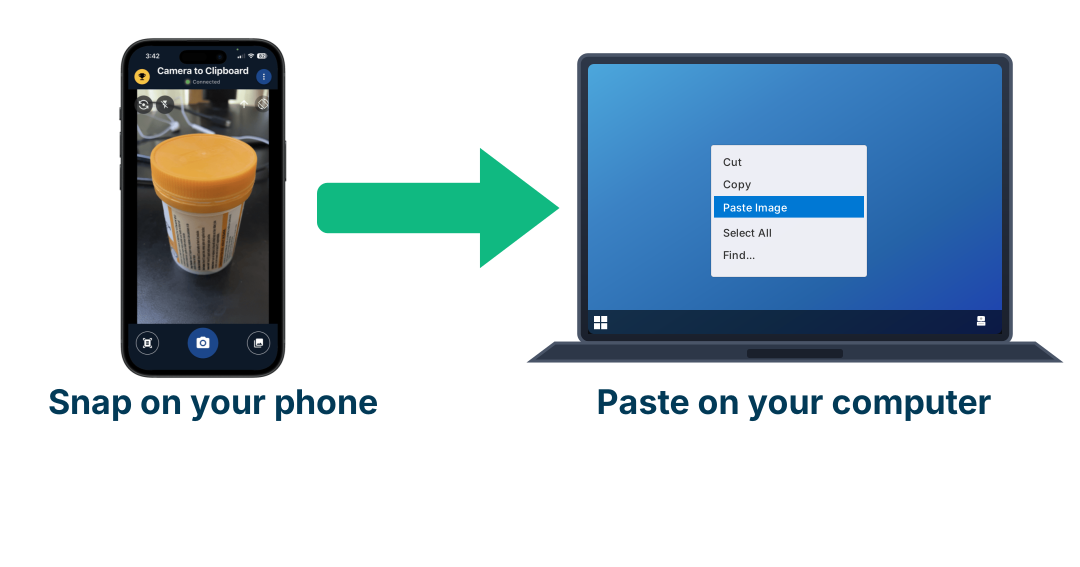
Use Camera to Clipboard to make an ad that shows the product
The money framing is the worst-performing half of a referral offer and it is also the half both cheap networks reject, so a dollar figure is the one thing that cannot carry the ad. What is left is the product doing something a viewer can recognise, which means a photograph or a captured screen, and then getting that picture into whatever you design in. Camera to Clipboard, one of my own apps, makes that one step instead of three.
- A photo you take inside Camera to Clipboard is on your computer's clipboard the moment you take it. No emailing it to yourself, no cable and no upload to a third party. The phone and the computer talk over your own local network and the picture goes straight across.
- Pasting into Photoshop or GIMP arrives as a new layer or a new document, which is where an ad actually gets built. Word and Google Docs take it inline instead. It arrives as an ordinary clipboard image, so any tool that accepts a pasted picture accepts this one.
- Rewards aimed at the friend beat rewards aimed at the sender, so the picture in the ad has to show what the friend gets rather than what the sender earns. A shot of the product mid-task is exactly that, and sending several from the phone's library at once means you can build three versions of the ad and let them compete.
Paying on signup puts a bounty on fake accounts
Every referral program attracts some abuse. Advertising the payout to strangers changes the scale of it, because you have gone looking for people motivated by the reward and told them the reward exists:
- Self-referral is the common case and it is cheap to run. A second email address, a virtual phone number and a fresh device fingerprint is a few minutes of work for a payout, and the tooling to do it at volume is a commodity.
- One rider gamed an Uber referral code into hundreds of thousands of dollars. One well-known 2014 incident involved a rider optimising an Uber referral code for search and email and accumulating over $50,000 in ride credit. A separate prosecution alleged hundreds of stolen and false identities used to take $500,000 in referral and ride credits from a ride-hailing business.
- Referral rings defeat per-account detection by design. Real people with real devices referring each other in a circle look exactly like a friendship group, because in a sense they are one. Device fingerprinting does not catch it.
- Your payout trigger matters more than your fraud detection. Every detection tool is probabilistic and gets gamed. Requiring a genuine first purchase before the reward is deterministic: it makes fraud cost more than it pays, which is the only defence that keeps working.
- Fraud grows fastest exactly when the program is working. The moment your code appears in public places is the moment it appears in the places fraud rings watch, so abuse arrives with success rather than before it.
The detail that decides everything else
Reward on the referred person's first purchase, never on their signup, and never on an install. It costs you participation and buys you three things at once: fraud stops paying, your reward converts from a marketing cost into a cost of a real sale, and the reward per paying customer drops by however much your signup-to-paying rate is below 100%. On a 30% conversion rate that single rule change is a 3.3x reduction in reward cost per customer.
Uber paid $199 million for referrals, then shut it down
Uber is the best-documented test of this idea, at a scale nobody else has matched, and it is worth being precise about what it does and does not prove:
- The bounties were enormous and heavily advertised. Drivers could earn several hundred dollars for referring another driver, and considerably more for a driver who signed up with a rental car. This was not a quiet in-app prompt, it was a paid acquisition campaign for referrers.
- The spend curve went one way. Driver referral incentives ran at $199 million in 2017, $136 million in 2018 and $103 million in 2019, and were expensed as customer acquisition cost. Uber discontinued both the rider and driver referral programs in 2020.
- It worked for as long as it did because of the two-sided marketplace, not the referral mechanism. A recruited driver is supply. Uber was short of supply, every new driver reduced wait times for every rider, and the value of that spilled well beyond the individual recruit. Almost no software product has that property.
- Driver churn made it a treadmill rather than an investment. With monthly driver churn in the low teens, a recruited driver is not a durable asset, so the same money has to be spent again next year. That is the opposite of the compounding argument used to justify a high recruitment cost.
- The honest reading is that it is a market-share weapon, not a profit strategy. It is available to a company that has decided to buy a market and can absorb hundreds of millions of dollars doing it. If that is not your situation, Uber's numbers are a warning rather than a template.
The other big spender, and what happened next
Temu ran the consumer version of this at a scale nobody has repeated, pairing cash-equivalent referral rewards with an ad budget JPMorgan estimated at a $3 billion annual run rate, plus Super Bowl slots and $15 million in giveaways. It bought the top of the US download charts. Morgan Stanley then counted 20% fewer households shopping on Temu in January than in the previous September, and Temu's marketing spend fell from over 20% of revenue in early 2024 to under 10% in the second half. Cash recruits people. It is much weaker at keeping them.
Shared links have the least friction and the worst leakage
A link is the least restrictive way to run a referral, and that choice has a cost. The friction you remove for the referrer is also friction removed for everyone else:
- A referral link attributes automatically on click and needs no support. Attribution happens automatically on click, it survives a text message and a social post, and there is no "where do I enter this" moment at checkout to lose people at.
- A link is also the easiest thing in the world to post publicly. The same property that makes it frictionless makes it indexable, and referral links accumulate on aggregator sites where people go looking for a code before checking out.
- A customer already on the way to you who searches for a code takes it from your margin. This is the affiliate cannibalisation problem: a customer who was already on the way to you searches for a code, finds one, and now you pay a bounty on a sale you had. The referrer did no work and the traffic was yours.
- Codes are worse on friction and better on control. A code can be capped, expired, made single-use or tied to a named partner, which lets you shut down leakage. It also loses you every customer who cannot be bothered.
- The strongest combination is a link, paid on first purchase, with public-posting restricted in the terms. You keep the friction low where it matters and you keep a lever to pull when a code turns up on a deal site.
| Mechanism | Friction for the referrer | Friction for the friend | How well it tracks | Exposure to fraud and leakage | App store rules |
|---|---|---|---|---|---|
| Personal shareable link | Lowest. Copy and paste, one tap | Lowest. Tap and land, nothing to enter | Automatic, until a blocked cookie loses the click | Highest. Posts publicly, ends up on aggregators | Fine on both stores |
| Personal coupon or promo code | Low. Short string, easy to send | Medium. Has to be typed at checkout | Exact, and it survives lost cookies | Medium. Cappable, expirable, revocable | Fine on both stores |
| In-app invite from the contact list | Lowest. Pick names, tap send | Medium. Arrives as an unsolicited message | Exact | Highest legal exposure. You wrote the text | Allowed, and the message is attributed to you |
| QR code for in-person sharing | High. Both people need to be present | Lowest. Point the camera | Exact | Lowest. Hard to farm at volume | Fine on both stores |
| Reward paid to the friend, not the sender | Lowest. It reads as a favour, not a pitch | Lowest. They get something | Same as a link, so the same cookie problem | Medium. Still worth a fake account | Restricted on iOS. Only the sender may be rewarded |
| Paid affiliate account with a dashboard | Highest. Application, tax form, approval | Lowest. An ordinary link | Exact, with reporting per partner | Lowest. Everyone is identified | Fine, it sits outside the app |
A dollar figure in the ad breaks Google and Meta policy
Before any of the economics matter, the creative has to be approved, and the version that makes the idea work is the version that gets rejected:
- Google treats a promised income as an unreliable claim. Its misrepresentation policy prohibits get-rich-quick offers and unrealistic or exaggerated return claims, and the rule applies to on-screen text and visual implication, not just the headline.
- Meta rejects a named dollar amount with near certainty. Money-making offers are among the most heavily policed categories under its unacceptable business practices standard. "Earn $500 a day" and "make $10,000 a month" are the textbook rejections.
- What survives review is the weak version of the ad. Describing the program, the community or the product without a figure is compliant, and it is a fraction as compelling. Removing the number removes the reason the idea looked cheap.
- Neither platform requires you to be dishonest to be rejected. A true earnings figure is still an earnings figure. Reviewers act on the claim's form, not its accuracy, so being able to prove your number does not get the ad approved.
- Appeals are slow and the account carries the history. Repeated disapprovals in a sensitive category attract more scrutiny to everything else you run, so this can quietly raise the cost of your ordinary campaigns.
Nine US legal boundaries this idea has to clear
A single-tier referral program with no joining fee is a perfectly legal, ordinary thing that thousands of companies run. Recruiting the participants with ads does not change the law, it changes how many strangers you are responsible for, and three of the nine rules below get much harder because of that:
- The FTC requires an advertised earnings figure to be typical, not merely attainable. The FTC requires that an advertised figure be typical for people in the same position, not merely attainable. In 2024 it brought a case against Arise Virtual Solutions over an advertised "up to $18 an hour" when fewer than 1% of workers earned it. An FTC consumer study also found many people read "up to" as the result they will get, not the ceiling.
- The FTC put 1,100 money-making-venture companies on notice for penalties in 2021. In 2021 it sent a Notice of Penalty Offenses to more than 1,100 companies that pitch money-making ventures, which makes civil penalties available for conduct already found unlawful. The current maximum is $53,088 per violation, and in January 2025 the FTC proposed a dedicated rule on deceptive earnings claims.
- Every referrer is an endorser, and every endorsement needs a disclosure. Under the Endorsement Guides, a material connection has to be disclosed clearly and unavoidably every time the endorsement appears. This is the first rule that buying your referrers makes worse: you cannot supervise thousands of strangers you have never spoken to.
- Referral texts can make you the sender. Washington's CEMA is being used against refer-a-friend programs where the brand designed the flow and wrote the message, and Robinhood settled such a claim for a reported $9 million. A court also held that Section 230 did not shield Capital One from a claim over a refer-a-friend text. This is the second rule that gets worse with scale: more strangers means more messages you did not personally send but did author.
- Keep it one tier, keep it free to join, and pay on sales. The Koscot test turns on whether rewards come from recruiting rather than from real sales to end users. A single-tier program with no fee that pays on a purchase is not a pyramid. Paying people for recruiting other recruiters is where that stops being true.
- Apple restricts who may be rewarded. Under the App Review Guidelines, an app must not require actions in exchange for compensation, and in referral flows the reward is expected to go to the sender rather than the person accepting the invitation. That directly conflicts with the friend-benefiting design the research says performs best, so on iOS you cannot run the version that works.
- Google Play polices incentivised installs and reviews. Offering money or goods in exchange for an install, rating or review is manipulation of store metrics under Play policy. Referrals themselves are fine; a reward tied to the install event is the risk.
- Payouts are taxable income and you are the payer. From 2026 the 1099-NEC and 1099-MISC reporting threshold rises from $600 to $2,000 under the One Big Beautiful Bill Act, indexed after 2027. Under the threshold you still need identity and address details on file, and non-US referrers bring their own withholding paperwork. This is the third thing that gets worse with strangers: thousands of tiny payees is an operational cost, not a rounding error.
- Finance, insurance, healthcare and legal cannot pay referral fees at all. Financial services, insurance, healthcare and legal services sit under anti-kickback and finder's-fee rules that restrict or prohibit paying for referrals outright. Check the sector rule before the marketing plan.
| Rule | Who enforces it | What getting it wrong costs | Does recruiting by ad make it harder? | The fix |
|---|---|---|---|---|
| Earnings claims must be typical | FTC, and state attorneys general | Up to $53,088 per violation | Much harder. The ad is the claim | Drop the figure, or publish typical results |
| Endorsers must disclose being paid | FTC Endorsement Guides | Penalties plus the brand damage | Much harder. Thousands of strangers | Force a disclosure into the shared text itself |
| Refer-a-friend texts | TCPA, and Washington's CEMA | Class actions, one settled at $9m | Much harder. More senders, same author | Never pre-compose the message or read contacts |
| No rewards for recruiting recruiters | FTC, via the Koscot pyramid test | Existential. The program is shut down | No change. It is a design choice | One tier, free to join, paid on real sales |
| Apple: reward the sender, not the invitee | App Review | Rejection, and release delay | No change. Same rule either way | Sender-only rewards on iOS builds |
| Google Play: no incentivised installs | Play Console policy | Listing suspension in the worst case | Somewhat. Volume attracts attention | Reward the purchase, never the install |
| Tax reporting on payouts | IRS, from $2,000 a year in 2026 | Penalties and unpaid-payee disputes | Somewhat. Many tiny payees | Collect tax details before the first payout |
| Sector bans on paying for referrals | Finance, insurance, health and legal regulators | Licence risk, well beyond a fine | No change. It is banned regardless | Check before designing anything |
| Platform ad policy on income claims | Google Ads and Meta review | Disapproval, and account scrutiny | Much harder. It is the whole creative | Advertise the program, never the payout |
This is a summary of published rules and cases, not legal advice, and it covers the United States. Get a lawyer to look at a referral program before you launch one, particularly if you pay cash or operate in a regulated sector.
The three versions that work need many customers per recruit
The idea is not universally wrong. It is wrong for consumers referring consumers, which is the version most people picture. Three variants clear the bar:
- Recruiting distributors rather than consumers. Somebody with an audience produces dozens of referred signups, not two, so a recruitment cost of a few hundred dollars amortises across all of them. This is ordinary affiliate recruitment and it works, but you find those people by searching for them and writing to them, not by buying banner impressions and hoping one of them is browsing.
- A marketplace short of drivers or sellers can justify paying to recruit referrers. When the referred person is a driver, a seller, a tutor or a host, they are not a cost, they are inventory that makes the whole marketplace work better for everybody already on it. That spillover is what justified Uber's spend, and it does not exist for a single-sided product.
- Advertising the program to people who are already your users. This is the version almost nobody counts as "ads", and it is the one that pays. Your own users cost nothing to reach, they already like the product, and their recommendations are credible. An in-app prompt after a good moment beats every banner you could buy.
- All three exceptions turn on one number, referrals per active referrer. Referrals per active referrer. Everything else in the model can stay where it is; if that figure goes from 2 to 30, the arithmetic inverts. It is the only variable in the chain you cannot improve, only select for.
- Which is why the recruiting channel decides the outcome, not the reward. Most of the effort in these programs goes into tuning the bounty. The bounty is the small lever. Who you recruit is the large one.
| Your situation | Referrals one recruit produces | How much extra a referred person is worth | Verdict on recruiting referrers with ads | What to do instead |
|---|---|---|---|---|
| Consumer app, one-off or subscription | One or two | 16% more, the one figure anybody has measured | No. The worst case in the whole table | In-app prompts to existing users, free |
| B2B SaaS with a sales-assisted funnel | A few, but high value each | A lot. A warm intro shortens the sales cycle | No. Your buyers are not on banner inventory | A partner program, recruited by hand |
| Two-sided marketplace short of supply | A few, and each one is inventory | A lot. Supply improves the whole market | Defensible, if you can fund a treadmill | Cap the bounty, pay it in stages on activity |
| Ecommerce with repeat purchase | One or two | Moderately. Repeat purchase carries the reward | No. Codes leak to deal sites and cost margin | Post-purchase referral offer, on-site |
| Creator, publisher or community product | Dozens, if the recruit has an audience | A lot. Audiences arrive pre-qualified | Only for the audience owners, and by outreach | Find and contact them directly |
| Fintech, insurance or healthcare | Varies | Varies, where it is permitted at all | No. Often prohibited before economics apply | Check the sector rules first |
Use Repeat Recorder to rehearse a pitch to a community owner
The table keeps arriving at the same answer: the only group worth recruiting is the people who already have an audience, and they have to be found and contacted by hand rather than bought at auction. That turns the whole campaign into a handful of conversations, so each conversation carries the weight an entire ad budget was supposed to carry. Repeat Recorder, another of my own apps, records you and plays the take straight back without you touching the phone.
- Repeat Recorder replays each take automatically and then starts recording again, so you can run the same thirty seconds ten times over without picking the phone up. It was built for speech rehearsal, language learning and vocal training. Practising what you will say to a community owner is the same loop with your own words in it.
- An ad-recruited referrer costs about $31, and about $315 once you account for the 90% who never refer anybody. One community owner who says yes is worth more than a month of that, which makes half an hour of rehearsal the cheapest line in the whole plan.
- Takes worth keeping go into favourites and into folders you name yourself, dragged into whatever order you want. The version that worked on the last call is still there before the next one, instead of being reconstructed from memory each time.
Conclusion: how to recruit referrers without buying ads
- Buying ads to recruit referrers pays for a salesperson rather than a customer, so one recruited referrer costs about $31 and about $315 once you count the 90% who join a referral program and never refer anybody. An ordinary ad has two steps between the money and the revenue, click then buy. This one has five, and each of them takes its cut. Even the $31 figure, before the 90% is applied, is already most of what a finished paying customer costs on Meta at $42 to $48.
- Every recruited referrer who actually refers has to produce about five or six referred signups to break even, and closer to 60 on ordinary numbers, while a consumer produces one or two and somebody with an audience produces dozens. That single figure divides every version of this idea that works from every version that does not, and it is the only variable in the chain you cannot improve, only select for. Which is why the recruiting channel decides the outcome and the size of the bounty barely matters.
- Advertise the referral program to the customers you already have, and find the people with audiences by hand instead of bidding for them. Your own users cost nothing to reach, already like the product, and are the only audience whose recommendation carries weight, so an in-app prompt timed to a moment the product just worked beats every banner you could buy. Audience owners are found by searching for them and writing to them. Whichever way you recruit, pay the reward on the referred person's first purchase, because a $25 bounty paid on signup costs $83 for each paying customer when 30% of signups pay, and the same $25 paid on a purchase costs $25.