
If you do one off-site thing for AI visibility, do this one. Across the studies, YouTube mentions are the single strongest measured correlate of showing up in AI answers, stronger than backlinks, brand mentions, anything. Here is why, what format actually gets cited, and how to earn it.
YouTube is the strongest lever and Google owns it
- YouTube mentions are the strongest AI-visibility signal anyone has measured. In a study of 75,000 brands, YouTube mentions correlated with AI visibility at around 0.74, the top signal, and it held across ChatGPT, Google AI Mode and AI Overviews alike. Backlinks, by comparison, sat down around 0.22.
- Google owns it, so the machinery is on your side. YouTube is a Google property, its transcripts and descriptions are indexed, and the models were trained on them. So a video that names your app is content the AI can actually read and reach.
- Video is a format nothing else provides. A spoken review or demo, with a transcript, is a different kind of source from a blog post, which is part of why it is weighted so heavily.
- But it is the mention that counts, not the polish. The signal is your app’s name appearing in the title, description and spoken transcript, on channels the world watches. That is the thing to engineer.
Use Repeat Recorder to rehearse the line that names your app
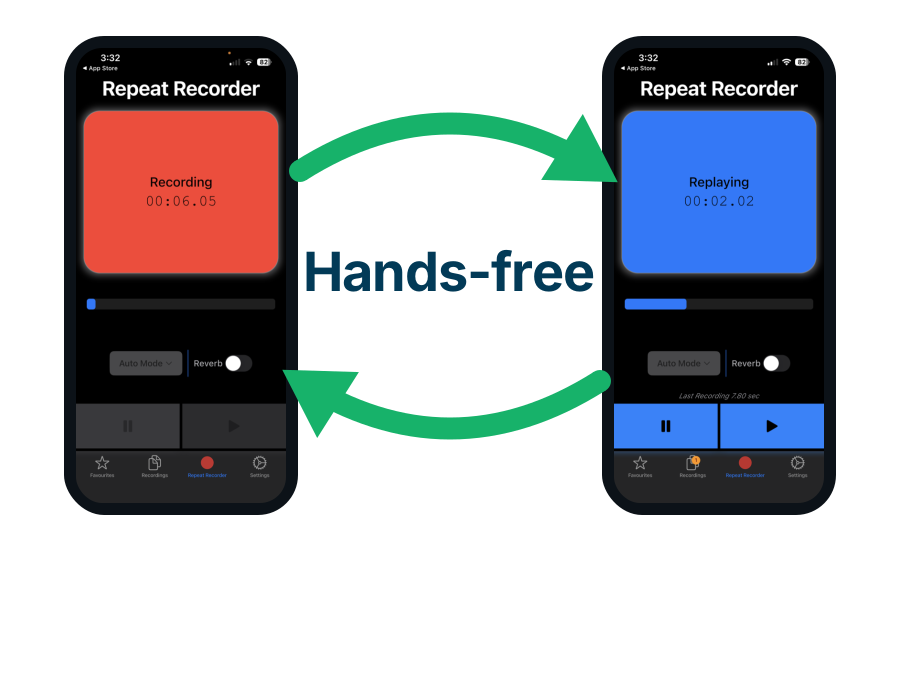
If the thing being counted is your app’s name inside the spoken transcript, then the sentence you say it in is the whole asset, and it is usually said once, quickly, in the middle of a paragraph. Repeat Recorder, one of my own apps, records you and plays the take straight back without you touching the phone, so that one sentence can be drilled before anybody points a camera at you.
- Your app’s name has to survive the transcript, because the transcript is the part an AI actually reads. A name swallowed in the middle of a fast sentence comes back out of automatic captions as a different word, and a misspelt name is not a mention at all. Saying it once, slowly, in a short sentence of its own is the fix.
- Repeat Recorder plays each take back on its own and then starts recording again, so the sentence naming your app can be run ten times without picking the phone up. That hands-free loop is the whole app, and it was built for speech rehearsal, language learning and vocal training, which is the same drill with different words.
- Takes worth keeping go into favourites and into folders you name yourself, reorderable by dragging. The wording that came out cleanest is then the wording you hand to a creator you have briefed, rather than a phrase you half remember on the day.
Long videos or Shorts? Long-form wins by a mile for AI citations
If you commission a video, the format matters as much as the fact of it, and for AI visibility it is not close: long-form wins heavily, for a reason that has nothing to do with reach.
- About 94% of YouTube AI citations go to one kind of video, not the other. In a 2026 study of more than 100 million AI citations, roughly 94% of YouTube’s AI citations went to long-form videos and only about 6% to Shorts. It is a single vendor study, so treat the exact number as directional, but the direction is not subtle.
- It is about the transcript, not the reach. The AI reads the video’s transcript and description. A fifteen-to-sixty-second Short has a thin transcript that rarely says enough to be “the answer” to a question; a ten-to-twenty-minute explainer has a rich, quotable transcript the model can lift from.
- Chapters multiply your citations. Long videos with timestamped chapters get cited chapter by chapter, each chapter is a separate passage the AI can pull, so one good long video can be cited several times over. A Short has no chapters, so at best it earns one shallow citation.
- Views still do not matter. The same study found engagement, views, likes and subscribers had essentially no correlation with citations, and about 40% of cited videos had under 1,000 views. So a viral Short does not buy AI authority; a genuinely useful long video does, even with modest reach.
- Shorts are a human-reach play, not an AI one. What little Shorts citation exists is concentrated inside Google’s own AI answers, not ChatGPT or Perplexity. Use Shorts for discovery and social reach; use long-form to be cited.
So the shape the AI actually quotes is a real long-form video, a review, demo or explainer of ten to twenty minutes, with timestamped chapters, human-checked captions, a proper written description, and your app named (and the key point stated) in the first fifteen seconds.
Use Camera to Clipboard to put phone screenshots in your video
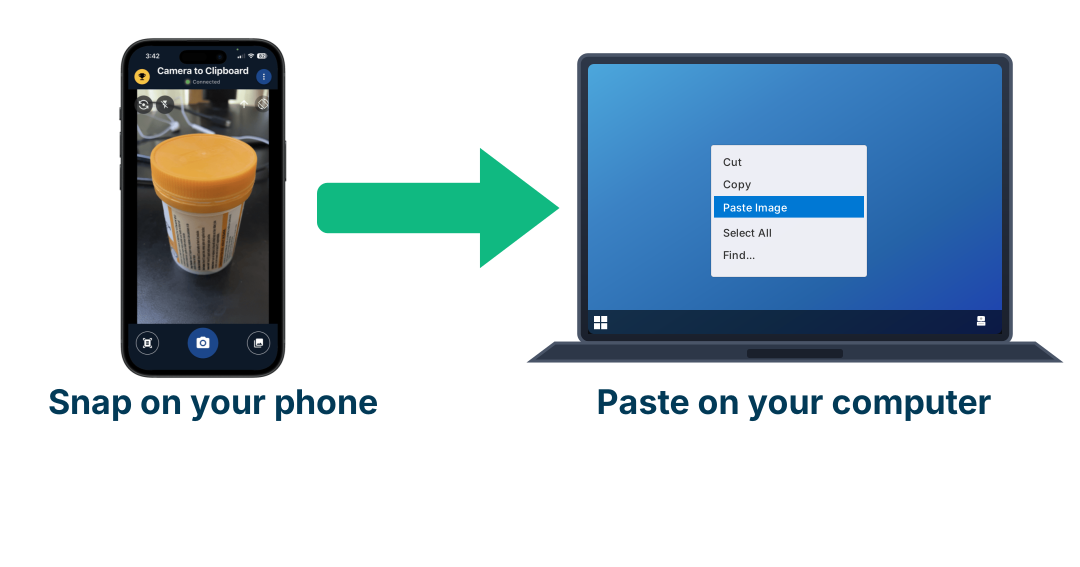
A ten to twenty minute explainer needs something on the screen for every one of those minutes, and when the thing being explained is a phone app, that something is screenshots. Getting them from the phone to the computer is the step that turns a one hour edit into a three hour one. Camera to Clipboard, another of my own apps, sends a picture from the phone straight to the computer’s clipboard.
- About 94% of YouTube’s AI citations went to long-form videos, so the format worth making is the one that needs the most pictures. Ten to twenty minutes of explaining a phone app is ten to twenty minutes of screens, and every one of them starts life on a phone.
- Several pictures can be sent out of the phone’s library at once, so a whole sequence of screenshots arrives on the computer together. There is no emailing them to yourself, no cable and no upload to somebody else’s website. The phone and the computer find each other over your own local network.
- Each picture lands as an ordinary image on the clipboard, so the program you edit in takes it with one paste. Photoshop and GIMP open it as a new layer or a new document, and Word or Google Docs takes it inline, which covers both the video itself and the written description underneath it.
Your own channel counts as one source, no more
- Your own video counts, but only as one source, and uploading more does not add. A video on your own channel is a legitimate source, it is just an owned one, which the models weight below an independent creator’s mention. And because the AI deduplicates near-identical content, ten videos on your own channel behave like one source, not ten separate votes. So having a channel is worth it; padding it out with more of your own videos is not, one genuine third-party video does more than ten of yours.
- Being covered on other people’s channels is the win. One genuine creator review, watched by a real audience, is the third-party mention the engines reward, and it is exactly what self-production cannot manufacture.
- Several mid-size creators beat one big YouTube sponsorship. Several genuine mid-size creators, or one whose video nudges others to cover you, beats a single expensive placement. Aim to start a conversation.
Relevance beats reach, so a niche creator wins
Here is the question that should decide your budget. Say you sell a finance app. Is it better to pay a big travel YouTuber (huge reach, wrong topic) or a smaller finance one (fewer views, right topic)? For AI visibility the smaller, relevant one wins, and it is not close, because the AI reads the topic of the content, not the fame of the creator.
- The AI matches your question to the content’s meaning, not just the brand name. When someone asks a finance question, the engine pulls content that sits in the finance “neighbourhood”, it compares the meaning of the query to the meaning of each passage. A finance app named inside a travel video is surrounded by travel talk, so it lands in the wrong neighbourhood and rarely gets retrieved for a finance query. Google’s AI Mode even splits your question into finance sub-topics and searches each one, so off-topic content simply is not what it is hunting for.
- Reach is the one thing that does not correlate with getting cited. In the large YouTube citation study, views, likes and subscriber count all correlated with citations at essentially zero (around -0.03), and about 41% of cited videos had under a thousand views. So the travel creator’s big advantage, audience size, sits on exactly the axis that does not move AI citation. What did correlate was clear, descriptive, on-topic metadata, which a genuine finance review naturally has.
- Off-topic mentions build a weak brand association; on-topic ones build a strong one. Models learn what your app is from the company it keeps. A finance app appearing again and again alongside finance topics teaches the model “this is a finance app”; the same name dropped into travel content teaches it almost nothing coherent. Relevance is not just about one video getting pulled, it is about building the right identity for your product in the model’s memory.
- It is the content’s topic that is tracked, not the creator’s identity. The AI does not “know” that one channel is a travel guy and another a finance expert as people, it reads what each video is about. A famous creator helps only to the extent their fame lines up with genuine topical authority in your niche; borrowed fame in the wrong topic does little.
So brief for relevance, not reach. A mid-size creator whose audience genuinely cares about your category, and who will talk about your app in the right context with the right words, is worth far more than a bigger star in an unrelated niche. One honest caveat: a huge off-topic creator is not strictly worthless, the burst of attention can send people searching your name and spawn other, on-topic mentions that do get cited. And no one has run the exact experiment, so this is the reasoned read of the evidence, semantic retrieval, the near-zero reach correlation, and the AI’s bias toward topically authoritative sources all point the same way, rather than a single measured result.
Thinking of paying a creator to make that video? It can work, but only if you brief it right and match the audience to your market. See the companion guide, Should You Pay a YouTuber for AI Visibility?, for the paid-creator playbook, language and audience matching, whether you can repost the video yourself, and why views matter less than you think.
Conclusion: how YouTube gets your app cited by AI, in one glance
- A YouTube mention means your app named in the title, description and spoken transcript of somebody else’s video. Those words are the whole asset, because an AI reads the transcript rather than watching the video. A video on your own channel is a legitimate source but counts as one however many you upload, so a single genuine review by an independent creator does more than ten of your own uploads.
- About 94% of YouTube’s AI citations went to long-form videos and only about 6% to Shorts. That comes from a 2026 study of more than 100 million citations run by a single vendor, so treat the exact figure as directional. A ten to twenty minute explainer has a rich transcript and timestamped chapters an AI can quote passage by passage, and a fifteen second Short has neither.
- Brief a mid-size creator in your own subject for a ten to twenty minute video, not a big star in an unrelated one. Views, likes and subscriber counts moved citations by almost nothing, and about 40% of cited videos had under 1,000 views, so reach is the one thing not worth paying for. Ask for timestamped chapters, human-checked captions, a written description, and your app named clearly in the first fifteen seconds.