
YouTube mentions are the single strongest correlate of AI visibility, so hiring a creator is one of the few paid plays that genuinely works. But three things decide whether the money is well spent: what you publish, who the creator reaches, and whether you understand what the AI can actually see.
Paying a YouTuber works, but the video has to stay on YouTube
Here is the obvious next move: if a creator video is the strongest signal, can you just hire one? Yes, and it is one of the few paid plays that genuinely works, because unlike a video you make yourself, a real creator is an independent source with a real audience, exactly what the engines reward. Two things decide whether the money is well spent.
Why it works:
- A creator naming your app on YouTube manufactures the top AI signal legitimately. A creator naming your app in the title, description and spoken words is precisely what the strongest correlation is built on, and because it is someone else's channel it counts as the third-party mention the engines weight most heavily.
- Sponsored does not seem to be discounted. There is no sign the AI can tell a paid video from an organic one, an
#adlabel does not erase your app's name from the transcript it reads. You must still disclose the sponsorship, it is legally required, but disclosure does not appear to cost you the pickup.
The catch, and the part of your plan to change:
- Post it on YouTube, not Instagram, for the AI. YouTube is Google-owned with clean transcripts the models read, and earns something like 18 times more AI citations than Instagram. Instagram is image-first and was walled off to crawlers until mid-2025, so it barely feeds the AI at all. Cross-post if you like, but treat the Instagram version as human reach, not AI pickup.
- One video is a seed, not a win, and views matter less than you would think. The data here is almost counter-intuitive: the raw number of videos that mention you correlated slightly higher with AI visibility (~0.74) than the view-weighted version (~0.72), and brands “aren’t at a huge disadvantage if mentioned in low-view videos, so long as they’re mentioned widely.” Views do help, but indirectly: a high-view video ranks better, gets embedded and discussed more, and so is more likely to be found and referenced. The AI is not reading a view counter and thinking “trending”, and “trending” itself is not a citation signal; recency and being referenced across many sources are. So a couple of genuine mid-size creators, or one whose video nudges others to cover you, beats a single expensive high-view placement. Aim to start a conversation, not buy a billboard.
- Do not buy views, and skip the no-audience shills. Fake engagement gets stripped and can get a channel terminated, and a wave of identical paid clips from tiny accounts reads as manipulation and builds no real signal. Pay for a real, engaged audience or do not bother.
So yes, hire the creator, but spend where it compounds: a genuine video, on YouTube, with your app named out loud, ideally the first of several. That is the honest version of the strongest lever in this whole piece, and it is exactly why it works where making the videos yourself does not.
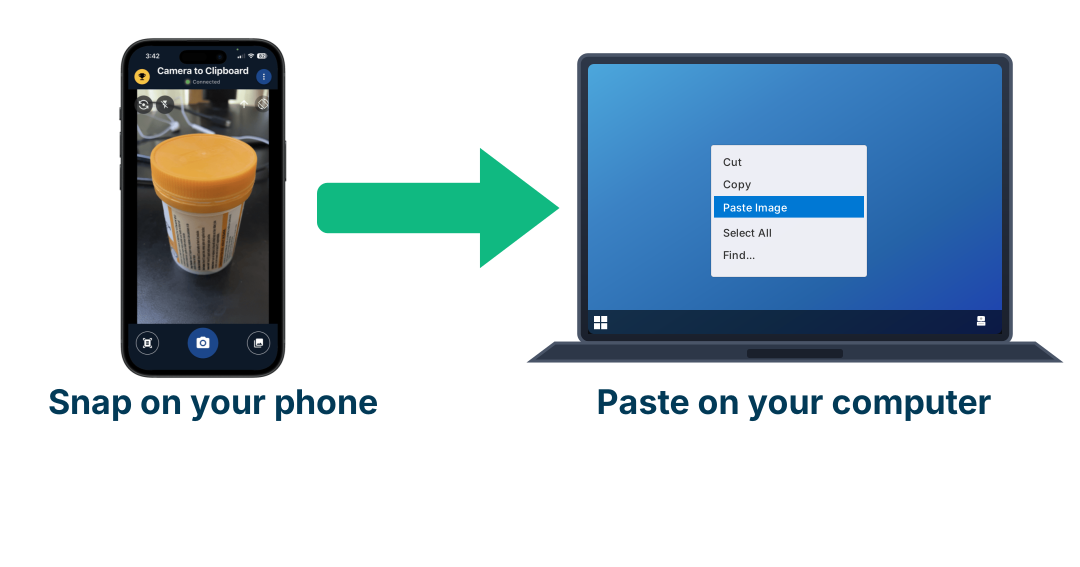
Use Camera to Clipboard to send app screenshots to a creator
Briefing a creator means showing the creator what your app actually looks like, and the pictures that do that live on the phone while the brief you are writing lives on the computer. Emailing yourself a batch of screenshots is the part of this job everybody puts off. Camera to Clipboard, one of my own apps, is a phone camera and photo library that pastes straight onto the computer.
- A picture sent from Camera to Clipboard is on your computer's clipboard ready to paste, with no email to yourself and no cable. The phone and the computer talk to each other over your own local network, so nothing is uploaded to a third party on the way. It arrives as an ordinary clipboard image, which means Word and Google Docs take it inline and Photoshop or GIMP open it as a new layer.
- Several pictures can go at once out of the phone's library, which is what a brief actually needs. One screenshot of your app is never enough to explain it to somebody who has not used it, and sending the six that show the whole flow is one action rather than six.
- Assembling a picture pack is worth automating because the plan on this page is several creators, not one. The number of videos mentioning a brand correlated slightly higher with AI visibility, at about 0.74, than the view-weighted version at about 0.72, so the same brief goes out repeatedly to mid-size creators instead of once to an expensive one.
A cheap creator anywhere works if the audience is English
A tempting shortcut: a creator with 100,000 followers is far cheaper in some countries than others, so why not hire a cheap overseas one? The catch is that for AI visibility, the language the creator works in, and the market that language reaches, matter as much as the follower count. A cheap creator in the wrong language mostly builds your visibility in the wrong market.
- The AI does not look up who watches the channel, it reads the language. This is the part that trips people up: ChatGPT and Google cannot see a creator’s viewer demographics. What they read is the language of the video itself, its title, description and spoken transcript, and they match that against the language of your question. An Indonesian-language video simply reads as an Indonesian source, so it surfaces for Indonesian questions and not English ones. The “audience” follows from the language; it is not something the AI knows directly. (Google, which owns YouTube, also has real data on where a video is watched and can fold that into its ranking, so its AI surfaces have a slightly more direct regional signal than ChatGPT, which leans almost entirely on the content’s language.)
- AI answers are localised, so an English question pulls English-language sources. An English question from a US or Australian user pulls mostly English-language, geo-relevant sources. A video in another language is unlikely to be surfaced for your English queries at all, and ChatGPT in particular leans on English and global sources.
- A brand’s AI reputation is largely per-language. Language models store facts in separate per-language pockets, not one shared brain, so a recommendation earned in one language does not automatically carry into another. Your app’s name might transfer, but the “which app should I use” association mostly does not. A mention in an Indonesian video counts mainly for Indonesian queries.
- Cheap large-follower channels are often hollow. Bought or inflated subscribers are common and get purged (YouTube removed millions of spam channels in a single quarter), and the AI signal is weighted by real views, so a 100,000-subscriber channel with dead followers contributes little.
- But a real but foreign audience is not the problem, only a fake one is. If the channel is genuinely English yet its viewers happen to be in India or Indonesia, ChatGPT cannot even see that, it reads the page through Bing and has no window into who watched, so real foreign views still count as real reach. Google, which owns YouTube, can see it and may weight it slightly, but only as a mild secondary signal. What actually costs you is foreign-language content and fake, bot-inflated followers, not real viewers who happen to live somewhere else.
- So when a cheap overseas placement fails, it is one of two things. Either the content is in the wrong language (it lands in the wrong language space), or the channel is hollow (bought followers, few real views). Fix both, genuine English content and real engagement, and the creator’s location stops mattering.
The rule is simpler than “hire Western”: the creator’s nationality is not the point, the language of the content and the reality of the reach are. A cheap Filipino or Indonesian creator who genuinely makes fluent, on-topic English videos, with an English title and description, can work perfectly well and be a real bargain, because to the AI that video simply reads as an English source. What actually fails is foreign-language content (wrong language space), a hollow channel of bought followers (few real views, so little weight), or an audience with no interest in your category. So vet three things: is the English genuinely good and on-topic, are the views and engagement real, and does the audience care about what your app does. The one time a foreign-language creator is the right call is when you are deliberately targeting that language’s market. (The localization evidence here leans on GEO-vendor sources, so treat it as directional; the solid part is that language models are measurably inconsistent across languages.)
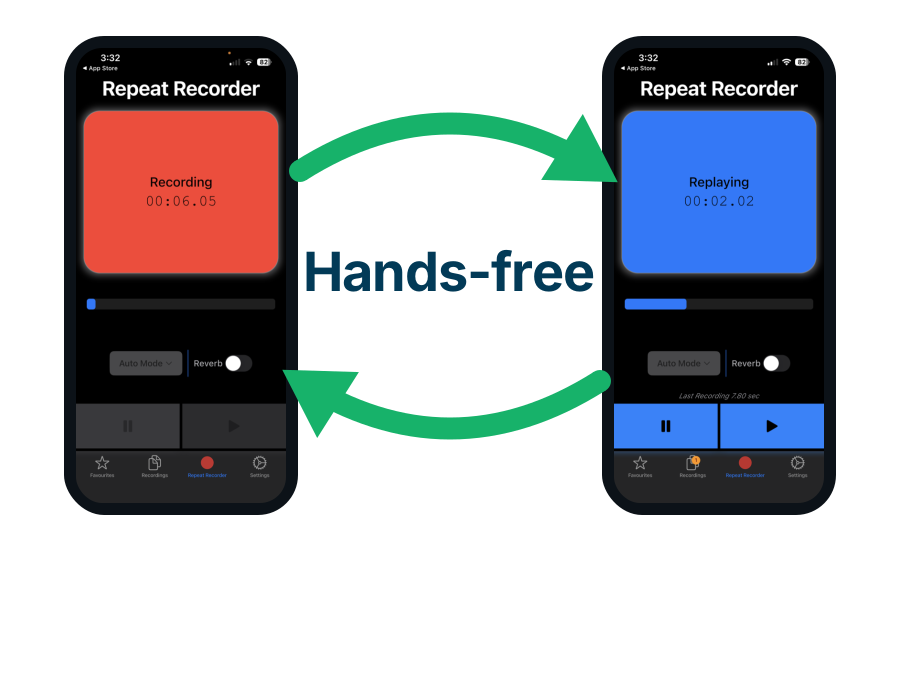
Use Repeat Recorder to rehearse the English you say on camera
What the AI reads is the spoken transcript, so every English sentence anybody says in that video is a sentence that gets indexed, including yours if you appear in it or record the voiceover. Fluent, on-topic English is the thing this whole section says you have to vet, and it is easier to vet in yourself than to demand of somebody else. Repeat Recorder, another of my own apps, records you and plays the take straight back without you touching the phone.
- Repeat Recorder plays each take back automatically and then starts recording again, so one sentence can be run twenty times without picking the phone up. That hands-free loop is the whole app, and it was built for exactly this job, which is speech rehearsal and language learning rather than making finished recordings.
- The line worth drilling hardest is the one where your app is named out loud, because the transcript is what the AI actually reads. A name that comes out slurred or mispronounced is the version that ends up written into the transcript, and a transcript is the only part of the video ChatGPT and Google can read at all.
- Two attempts at the same sentence can be saved into folders you name yourself and kept as favourites, so you can hear them back to back. Folders reorder by dragging, so a script of six lines stays in the order you will say them rather than in the order you happened to record them.
Reposting the video yourself is safe but barely helps the AI
Reasonable follow-up: you cannot ask the creator to post everywhere, so can you take his video and re-post it on your own YouTube, Instagram and TikTok? Yes, it is safe and normal, no platform flags it as a “fake” or stolen video. It just does very little for AI visibility.
- YouTube's reused-content rule is about ad revenue, not about sponsored mentions. The scary-sounding “reused / inauthentic content” rule is about ad-revenue eligibility, aimed at bulk content farms, not a penalty for posting your own promo. At worst, a bare re-upload cannot earn ad money (moot if your channel is not monetizing) and ranks below the creator's original in YouTube's own search.
- Get written permission for the video and any music in it. Get written permission for the video and any music in it, and if the creator uses Content ID, have them allowlist your channel, otherwise you may pick up an automatic (harmless, disputable) claim on your copy.
- Upload a clean, watermark-free master natively. TikTok and Instagram quietly throttle the reach of videos stamped with another app's watermark. They do not ban it, but re-upload a clean file to each platform rather than sharing a TikTok-stamped clip to Instagram.
- But your own copies barely move the AI, and that is the whole point. The engines dedupe near-identical videos, so a second copy on your channel collapses back to one, and owned content is weighted below the creator's independent original anyway. TikTok and Instagram are near-zero for AI regardless: YouTube earns roughly 18 times more AI citations than Instagram and 50 times more than TikTok, and almost all of that goes to long-form video, not short clips.
So repost freely for human reach, but do not expect it to stack visibility. The one upload that actually feeds the AI is the creator's own long-form video on the creator's own channel. You do not need him to post everywhere, you need that one to be real.
Long videos or Shorts? Make it long-form
One format point before you brief the creator: for AI visibility, long-form videos beat Shorts by a wide margin, roughly 94% of YouTube’s AI citations go to long-form, because the AI reads the transcript and a Short barely has one. So commission a real ten-to-twenty-minute video with timestamped chapters, not a Short. The full breakdown is in the YouTube for AI SEO guide.
Conclusion: how to pay a YouTuber for AI visibility
- Paying a creator works because the video sits on somebody else’s channel, which is the independent mention the AI engines weight most heavily. There is no sign the engines can tell a paid video from an organic one, and the sponsorship disclosure you are legally required to add does not remove your app’s name from the transcript they read.
- YouTube earns roughly 18 times more AI citations than Instagram and 50 times more than TikTok, and about 94% of them go to long-form video. A Short barely has a transcript, and the transcript is the only part of a video ChatGPT and Google can read, so commission a real ten to twenty minute video with timestamped chapters.
- Brief two or three mid-size creators to make genuinely English long-form videos on their own channels rather than buying one expensive placement. The creator’s country does not matter but the language of the video does, because AI answers are localised and a foreign-language video reads as a foreign-language source. Reposting the video on your own channels is safe and adds human reach, but the engines collapse near-identical copies into one, so it adds no AI visibility.