
A tempting idea: write a Medium article about your app that links back to your site, and now you have an “external” reference. It mostly does not work, and understanding why explains how AI decides which sources to trust at all.
A Medium article that links to you is still your own content
Here is a clever-sounding idea I see a lot: write a Medium article about your app that links back to your site, and now you have an “external” reference pointing at you. It feels like a shortcut. It mostly is not, because to an AI it is still you writing about you, just hosted somewhere else.
- A self-written Medium post is not an independent mention. The whole reason third-party mentions matter is that they are someone else vouching for you. An article you wrote yourself is self-published content, and the fact that it sits on medium.com instead of your own blog does not turn it into independent validation.
- Medium tags your outbound link nofollow, so it passes no ranking value. Medium tags external links so they pass no ranking or authority value. So the “reference pointing to me” is not the signal it looks like, it is a dead link as far as authority goes.
- When it is cited at all, the credit goes to medium.com, not you. Exactly like LinkedIn: if the Medium article surfaces in an answer, the AI shows medium.com/@you, not your product’s site. You built Medium’s authority, not your own.
- And Medium is a minor source anyway. In the citation data it is a rounding error, around 0.4% of Google AI Overview citations and not even in ChatGPT’s or Perplexity’s top sources, while Reddit, YouTube, Wikipedia, LinkedIn and Quora do all the work. Unlike login-walled LinkedIn posts, Medium articles are indexed, they just are not cited much.
- Medium caps undisclosed AI-written posts to your existing followers only. Medium now caps undisclosed AI-written content to your existing followers only and demonetises it, so churning out AI articles to farm references gets throttled at the door.
- A Medium canonical pointing back to your own page removes the reason to post there. Medium lets you set a canonical tag pointing back to your own page (via its Import tool), which is the right thing to do so you do not outrank yourself, but it also tells Google “the real version lives on the author’s site,” so the Medium copy is deliberately deduplicated away. You cannot have it both ways: either it competes with your own page, or it defers to it.
It is worth understanding why Medium ends up so far down, because it is not quite that the AI has decided “Medium is bad”. It is more mundane than a verdict, and more useful to know:
- Assistants do not blacklist Medium, they just find no trust signals on it. The AI carries no “Medium is low quality” flag. It picks sources by signals, authority, originality, consensus, freshness, and Medium brings few of them. Anyone can publish anything on it with no vetting, so the platform itself vouches for nothing, unlike Wikipedia (edited and sourced), Reddit (real human consensus, hard to fake) or YouTube (Google-owned, a format of its own).
- The average Medium article is rehashed, not original. Most of it recombines information that already lives in a more authoritative place, and the AI deduplicates and prefers the original. Sources with primary data, first-hand experience or genuine expertise get pulled in; a generic explainer rarely does.
- Google already downranked it, and Google’s AI feeds on Google. Medium’s search visibility has repeatedly been knocked by Google’s “helpful content” and spam updates aimed at thin, mass-produced writing. Because AI Overviews lean on what ranks, that downgrade carries straight through to the AI answer.
- So there is a real reputational element, just not a categorical one. Between years of SEO-spam and now a flood of AI-generated posts, Medium’s signal-to-noise is low, and the systems that feed the AI have effectively learned to trust the platform less. But it is a consequence of weak per-article signals, not a ban, a genuinely excellent, expert-written Medium piece can still be cited. It is the median that drags the platform down, and your one self-promotional post sits below the median.
So no, it is not a hack. A genuinely useful, human-written Medium article published into a real publication with its own readers can still be worth doing, as a distribution channel that puts your work in front of people who might then mention or link you for real. But set the canonical back to your own site and treat Medium as an audience, not a backlink. As an AI-visibility lever it sits near the bottom of the list, below genuine third-party coverage, Reddit and Quora, YouTube, and your own quotable pages. (The citation figures are early-2026 vendor studies, consistent with each other on the direction: Medium is minor.)
Use Repeat Recorder to rehearse a video instead of a Medium post
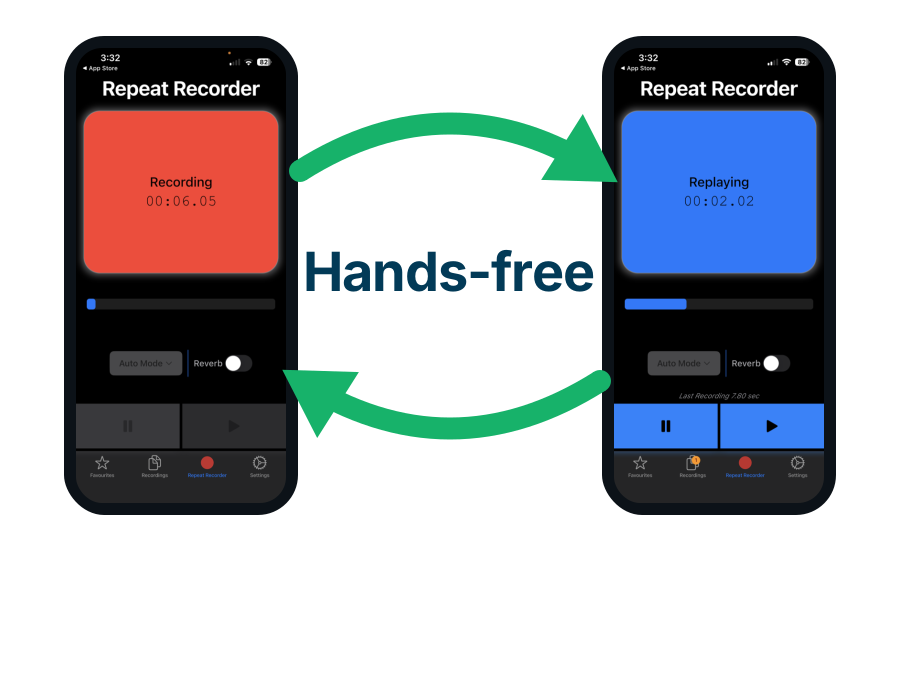
The reason a Medium post does so little is that typing one costs nothing, and the sources an AI leans on are the ones carrying attention that is expensive to fake. Recorded speech is the cheapest way an individual can produce that kind of signal, and the part people avoid is hearing themselves say it badly. Repeat Recorder, one of my own apps, records you and plays the take straight back without you touching the phone.
- Repeat Recorder replays each take automatically and then starts recording again, so you can run the same sentence twenty times without picking the phone up. That hands-free loop is the whole app. It was built for people drilling a phrase in a new language and for vocal training, and rehearsing a spoken explanation of your product is the same job with different words.
- Medium is around 0.4% of Google AI Overview citations while YouTube is one of the handful of sources doing the work, so the hour is better spent on something spoken. An hour of writing produces a post that credits medium.com. An hour of rehearsing produces a take you can put on a platform that is actually cited, and the article above is the argument for why those two hours are not equivalent.
- Takes worth keeping go into favourites and into folders you name yourself, which you can reorder by dragging. Two attempts at the same opening line end up sitting next to each other, so picking the better one takes about a minute rather than a re-record from scratch.
Conclusion: what a Medium article does for AI visibility
- A Medium article you wrote about your own product is self-published content hosted somewhere else, not an independent mention of you. Medium tags your outbound link so it passes no ranking value, and on the rare occasion the article is cited the AI shows medium.com, not your product’s site.
- Medium is around 0.4% of Google AI Overview citations and is not among ChatGPT’s or Perplexity’s top sources. That is not a verdict on your writing. The sources an AI leans on are the ones carrying a signal that is expensive and independent to fake, such as votes from many real accounts on Quora or real watch time on YouTube, and a Medium post has one author, no crowd and no vote.
- Treat Medium as an audience rather than a link back to your site, and set the canonical tag to your own page. A human-written article in a real publication with its own readers can still put your work in front of people who then mention or link you for real. The canonical tag tells Google the real version lives on your site, which is what folds the Medium copy away, and that is the right trade. For getting cited in AI answers, Medium sits below genuine third-party coverage, Reddit, Quora, YouTube and your own quotable pages.